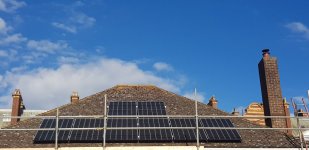
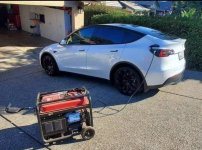
Who has solar?

Been considering solar for a while now and keep coming back to DIY option, so much cheaper, only downside is no feed in tariff but done correctly that's not an issue at all.
Can start small as well, with a couple of panels.

I think if you know what you are doing with electrics and are confident on a roof that could be a great option. A friend's father (retired leccy) is doing this for her.

If you're not qualified, then it might be a good idea to get somebody who is to make/check the connections into the consumer unit. In theory mine will be able to feed a maximum of 6KW into the fuse board so I'd want to be sure it was the right way round :)
 
I think if you know what you are doing with electrics and are confident on a roof that could be a great option. A friend's father (retired leccy) is doing this for her.

If you're not qualified, then it might be a good idea to get somebody who is to make/check the connections into the consumer unit. In theory mine will be able to feed a maximum of 6KW into the fuse board so I'd want to be sure it was the right way round :)
Not qualified electrician but I work in aerospace electronics so it will be a doddle. I like that I could basically start with a panel or two and add to it as I go, so there is no big initial outlay, good idea to use micro inverters anyway for efficiency.
 
Yeah, only because the battery inverter is rated at 3kW max, I can even think about installing it myself. My Dad and I did very briefly consider DIY install EV charger on their new house a couple months back, decided that 7kW for many hours overnight when everyone is asleep is best left to professionals.

Even with vat it's looking to be almost half the cost of paying an installer.
Feed in tariff is no loss either when there are plenty ways to use 100% of the generated power.
I don't understand why it's so expensive to install. The AC battery system is incredibly simple, pretty much an appliance that can also feed power back by raising its own voltage. No other complicated relay/switches/etc. I'm a chartered electronic engineer, not used to this level of voltages but underlying principle is very simple compared to my day job. Just need to turn everything off before working and take precautions to ensure all connections are secure.

The rant earlier is more towards government policy that requires people to use an installer to get the tax break.
Also the fact there's no tax break for retrofitting battery.

It's similar to the other grant last year for insulating homes. I got quotes of over £350 to add insulation to my loft, which included government contribution massive 2/3 of the price. Whereas I can DIY the job myself for half that. I'm convinced the installer are raking it in by increasing the price during the government schemes.
 
IIRC, any NEW circuit has to be signed off by a qualified professional, although anyone can (in theory) do the actual install. A couple of sparky mates won't do the sign offs without a very thorough inspection of all connections since they would be responsible for any shoddy work even though they hadn't done it themselves.
 
IIRC, any NEW circuit has to be signed off by a qualified professional, although anyone can (in theory) do the actual install. A couple of sparky mates won't do the sign offs without a very thorough inspection of all connections since they would be responsible for any shoddy work even though they hadn't done it themselves.
What dictates a new circuit. I'll just repurpose the old shower circuit.
 
Not sure - check with a qualified person! :P
 
If you fit solar panels then please do not forget to install mesh around them to stop nesting birds. Its really in your interest.
 
What dictates a new circuit. I'll just repurpose the old shower circuit.
The electrician who did our survey said that they will need 2 circuits on the board. We have exactly 2 circuits free so won't need a new unit and part p signoff but if you only have 1 you might.

It's going to be a day's work by 2 roofers and an electrician plus scaffolding plus our install survey so I guess the price includes 1500ish+ for labour and access.
 
IIRC, any NEW circuit has to be signed off by a qualified professional, although anyone can (in theory) do the actual install. A couple of sparky mates won't do the sign offs without a very thorough inspection of all connections since they would be responsible for any shoddy work even though they hadn't done it themselves.
Yes, any notifiable work will require Part P electrician to sign this off. This includes new circuit. Modifying an existing circuit is not a notifiable work.

Yes, finding a sparky willing to certify may be an issue, I've not considered this nor tried.
Can you not simply ask for a standard EICR safety check to be carried out on the new circuit? I know, ask a qualified person.....

The electrician who did our survey said that they will need 2 circuits on the board. We have exactly 2 circuits free so won't need a new unit and part p signoff but if you only have 1 you might.

It's going to be a day's work by 2 roofers and an electrician plus scaffolding plus our install survey so I guess the price includes 1500ish+ for labour and access.
Whilst having your fuse box opened by a sparky, worth considering adding this for a piece of mind:
 
Been considering solar for a while now and keep coming back to DIY option, so much cheaper, only downside is no feed in tariff but done correctly that's not an issue at all.
Can start small as well, with a couple of panels.
What you have to be careful of is that if it's sunny and there's a power cut, your panels don't try to feed any excess generation in to the grid. The bloke working up a pole on the electric that's supposedly off will get a nasty shock (literally) if you do.
 
What you have to be careful of is that if it's sunny and there's a power cut, your panels don't try to feed any excess generation in to the grid. The bloke working up a pole on the electric that's supposedly off will get a nasty shock (literally) if you do.
Why? That's the whole point of grid tie in so of course it would feed back into the grid, though hopefully not by much is want to be using it all.
During a power cut the system will disconnect from the grid as part of the regulations.
 
Last edited:
What you have to be careful of is that if it's sunny and there's a power cut, your panels don't try to feed any excess generation in to the grid. The bloke working up a pole on the electric that's supposedly off will get a nasty shock (literally) if you do.

I asked the firm who are fitting mine if I could run the house from the batteries during a power cut. He explained that for safety reasons this isn't possible for the exact scenario of electrocuting a power worker. The only exception he said is The Tesla power wall which builds in lots of safety features but costs about 9 grand when you can actually find one.

BTW - he suggested a couple of power sockets attached to the batteries. In the event of power cut we can run an extension lead and get the router and computers working. Or the telly so we can make our neighbours jealous.
 
I asked the firm who are fitting mine if I could run the house from the batteries during a power cut. He explained that for safety reasons this isn't possible for the exact scenario of electrocuting a power worker. The only exception he said is The Tesla power wall which builds in lots of safety features but costs about 9 grand when you can actually find one.

BTW - he suggested a couple of power sockets attached to the batteries. In the event of power cut we can run an extension lead and get the router and computers working. Or the telly so we can make our neighbours jealous.
It's actually fairly simple to do with any battery system. Not a DIY job though as it needs the main fuse pulling to fit a relay before your consumer unit, when a power cut is detected the relay trips this disconnecting you from the grid, when power is restored the relay switches again.
 
Last edited:
It's actually fairly simple to do with any battery system. Not a DIY job though as it needs the main fuse pulling to fit a relay before your consumer unit, when a power cut is detected the relay trips this disconnecting you from the grid, when power is restored the relay switches again.
Oh that's interesting. I guess I could get that done later if I needed it.

Not that power cuts are common here. When I lived about 20 miles away we would get very short duration cuts every few weeks. Just enough to bounce everything in the house in an annoying way.

It would make me feel awfully smug in a power cut though :)
 
Oh that's interesting. I guess I could get that done later if I needed it.

Not that power cuts are common here. When I lived about 20 miles away we would get very short duration cuts every few weeks. Just enough to bounce everything in the house in an annoying way.

It would make me feel awfully smug in a power cut though :)
That's what I thought probably not worth the cost of parts. I can't remember the last time we had a power cut. Get the odd brown out, but I doubt they would help for that probably not fast enough switching.

I plan to start with a couple of panels on my garage roof, costs about £750 for two, then go from there.
 
I asked the firm who are fitting mine if I could run the house from the batteries during a power cut. He explained that for safety reasons this isn't possible for the exact scenario of electrocuting a power worker. The only exception he said is The Tesla power wall which builds in lots of safety features but costs about 9 grand when you can actually find one.

BTW - he suggested a couple of power sockets attached to the batteries. In the event of power cut we can run an extension lead and get the router and computers working. Or the telly so we can make our neighbours jealous.


For relatively low power use, a couple of 12V Leisure type batteries and an inverter would be my choice to get a couple of things up and running. The reason for 2 is that 2 lower capacity batteries will probably be cheaper than one high capacity one, judging by the prices in the GoOutdoors catalogue that dropped on the mat this morning!
 
I've been looking at solar as well, but the relevant sided roof has two large Velux windows so not a huge amount of space left and it's a pretty high roof (15+ metres I think). I was also looking to build a new large lean-to shed and use that roof, but how easy it is to steal these panels?
 
I've been looking at solar as well, but the relevant sided roof has two large Velux windows so not a huge amount of space left and it's a pretty high roof (15+ metres I think). I was also looking to build a new large lean-to shed and use that roof, but how easy it is to steal these panels?
Best buy them , It's safer
 
I asked the firm who are fitting mine if I could run the house from the batteries during a power cut. He explained that for safety reasons this isn't possible for the exact scenario of electrocuting a power worker. The only exception he said is The Tesla power wall which builds in lots of safety features but costs about 9 grand when you can actually find one.
This is the reason I have a Tesla Powerwall and not any of the competitors. The gateway stops either the solar panels or the battery feeding in to the grid if the grid is down, but the house remains powered until the battery goes flat.

I get a lot of power cuts or dips, last year it was one a month on average. A big motivation for getting a battery was the ability to seamlessly power the house during grid interruptions. I also have a 3KVA UPS backing up the server in addition to the ~12kWh a fully charged Tesla provides.
 
The RF noise from some solar installations tends to affect frequencies in short wave - circa 2MHz upto maybe 20MHz, so AM broadcast bands and ham radio bands. Info: PV Noise
This probably doesn't bother most people but can be very disruptive to people within a radius of maybe 50m should they be users of those frequencies

Totally agree PMA, but although a huge nuisance, there is a bigger possible concern. The interference may be a big and very noticeable factor for the 50m you mention, however it adds greatly to the background noise for a much greater distance, and this can prevent the monitoring of frequencies used by undesirable organisations round the world because they can't be heard above the background.
Any body who in their youth listened to the "trawler bands" wouldn't have a hope of listening to the same signals now.

As far as cost benefits go, the FIR has dropped a lot since it first began, unless you can match your consumption to generation, the savings will not be huge, and you are stuck with the panels on you roof for many years. This is often a put-off for potential buyers if you ever want to sell.

My neighbours were full of all the benefits when they first got them, but haven't heard anything from them for a couple of years now :)
 
you are stuck with the panels on you roof for many years. This is often a put-off for potential buyers if you ever want to sell.
You'd want the panel to be up there for many years. Can't say it's a bad thing for perspective house buyers, it'd be electricity off-set or completely free electricity. Great benefits with ever rising energy costs. I'd certainly rate them higher than a fireplace that we'll never use.
 
As far as cost benefits go, the FIR has dropped a lot since it first began, unless you can match your consumption to generation, the savings will not be huge, and you are stuck with the panels on you roof for many years. This is often a put-off for potential buyers if you ever want to sell.
Why wouldn't you want to be "stuck" with the panels? Free electricity, so what's the problem, and I find it difficult to imagine anyone buying the house would be put off by the presence of solar panels reducing the electricity bills.

What's the problem with them exactly?
 
Why wouldn't you want to be "stuck" with the panels? Free electricity, so what's the problem, and I find it difficult to imagine anyone buying the house would be put off by the presence of solar panels reducing the electricity bills.

What's the problem with them exactly?
Initially I wondered that as well, and wondered why many for sale adverts don't mention the panels clearly visible on the roof of a property.
Speaking to people who sell houses I got a mixed response, some see it as a feature, others say they don't have the universal appeal that many think they do.
The other day I did see an advert featuring panels that "provided an income of £9500 a year"

I agree that with rising energy costs, if you can use the power they generate, the savings they offer are increasing, but many round here who work during the day say that the overall savings are not nearly what they were led to believe.

You are stuck with them because they are installed on a binding contract effectively leasing your roof for a set number of years. (Obviously not talking about those where people have paid for their installation personally)

I think the people who got in when the installation schemes first started are the most fortunate, their feed in rates were very good.

At today's rates, I am not convinced, the major savings would come from using the generated power.
Batteries and inverters to store and use the power would help, but are expensive to install, and batteries don't last for ever. Very good if you do not have a regular supply, but the expenses would greatly reduce savings when you do have a regular supply.

As mentioned in a previous post, they can and often do produced a lot of RFI, the ones around me certainly do.

Personally I have not chosen to have them installed, many have, and I hope they get good savings from them.
 
As far as cost benefits go, the FIR has dropped a lot since it first began, unless you can match your consumption to generation, the savings will not be huge, and you are stuck with the panels on you roof for many years. This is often a put-off for potential buyers if you ever want to sell.

I think those concerns only apply with the "free install" model, and like the FIT that mostly doesn't exist for private houses any more.

I can imagine being put off buying a house if it had what's essentially rented solar - you can't remove them or install your own but depending on the contract may see no real benefit. But for purchased systems I can't see the issue. Some people may not like the look of them but you could likely uninstall a system in a day and at a profit if you resell the panels.

Meanwhile, I'm still in the honeymoon period of checking the meter to see if I can boil a kettle :). Due to supply issues, the batteries won't be here for a couple of weeks so we can only use what we are generating at the time. Yesterday afternoon the meter was showing over 3kw generation as the west array was in full sun. Since they were turned on around 3pm yesterday they have generated > 10 kwh. At current rates I could sell that for up to £1.20 or take £2.95 off my bill if I can use it all.

Just another 11k or so to go.......
 
Here's hoping the supplier come through with your batteries quickly.
 
Here's hoping the supplier come through with your batteries quickly.
Thanks. They are hoping for a couple of weeks. And of course I'm not paying until they are installed.

They offered to delay the whole installation until the batteries were available so I'm just treating the period between now and then as a bonus.

Meanwhile, the council scheme which initially got my interest are quoting 8 months to installation.
 
  • Like
Reactions: Nod
Out of interest, what monitoring software are you using?

Did you go with a "hybrid" inverter so battery is charged directly from solar PV? Instead of converting to AC and then another AC inverter back to DC for battery. How would it work without battery being installed if it's a hybrid inverter?

As mentioned in a previous post, they can and often do produced a lot of RFI, the ones around me certainly do.

Personally I have not chosen to have them installed, many have, and I hope they get good savings from them.
It's also not purely about return on investment. Many install of household solar generation also allows the grid, as a whole, to become less dependent on fossil fuels, which in turn will drive down energy cost for everyone.
 
Out of interest, what monitoring software are you using?

Did you go with a "hybrid" inverter so battery is charged directly from solar PV? Instead of converting to AC and then another AC inverter back to DC for battery. How would it work without battery being installed if it's a hybrid inverter?


It's also not purely about return on investment. Many install of household solar generation also allows the grid, as a whole, to become less dependent on fossil fuels, which in turn will drive down energy cost for everyone.

I'm really disappointed that I don't have monitoring software yet ;( That comes with the battery install. Even our smart leccy meter doesn't work (never did) so I keep going into the garage and pressing a button to see what the power production is. Not yet bored enough to put it in Excel :D

We have a Solis S5 inverter - it's actually twin inverters so the west and east arrays can run independently for efficiency. So yeah DC -> AC -> DC. Nor ideal but we were already pushing the budget.
 
You are stuck with them because they are installed on a binding contract effectively leasing your roof for a set number of years. (Obviously not talking about those where people have paid for their installation personally)
Then I'll agree with you that the "rent-a-roof" schemes are not ideal, though the free electric is not to be sniffed at. I bought mine outright at the lowest level of feed in tariff just before it was cancelled entirely (about 4p/kWh).

I was on 8 years repayment for the panels alone, but as I bought a battery as well that turned into 12-13. However, rising unit costs are reducing that again, by a lot.
 
Here's hoping the supplier come through with your batteries quickly.

Three and a half MONTHS. They installed the batteries yesterday :) Typically it's raining now so we may not hit zero from grid until tomorrow.

Some quick maths for the people who can't / don't want to fit panels.....

7.2KW of batteries plus all the stuff to make it work was £3,400 including fitting. You can charge the batteries from the mains. So....fit batteries without solar panels, switch to Octopus Go and get electricity at 7.5p between 00:30 and 4:30. Use this to charge your batteries. Through the day use only battery power. This is saving about 22p / kWh ATM (and this differential may rise as prices increase). 7.2 * 22p = £1.58. At current prices, your batteries pay for themselves in less than 6 years. (There's a bunch of assumptions in there but you get the drift). In fact, Agile Octopus may suit you even better but that's a whole other spreadsheet.

And yes, I get the irony and unfairness of people who can afford £3k+) saving money. See our dearly departed PM's quote on buying a £30 kettle.
 
Three and a half MONTHS. They installed the batteries yesterday :) Typically it's raining now so we may not hit zero from grid until tomorrow.

Some quick maths for the people who can't / don't want to fit panels.....

7.2KW of batteries plus all the stuff to make it work was £3,400 including fitting. You can charge the batteries from the mains. So....fit batteries without solar panels, switch to Octopus Go and get electricity at 7.5p between 00:30 and 4:30. Use this to charge your batteries. Through the day use only battery power. This is saving about 22p / kWh ATM (and this differential may rise as prices increase). 7.2 * 22p = £1.58. At current prices, your batteries pay for themselves in less than 6 years. (There's a bunch of assumptions in there but you get the drift). In fact, Agile Octopus may suit you even better but that's a whole other spreadsheet.

And yes, I get the irony and unfairness of people who can afford £3k+) saving money. See our dearly departed PM's quote on buying a £30 kettle.
How long will the batteries last?

Presently Octopus Agile costs much more than the capped rate, at all times of the day.


Al least the car is greencar.jpg
 
7.2KW of batteries plus all the stuff to make it work was £3,400 including fitting.
That's SUPER cheap!
Was it a "hybrid" inverter and the cost was only for the battery? I guess because you ordered as part of solar install, 0% VAT.

I did the same calculation and came to similar conclusion, you can also count the "free" energy from solar.
I'm looking at 9.5 kWh battery with AC inverter package at £3800 for the parts. Need to add 20% VAT and labour :(
But first, I've signed up for Indra V2H trial, we'll see if I get selected. £1600 for a V2H inverter only compatible with Nissan Leaf, but will give me ~18 kWh home battery, or 40 kWh in a few years when we change to a newer Leaf (wife don't like change, happy with Leaf).

Yesterday, I managed to get Tesla to charge at 1 Amp using their wonderful API calls with Home Assistant. Tesla API calls is 1000x better than Nissan EV, and they are always improving, I read this amp adjustment feature was only added a few months ago. This allows me to make use of vastly more solar production at ~240w adjustment increments. Charged 1 kWh for free yesterday despite the showers :D

How long will the batteries last?

Presently Octopus Agile costs much more than the capped rate, at all times of the day.
Home battery will last many years, just like EV batteries. The GivEnergy LFP battery I'm looking at guarantees 70% advertised capacity and performance for 10 years. It can still be used for many years after that.

This link shows today's Agile pricing. Currently not worth going for them because it comes out more expensive than Go. But previously, before 2021, there had been many nights where people were getting paid to put demand on the grid. This will return when the energy market is reformed and cheap renewables are de-coupled from expensive fossil fuel.

Off-peak tariff will always exist, it was Economy 7 and now also EV tariff. It will always exists to incentivise people to time-shift their usage away from peak periods. As more and more cheap but uncontrollable renewables are installed, able to be flexible with one's demand will allow massive savings. I predict we'll see many more demand-side incentives in the next ~10 years. Time of use tariff is a start, think fridges that allow a bit more temperature drift but able to turn on/off to assist with minor load variations, think air-con or heat pumps that use house thermal mass by pre-condition more before the peak periods to reduce demand during peak.

 
Last edited:
That's SUPER cheap!
Was it a "hybrid" inverter and the cost was only for the battery? I guess because you ordered as part of solar install, 0% VAT.

I did the same calculation and came to similar conclusion, you can also count the "free" energy from solar.
I'm looking at 9.5 kWh battery with AC inverter package at £3800 for the parts. Need to add 20% VAT and labour :(
But first, I've signed up for Indra V2H trial, we'll see if I get selected. £1600 for a V2H inverter only compatible with Nissan Leaf, but will give me ~18 kWh home battery, or 40 kWh in a few years when we change to a newer Leaf (wife don't like change, happy with Leaf).

Yesterday, I managed to get Tesla to charge at 1 Amp using their wonderful API calls with Home Assistant. Tesla API calls is 1000x better than Nissan EV, and they are always improving, I read this amp adjustment feature was only added a few months ago. This allows me to make use of vastly more solar production at ~240w adjustment increments. Charged 1 kWh for free yesterday despite the showers :D


Home battery will last many years, just like EV batteries. The GivEnergy LFP battery I'm looking at guarantees 70% advertised capacity and performance for 10 years. It can still be used for many years after that.

This link shows today's Agile pricing. Currently not worth going for them because it comes out more expensive than Go. But previously, before 2021, there had been many nights where people were getting paid to put demand on the grid. This will return when the energy market is reformed and cheap renewables are de-coupled from expensive fossil fuel.

Off-peak tariff will always exist, it was Economy 7 and now also EV tariff. It will always exists to incentivise people to time-shift their usage away from peak periods. As more and more cheap but uncontrollable renewables are installed, able to be flexible with one's demand will allow massive savings. I predict we'll see many more demand-side incentives in the next ~10 years. Time of use tariff is a start, think fridges that allow a bit more temperature drift but able to turn on/off to assist with minor load variations, think air-con or heat pumps that use house thermal mass by pre-condition more before the peak periods to reduce demand during peak.

That is the site I checked the price trends on.
And now you have to own an EV to get the Go (EV) tariff

I agree that with current pricing, all these ideas get a little more attractive, but you mentioned the Agile tariff becoming more worthwhile when the situation stabilises, but at the same time, if it does get cheaper again, all these good schemes will take even longer to pay for themselves.

To me, it is all still a bit of a gamble :)
 
That is the site I checked the price trends on.
And now you have to own an EV to get the Go (EV) tariff

I agree that with current pricing, all these ideas get a little more attractive, but you mentioned the Agile tariff becoming more worthwhile when the situation stabilises, but at the same time, if it does get cheaper again, all these good schemes will take even longer to pay for themselves.

To me, it is all still a bit of a gamble :)
Whilst you need to own an EV as per Octopus Go T&C, I have read that they don't actively enforce that. Of course it's a gamble without a large load during cheap periods.

If/When the price stabilises, these tariff will always reduce in price. At beginning of 2022, people were able to sign up to 5p/20p when SVT (aka price cap) were around 16p. That only changes the formula from 22p per kWh saving to 15p per kWh. But as said, before 2022 there were better Agile deals for home batteries.

As reasoned earlier, demand side incentives will always be there. So to me, the only gamble is having the financial capability but not seriously investigate and consider cheaper + greener approaches.
 
That is the site I checked the price trends on.
And now you have to own an EV to get the Go (EV) tariff

Ah I hadn't checked Agile tariffs - I just knew the concept. Sounds like it's an easy calc. I I also wasn't aware you needed an EV to get Go.

I've also seen some comments recently that an immersion heater on Go might be cheaper than gas to heat water. I haven't fact checked these because I don't have an immersion and it's hard to fit one but I suspect the quality of the insulation on your tank and what time you get up would be factors. Right now, gas is 7.32p and Go electricity is 7.5 so if your boiler is less than say 80% efficient it might be worth doing the sums.
 
Ah I hadn't checked Agile tariffs - I just knew the concept. Sounds like it's an easy calc. I I also wasn't aware you needed an EV to get Go.

I've also seen some comments recently that an immersion heater on Go might be cheaper than gas to heat water. I haven't fact checked these because I don't have an immersion and it's hard to fit one but I suspect the quality of the insulation on your tank and what time you get up would be factors. Right now, gas is 7.32p and Go electricity is 7.5 so if your boiler is less than say 80% efficient it might be worth doing the sums.

I think a potential problem could be tax.
It won't be long before a hefty tax is applied to electricity used to charge EVs, which would mean if you have that tariff to charge batteries, you will be paying the extra tax on it.

I don't believe any government here is going to just lose the tax on car fuel :)
 
Ah I hadn't checked Agile tariffs - I just knew the concept. Sounds like it's an easy calc. I I also wasn't aware you needed an EV to get Go.

I've also seen some comments recently that an immersion heater on Go might be cheaper than gas to heat water. I haven't fact checked these because I don't have an immersion and it's hard to fit one but I suspect the quality of the insulation on your tank and what time you get up would be factors. Right now, gas is 7.32p and Go electricity is 7.5 so if your boiler is less than say 80% efficient it might be worth doing the sums.
Ensure you have a large load most nights (eg charging the battery) will be fine. Octopus doesn't actively check EV ownership status.

Yes, 7.5p/kWh of electricity heating the water at 100% efficiency is cheaper than condensing boiler at 85-95% efficiency burning gas at 15p/kWh. Even at current SVT price of 7.4p/kWh for gas, it's about similar cost to heat water tank via immersion heater.

I don't agree with Steve on EV tax, but I won't comment on EV specific stuff in this solar panels thread.
 
Back
Top