OFFICIAL I HAVE A NEW (FILM RELATED) TOY THREAD!!

I got a leather strap from IMKShop on the bay for my Mat - the MATIN Vintage-30. Quick delivery and a good price - it really suits the camera well


Just had a look....Quite classy!

That Yashica looks gorgeous :cool:

Y'know, I knew I never should have set foot in this area of the forums, I haven't even shot a full roll of film yet (too damn hot!) and I'm already lusting after Mamiya C330's and the like :cuckoo::lol:

Noticed a Mamiya 645 1000s in great nick about half a mile from me on gumtree, advert is a couple of weeks old and at £130 it's most likely gone. But my god, film gets you so much camera (literally!) for so little cash!! :bonk:

Welcome to fillum! lol

We hold no responsibility in f&c for any infection of GAS......it is up to you to resist temptation :D

Who has a smashing Mummy then, camera looks in great condition.

Mmmm yeah, she's alright in small doses! :D :D :D
 
Just out of interest, what replacement batteries do you guys use in your 124G??

I haven't yet looked in the battery compartment as the meter is operational so i don't know what is installed.

Perhaps I need to account slightly for differences in the meter readout due to voltage being higher/lower than the original 625 cell ?, or are the differences negligible?
 
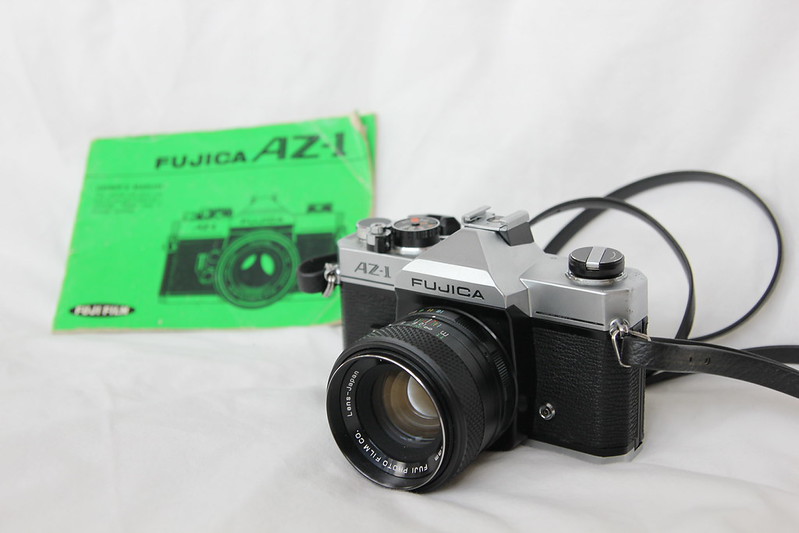
My new toy (thanks to the advice of those who persuaded me to buy it!):

Fujica AZ-1 with Fujinon 1.8 55mm lens in stunning condition. Also came with official case.

9347873563_d0a483e497_c.jpg


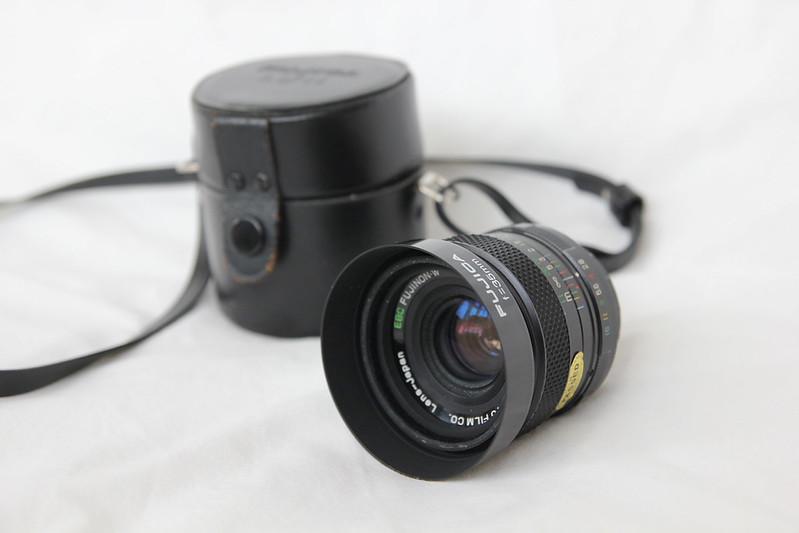
Fujinon EBC 28mm lens with original case and hood - absolutely immaculate condition:

9350650646_b59529c862_c.jpg


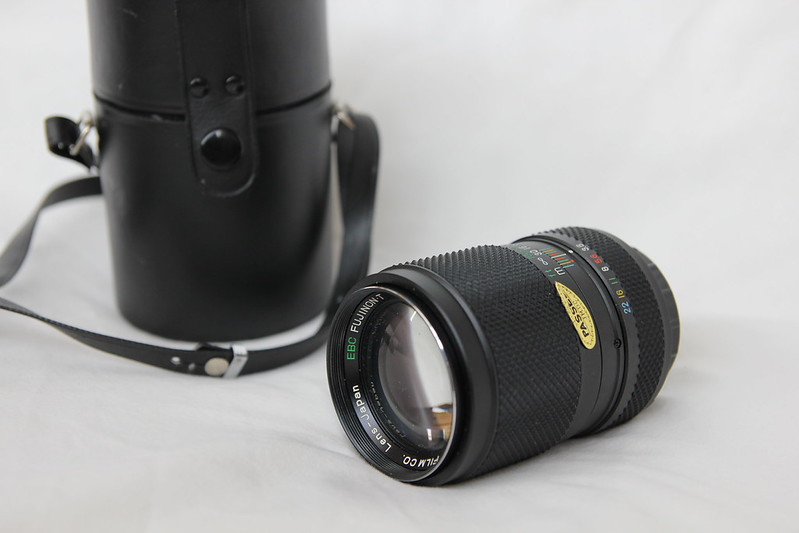
Fujinon EBC 135mm lens with original case - also absolutely immaculate condition:

9350648120_5ca83344b4_c.jpg


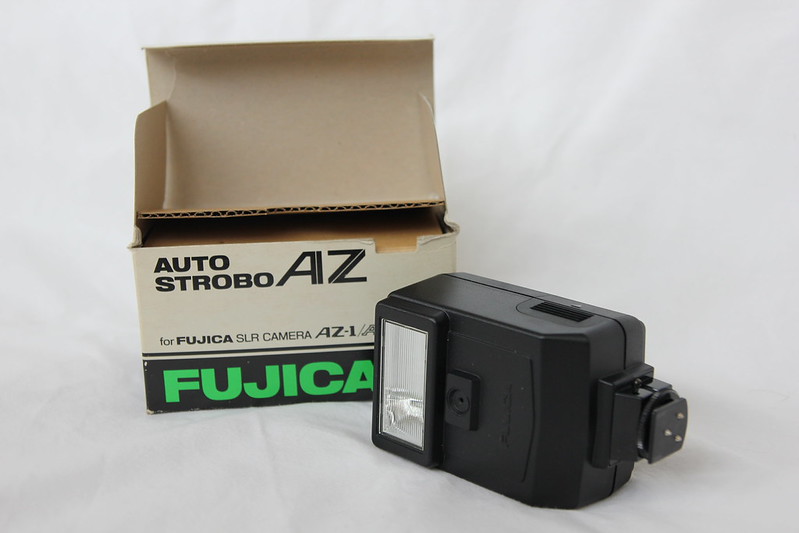
Matching flash unit:

9347871363_6e94d12fca_c.jpg


It's all as good as new, the owner even noted down all the serial numbers in the front of the manual. Can't wait to get out and try it!

Chris
 
Very tidy set up there Chris..... enjoy!
 
Just out of interest, what replacement batteries do you guys use in your 124G??

I haven't yet looked in the battery compartment as the meter is operational so i don't know what is installed.

Perhaps I need to account slightly for differences in the meter readout due to voltage being higher/lower than the original 625 cell ?, or are the differences negligible?

I buy the Wein cell 1.35V equivalent to the PX625, I found a good supplier at a good price, I will look it up and post a link for you.


http://www.ebay.co.uk/itm/NEW-IMPRO...t=US_Camera_Battery_Grips&hash=item3f21f12f4b
 
Last edited:
Perhaps I need to account slightly for differences in the meter readout due to voltage being higher/lower than the original 625 cell ?, or are the differences negligible?

It depends on the camera.

It's easy to tell.

If the meter always shows correct exposure with the meter needle in the middle of its travel and when the camera is switched off, the needle rests in the same place, it has a circuit which is not sensitive to changes in voltage. Just about any cell of any voltage which you could make fit and contact on both sides will work.

This is called a bridge circuit. At correct exposure, the same current flows through two separate circuits and the meter coil forms a 'bridge' between them. If the same current flows through both sides, the meter has the same voltage at both ends so no current flows through it. If there is equal voltage either side, the actual voltage doesn't matter as one cancels out the other.

The Pentax Spotmatic has this type of meter circuit.

However, if you set the exposure by adjusting so that a secondary needle matches the position of the meter needle, then it is not a bridge circuit and is likely to be voltage sensitive.

The Olympus OM falls into this category.

A simple modification can be carried out to a camera which needs 1.35 volts. Just solder a Schottky diode in series with one of the cell connections* and it will drop a small amount of voltage leaving 1.35 volts for the meter circuit when used with a 1.5 volt cell.

(* as it's a diode it must be connected the right way round or no current will flow).

More information than you could ever want on the subject here: http://www.google.co.uk/url?sa=t&rc...HMO6n3sn20ReCU8sQ&sig2=aZJ1KIfL885exFaeyePKnQ


Steve.
 
Last edited:
I buy the Wein cell 1.35V equivalent to the PX625, I found a good supplier at a good price, I will look it up and post a link for you.


http://www.ebay.co.uk/itm/NEW-IMPRO...t=US_Camera_Battery_Grips&hash=item3f21f12f4b

You can get them cheaper at 'The Small Battery Company', only £5.50 and includes quick 1st class postage (mine came after a couple of days).

http://www.smallbattery.company.org.uk/sbc_mrb625.htm

Thanks for the links guys...much appreciated!

I'm tipping that the battery lasts for quite some time (12 months maybe under average use?) given that it only feeds the meter.

It depends on the camera.

It's easy to tell.

If the meter always shows correct exposure with the meter needle in the middle of its travel and when the camera is switched off, the needle rests in the same place, it has a circuit which is not sensitive to changes in voltage. Just about any cell of any voltage which you could make fit and contact on both sides will work.

This is called a bridge circuit. At correct exposure, the same current flows through two separate circuits and the meter coil forms a 'bridge' between them. If the same current flows through both sides, the meter has the same voltage at both ends so no current flows through it. If there is equal voltage either side, the actual voltage doesn't matter as one cancels out the other.

The Pentax Spotmatic has this type of meter circuit.

However, if you set the exposure by adjusting so that a secondary needle matches the position of the meter needle, then it is not a bridge circuit and is likely to be voltage sensitive.

The Olympus OM falls into this category.

A simple modification can be carried out to a camera which needs 1.35 volts. Just solder a Schottky diode in series with one of the cell connections* and it will drop a small amount of voltage leaving 1.35 volts for the meter circuit when used with a 1.5 volt cell.

(* as it's a diode it must be connected the right way round or no current will flow).

More information than you could ever want on the subject here: http://www.google.co.uk/url?sa=t&rc...HMO6n3sn20ReCU8sQ&sig2=aZJ1KIfL885exFaeyePKnQ


Steve.

Thankyou very much for taking time to explain in so much detail.....being able to understand how systems operate makes it so much easier to figure out solutions.
 
Thanks for the links guys...much appreciated!

I'm tipping that the battery lasts for quite some time (12 months maybe under average use?) given that it only feeds the meter.

They only for a maximum of about 10 - 12 months even when not used as the moment the tab is removed and air can enter the battery then their lifespan starts.
 
They only for a maximum of about 10 - 12 months even when not used as the moment the tab is removed and air can enter the battery then their lifespan starts.

OK thanks for that.

The prices for other batteries on that site are reasonably priced even with postal costs to send out here so thanks to you I've now got another battery supplier to keep these old critters ( cameras!) going.
 
I bought a bunch of Wein cell batteries from Boots, they're hearing aid batteries. One thing to check, as they work by reacting with air, the battery cap needs a hole in it to let air in. Both my cameras that use them (yashmat 124 and a Minolta Hi-matic) have holes in the cap but I don't know if they were there originally or a previous owner drilled them.

It's also handy to have a washer that fits over them to keep the battery central for a good contact. I can measure them once I'm home if it'd help.

The battery in the Minolta only lasts about 3 months.
 
I bought a bunch of Wein cell batteries from Boots, they're hearing aid batteries. One thing to check, as they work by reacting with air, the battery cap needs a hole in it to let air in. Both my cameras that use them (yashmat 124 and a Minolta Hi-matic) have holes in the cap but I don't know if they were there originally or a previous owner drilled them.

It's also handy to have a washer that fits over them to keep the battery central for a good contact. I can measure them once I'm home if it'd help.

The battery in the Minolta only lasts about 3 months.

Well I've removed the cap which doesn't have a hole in it and can see the battery is a PX625A alkaline cell made in China.

What make it is I have no idea.

I had to re insert the battery twice as the first time, the meter needle was moving erratically.....presumably that's the contact issue that you've mentioned although there is a tiny bit of corrosion to the contacts in the camera so in time i'll clean them up.

Size of washer would be appreciated as and when you get a spare minute...cheers!
 
Washer dimensions are I/D 11mm (the diameter of the cell), O/D 15mm. That's from the battery in the Minolta, the O/D can be a wee bit bigger if it'll fit in the battery compartment.
 
Washer dimensions are I/D 11mm (the diameter of the cell), O/D 15mm. That's from the battery in the Minolta, the O/D can be a wee bit bigger if it'll fit in the battery compartment.

Thanks Dean.....I think I have something suitable knocking about in my "box o' bits".

Could take some finding mindst as it's a BIG box! :D
 
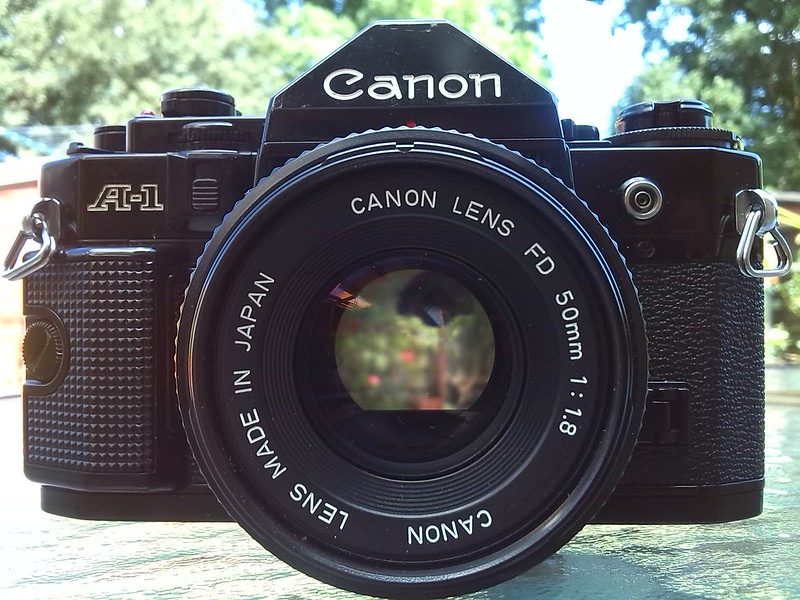
Got my replacement Canon A-1 after the first one had a meter problem, from West Yorkshire Cameras in leeds. Great service by Nick & Tom up there :thumbs: Seems like a great little film... sorry, fillum :D focused camera shop :thumbs:

Along with my charity shop 50mm f/1.8 (also got a super-paragon 2x teleconverter) I'm very happy, they're both in near mint condition. The A-1 is an 'X' date code which makes it made in 1983, 2 years younger than me at 30 years old.

Canon A-1, 50mm f/1.8 by Paul_Sims, on Flickr

Canon A-1, 50mm f/1.8 by Paul_Sims, on Flickr
 
Last edited:
Thanks Dean.....I think I have something suitable knocking about in my "box o' bits".

Could take some finding mindst as it's a BIG box! :D

Asha I would just try it out as it is, I've used those weincells for the past 4 - 5 years in my Spotmatic F which has no airholes and they've always worked fine.
 
Asha I would just try it out as it is, I've used those weincells for the past 4 - 5 years in my Spotmatic F which has no airholes and they've always worked fine.

That's fair enough, mine came with the washer so I thought it was the done thing :)
 
Contax G1 (Green Label) and Data Back.

http://s21.postimg.org/t0y07n37r/image_3.jpg[/IMG]

http://s21.postimg.org/8n6vc8wlj/image_4.jpg[/IMG]

http://s21.postimg.org/ywrxv1iiv/image_5.jpg[/IMG]

Like to see it Mel...but the links don't work for me.
 
Asha I would just try it out as it is, I've used those weincells for the past 4 - 5 years in my Spotmatic F which has no airholes and they've always worked fine.

You don't need to use a wein cell in a Spotmatic. Anything which fits will do.


Steve.
 
This may not look much...

IMAG1070.jpg


but it enables me to take this:

IMAG1071.jpg


and do :naughty::naughty::naughty:
this:

IMAG1073.jpg


Duxford Merlins and Motors here I come:thumbs::thumbs:
 
Mel, that's a very smart bit of kit.:thumbs:
 
You don't need to use a wein cell in a Spotmatic. Anything which fits will do.


Steve.

The Spotmatic F uses the PX625 battery rather than the PX400 like all the other non-ES versions and despite me searching around I couldn't find a definite answer as to whether it had the bridge circuit or not like the others. When I brought it it came with some of them so I had always assumed it needed them, having a look around I did find one of your Flickr posts about it and the link to the manual so from that I think I will get a silver-oxide battery when the weincell I have runs out.
 
The Spotmatic F uses the PX625 battery rather than the PX400 like all the other non-ES versions and despite me searching around I couldn't find a definite answer as to whether it had the bridge circuit or not like the others.

The F doesn't have a standard bridge circuit like the others. Instead it has a meter with two coils.

Current through one pushes the needle one way and current through the other pushes it the other way.

Correct exposure is when there is the same current flowing through both coils and the meter takes up the centre position.

So it works just like the more usual Wheatstone bridge circuit but is achieved in a different way. This means you can use any cell which will fit. The F takes a much smaller cell. I sometimes buy cards with lots of different sized cells on it from £1 shops. There is often one on there which will fit.

The last page here shows the standard Spotmatic circuit: http://www.pentax-manuals.com/manuals/service/spot_sm.pdf

And here is the F circuit (if asked for a password, use Pentax): http://www.pentax-manuals.com/manuals/service/spot_f_meter.pdf

(all from this site: http://www.pentax-manuals.com/manuals/service/servicemanuals.htm )


Steve.
 
Last edited:
My new toy from just a few weeks ago, the Fuji GA645, is already off for repairs... So, I've had to pick up another new toy to occupy my time until it returns:


Minolta Autocord by skysh4rk, on Flickr

I've already put two rolls through the Autocord and the lens is nice and sharp and the camera seems to function as it should. The only downside is that the screen's a bit darker than my SQ-A and doesn't have a split-prism focusing aid.

After using the very electronics-laden Fuji though, it's nice to be back to basics with the Autocord's purely mechanical operation.
 
It's been a while since I've bought some new kit due to my need to offload some stuff instead but while I fanny about trying to decide what I'm going to sell, here's a not-great phone image of a rather nice Nikon 50mm f/1.4 I picked up a few weeks ago from the local independent camera shop. It's practically mint and goes very well with the FE2.


Nikon 50mm f/1.4 by Strappster, on Flickr

I'll be developing and scanning some photos today taken with this combo. :)
 
That's a big 'un. Looking forward to seeing the results from this, I've seen the extremely high F's for om's but they go for big money and I'd prefer to spend the cash on rb kit.
 
A comparison image from an underexposed Velvia slide on both the V500 and my Drum Scanner
Both images straight out of the scanner, no colour correction applied, no exposure tweaks. Both scanned as 16 bit TIFFs

Drum scanner on the left, V500 on the right. Not a scientific test, just a bit of fun really.


The photobucket compression has killed a load of the colour and the highlights too.
 
A comparison image from an underexposed Velvia slide on both the V500 and my Drum Scanner
Both images straight out of the scanner, no colour correction applied, no exposure tweaks. Both scanned as 16 bit TIFFs

Drum scanner on the left, V500 on the right. Not a scientific test, just a bit of fun really.

http://s1221.photobucket.com/user/robhooley167/media/DSvsV500_zpsb32c34f5.jpg.html

The photobucket compression has killed a load of the colour and the highlights too.

Quite a difference. One of the reasons that I have all my colour work scanned by AG at the time of processing. Even thinking of sending them my MF black and white because of the scan quality.
 
Well Rob the drum wins hands down as it should, but I cannot help thinking that you could get more out of your V500 should you wish, as the shown photo is just so bad. Is it my imagination or is the tower in the V500 scan leaning to the right more, everything else looks the same.
 
That's quite a difference, it's just a shame that drum scanners take up so much space. Maybe we should resurrect the scanner comparison thread with your drum scanner as a reference.
 
I know what you mean about the tower Richard, it puzzled me a little, I can only assume that the v500 image is a little wonky

Nick, ill do a few scans when the full software arrives, the demo version blocks off most of the features and watermarks the images, the full version should pull more shadow detail out as it allows for changing the power of the amplifier in the scanner rather than just brightening the image in PP
 
Back
Top