AndrewFlannigan
Suspended / Banned
- Messages
- 11,977
- Edit My Images
- No
There's a loaded film camera behind the door, ready for my next walk. Always. Probably 80% of my photos are taken within 4 miles of home, so your comments particularly resonate with me. I am a bit lucky though, in that when Mrs R makes a related complaint, she says "Have you been out taking photos of the castle again? You must have thousands of them by now!". But then...... I rarely plan a photograph, and just react to whatever fate gives me. But I regularly go to the same places repeatedly, so I know them extremely well, and my photographs are a way of constantly reinforcing the connection I feel with them. Not all of them fall into this category, but a lot of them do.
I like seeing the same thing over and over, but in a different light from the last time I saw it. But I suspect most would look at my photographs and think "Didn't he just photograph that tree stump yesterday? "

I was really very lucky, I'd bought a Pentax Electro Spotmatic but had zero technique. I didn't know at the time, but that Electro Spottie had the most amazing exposure meter, which compensated so well for what I didn't know. I got a few rolls of Ektachrome and Kodachrome, and spent 3 weeks travelling round NZ about Christmas 1974 with the new Mrs R, and I ended up with very few duds. Used it a lot in the Flinders Ranges in Northern South Australia, and in the Northern Territory, in extremely challenging high contrast situations, just a brilliant film.By the time I could afford Kodachrome and had the technique to use slide film properly, it was no longer available!
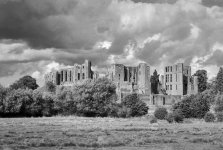
Yes, a castle is handy, I'm lucky as well, in that I have some fields and a little bit of woodland to revisitThere's a loaded film camera behind the door, ready for my next walk. Always. Probably 80% of my photos are taken within 4 miles of home, so your comments particularly resonate with me. I am a bit lucky though, in that when Mrs R makes a related complaint, she says "Have you been out taking photos of the castle again? You must have thousands of them by now!". But then...
View attachment 470477
Pentax MX, Helios 44K 58mm f/2, orange filter, Kentmere 100, devved in HC-110 dilution B, home scanned.
I was really very lucky, I'd bought a Pentax Electro Spotmatic but had zero technique. I didn't know at the time, but that Electro Spottie had the most amazing exposure meter, which compensated so well for what I didn't know. I got a few rolls of Ektachrome and Kodachrome, and spent 3 weeks travelling round NZ about Christmas 1974 with the new Mrs R, and I ended up with very few duds. Used it a lot in the Flinders Ranges in Northern South Australia, and in the Northern Territory, in extremely challenging high contrast situations, just a brilliant film.
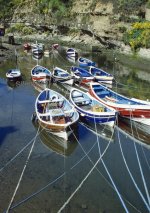
Similarly at Staithes everybody goes to the same place up Cowbar Hill and takes the same elevated shot of shot of the boats in the river and harbour. I clung to the bridge parapet and got a different angle.
View attachment 470072
I have not seen any photos from this angle since I took it around 2002 or before. The actual planning involved coinciding good weather before the boats were moved into the main harbour around the end of May and high tide between 9am and 11 am. I rode my motorbike 80 miles each way to get it.
Sometimes you have to plan and work for the right image. Other times it just seems to fall into place, but the guidelines of the rule of thirds and leading lines are never far from my thoughts and often all it takes is a few paces one way or the other, standing on a wall or laying on the ground to make all the difference.


In addition to what @StephenM said, the choice may come down to what you are photographing. Even on a tripod, you may still need to stop motion (wind blowing branches, waves crashing etc) and the faster film will give you more flexibility on shutter speed choice. Or are you suggesting ISO 100 on a tripod vs ISO 400 handheld?In this winter light and dull cloudy overcast skies will i get the same results using a 100 ISO film on a tripod or would I be better off using 400 ISo.
Will results be different?
The tide wasn't best suited on the day I visited a few year's back (there with my wife, rather than for photography expressly, so I had to make do), and there weren't as many boats about, but...
At low tide by fishyfish_arcade, on Flickr
The view the other direction was more pleasing (still from the bridge).
A cloudy day in Staithes by fishyfish_arcade, on Flickr
It's a location I plan to travel to again at some point with a more defined plan.

In addition to what @StephenM said, the choice may come down to what you are photographing. Even on a tripod, you may still need to stop motion (wind blowing branches, waves crashing etc) and the faster film will give you more flexibility on shutter speed choice. Or are you suggesting ISO 100 on a tripod vs ISO 400 handheld?
On grey days, particularly with a bit of mist, I found the softer/grainier (higher ISO) files gave poorer subject separation with subjects of similar tone than slower films. As an aside, larger negatives were much better than smaller negatives getting separation in these conditions.
Cynically - the 100 ISO will be less grainy, sharper (because of the tripod) and better composed (because you'll take more care in camera position and more notice of what's in the viewfinder when using a tripod).
Depending on the film, contrast may be slightly less with the 400, but variations in developing will make this probably invisible.
The low light benefit is being able to use faster shutter speeds. (or smaller apertures) than a slower film would allow.I was thinking about film sensitivity, really and wondered if there was a low light benefit to higher ISO, I had not considered wind and leaves etc
You are right about the tripod, they certainly make me look more carefully at the scene
I know that some photographers believe that film photographs should not be edited, but that is a fallacy, as it's not possible to present an unedited film image.
In this winter light and dull cloudy overcast skies will i get the same results using a 100 ISO film on a tripod or would I be better off using 400 ISo.
Will results be different?
In winter/dull conditions a higher ISO film will be ''better'' because it will collect more light so give you faster shutter speeds and/or more depth of field - much like it would with your digital camera.
Obviously ''better'' with regard to film is difficult to answer because typically a 100 ISO film & a 400 ISO film will be different film stocks so colour, grain, DR, etc will be different anyway even shot side by side.
Also, it's not a bad idea to build the habit of looking for solid supports on which to place your camera. This has got me out of difficulty, when embarrased by low light levels.IME unless shooting some kind of action, with film one is better off using whatever you are used to most of the time and taking a tripod to get the aperture you need (and not forgetting reciprocity failure)

IME unless shooting some kind of action, with film one is better off using whatever you are used to most of the time and taking a tripod to get the aperture you need (and not forgetting reciprocity failure)
Why are you being so prescriptive?Rather than chase different films or developers, it's worth considering how much difference image editing makes in the production of the images by other photographers that we are able to view. The phrase "image editing" covers both software editing and darkroom work, and includes changes to brightness, contrast, texture, image tone, etc. It covers not just "global" changes that affect the whole image, but "local" changes that affect a selected part of the image.
Localised editing allows the photographer to influence which areas of the image appear more or less prominent.
I know that some photographers believe that film photographs should not be edited, but that is a fallacy, as it's not possible to present an unedited film image.
I did not state that "what happens before pressing the shutter" was not important. I merely stated it was a fallacy that film photographs could be presented in an unedited state - although I accept the point made by @ancient_mariner that transparency film comes close to that state.Why are you being so prescriptive?
Why it's something you don't enjoy doing, you don't approve of, or perhaps cannot do to a good level of quality "a fallacy"?
Just do what you enjoy my friend, and let others do what they enjoy.
I for instance enjoy the challenge of what happens before pressing the shutter the most, and what happens in the developing tank as a close second. Manipulating only composition, exposure and development variables and standardising everything that happens after is absolutely possible, can be creatively rewarding for some, and is most definitely not a fallacy.
In general, I couldn't care less about making an image happen by heavily manipulating it in Photoshop or in a darkroom, but I wouldn't dream of suggesting people who seem to enjoy that more tinker-y part of the workflow are committing a "fallacy".
Then again, I find Ansel Adams a truly mediocre and overrated photographer, and a relatively poor writer. America gave us far better photographers
Live and let live Sir!
Fuji Acros does not suffer from reciprocity failure until (if I remember correctly) the exposure exceeds two minutes.I was reading the other night, three books on the go so cannot remember which one (@Stephen L fault) and there was a mention of a film that had no reciprocity failure. I thought to myself "must remember that one" and of course I have promptly forgot.
I did not state that "what happens before pressing the shutter" was not important. I merely stated it was a fallacy that film photographs could be presented in an unedited state - although I accept the point made by @ancient_mariner that transparency film comes close to that state.
That would be interesting on the OM2 Kevin, in Auto it will meter from the film up to two minutes, no need to calculate reciprocity for night time shots.Fuji Acros does not suffer from reciprocity failure until (if I remember correctly) the exposure exceeds two minutes.
Even for black and white film, which is what I work with, it is entirely possible to achieve a reproducibly fixed, standardised scanning and minimal post-processing workflow to the extent that the major sources of visual variation in the final image are represented in the negative.
Exposure, film choice, developer choice, development routine will impart a strong, reproducible look to the final image that is not confounded by post processing routine unless we let it or we want it to.
If one wishes, 'the negative is the score and the negative is 99% of the performance'.
Experimentation is best done using the same components to repeat results and then with only one change at a time similarly repeating the experiment before moving on to change another element.
That has given me inspiration for my next photo DavidI think that you need to slow down and do less 'research'.
I have been using PanF in ID11 for 60 years now. I know how to treat it to get the photographs that I want.
I have sometimes used FP4 and in moments of speed maddness HP5!
Experience is the way to obtain the images that you seek. Constantly changing film and developer will teach you nothing.
Choose a film, choose a developer, stick to them. Make photographs!
I appreciate that I am still quite new to film photography and that my opinion means little to many, if anything at all, but I would like to reply to the above comment in the following way;
We are not cavemen rubbing sticks together hoping that something will make fire and going through a rigorous testing regimen to establish a database of knowledge.
There is well over a hundred years of extremely well documented history regarding film, developers and their attributes, also the many deficiencies of each. Everything in film photography, as in life, is a compromise. Grain size, sharpness, speed loss to name but a few.
I will not go through the testing exercise, I will guess. It will not be a random guess as I will try to balance the relevant factors as best I can by considering the attributes of the film, grain type and relative size, considerations of the scene that I wish to photograph and then select a developer that I think will get me closest to the attributes I desire, for instance smoothness, tonality and ability to control the brightness range of the scene.
After having a great deal of pleasure and satisfaction investigating the myriad of options and combinations. I will select the developer, note the areas where it is potentially lacking in that given scenario, under those conditions and try to mitigate, as best I can with my limited experience, anything that my research has identified as a solvable problem with that combination. If my developer choice will result in a loss of a stop I will expose a stop more, speed is the easiest, I think, problem to solve.
Its a guess, I would like to think that its an educated guess based on my own research on the various topics which will get me somewhere in the ball park. What has been letting me down is the reliance on the many published development times out there, which in my experience have been well wide of the mark for the basic development process I am employing.
Or I could have completely misinterpreted your comments due to its brevity and you mean start the experimentation after all the research on the optimum combination has been completed, which I have been doing when published times have let me down.
The advice that @David_Mug has just given you is the same as others have being giving you for weeksThat has given me inspiration for my next photo David![]()
It's also possible that the enjoyment only comes because of its potential to improve or understand some aspect of your photography.It's possible to enjoy the experimenting and the process, but if that is the thing one enjoys the most then one is better off getting a chemistry set and ditching the expensive cameras.![]()
In the system described the post-processing has simply been fixed based on some arbitrary values, but is still essential to produce a useful photograph. The negative is the unedited state, and you are still processing albeit with as little personal involvement as possible.
It's possible to enjoy the experimenting and the process, but if that is the thing one enjoys the most then one is better off getting a chemistry set and ditching the expensive cameras.![]()
Really replying for @Barney but your answer has set the sceneEven for black and white film, which is what I work with, it is entirely possible to achieve a reproducibly fixed, standardised scanning and minimal post-processing workflow to the extent that the major sources of visual variation in the final image are represented in the negative.
Exposure, film choice, developer choice, development routine will impart a strong, reproducible look to the final image that is not confounded by post processing routine unless we let it or we want it to.
If one wishes, 'the negative is the score and the negative is 99% of the performance'.
Really replying for @Barney but your answer has set the scene
This was the aspiration behind Ansel Adam's zone system. It was also Ansel who introduced the idea of the negative being the score and the print the performance, but the most important part was the "visualisation" that controlled how the negative was exposed and developed.
He carefully placed the exposure to match specific tones and then controlled the other tones by choosing filters that selectively increased or decreased their tonal values, and by increasing or decreasing development times (sometimes by changing developers), he would further alter the tonal relationships in the negative. His aim was to get a negative that fully represented the tonal qualities he had visualised at the time of exposing the picture.
This could dramatically reduce the time needed at the printing stage, and although I never fully embraced the zone system (but probably went 80%-90% of the way), as an industrial photographer(in the film days) with lots of difficult subjects to photograph, learning and applying the zone system revolutionised my photography (and time in the darkroom).
I'm not a massive fan of Ansel Adam's photographs (neither was Ansel Adams, who felt he had made a trap for himself by being so heavily identified with a particular style of photograph).I don't enjoy Ansel Adams photography but I appreciate and acknowledge his attempt to popularise densitometry (which is just basic physics as you know, and is based on a theoretical framework that existed before Adams. But you're right, a hybrid approach to the zone system is what I've been hinting at in my posts without explicitly mentioning it.
There is value in a 'zone system' approach even when the outcome is a scan IME, and that's what I aim for: carefully controlling exposure, development, film and development time to obtain the negative that will scan to optimality (according to my definition of optimality) faster, and with the least amount of time spent on post processing (or printing, when/if I print my images in a darkroom).
YMMV.