Moadib
Suspended / Banned
- Messages
- 1,062
- Edit My Images
- Yes
Its not just any private company, it underpins the economy, it underpins society, Take liquidity out the system, how does society operate, what happens to interest rates, mortgages and investments, the capitalistic enterprises that fund the socialist values that we strive to keep, things like the NHS and state pensions.
IMO that's true only to the extent we we choose to believe it.
Of course those companies will cry that they are more important - they want to continue socialising losses (while privatising profits). But I'm afraid they are "just another private company". (Frankly if a company ever really was "too big to fail" then the people need to consider it "too big to exist" and disband it - you can't have that kind of unmanageable threat to the economy).
As for liquidity, we have other banks! Of course our society needs "banks", but that doesn't mean we need THOSE banks. Let the banks fail and other, more prudent, banks would step in and buy up the remaining viable assets - that is what happens in capitalism. Not only would society continue to operate, it would be improved (much improved) by the process of financial Darwinism - good decisions are rewarded, bad ones drop by the wayside. By propping up BAD decisions we not only reward but perpetuate those failures. There is no "free" wealth - the fact that we direct wealth toward propping them up directly takes that from other sectors of society. That is a choice, and IMO a bad one.
I agree, THAT is indeed the question on which to ponder. It makes no sense to do so, and yet it happened - speculating on why that might be can be enlightening.If the UK thought they could dump it why didn't they?
The protection ceiling was £50,000, and was raised to £85,000. Savers' assets were already protected.£2000 was the savings limit ceiling, then a percentage of what was left if the banks went bust if I recall correctly.
To me the answer to that lies in the question, we just need to frame the question another way.Just to clear up about facts and lies. It been said here that all/most politicians are liars (not necessarily disagreeing here), even one attributed to Salmond himself. Are we telling the undecided voters in the absence of facts that Scots lies are better for you than EU/UK lies?
We accept that we are surrounded by lies, and that fact will not be changed by a vote. Is it then better to be faced with lies which are more controllable, or less controllable?
As a nation Scotland cannot possibly influence the near 400 million EU, nor even the 70 million UK. Let's say Scots wanted to maximise "Gross National Happiness" "GNH
 " over the next twenty or a hundred years - which path gets us to the better result? Self-determination toward that outcome, or being a cork in the UK tide?
Look at the UK over the past decades - a massive slump bailed out by an oil find. Rampant financialisation, followed by a credit and housing bubble of epic proportions. If that's economic management, it's neither planned, sustainable or anything to crow about. IF a better path is desired, it's easier to find consensus among fewer people than among many. The more people you bundle in, invitably the less of a consensus there must be.
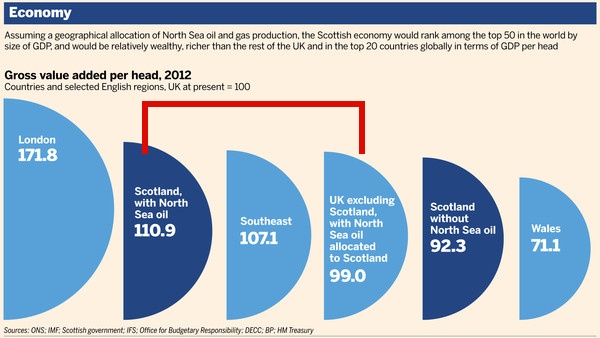
There's an argument from the No camp that I can't get my head around - it's that Scotland is too poor to stand on it's own feet, that the rest of the UK is supporting Scotland, and that Scotland would collapse without that.....but despite all those horrific flaws we still want to keep you....
Excuse me...?! So Scotland is like the alocholic uncle, and the UK is putting Scotland up while we drink it out of house and home. If that is indeed the case, why does the UK wish to retain Scotland?
However, I do indeed think the relationship is a bit like that - oil wealth flows south, and Scotland gets a lot back in "benefits", public sector jobs, disability, unemployment etc. I think that's bad for both parties. Scotland needs to plan for a world post North-sea oil, and it won't do that while getting benefits from the rest of the UK. Far better to learn to live in the real world now - Norway is an example, having used oil for sovereign wealth fund and developing for the future, rather than squandering it now.
Norway is not part of Sweden, yet they trade, share borders, people, money, goods, services flow easily back and forward. So too Scotland and the rest of the UK have a long and rich history that will not be changed by a decision over where laws are made. We have history from before Scotland was even Scotland, when we were a group of ununited clans - that will not be changed by a different face on banknotes, or location at the bottom of a statute.
Last edited:


 ). As I said earlier, we fought and died alongside each other in two world wars. Not for Scotland, Wales, or England, but for Britain.