why I don't need full frame

For the purpose of explaining, you screen displays 1000 pixels horizontally

If you have a picture 1000 pixels wide, a 100% crop would display it exactly across the screen

If you had a picture 4000 pixels wide, a 100% crop would display 1/4 of the width of the picture across the screen

Selecting a 100% view in my software, either CS5 or PS2022, produced the pictures above.

The G3 picture just doesn't look 400 anythings to me, looking at the size of the crop relative to the whole picture. Looking at G1, GM5, GX80 and GX9 and A7 files I can't get that % of a picture or there abouts to be 400 anythings. My best guess looking at my software is it's somewhere in the 90 to not quite reaching 150% view. Possibly 80-120%.

So there's something off for me at least as I've never seen a 400% anything look that good never mind from a quite old MFT G3, but in the end... it doesn't really matter. We must be talking about different things or at least how the different software does it.

It doesn't matter. We all get there somehow.
 
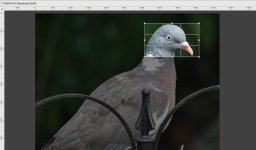
To display the whole of this image on the working area of the screen, you can see at the top left the crop, about 21%

cr1.jpg


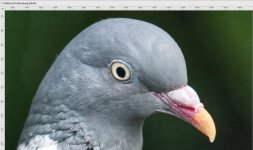
To get the head only in, it is about an 84% crop
cr2.jpg


If I went to 100% crop, I would have one pixel of the image displayed on one pixel of the screen.


It has nothing directly to do with the percentage of the picture that is cropped, it is solely the ratio of screen pixels to picture pixels.

A 100% crop would change size on the screen depending on the resolution of the screen (for the same inch size screen) The higher the resolution of the screen, the smaller the image on the screen. Most screens won't have room to display a 100% crop of a whole photo, as the photo will usually have more pixels across than the screen, so the crop will be less than 100% to fit it on.
 
I shouldn't have typed "crop;" it's zoom/scale of image resolution vs viewing resolution... I've fixed that.

The % zoom thing in LR is only relevant to your monitor... i.e. change your monitor's display resolution setting and 400% zoom looks different. And depending on the OS you are running LR on it can also depend on if you have LR set to run in low resolution mode or not. The zoom box size in the navigator is relative to the display area in LR... e.g. resize the LR window and the size of the zoom box changes. Alby is apparently using a much larger monitor than my 16" MBP has.

That's one of the reasons you have to be wary about reviews... "at 100%" doesn't really mean anything. Prior to LR 2020 100% used to be labeled 1:1, and 400% was 4:1, etc.

% crop is/should be how much of the original image area is remaining in pixel dimensions (LxW)... e.g. cropping to .5 width and .5 height is a 25% crop (cropped to 25%). But sometimes I see people say cropped by 25%; which is also fine. E.g. if I cropped to that composition it would be cropped by 90%, or to 10%... the limit is 100%. For anything else you would have to resample the image/data.
 
Last edited:
To display the whole of this image on the working area of the screen, you can see at the top left the crop, about 21%


To get the head only in, it is about an 84% crop


A 100% crop would change size on the screen depending on the resolution of the screen (for the same inch size screen) The higher the resolution of the screen, the smaller the image on the screen. Most screens won't have room to display a 100% crop of a whole photo, as the photo will usually have more pixels across than the screen, so the crop will be less than 100% to fit it on.
That is zoom level, not crop.... if you did crop it like that, it would then say 100%.

But both do vary in physical dimensions based upon the display's resolution (pixel size/density).
 
Last edited:
I often here the excuse as to why people buy 60mp full frame cameras ,its because you can crop in more .. o.k so this is from my 20mp olympus omd1-mkiii and the crop I have used is from the top right hand corner edge of the photo .
hhmmmmmmmmmm
as shot by jeff cohen, on Flickr

the two of us by jeff cohen, on Flickr


kinda shows up the truth a bit I think

Hi Jeff, I'm happy if you're happy! Surely it all depends on what a person needs, wants, can manage and has budget for. There's no one-size-fits-all which is why we have endless discussion threads which is potentially a helpful thing for people looking for input to make an informed choice for their own situation.
 
I find this thread interesting (until you started talking crop percentages and pixels, then my brain began to melt)

Hearing so many people speaking positively about MFT is good for a newbie like me who chose MFT. I think the comments about what you do with your images is a good point. I can tell that some of my wildlife shots are over cropped and doctored, and many people on hear would bin them, however, I share them to a local FB group. It's for people who live/lived in my town, "a local group for local people" and I expect most on the group only carry a smartphone, so my imperfect wildlife shots are greeted with joy and thanks and wishes to see more :)
 
I think Alan @woof woof is right here the big advantage of the smaller sensor camera is the multiplication factor of the lenses which makes longer reach easier and cheaper plus the use of shorter FL generally means more DoFin the same composition as compared to FF or larger.
There is no advantage compared to cropping a larger sensor with the same pixel pitch... in either subject magnification, recorded resolution/detail, nor DOF.
E.g. using a crop sensor in the same situation (lens/settings/subject distance) results in less DOF than a FF sensor records, and cropping the FF sensor in post gives the same result.

Cheaper/lighter/smaller... yeah; it can be.
 
oh well I just read through the replies and now feel a total failure think I'll take up knitting instead ... then I looked on flickr at my stats and that cheered me up a bit 10,595,875 views of my rubbish to date hmmmmmmm
 
oh well I just read through the replies and now feel a total failure think I'll take up knitting instead ... then I looked on flickr at my stats and that cheered me up a bit 10,595,875 views of my rubbish to date hmmmmmmm

Daft ha'porth! Just don't look for problems that aren't there.
 
I shouldn't have typed "crop;" it's zoom/scale of image resolution vs viewing resolution... I've fixed that.

The % zoom thing in LR is only relevant to your monitor... i.e. change your monitor's display resolution setting and 400% zoom looks different. And depending on the OS you are running LR on it can also depend on if you have LR set to run in low resolution mode or not. The zoom box size in the navigator is relative to the display area in LR... e.g. resize the LR window and the size of the zoom box changes. Alby is apparently using a much larger monitor than my 16" MBP has.

That's one of the reasons you have to be wary about reviews... "at 100%" doesn't really mean anything. Prior to LR 2020 100% used to be labeled 1:1, and 400% was 4:1, etc.

% crop is/should be how much of the original image area is remaining in pixel dimensions (LxW)... e.g. cropping to .5 width and .5 height is a 25% crop (cropped to 25%). But sometimes I see people say cropped by 25%; which is also fine. E.g. if I cropped to that composition it would be cropped by 90%, or to 10%... the limit is 100%. For anything else you would have to resample the image/data.
Yes, I did say it was dependent on the monitor for one simple reason, a 100% crop simply means that 1 pixel on the image is mapped to one pixel on the monitor.

If I had cropped the head a bit tighter, so that the resultant image fits in the work area, it would now be a 100% crop of that part of the photo.
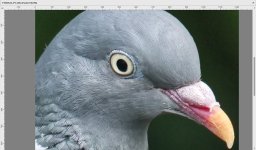
cr4.jpg

The zoom figure would agree, because that is how the zoom figure is calculated, by the ratio of pixels between the image and the screen.


As for "% crop is/should be how much of the original image area is remaining in pixel dimensions (LxW)... e.g. cropping to .5 width and .5 height is a 25% crop (cropped to 25%). But sometimes I see people say cropped by 25%; which is also fine. E.g. if I cropped to that composition it would be cropped by 90%, or to 10%... the limit is 100%. For anything else you would have to resample the image/data." I agree with you completely, however it seems that we are stuck with it. I think it is the photography industry press that is to "blame", they wanted a way that printed images in magazine could be compared on a level field. which to me isn't very logical, as the printed or displayed images are never really good enough to make a worthwhile comparison anyway.
I don't see any other reason for it, and they should have come up with a different term and not used "100% crop" which logically would mean you have 100% or nothing of the original image left depending if it was to or by.

I use "to" as in "cropping to .5 width and .5 height is a 25% crop (cropped to 25%)." and would normally call that a 25% crop, and I think that is what most people understand by it.

However the numbers on software (most) and the term 100% crop refer to pixel ratios between the screen and image, not percentage of image area.

 
oh well I just read through the replies and now feel a total failure think I'll take up knitting instead ... then I looked on flickr at my stats and that cheered me up a bit 10,595,875 views of my rubbish to date hmmmmmmm
You could always knit a nice warm cover for your E-M1iii, as it’s so obviously old and decrepit :p
 
My understanding of "crops" and more on "crop" in a second, has always been that 100% means I'm looking at a full sized image, as in 1ft or 1m wide or whatever, and what is displayed on me screen is the portion that fits. If I then cut out what I can se on my screen that's a 100% crop.

I could and indeed probably am wrong but what I see does seem to tally somewhat with what I'd expect so if I'm wrong by some happy coincidence it's sort of working for me.
 
oh well I just read through the replies and now feel a total failure think I'll take up knitting instead ... then I looked on flickr at my stats and that cheered me up a bit 10,595,875 views of my rubbish to date hmmmmmmm

The picture isn't a bad picture Jeff and MFT is a nice system but I don't think it's worth fooling ourselves that the image quality will match what you can get from a larger format system but that doesn't mean that MFT can't be easily good enough for many people and uses as clearly it can be.

In the DSLR days advantages of MFT for me included WYSIWYG and all that and the focus accuracy and consistency and speed and the quality of the lenses too but APS-C and FF mirrorless are available now and those systems also now have all the focusing and modern lenses advantages. For me MFT still has some advantages but these days the bulk and weight and even cost advantages may not always apply as some MFT options are pretty bulky now and also small APS-C and FF options are available (Sony A6xxx and the FF Sony A7c for example and the Fuji X100x) and some MFT options are pretty expensive. One remaining advantage for me is speed as all of my MFT cameras are significantly faster to acquire focus and take a picture than my old Sony A7.
 
The picture isn't a bad picture Jeff and MFT is a nice system but I don't think it's worth fooling ourselves that the image quality will match what you can get from a larger format system but that doesn't mean that MFT can't be easily good enough for many people and uses as clearly it can be.

In the DSLR days advantages of MFT for me included WYSIWYG and all that and the focus accuracy and consistency and speed and the quality of the lenses too but APS-C and FF mirrorless are available now and those systems also now have all the focusing and modern lenses advantages. For me MFT still has some advantages but these days the bulk and weight and even cost advantages may not always apply as some MFT options are pretty bulky now and also small APS-C and FF options are available (Sony A6xxx and the FF Sony A7c for example and the Fuji X100x) and some MFT options are pretty expensive. One remaining advantage for me is speed as all of my MFT cameras are significantly faster to acquire focus and take a picture than my old Sony A7.
Don't forget handholding long lenses at ridiculous slow shutter speeds and getting sharp shots ;)
 
Don't forget handholding long lenses at ridiculous slow shutter speeds and getting sharp shots ;)

That's something I don't do and I don't know how good the IS is on the competitor APS-C and FF mirrorless systems.

Looking at what I used to get from film I think MFT is a Godsend but the system doesn't exist in isolation and whilst I can appreciate that some people will never want for more "we" must accept that the various options on offer have different capabilities and compromises and strengths and weaknesses and there are decisions to make. For me there are some MFT options which now make little sense when I have my A7... but there are also other options which do offer advantages over my FF A7. It all depends, as it does for us all :D
 
Last edited:
My understanding of "crops" and more on "crop" in a second, has always been that 100% means I'm looking at a full sized image, as in 1ft or 1m wide or whatever, and what is displayed on me screen is the portion that fits. If I then cut out what I can se on my screen that's a 100% crop.

I could and indeed probably am wrong but what I see does seem to tally somewhat with what I'd expect so if I'm wrong by some happy coincidence it's sort of working for me.
Usually 100% crop means a crop provided at 100%; i.e. not downsampled. That way, when I look at it on my computer at 100% zoom (full size) it looks the same as if I had the original file zoomed to 100%.
I guess context matters... 100% crop is usually only used/mentioned when providing/evaluating some technical aspect at pixel level/full resolution.
 
One remaining advantage for me is speed as all of my MFT cameras are significantly faster to acquire focus and take a picture than my old Sony A7.
That's the thing... While I can get significantly better IQ out of the high resolution FF cameras; I quite often don't. And when I don't, there's no advantage to it.
But, a lot of that comes down to pixel pitch/size more than anything else.
 
That's the thing... While I can get significantly better IQ out of the high resolution FF cameras; I quite often don't. And when I don't, there's no advantage to it.
But, a lot of that comes down to pixel pitch/size more than anything else.

Lenses do make a difference here as some are faster than others but with a fast acting lens I can just point a MFT camera at something and press the shutter and in all but low light the camera will have metered and acquired focus and the snap shot will be in focus. My A7 is quite old now but even with my fastest operating FF lenses it can not match the speed of my MFT cameras. I suppose one reason could be that with MFT there's less glass to move around.
 
I wonder too how much one of the strengths of full frame - shallow depth of field - works against it when you want to quickly snap something moving fast. Things are definitely getting better though.
 
Lenses do make a difference here as some are faster than others but with a fast acting lens I can just point a MFT camera at something and press the shutter and in all but low light the camera will have metered and acquired focus and the snap shot will be in focus. My A7 is quite old now but even with my fastest operating FF lenses it can not match the speed of my MFT cameras. I suppose one reason could be that with MFT there's less glass to move around.


As you know the latest Sony A7 cameras have lightening fast af, stupidly and unnecessarily fast, weapons grade even autofocus and whilst I appreciate the A7 Mk 1 is sluggish that’s not format specific it’s just an early Sony camera
 
Last edited:
I wonder too how much one of the strengths of full frame - shallow depth of field - works against it when you want to quickly snap something moving fast.
Depends on the technology. If you are talking about a FF DSLR, then the DOF at the image sensor has no impact on the PDAF. If comparing mirrorless cameras, then it can have more of an effect; but there are a lot of other variables in the mix as well...
 
That's the thing... While I can get significantly better IQ out of the high resolution FF cameras; I quite often don't. And when I don't, there's no advantage to it.
But, a lot of that comes down to pixel pitch/size more than anything else.

And that, specifically, is when you get into the world of high end lenses to resolve on these things.

There are probably only a handful of lenses that will fully resolve a D850 sensor for instance and one of them are zooms.
 
As you know the latest Sony A7 cameras have lightening fast af, stupidly and unnecessarily fast, weapons grade even autofocus and whilst I appreciate the A7 Mk 1 is sluggish that’s not format specific it’s just an early Sony camera

As you'll have seen, I did say that my A7 is quite old.

If/when I get a newer FF camera I'll be interested to see if it can match the speed of MTF. I'll be pleased if they can but also surprised as MFT has the advantage of having much less glass to move about quickly.
 
As you'll have seen, I did say that my A7 is quite old.

If/when I get a newer FF camera I'll be interested to see if it can match the speed of MTF. I'll be pleased if they can but also surprised as MFT has the advantage of having much less glass to move about quickly.
I think its going to be very much camera specific, my MFT camera is very slow to focus. Bigger lens elements just have bigger motors. One of the fastest focusing lenses of all time is the Nikon 200mm f2 and that has dinner plate size elements!
 
Depends on the technology. If you are talking about a FF DSLR, then the DOF at the image sensor has no impact on the PDAF. If comparing mirrorless cameras, then it can have more of an effect; but there are a lot of other variables in the mix as well...

I was thinking more in terms of a shorter focal length lens having a slightly greater depth of field for a given aperture, therefore the chances of getting a photo in focus might be slightly higher - all else being equal.
 
I was thinking more in terms of a shorter focal length lens having a slightly greater depth of field for a given aperture, therefore the chances of getting a photo in focus might be slightly higher - all else being equal.
Yes... more DOF does give you something of a focus buffer/tolerance range.

And I do wonder if that doesn't (at least partially) account for some of what I hear about some cameras "nailing focus" so much more reliably... particularly when the smaller sensor has a similar pixel pitch (lower resolution); not only more DOF, but also less ability to evaluate focus as critically.
 
OMG the post wasn’t meant to be taken that seriously please calm down .. it’s only a hobby
 
OMG the post wasn’t meant to be taken that seriously please calm down .. it’s only a hobby

But some people like @Crotal Bell are expecting to commit hundreds of pounds on the basis of something you are suddenly not taking seriously. Seems like a good idea that we do discuss it a little deeper.
 
But some people like @Crotal Bell are expecting to commit hundreds of pounds on the basis of something you are suddenly not taking seriously. Seems like a good idea that we do discuss it a little deeper.
True, but some people are taking it beyond seriously- almost confrontationally
 
At the end of the day it is @Crotal Bell ’s decision
I would hate to be the one who recommended something based on my experience only for him to discover its not suitable for him
 
At the end of the day it is @Crotal Bell ’s decision
I would hate to be the one who recommended something based on my experience only for him to discover its not suitable for him
Very true, from my way of looking at it, I can't talk about something I have had no experience with, so I can only say how I have found things, and he must decide what things are relevant to his decision.
 
True, but some people are taking it beyond seriously- almost confrontationally

I haven't seen anything in the thread that was confrontational, and though SK66 was honest about the quality of the 100% crop it was not in a way to put BF down. It seemed to be a constructive discussion.
 
I haven't seen anything in the thread that was confrontational, and though SK66 was honest about the quality of the 100% crop it was not in a way to put BF down. It seemed to be a constructive discussion.
In all honesty it depends on what said photos are going to be used for .. I have no doubts that @Crotal Bell will only be posting shots on the interwebby not hanging them in a gallery to sell to the highest bidder , , and though money will change hands at the level the enquiry is at if not suitable then not much lost on resale value either , he’s not talking rolls Royce or Aston Martin money .
I’m just a o.a.p with limited funds that endeavours to get the best equipment bang for bucks possible . If funds and health were better I would probably advise differently but as it sounds like keith@crotal bell is in the same boat the advise and samples photos I have given him are based on experience , he or you can take it or leave it .
The only thing missing from the equation and that’s more relevant than anything is what computer/ mac is being used for PP and what. Skill level has the OP got a point often left out of any post ….
I have known guys and still do with gear that I could only drool over ,that just shoot out of focus j.pegs and are quiet happy with that
 
Back
Top