Why are people buying electric cars?

  • Thread starter Thread starter Deleted member 68495
  • Start date Start date
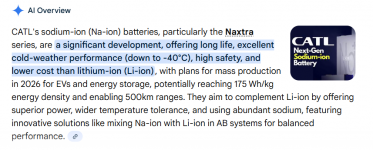
Sodium Ion Batteries - Coming to a car near you in a couple of years..
60% cheaper, Same or lighter weight, 5 times longer lifespan, Sodium, Aluminium the main components no rare earth metals, no lithium. and no need to rebuild factories to make them.

One of the most important elements he mentions near the end is that all the components used to make the batteries are abundantly available all round the world, so no chance of folk like the tangerine taco closing off the market to hike prices.

View: https://www.youtube.com/watch?v=5YUeYbfkIts
 
Last edited:
EVERYONE PAYS FOR THE ROADS
Shouting doesn't make anything true.

While factually correct, in that road building and maintenance is in practice paid out of the general funds (as is all other government expenditure) the myth we are then given is that Road Fund Tax, Fuel Duty and etc, is where the money comes from.

Having told that big lie, no one should complain if some of us say: "OK, then why is "X" paying a smaller share than me?"
 
Which is just plain unfair.

This issue highlights a glaring fault in our "democracy". Once a minority grabs control, the rest of us are dragged down whatever path they choose. There is no logical reason not to charge all vehicle owners for the expected wear that their vehicles will cause to the roads and other infrastructure, as well as for all "improvements".

nope more pollution = more tax :-)
 
Sodium Ion Batteries - Coming to a car near you in a couple of years..
60% cheaper, Same or lighter weight, 5 times longer lifespan, Sodium, Aluminium the main components no rare earth metals, no lithium. and no need to rebuild factories to make them.

One of the most important elements he mentions near the end is that all the components used to make the batteries are abundantly available all round the world, so no chance of folk like the tangerine taco closing off the market to hike prices.

View: https://www.youtube.com/watch?v=5YUeYbfkIts

Yeah Sodium batteries will kill the whole debate about EV vs ICE

1767532332283.png
 
Here's my thoughts on the subject.
I have had a BYD Seal on a lease plan for just over a year and 24,000 miles. It replaced an aging Mazda 3 2.0 petrol.
Two weeks before signing up, I was still anti EV, but was looking at options due to the impending death of the Mazda. I travel between 50 and 60 miles each way to work depending on the route and at different times of the day due to shift work.
The car has been amazing, I absolutely love it BUT, I have never had to charge it anywhere other than at home or work and the range takes a massive hit in the winter.
Realistically, I wouldn't just jump in and drive somewhere like I would with a petrol car due to my tendency to over-think situations and worry about range/charging.
I still believe that the UK isn't and probably never will be ready for everyone to drive an EV with current technology.
Was it a good choice for me? Absolutely for my commute but not sure I want to head off on a long trip and rely on public chargers.
 
Well we live in a free country, where your allowed to have an opinion, some peoples opinions upset others, and many a time I have had that experience,
It is because of that right, that we have a country where we have that freedom to say what we think about issues on a daily basis.

Unfortuantely, this is less applicable under the current Stamer regime.
 
Here's my thoughts on the subject.
I have had a BYD Seal on a lease plan for just over a year and 24,000 miles. It replaced an aging Mazda 3 2.0 petrol.
Two weeks before signing up, I was still anti EV, but was looking at options due to the impending death of the Mazda. I travel between 50 and 60 miles each way to work depending on the route and at different times of the day due to shift work.
The car has been amazing, I absolutely love it BUT, I have never had to charge it anywhere other than at home or work and the range takes a massive hit in the winter.
Realistically, I wouldn't just jump in and drive somewhere like I would with a petrol car due to my tendency to over-think situations and worry about range/charging.
I still believe that the UK isn't and probably never will be ready for everyone to drive an EV with current technology.
Was it a good choice for me? Absolutely for my commute but not sure I want to head off on a long trip and rely on public chargers.
Good a fair and honest statement on realistic day to day running of a EV.
How much is the cost of charging an EV. Is it far less than fuel ?
 
For public kerbside charging I can't imagine it would be financially viable because of the sheer number required, although I suppose unlike lamp posts providing street lighting they would at least have an overhead charge option for a direct ROI, unless the overhead (i.e. not the electricity part) is factored into Council Tax for an indirect ROI, but then people with driveways and non-car users may not be happy with that.

For private kerbside charging it's not a solution because you are often not guaranteed a space outside your house. This could be somewhat solved for many terraced houses by providing them with their own space on the public road/kerb, for one car. But that's not a solution for tenements, high rise flats etc.

But then again, we don't have our own personal fuel bowsers or storage tanks to cater for ICE. If the public charging is fast enough and the cost not ridiculous, then it shouldn't be much different from how we refuel ICE. As for homeowners with solar and battery arrays having an advantage of being able to charge at home, well I guess there's an argument that they have had to finance the initial installation and hardware outlay (although some have had generous grants) which those without driveways haven't had to.
 
For private kerbside charging it's not a solution because you are often not guaranteed a space outside your house. This could be somewhat solved for many terraced houses by providing them with their own space on the public road/kerb, for one car. But that's not a solution for tenements, high rise flats etc.
Only somewhat though. e.g. the noises about how few parking spaces are built at new developments.
 
Good a fair and honest statement on realistic day to day running of a EV.
How much is the cost of charging an EV. Is it far less than fuel ?

Charging at home works out a lot cheaper than petrol. The Mazda I had wasn't that efficient as an older (2010) 2.0 petrol car and with me having a bit of a heavy right foot I was putting in about £350 a month. Charging at night on an EV tariff was costing about £65 a month in the summer. A bit more during winter
 
Here's my thoughts on the subject.
snip..
Was it a good choice for me? Absolutely for my commute but not sure I want to head off on a long trip and rely on public chargers.

What to do is try a public charger at some point where you need a charge but are not desperate. Then wait till summer and go for a long drive over a weekend but head for somewhere that has chargers or that you know en route there will be some. Just to test the possibilities.
 
Positive Guardian article on electric cars
Apparently ‘Solid-state batteries are going into trial next year with the promise of 500 miles on a 10-minute charge though’ will be a few years before they are widespread as apparently will take a while to scale up production and reduce costs
Interesting though and it does look like Tesla isn’t the future as people don’t want to be associated with Musk
https://www.theguardian.com/comment...hicle-elon-musk-tesla-sales?CMP=share_btn_url
 
Positive Guardian article on electric cars
Apparently ‘Solid-state batteries are going into trial next year with the promise of 500 miles on a 10-minute charge though’ will be a few years before they are widespread as apparently will take a while to scale up production and reduce costs
Interesting though and it does look like Tesla isn’t the future as people don’t want to be associated with Musk
https://www.theguardian.com/comment...hicle-elon-musk-tesla-sales?CMP=share_btn_url

Tesla isn't the future because they have no models under development. It looks like they are intending to bow out of car production unless they are awaiting for new technology to kick in before committing.

Regarding the sodium battery plans; I wonder how that is going to affect the new ev market between now and them becoming available?
 
Good a fair and honest statement on realistic day to day running of a EV.
How much is the cost of charging an EV. Is it far less than fuel ?
A rough rule of thumb if you are charging at home is to take the EV's miles / kWh and multiply by 35 to get the equivalent mpg for an ICE
 
Tesla isn't the future because they have no models under development. It looks like they are intending to bow out of car production unless they are awaiting for new technology to kick in before committing.

Regarding the sodium battery plans; I wonder how that is going to affect the new ev market between now and them becoming available?

Ahh I see yes that makes sense
Yes see what you mean, people may wait and see what happens with the new technology
Maybe people are leasing rather than buying an EV ?
Not sure though as we haven’t looked into it as at the moment am not planning to change cars and anything decent ICE or EV is out of our budget anyway at the moment though am thinking in the longer term EV will be more affordable
 
Tesla isn't the future because they have no models under development. It looks like they are intending to bow out of car production unless they are awaiting for new technology to kick in before committing.

Regarding the sodium battery plans; I wonder how that is going to affect the new ev market between now and them becoming available?

I read a while ago, that apparently the whole point of Tesla cars was just to collect a massive amount of data from all the sensors and cameras of driving habits and techniques etc with the aim being to use that data for the development of automated cars in the future.

Of course, it was the Internet so it might not have been true.
 
I think at the moment Musk is focusing on AI, space, advanced transport systems and robotics, although I've heard him mention convergence - possibly bringing all of these things and his companies together with shared interests and tech. It will be interesting to see where he heads towards.
 
Tesla isn't the future because they have no models under development. It looks like they are intending to bow out of car production unless they are awaiting for new technology to kick in before committing.

Regarding the sodium battery plans; I wonder how that is going to affect the new ev market between now and them becoming available?
There will always be someone waiting for the next tech, we see it in everything from TVs to Camera gear to cars. I reckon nearer time there will be an effect on sales but with prices dropping so fast it may not be that big.
 
I wish I knew where the bribes were available.
 
VW passing Tesla for sales in Europe for the first time.


I quite like the 'new' Tiguan, and I'm very pleased to see Tesla slipping down for multiple reasons. Having just bought another car (collect it Saturday) I'd looked at a Tesla model Y but realised that I really hated the interior and the control system. Gone for a 3YO BMW X1 diesel - mid-high 50s mpg, lots of space for a smaller SUV and a great cabin and handling. I could have got an MG HS hybrid new for the same money, but I think this will last longer and be better environmentally because of it. Perhaps in 5 years time I'll reconsider about an EV.
 
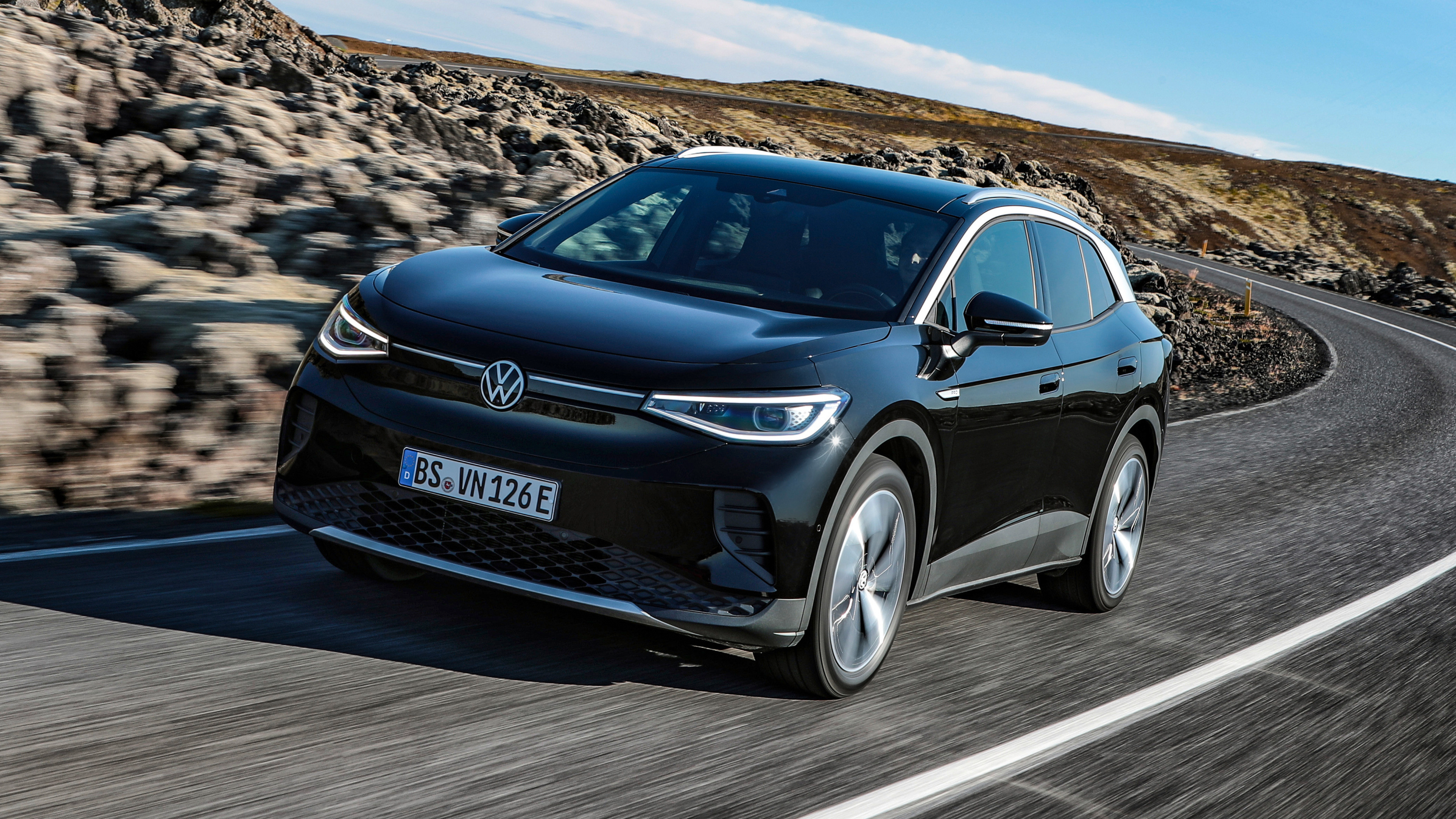
The VW ID.7 tourer ticks a lot of boxes and sits nicely the middle of the EV tourer segment. I have noticed in a review that the brakes are mentioned as being woefully underpowered. I was told the same from an associate who had an Audi EV, so much so that he felt like he had to leave massive gaps from the car in front. I'm guessing in the cases they are using regular brakes on what is presumably much heavier cars.
 
I have noticed that on some of the cars I drive at work, EV cars don't have a vacuum brake servo assist its electronic, and the brake pedal application feels different.
We have had a notice from VOSA that if we are replacing the beam jacks on the MOT ramp they have to be upgraded to cope with the extra weight of the larger EV cars.
I charged an EV car up yesterday on a high speed charger, it took 2.5 hours to get it from 20% to 80%
 
There are posts describing how usually an ev will have facility for the accelerator pedal to affect braking. A bit like engine braking, but the affect can be increased or decreased to suit. This means less wear on the brake parts and brake pads last a lot longer. The charging time is variable depending on the age and capacity of the battery and the power of the charger. A full charge using domestic supply would take all night, but the same could be achieved in less than half an hour or less using one of the fast chargers that you find at some supermarkets and motorway service stations. I'm still not convinced that for our use an ev would suit us. On a recent trip back from the south of France I reckon having an ev would have added three or four hours to the already fraught and extended journey.
 
Last edited:
Braking doesn't seem to have been sorted on hybrid vehicles from some makers yet. The Citroen I drove a couple of weeks ago used 2 stages with a large travel between, and it was not an obvious way to manage braking.
 
Braking doesn't seem to have been sorted on hybrid vehicles from some makers yet. The Citroen I drove a couple of weeks ago used 2 stages with a large travel between, and it was not an obvious way to manage braking.

Last year I had use of three hybrids; Fiat Panda, Mazda 3 & Suzuki Swift. They all had differering levels of electronic braking, from zero in the Fiat to almost an emergency stop (or that what it felt like on the motorway) in the Suzuki. They were rated in the same order regards lane guidance. The Suzuki was like arm wrestling, the Mazda more subtle and the Fiat was "Do what you want. You're the driver".
 
ICE vehicles have different braking characteristics too. An automatic will be different from a manual, even if it's the same model. A fully charged EV will have very little "engine" braking since there's nowhere for the power that regeneration braking creates to go, so the less used mechanical brakes will be pressed in to action.
 
My car has a brake wash system which activates in the rain using the rain sensor. It's supposed to retain the initial bite and it does seem to work in my experience.

I believe some EV's also have a similar system (Hyundai and Kia in particular) except I believe theirs is not just for when it's raining but also when dry to clear dirt and debris due the lesser use of the brakes. Logically, it would make sense to me to be a mandatory requirement for EV's to keep the brakes in tip top condition for when they are needed.
 
I think it's the brakes are automatically applied very slightly to remove excess water from the discs, simmilare to when you go through a ford and have to dab your brakes to dry them out
 
The VW ID.7 tourer ticks a lot of boxes and sits nicely the middle of the EV tourer segment. I have noticed in a review that the brakes are mentioned as being woefully underpowered. I was told the same from an associate who had an Audi EV, so much so that he felt like he had to leave massive gaps from the car in front. I'm guessing in the cases they are using regular brakes on what is presumably much heavier cars.
The lack of a decent electric estate car has been an immediate dealbreaker but I've been keeping an eye on the ID7 Tourer prices since it looks a good estate. Unlike most of the VW estates (Arteon, Superb, Octavia) it comes with a flat load bay which is a big plus for me, I know it's an optional extra but as is usually the case people rarely seem to choose it. I've noticed the second hand ones are down to around £30,000 so they're approaching the point I'd consider one, I've not heard of brake problems but I wonder if that's a pure mechanical problem? Electric cars usually have powerful regen braking through the electric system.

That said I'd probably still go for a Toyota Corolla given they have a good reputation for reliability and there doesn't seem to be much coming from the Japanese manufacturers for pure electric cars with the upcoming models being other cars with a different badge largely. I don't do many miles so there's not much benefit to an electric car and many possible downsides, although it's getting pretty old my current car (2011 Mazda6) is still very reliable and lacks the complexity of newer cars particularly electric cars.

There's a new electric bus service in Scotland by a company called Ember and gave them a go recently, I was impressed with the electric aspect. The power delivery was very smooth and going through stop/start traffic there wasn't the usual diesel rumble and vibration which was definitely a plus.
 
I read a while ago, that apparently the whole point of Tesla cars was just to collect a massive amount of data from all the sensors and cameras of driving habits and techniques etc with the aim being to use that data for the development of automated cars in the future.

Of course, it was the Internet so it might not have been true.

these is a bit of truth in there to be fair, Elon is a very forward thinking man and he knows that the Chinese at some point will thrash Tesla like a bad dog, that's just a matter of time so he needs to keep moving.

Robotaxis are one field but its mainly AI and Robots that he is interested in, the holy grail is to build a robot that can replace a human in factories especially,
imagine a workforce that is 24h/cheap, reliable , can work in freezing cold conditions, once you allow your mind to see his vision its merciless.
 
The lack of a decent electric estate car has been an immediate dealbreaker but I've been keeping an eye on the ID7 Tourer prices since it looks a good estate. Unlike most of the VW estates (Arteon, Superb, Octavia) it comes with a flat load bay which is a big plus for me, I know it's an optional extra but as is usually the case people rarely seem to choose it. I've noticed the second hand ones are down to around £30,000 so they're approaching the point I'd consider one, I've not heard of brake problems but I wonder if that's a pure mechanical problem? Electric cars usually have powerful regen braking through the electric system.

That said I'd probably still go for a Toyota Corolla given they have a good reputation for reliability and there doesn't seem to be much coming from the Japanese manufacturers for pure electric cars with the upcoming models being other cars with a different badge largely. I don't do many miles so there's not much benefit to an electric car and many possible downsides, although it's getting pretty old my current car (2011 Mazda6) is still very reliable and lacks the complexity of newer cars particularly electric cars.

There's a new electric bus service in Scotland by a company called Ember and gave them a go recently, I was impressed with the electric aspect. The power delivery was very smooth and going through stop/start traffic there wasn't the usual diesel rumble and vibration which was definitely a plus.

For me it's the lack of on street parking that still presents a problem. I'm sure it will be solved at some point. Meanwhile, I'm happy with my current car apart from the fuel economy.

It was in an Honest John review where the brakes were mentioned. I don't think they are faulty, just underpowered for the weight of the car.

They've got electric buses in Glasgow, they look the same but are quieter. EV would seem ideal for buses seeing as they can return to base to charge overnight.
 
Back
Top