Why are people buying electric cars?

  • Thread starter Deleted member 68495
  • Start date
This is what concerns me about changing my Mazda 6 for an EV, especially the Mazda 6E. I have so many extra features on my current car, because since it had been briefly used as a demonstrator by the dealership manager, I doubt I could have them all on a new car even if they were available. When I had a Disco at the same time for a while, I found it a distinct disappointment compared to the Mazda. The Suzuki I was interested in can't really compare so I've ditched that idea. I'll come back to this in 6 months time and re-review.
 
This is what concerns me about changing my Mazda 6 for an EV, especially the Mazda 6E. I have so many extra features on my current car, because since it had been briefly used as a demonstrator by the dealership manager, I doubt I could have them all on a new car even if they were available. When I had a Disco at the same time for a while, I found it a distinct disappointment compared to the Mazda. The Suzuki I was interested in can't really compare so I've ditched that idea. I'll come back to this in 6 months time and re-review.
It's a generalisation but it seems to be a different way Japanese and European car manufacturers spec their cars, Japanese cars tend to come with a higher standard spec with few optional extras whereas European cars tend to have a lower standard spec and large amount of optional extras. My Mazda6 I don't think had any optional extras and had a wide range of features as standard some of which were quite advanced for what is now a 15 year old car so it has the blind spot monitoring, heated seats, keyless doors/start, front/rear parking sensors etc. A friend bought a brand new Honda FR-V and there were just three specifications and two engines so just six different cars you could buy (excluding colour), similarly I notice when looking at Toyota they also have a high amount of standard spec. The reliability of Japanese cars is one of the main reasons I want another one but also it's so much easier shopping for them second hand because I know which spec to go for since it will have the features I want.

Before the Mazda I had VW based Skodas and Seats which buying second hand was a challenge because the spec could vary hugely from car to car and from year to year so I had to really learn which features were standard and which were extra each year. It's still the same now, I've been looking at Octavias, Passats and Superbs because they are all obviously great estate cars but the spec varies, some features were only optional and basically no-one seemed to choose them (the flat boot floor is one I want but few seem to have) and I'm used to looking at Mazdas/Toyotas so I get caught out...I'll see a Skoda that looks quite good then realise it lacks some of the basic features I'm assuming it will have like a rear view camera and heated steering wheel.

That said and getting back on topic, the VW ID7 seems quite different to the Passat with only a couple of specs which are quite generous.

The Mazda is up for its MOT shortly so will see how it fares but at the moment it feels like it's worth hanging on for longer to see where the market goes.
 
We took a 1997 1.1 petrol Fiat Punto down to Avignon back in 2002, it managed the trip without any problems, including an ascent of Mt Ventoux.
 
Hybrids can be very reliable, there are 20 year old Toyota Prius still running around and ones with over 250,000 miles too.

They seem to be the taxi drivers favourite car round here.
 
Hybrids can be very reliable, there are 20 year old Toyota Prius still running around and ones with over 250,000 miles too.

They seem to be the taxi drivers favourite car round here.

Good point, I stand corrected on my post :)
It does look like hybrid cars can be no less reliable than petrol or battery powered ones
Our car, a Yaris is only available now as a hybrid, more than twice the price that we paid but all vehicles have gone up a lot in price over the last few years
 
Good point, I stand corrected on my post :)
It does look like hybrid cars can be no less reliable than petrol or battery powered ones
Our car, a Yaris is only available now as a hybrid, more than twice the price that we paid but all vehicles have gone up a lot in price over the last few years

Price of cars have gone up ridiculous amounts over the last 5 or 6 years, truth is it's really only EVs where there seems to be price drops, mainly as manufactures move from high-end only models to a wider range choice.

Some have seen the change coming, others haven't. Tesla sales have plummeted, and they cut the range to cut just 2 cars, BYD brought many more model across a wide price range and saw their sale quadruple to be the largest manufacturer in the world (and they don't sell anything in the USA market)
 
Hybrids can be very reliable, there are 20 year old Toyota Prius still running around and ones with over 250,000 miles too.

They seem to be the taxi drivers favourite car round here.

I raced a Prius once and for the first hundred yards I was winning, but then I tripped.
 
I've always called them a Priapus, but if you don't know Greek mythology then that's not funny.

For those looking at a new car, try Carwow - I got some good prices through them, even though I didn't buy through them in the end.
 
Hybrids can be very reliable, there are 20 year old Toyota Prius still running around and ones with over 250,000 miles too.

They seem to be the taxi drivers favourite car round here.

Had one as a company car 10 years ago - awful!
 
I've always called them a Priapus, but if you don't know Greek mythology then that's not funny.

For those looking at a new car, try Carwow - I got some good prices through them, even though I didn't buy through them in the end.


A neighbour of my parents was looking at one some years ago but being a recently promoted prebendary, he referred to it as a Pious!
 
I think, from what you have written, a hybrid would be a better bet for you. My mate get's around 500 miles in a hybrid 5 series BMW, I'm quite sure something like an X1 or X2 would fit the bill, and both have hybrid options (I think).
After visiting lots of dealer showrooms over a few weekends in January including many test drives, I ended up getting a mild hybrid diesel BMW 3 series. I'm averaging close to 50mpg on the daily commute, and almost 60 on the longer motorway runs. I reckon I'll keep this one for 5-6 years and then see what improvements have been made to EVs.

EV major plus points were smoothness, quietness (eerily quiet at motorway speeds), lots of tech as standard and potentially lower running costs. Downsides were reduced range at constant motorway speeds in cold weather, potentially horrific depreciation on some models, and silly sized 20" and 21" wheels on some. My wife particularly liked the electric Ford Puma, and as she mostly does short town trips, that might be an option when we come to replace her current petrol Nissan.
 
After visiting lots of dealer showrooms over a few weekends in January including many test drives, I ended up getting a mild hybrid diesel BMW 3 series. I'm averaging close to 50mpg on the daily commute, and almost 60 on the longer motorway runs. I reckon I'll keep this one for 5-6 years and then see what improvements have been made to EVs.

EV major plus points were smoothness, quietness (eerily quiet at motorway speeds), lots of tech as standard and potentially lower running costs. Downsides were reduced range at constant motorway speeds in cold weather, potentially horrific depreciation on some models, and silly sized 20" and 21" wheels on some. My wife particularly liked the electric Ford Puma, and as she mostly does short town trips, that might be an option when we come to replace her current petrol Nissan.

It sounds like we came to similar conclusions and bought similar cars. I got an X1 diesel MH, and it's averaged 54.7mpg on my daily commute with a range just over 600 miles. I'd been really tempted by a used i4, but the need for 2 charging stops on our regular 500 mile drive really put me off. This is nice and quiet, but I wish it were manual instead of auto, and can see how the presence of so many automatic cars has changed driving behaviour for the worse.

Like you, we'll probably keep it 6 years or so and review the situation.
 
It sounds like we came to similar conclusions and bought similar cars. I got an X1 diesel MH, and it's averaged 54.7mpg on my daily commute with a range just over 600 miles. I'd been really tempted by a used i4, but the need for 2 charging stops on our regular 500 mile drive really put me off. This is nice and quiet, but I wish it were manual instead of auto, and can see how the presence of so many automatic cars has changed driving behaviour for the worse.

Like you, we'll probably keep it 6 years or so and review the situation.
According to the statistics you sound like you're in the 2%. The average daily vehicle distance for UK is 30 miles. Most vehicles are stationary for 20 hrs per day and as such could be fuelled in that time. 2% of vehicle distances travelled are of 200+ miles in a single journey. So 98% of days / journeys would be more beneficial to have an EV on operational cost (assuming there is access to a charger during the 20hrs stationary time).
 
Another benefit of modern EVs is bidirectional charging, which some used in the recent winter storms.


That's a good feature, especially considering the size of EV batteries compared to home storage batteries.
 
France is now reducing its commitment to renewable energy policies and increasing the nuclear generation of electricity whereas Germany has decided to continue with its green renewable commitments. Both are citing the increase in evs as a major factor in the need for extra capacity.
 
France is now reducing its commitment to renewable energy policies and increasing the nuclear generation of electricity whereas Germany has decided to continue with its green renewable commitments. Both are citing the increase in evs as a major factor in the need for extra capacity.

France has a problem with modulating generation from nuclear, because the plants are designed for a steady output within a range, and changing output repeatedly puts additional thermal stress on the power stations. If not managed, this will cause early wear and potential failure.
 
France has a problem with modulating generation from nuclear, because the plants are designed for a steady output within a range, and changing output repeatedly puts additional thermal stress on the power stations. If not managed, this will cause early wear and potential failure.

The new 'fleet' are supposed to come on line by 2038. It is a big investment.
 
France has a problem with modulating generation from nuclear, because the plants are designed for a steady output within a range, and changing output repeatedly puts additional thermal stress on the power stations. If not managed, this will cause early wear and potential failure.
If only the French grid had multiple connections to multiple neighbouring countries (especially larger ones going gung ho for renewables) to be able to offload excess in times of lower domestic load...
 
If only the French grid had multiple connections to multiple neighbouring countries (especially larger ones going gung ho for renewables) to be able to offload excess in times of lower domestic load...
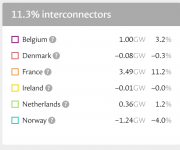
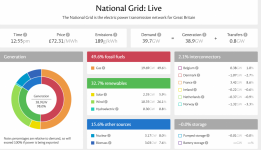
the UK takes a chunk from France most days

1770939676600.png
 
Quiet day on wind and solar is nicely helping and again getting a chunk from French Nuclear.

1770987866470.png
 
An interesting update with regard to VAT and public charging. It's not over yet though.
Another attempt to avoid paying their fair share. :tumbleweed:
 
I think that HMRC should be forced to rename VAT to JAT (Just Another Tax) there is no value added component at all.
For those who don't understand the English language, the tax is on the value added by the transaction.
 
well what an odd thing fuel prices are souring and EV charging prices are plummeting, wow what a thing :ROFLMAO:

from 1st april Octopus are doing 5.5p/kwh
 
https://www.theguardian.com/busines...elevance-iran-war-evs-china?CMP=share_btn_url

Interesting Guardian article on the electric car market at the moment
European and US manufacturers are pulling back from EVs while the Chinese are going full on for electric
I think the writing is on the wall for internal combustion engines even though at the moment there isn’t an EV that we could afford that has a decent range, that will change with the Chinese advancing the technology
BYD the Chinese carmaker has announced a new battery with a 600 mile range, that is seriously impressive
 
BYD the Chinese carmaker has announced a new battery with a 600 mile range, that is seriously impressive
That make an EV useful but driving style also affects range. Rolling road tests are not real world tests!
 
Some government members appear to have been handed a nice backhander, so that they will hand a nice backhander to those who can cheat the rest of us, who have to pay fuel duty.

So now we know why people are buying electric cars!

 
Some government members appear to have been handed a nice backhander, so that they will hand a nice backhander to those who can cheat the rest of us, who have to pay fuel duty.

So now we know why people are buying electric cars!


Which government members are you referring to?
 
Which government members are you referring to?
If I knew that I wouldn't have put "appear to have been" - it's often possible to smell the stink but find it hard to pinpoint the cause.
 
Often China is cited as the reason why The West shouldn't do anything to combat pollution and global warming.. Interesting article in The Sunday Times today about what China has been doing. Some uncomfortable stuff in there. And definitely a government that does things. Not sure if they get backhanders...

Also on Beijing’s clean-air hit list were cars. In mega cities such as Beijing and Shanghai they are the main cause of air pollution. But anyone visiting will be struck by the number of green registration plates, indicating an EV.
“To get a new petrol car on the road in Beijing, you enter a lottery with chances of winning at less than one in a thousand,” said Qiu. “But for an EV there is the certainty of a waiting list — albeit a very long one — and they’re now far cheaper than petrol cars.” EVs account for about 12 per cent of cars on China’s roads.

Perhaps the most significant component of China’s clean air drive, however, has been the shift to renewable energy sources. Green electricity production in the country totals more terra-watt hours than the entire EU produces from all its energy sources combined. In 2024 China invested almost a trillion dollars in its green energy sector, just shy of the $1.2 trillion that was invested globally into fossil fuels production.
 
Some government members appear to have been handed a nice backhander, so that they will hand a nice backhander to those who can cheat the rest of us, who have to pay fuel duty.

So now we know why people are buying electric cars!

You really do need to give it a rest. Electric cars are here to stay, and if a government build incentives to get us to move towards them, then so be it. It's no different from anyone getting tax relief or subsidy to help push the electorate towards the direction the government is trying to take.

Next you'll be saying sales people shouldn't get comission.....
 
You really do need to give it a rest.
OK, I'll offer you a deal: you stop bigging up electric cars and I'll stop pointing out how the British government is bribing a tiny minority with other tax payer's money.
Electric cars are here to stay
They may be but, if they're such a good idea, why aren't millions of of British drivers queuing up to buy them without a bribe from the public purse?
, and if a government build incentives to get us to move towards them, then so be it. It's no different from anyone getting tax relief or subsidy to help push the electorate towards the direction the government is trying to take.
...which has never been a good idea. Every time that has happened, the problems have surfaced and suddenly it's a fatherless child.
Next you'll be saying sales people shouldn't get comission.....
Just so long as every salesperson in a company receives the same rate of commission, I'm all for it. (been there, received that).
 
That make an EV useful but driving style also affects range. Rolling road tests are not real world tests!

I've often found petrol cars to be pretty accurate to their official mpg, even my current one is pretty much spot on. Diesel, however, I've found to be considerable worse than their official mpg. I've never owned an EV, certainly one person I know says his range is nowhere near the official claimed and completely woeful in winter, but I don't know how he drives it nor if you uses the full 100% of the battery capacity. I suspect many will claim that their EV range is amazing, even better etc.

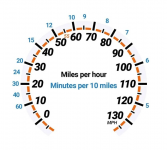
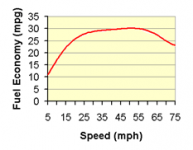
Speaking of economy, it would be interesting to see how driving habits would change if speedometers were replaced with paceometers. It certainly illustrates the non-linear consequences of driving at higher speeds and time to destination, especially above the economical sweet spot of 55mph. It would also be helpful to have a fuel useage type marking (could use office WLTP for that specific car) against each speed as well to show just how quickly economy drops as you approach 70mph+.


1774186997024.png 1774187097483.png
 
Speaking of economy, it would be interesting to see how driving habits would change if speedometers were replaced with paceometers.

I tend to think in terms of the trade-off between fuel usage and time for longer journeys, and also how bearable it is to be sat in a car moving relatively slowly for many hours. For our journey across France I'll normally run at 125 or 130kph on the autoroute as an acceptable balance between economy and time. The last 2 hours are on smaller country roads, and the limit moves around between 80 and 100kph except in villages.

As for diesel economy, they need a different technique to petrol, which can also vary between manufacturers too. I've been driving diesels for about 30 years now, and have sometimes needed brute economy above all else. Most economical was a Peugeot 307 SW that would do about 70mpg cruising at 65-70mph between Oxfordshire and Fleet in Hampshire.
 
I've driven various diesels for a good few years now. I hired a Moneo 2l estate once and for an easy 55mpg from it by driving between 50-65mph on the route between Salisbury and Exeter, mainly dual carriageway at times of low traffic. My Mazda 6 2.2l estate delivers 42mpg urban and uptown 60mpg on long runs if I hold it to slightly under 70mph on fast roads and just under the limits on other roads. However my past Disco's rarely did better than the book 27mpg, often worse, and my VW 2l Transporter camper van does about 27 urban and no better than about 33 on longer A road journeys. Weight, tyres, driving style especially momentum management, are all factors. I generally use gears to slow down as much as possible even on automatics, letting speed decay naturally, if I can.
 
Back
Top