Which Flash System?

Status
Not open for further replies.

Tyke Tiler

Suspended / Banned
Messages
3,980
Name
Tomas
Edit My Images
No
When your thinking about flash photography for the first time, one can become a little intimidated by the seemingly elusive and complex subject.

Whether you shooting as a hobby, for pleasure or to earn a living, all of the points covered in this text will help to understand the differences between the available systems.

The Three Typical Categories Of Flash System.

The most common type of flash units are designed for camera's directly. Excluding the onboard flash unit that can come fixed to a camera body, these are the typical AA battery powered 'flash gun' units that are seated onto a camera's hotshoe.
These are also referred to as 'speedlights', 'strobes' and 'hotshoe' flashes.
Hotshoe flashes can be used on or off camera.

Then there are the much more powerful flashes, also known as 'monoblocs' or 'studio flashes'. These are typically designed as stand alone units, they have the electrics and the head in a single housing and require mains power.

The third options are designed to provide power with portability, powered by hi capacity batteries and are usually referred to as 'head and pack' systems as the electrics and the head are housed separately.

All the options require synchronising or triggering systems to ensure that when you press the shutter on your camera, all of your flash units will fire simultaneously. These also are available in a series of options, pc sync cords, optical slaves and radio triggers.

As the fundamental principles of using flash in your photography are identical with each available system; to place, position and shape the flash to achieve a desired result.
Photographers will utilise all three flash options during their ventures and for varying reasons based on the situations and circumstances they encounter.

The Pro's & Con's Of Each System.

For a beginner to flash photography, one must first review our requirements. What do we want to achieve and how were going to achieve it?

Making a sensible decision is a mixture of recognising the limitations of each option, keeping within the budget and of course considering the category that you intend to shoot.

Maybe you have a spare room in your house and fancy building a small studio, you may also have no intention of venturing outdoors just yet so choosing one of the many monobloc/studio starter kits could be a better option for you.

Alternatively, If you intend to light a scene or portrait with a limited budget and portability in mind, then a hotshoe set up can be far more suited to your needs.

If your budget has no real limitation, intend on shooting on the move/outdoors, need to overpower the sun or light larger scenes, then a head and pack system can be the better choice long term.

There are many routes to follow so lets look at the limitations of each option and how it can effect our decision making process.

Hotshoe flashes.

Pro's.
  • Most compact, lightweight and portable option currently available.
  • AA battery powered.
  • Swift set up and installation.
  • Utilising coloured gels to creatively colour the light and also balance colour temperature is highly accessible.
  • External and compact battery packs are available to prolong use.
  • Typically have a rapid flash duration to freeze fast action.
  • Innovative shaping accessories in abundance, an array of effective D.I.Y alternatives to manufactured products such as snoots, grids and gobo's etc.
  • As hotshot flashes are small, they can be clamped or fixed into very tight spaces.
  • Price. A single hotshoe flash plus stand, umbrella swivel and basic modifier can be bought for less than £100.
Con's.
  • Power output is limited, approx 60ws.
  • Cheaper equivalents can offer slower recycle times.
  • Limited access to all light shaping tools and modifiers. Light modifiers above 80cm can be highly ineffective with single hotshoe units for example.
  • No modelling lamps.
  • When mixing varieties of differing brands, colour temperature can vary, causing tints and colour casts.

Monoblocs.

Pro's.
  • Power capability. Typical values range from 100ws to 2400ws and higher.
  • Mains powered. No recharging of batteries.
  • Faster recycle times.
  • Access to all available light shaping tools and modifiers.
  • Modelling lamps.
  • Provided flash tubes and brands are not mixed, there's consistent colour temperatures, so no casts or tints.
  • Price. A twin light starter kit including, stands, accessories and modifiers can be bought for less than £200
Con's.
  • Size
  • Weight.
  • Portability.
  • Larger scale shoots can require assistance.
  • Limited to mains power.
  • Cheaper equivalents can have slow flash durations, rendering them useless at freezing fast action.
  • When mixing varieties of differing brands, colour temperature can vary, causing tints and colour casts.
  • Cables can present serious hazards in certain circumstances.

Head & Packs.

Pro's.
  • Power capability. Typical values range from 100ws to 2400ws and higher.
  • Portability.
  • Swift set up and installation.
  • Access to all available light shaping tools and modifiers.
  • Provided flash tubes and brands are not mixed, there's consistent colour temperatures, so no casts or tints.
Con's.
  • Price. A single head and pack system typically starts at £600. Multiple units can be extremely expensive.
  • Weight.
  • Battery packs offer limited use per charge.
  • Large scale shoots can require assistance.
  • Modelling lamps drain batteries rapidly.
  • Cheaper equivalents have slower recycle times.
  • Cheaper equivalents can have slow flash durations, rendering them useless at freezing fast action.
  • When mixing varieties of differing brands, colour temperature can vary, causing tins and colour casts.

Once the aspects of each system are acknowledged and the limitations are respected, a productive decision can be made as to which system to buy or to use in any given circumstance.

Environments & Circumstances.

The variations of environments and circumstances we can encounter are infinite. During an assignment or project, there may be such restrictions as time, budget, safety, available space etc, so the knowledge that one can benefit from all three systems individually is invaluable.

If a studio environment is more to your needs or interests, then investing in portability may not be so much of a priority.
You'll have access to a constant mains power supply, a suitably spacious area in which to install your lighting indefinitely, a monobloc system will offer the most effective solution.

If portability is your most prominent concern, be it situations you can encounter in journalism for example, a swift set up is going to be an important factor so lighting with monoblocs systems maybe be highly inconvenient.
A hotshoe set up offers the most compact and rapid multiple light source option whereas a head and pack, though heavier and larger, will offer more power.

Power capability is an element that's importance can be overestimated as well as underestimated. There are many compromises when it comes to power output, for example a hotshoe set up, despite it's limited power can also be used to creatively light a portrait outdoors and even in difficult circumstances.
Primarily, we do not have to raise ISO sensitivity to compensate for lower power, instead we bring a lower power light closer, where it's far more effective.
Bright sunlight cannot be overpowered with hotshoes or even by monoblocs from the lower end of the power spectrum.
Typically 600ws is suggested to over power the sun, however this can be compromised by choosing an area of shade as opposed to direct sunlight, we can also choose to shoot later in the day, when the sun is lower on the horizon and during sunset.

Rolling With Today's Punches.

We will always want to use the very best, the most powerful or the most proficient systems available but we also have to accept that this is not always possible nor is it detrimental to achieve successful results.

Clients requirements can be largely effected by time frames, budget and of course their ideals.
In order to remain flexible and competitive, one should assess these elements and provide solutions. There is little point in enforcing your will on a client that has a non traversable restriction rooted in their requirements.
Their needs are your problem to solve and they will be more than happy to move to the next photographer who will comply more suitably.

There can be situations were time is extremely sensitive and the luxury of installing a location based studio environment is simply out of the realms of the time frame and budget.
You may be without assistance and need to utilise lightweight and quickly collapsible units.
You may wish to light family shots, children's birthdays, children playing, family get togethers and all the associated family events. Discreet, unobtrusive, compact and portable are just some of the important elements to consider.
Special moments happen quickly and your reactions have to be fairly rapid to capture them, even more so when choosing to light them creatively.

There are no real rules for which system to use, once we familiarise ourselves with each of the tools, acknowledged and accept the limitations, our decisions will become more productive and the results more successful.

Tell Your Story!

Now by no means is this a concise guide, it's a typical breakdown of the most common systems. So, for the next section, 'Out In The Field' we can get a TP group contribution going on to provide many views and experiences on the subject.

Everyone at all levels is invited to contribute and join in. :)

Let's hear about what systems you have used and why.

For further reading on the mechanics, principals and tips on flash photography please visit:

www.strobist.com

The Hot Shoe Diaries

How To Choose Studio Lighting

Tutorials by Lencarta

Where to buy:

There is a huge array of varying brands and manufacturers to choose from when it comes to lighting, with hotshoe flashes we have Nikon, Canon and the like and then theres Interfit, Elinchrom, Bowens, Profoto, Hensel, Broncolor etc for monoblocs, head and pack options.

Here are a few examples that you can receive some personal assistance through TP forum:

Hot shoe flashes and Accessories:
http://www.talkphotography.co.uk/forums/showthread.php?t=208644

Monoblocs & Head & Packs
http://www.lencarta.com/

Huge thanks to these fellow members for their contributions
Colin Greenlees aka Hacker
Richard Hopkins aka HoppyUK
 
Out In The Field, Contributed by Colin Greenlees.

Ease of use and portability are the main priorities for a modern wedding photographer as most couples are looking for a journalistic/documentary approach to their wedding photography. However, they still require some set shots (either candid or posed) that reflect the day and what it means. Heads and packs do have their places but few wedding photographers use them due to the weight and it usually means you have to employ extra staff as the photographer will not have time to set up the lights as he/she will be busy elsewhere.

There are many ways to achieve this but in the main they are as follows (this section does not include using fill in flash):
1. On camera flash (diffused)
2. On camera flash (bounced)
3. Off camera flash (either bare or using a modifier)

On Camera Flash (diffused)
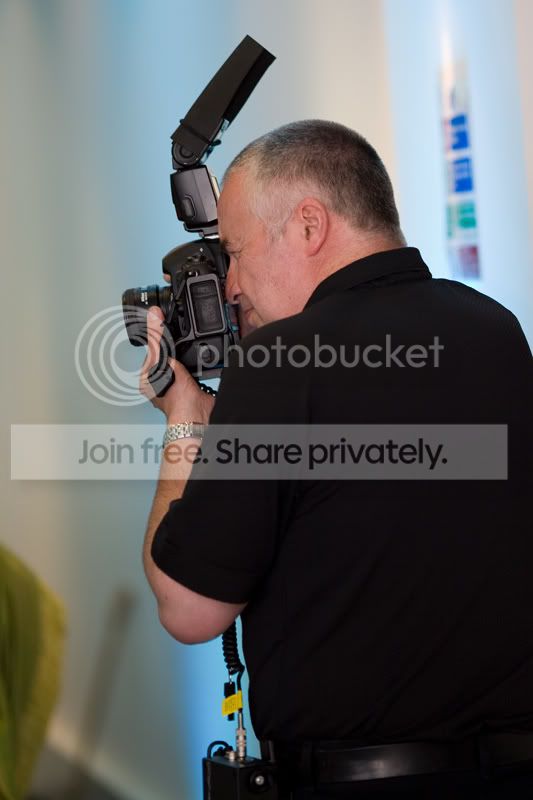
There are many types ranging from a simple Stofen type diffuser up to the Gary Fong Lightsphere and whole host of dedicated and home made units some of which are made from milk cartons! I have tried many different ones and the best I have come across is the Demb Flip-It as it uses a combination of bounce combined with a small amount of fill, it is also adjustable allowing the photographer to control the ratio of light hitting the subject.

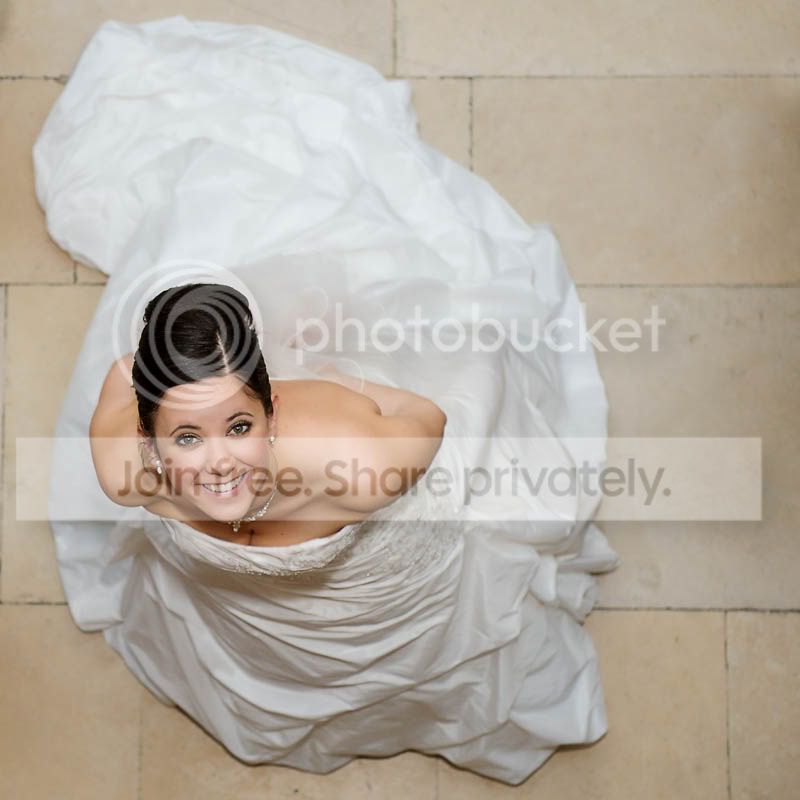
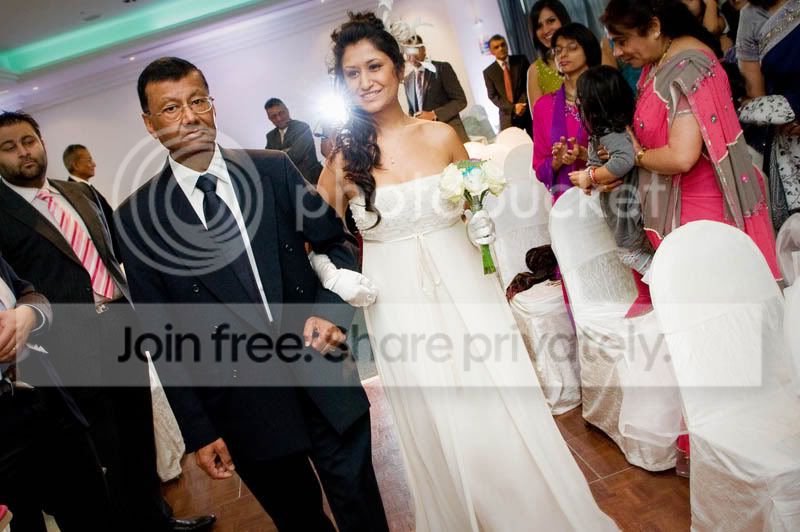
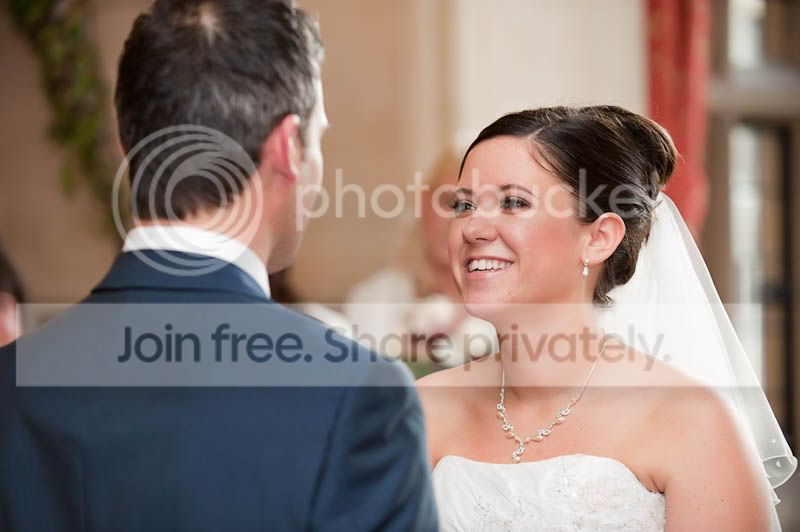
This image from a recent wedding was taken with on camera flash and using the Flip-It:
MRCeremony-38.jpg


The key thing to remember is that whilst some of these work quite well they are still relatively small sources of light and can cause unnatural looking harsh shadows and to effectively combat this you need to convert the light your small hotshot flash gives out to allow it to become a large, diffused and soft source of light. This is achieved by bouncing the flash.

On camera flash (bounced)
By bouncing the flash of a large surface you are effectively creating a very large source of natural looking light. A word of caution though, ignore those who tell you to bounce it off the ceiling almost straight up as you will get panda eyes which is very unflattering for most people. Also be very careful if angling the flash slightly towards the subject as any direct light from the flash will cause shadows.

The easiest way to bounce is over your shoulder aiming the flash at where the ceiling meets the wall (provided you have light coloured walls and ceilings) and remember not to stand too close to the wall as you want to create as large a spread of light as possible as is demonstrated in this next image. The bride was directly below me so I angled the flash directly above me to and bounced it off the ceiling.
MRReception-18.jpg


But what if you do not have light ceilings or walls? This is where a reflector comes in handy but you might need an extra pair of hands and if you do not have an assistant with it's time for the ushers to earn their keep! Keep the camera on flash and aim it towards the reflector, you might find you need to 'flag' the flash which means using something to prevent direct light from the subject, I use pieces of flexible Fab Foam held onto my flash with hair bands which means I can move the foam quickly when needed and is demonstrated here:
058-Edit.jpg


This is an example shot taken about the same time as above:
Service35.jpg


If you do not have a reflector sometimes you have to think on your feet and get creative, I've actually bounced flash of the best man's shirt before as that was the only light surface available, he held his jacket wide open and it did the job!

Obviously this mini-guide to bouncing flash is just the tip of the iceberg and there are many sources out there that will give you more information including the person who is considered one of the masters at teaching this underused technique - Neil van Neikerk.

Off camera flash
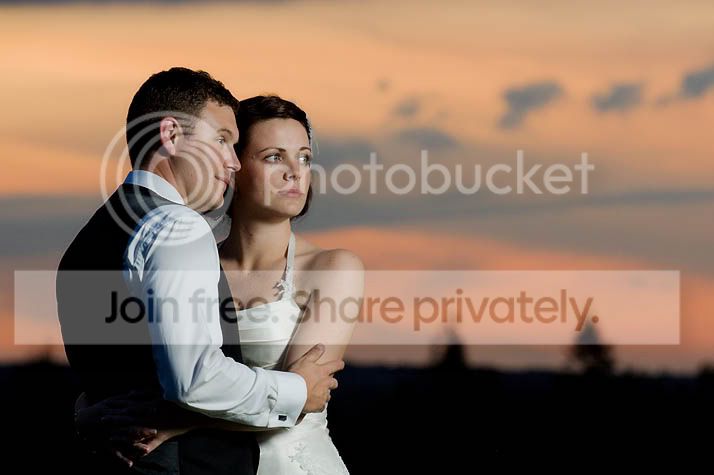
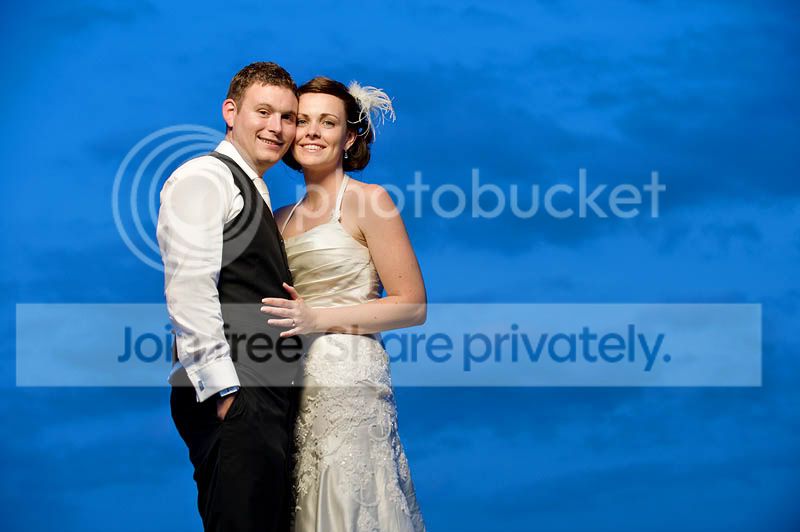
Another favourite technique of mine and many other photographers. I won't go into too much detail as I could be writing for the next year but by using off camera flash techniques you can bring extra depth and drama to your images. The next photograph was taken at a wedding with the flash on a monopod fired through the Lastolite Ezybox Hotshoe, the camera was in matrix metering mode and underexposed to bring out the colour of the twilight sky. The flash was fired using a Pocketwizard and I think you will agree it gave a pretty good result for a single small flash:
MelDanMD-52.jpg


A few moments earlier this shot was taken using the same set up but with the white balance set to Tungsten and a Colour Temperature Orange (CTO) gel fitted to the flash. Changing the white balance gives everything a strong blue cast which can work well for skies but this needs to be balanced with the CTO gel to keep the skin tones looking natural.
MelDan-13copy.jpg
 
4282794460_799894b338_o.jpg


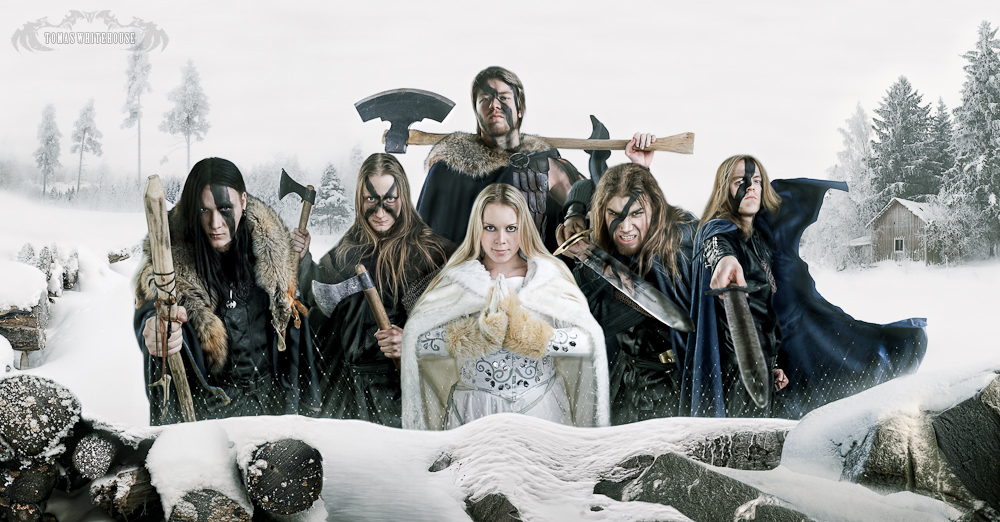
Century Media Records and graphics designer Jan Yrlund approached my buddy Eero and I to shoot the Finnish rock band 'Kivimetsän Druidi'.
The briefing we received was exactly that, brief, but what it did stipulate was that they need head turning, winter promo shots for their CD sleeve artwork.

It's January 9th and -24°C outside, the band made a firm assertion that shooting outdoors was not a favoured preference. I also was a highly concerned with safety issues and for the lighting equipment in such cold temperatures, let alone if it began to snow.
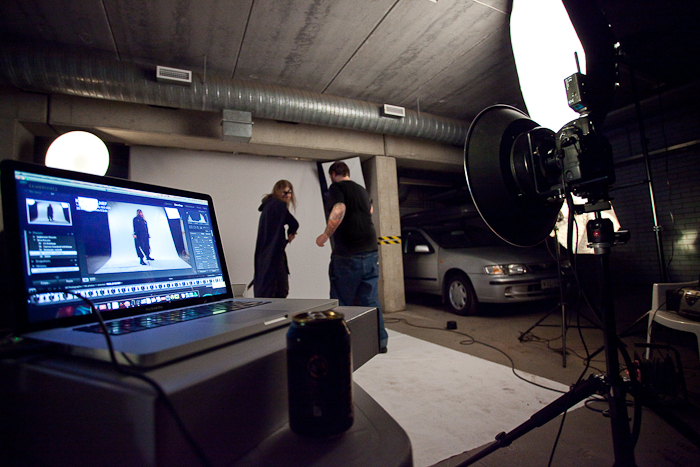
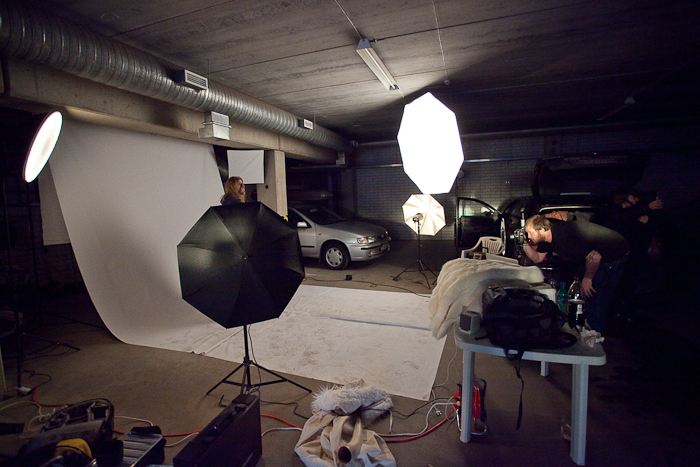
Thus a studio environment was installed in a previously arranged back up location, the unused garage area at Kouvola's newspaper HQ.

It's worth mentioning that as the garage floor was so dusty, safely gaffer taping the cables down was ineffective. We called a short meeting before the band entered the set and notified everyone clearly where the cables were and the where the safe entrance onto the cloth was.
Having someone trip over a cable a strip a light down is not something that anyone wants to experience and despite the messy appearance in the images here, both Eero and I were highly conscious of safety.

4281220940_e0e71f0bfd_o.jpg


4281222398_8ec8477f3d_o.jpg


As the location was now going to be indoors and the icy background was going to be added in post, we would be blessed with the advent of a continuos power source, we were also provided with enough space to install the 3 meter by 6 meter backdrop cloth, which allowed much more effective extractions and layer masking in photoshop. The only issue was that our backdrop cloth was not wide enough to accommodate six members wearing medieval battle gear.

The total shoot time including the installation was around 8 hours. There was myself and Eero rigging up and striking down the lighting.

We knew that this would be a long day as we needed to shoot a variety of poses and at differing focal lengths from each member.
So in this particular instance, low power battery operated flashes are clearly not the best way to go. All lights were monobloc studio heads.

Had the shoot gone ahead outdoors, I would have suggested a sunset shoot, would have readily chosen multiple hotshoe flashes and taken a single group shot rather than a composite.

Full set here:
 
An excellent write-up... Really well done!

I thoroughly enjoyed reading that. :)

Cheers,
Si
 
Just before Christmas I invested in my first head and pack system, I had no real intention of splashing out until I noticed an irresistible offer from Helsinki City's Profoto dealer = 1000€ discount :eek:

I picked up the set up I had been thinking about for some time, an AcuteB 600R pack, Acute D4 600ws Head, Acute D4 Ringflash, Softlight Reflector and a spare battery.
All for 2400€. :D
A mighty blow to the wallet but an absolute bargain never the less.

There are many cheaper alternatives however, the immediate pack that springs to mind and also the pack that I was considering for some time as a compromise, was the Lencarta Safari Ringflash and Safari head. This is the most reasonably priced kit available but the lack of reflectors always held me back on the sale. It would be really great to see more modifiers available for this set up as this is clearly a winning bit of kit.

Having this kind of power in a fairly portable package is a real luxury. I can only power either the ringlflash or the head at a time though as the AcuteB 600R can only power one at a time.
Despite it's portability, I won't automatically select it on a job due to it's weight. I travel around the city quite a bit by good old reliable Finnish public transport and I'll really start feeling the 8kg of weight if having to strap it over my shoulder when travelling by bus, tram or walking.
Combine this with the weight of my regular camera bag and a light stand then this can get quite uncomfortable.
However there must be a compromise, if you want big power in a smaller package then you'll pay the price in weight as well as the price tag itself.

4337346999_cee7aca72e_o.jpg


4537026191_4f39e57342_o.jpg


4346125352_7aa0ea028c_o.jpg


The Profoto AcuteB packs boast some very fast flash durations, 1/6800 at maximum. This comes in handy when you need to freeze action at your top syncing speeds, typically 1/200 and 1/250th.
4365229410_a088b763e5.jpg
 
In the above text, we have briefly considered lighting family photo's.

Each year my family visit us here in Finland, we hire a voyager sized vehicle and take the 4 hour drive to my girlfriends folk's summer cottage.
Traditionally, there is a no electricity rule as the fam wants to keep it as rustic and as faithful to the good old days as possible.
I love this despite having to take trips to the local village, some 30 minutes drive, to charge phones and batteries.

The car is pretty much full to the roof with everyones luggage, there is very little room reserved for photo gear.

This summer, I took a handful of hotshoe flashes, stands, gels and a few diffusers.

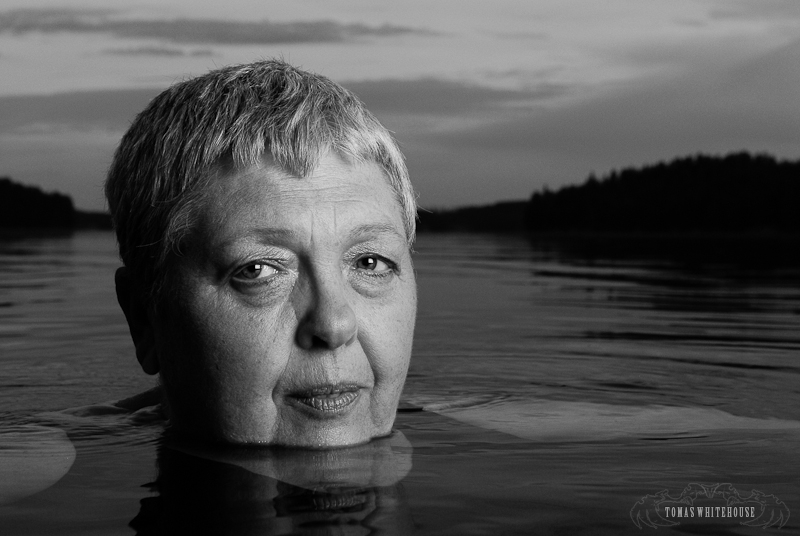
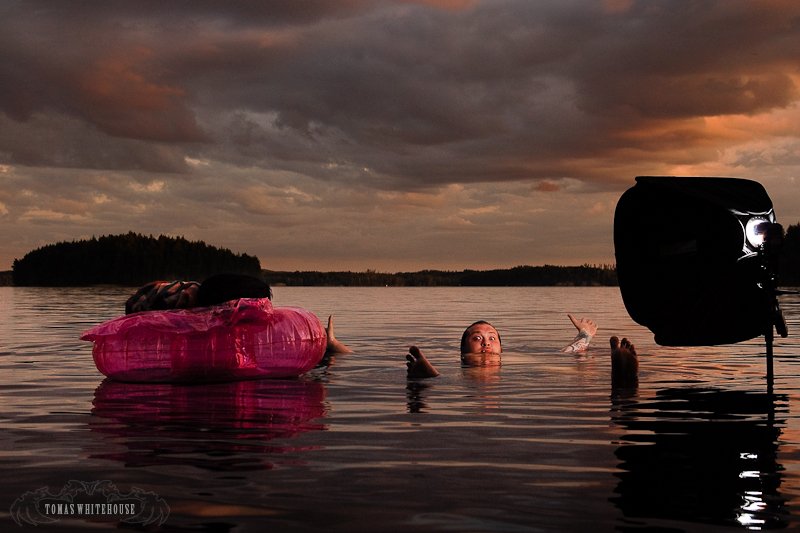
Also, after reading a fair bit of Joe McNally, I was desperate to try some portraits while peeps were enjoying a dip in lake after a hot sauna at sunset.

3792060420_58d5e1c440_o.jpg


3791248275_153a8e007f_o.jpg


A hotshoe flash at half power in a 60cm softbox is more than adequate here.
Since investing in a head and pack system I still wouldn't be wading into water with it.
During the summer lake Saimaa is like a vast expanse of motionless glass, zero current or tide so a hotshoe is not such a bad choice in terms of safety aspects.

The light stand was forced hard down into the silt and wasn't budging anywhere during our little session.

My brother and I also wanted something a little more fun and also daring in terms of hotshoe capabilities.
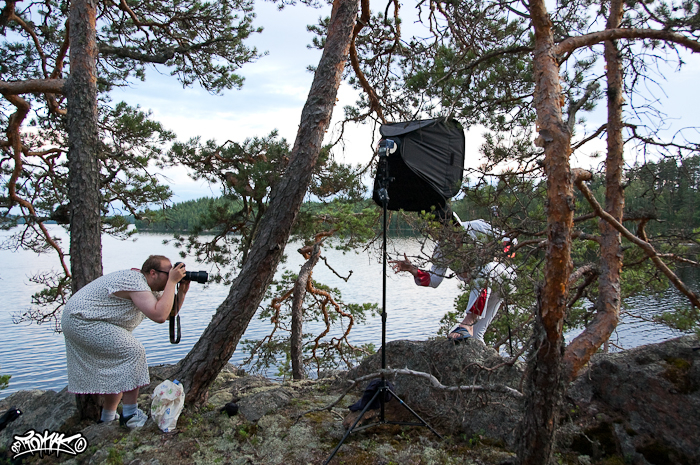
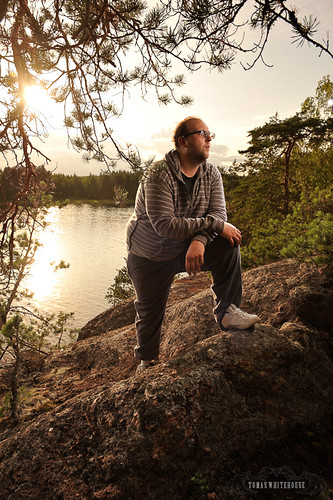
We set up a four hotshoe flash set up on a very picturesque cliff face just a short walk from the cottage, the sun was fairly high so we sought a little shade from a few towering pine trees and for the best chance of effectiveness, got the flashes in as close as possible.

I'm aware we look like a pair of nutters, when your both not exactly the modelling type, ya haffa ebb with a different rhythm :D

3792045760_51aac4ebcf_o.jpg


Great advantage with a hotshoe, our shortage of stands wasn't a problem thanks to a super clamp, in this picture a flash is clamped to a tree branch.
3791233319_d0da8de76b_o.jpg


3791212555_88d49d9749.jpg


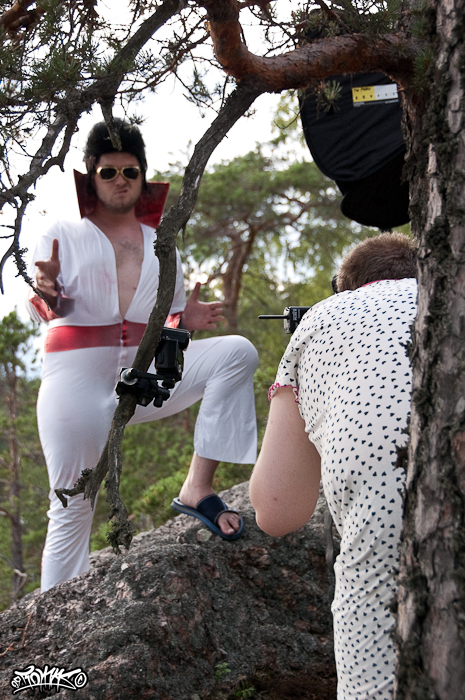
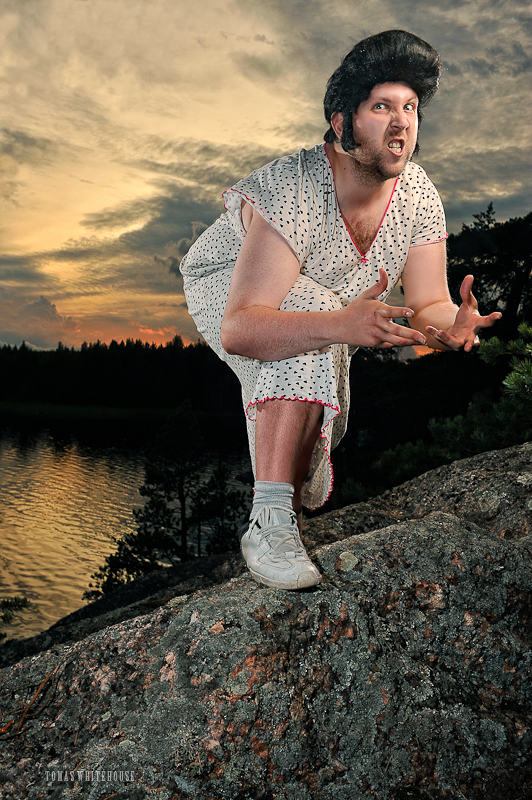
After the sun began to set, our lower power flashes had a little more effect.

'Mrs. Elvis'
3791247783_89ab7f6314_o.jpg


Now this could have been down far more effectively with more power. If our space in the car wasn't so limited and either I had a fair few grands worth or I was granted the use of 4 head and pack systems by someone very generous, many compromises could have been bypassed here.
The point is that our fundamental lighting principles remain the same, no matter the power, we are positioning and shaping light in order to achieve a desired effect.

More antics from this holiday here.
 
I think this is an excellent article - so much so that when I first saw it while away on business I struggled to read every word on my Blackberry:)

This is just the kind of balanced, objective post that people need, so that they can understand what it's all about and make informed decisions.

The reality of course is that no one system or approach can cover every need. People like me have all of them, and choose whichever is best for the particular job, people who are operating on a budget usually have to choose one or another because they can't fund or can't justify the funding for more than one type of system.

In my own posts, I often suggest either mains powered or battery powered studio flash, simply because I'm always trying to get people to use lighting creatively and to not assume that lighting starts and stops with softboxes and umbrellas, and it's much easier to be creative with studio lighting simply because of the wide range of good light shaping tools available for studio flash heads. But this doesn't mean of course that studio flash is the only option. It isn't.

There are a couple of things that might be worth adding. As well as the mains powered monoblock flash heads and the battery powered flash generators (pack & head in the U.S.) there are also mains powered flash generators. Big, heavy, expensive, high powered but used by studio pros because of the ease of adjustment (adjusting manually is much better than fiddling with a remote control and as the generators are on the floor adjustments are very easy) and tiny, lightweight heads, making them more stable and safer when perched high on a stand.

There is also the option of plugging a mains powered monoblock flash head into a car battery fitted with a pure sine wave inverter, or buying a ready made one such as the Tronix. AFAIK ANY mains powered flash can be used in this way, you won't get many flashes from it, recycling may be very slow, it isn't a good idea to use the modelling lamp, but it will work so is an option worth considering.

I think that Tomas was thinking only of the Safari ringflash when he wrote this, not the 'ordinary' Safari head
There are many cheaper alternatives however, the immediate pack that springs to mind and also the pack that I was considering for some time as a compromise, was the Lencarta Safari Ringflash and Safari head. This is the most reasonably priced kit available but the lack of reflectors always held me back on the sale. It would be really great to see more modifiers available for this set up as this is clearly a winning bit of kit.
The ringflash can't currently be fitted with any modifiers except gels, a diffuser and an umbrella, but the Safari ringflash head is standard S-fit so can be fitted with any of the 46 Lencarta light modifiers/shapers (soon to be over 60) and can also be used with all of the other S-fit accessories available from various sources.
 
I think this is an excellent article - so much so that when I first saw it while away on business I struggled to read every word on my Blackberry:)

This is just the kind of balanced, objective post that people need, so that they can understand what it's all about and make informed decisions.

Cheers Garry :thumbs:

There is also the option of plugging a mains powered monoblock flash head into a car battery fitted with a pure sine wave inverter, or buying a ready made one such as the Tronix. AFAIK ANY mains powered flash can be used in this way, you won't get many flashes from it, recycling may be very slow, it isn't a good idea to use the modelling lamp, but it will work so is an option worth considering.

Indeed, good points. I've just purchased an Innovatronix XT Explorer pack, they were on sale over here for 399€ so I thought I'd give them a whirl.
Here it is fresh out of the box...
20100428-xhm3knmhsmnrmcsgc8xasymum2.jpg

I intend to use this with a single 600ws head for larger scale outdoor shots. I'll add a more detailed write up to this thread when I've have the chance to put it out in the field properly. So far initial testing has impressed me very much.

There's also a chap on here who has built his own battery pack from a pure sine wave inverter and a car battery iirc.

If your into all day shoots out in the thick of it, t's also possible to run a bunch of monoblocs from a petrol generator although this heeds caution at the highest degree. There's not too much literature available on the subject, it requires an extensive knowledge of electric engineering to do it safely and successfully.
More on that at another time too.

I think that Tomas was thinking only of the Safari ringflash when he wrote this, not the 'ordinary' Safari head The ringflash can't currently be fitted with any modifiers except gels, a diffuser and an umbrella, but the Safari ringflash head is standard S-fit so can be fitted with any of the 46 Lencarta light modifiers/shapers (soon to be over 60) and can also be used with all of the other S-fit accessories available from various sources.

Correct, it would be great to see the Safari Ringflash have some Profoto and Hensel 'esque reflectors/diffusers in the future. Maybe we should put a word in :thinking:

When you have time Garry (I appreciate your a busy chap), could you include some of your field experiences here? Be good to get a fair few all in the one place :thumbs:
 
Tom.. what a superb article. Thanks for all your time and trouble. :thumbs:
 
Thanks to Thomas and Colin for making this one of the best threads on TP. I hope others have found it as interesting and informative as I have. Personally I couldnlt add much to what Colin has said. The Demb flip-it's are the best in the business for on-camera flash - helping to soften the light and increasing the size of the light source. Off camera, I mostly use the Lastolite Ezybox softboxes and it's worth noting that Lastolite have just released a new 76cm x 76cm model - mine arrived yesterday but I'm yet to use it.

For me, i find the size and portability of hotshoe flashes to be the best solution. I now have two SB-900's and it's got to a point where I'm wondering if it would be a good idea to buy a couple more to help light big groups or if it would be better to go for a head and pack option. There's a separate thread on the best head & pack systems out there. It's here - http://www.talkphotography.co.uk/forums/showthread.php?t=198963 I'd love to add the quadra's or something similar to my arsenal but the initial outlay is very high. Perhaps better to get another SB-900/800 now, and then another in a month or two.....

The guys have already established that there is a huge choice and some are far more appropriate than others. Whatever, controlling the light is the most important (and most fun) thing when shooting weddings and portraits and I'm convinced that you can never have enough "stuff". The boot of my car is testament to that!!

Thanks again TW :)
 
Nice article, but the Lencarta website doesn't list Bowens, Elinchrom, Profoto, Lastolite, Interfit or other studio strobe manufacturers. Perhaps link to those as well so that viewers have easy access to the other "big names"? :)
 
Nice article, but the Lencarta website doesn't list Bowens, Elinchrom, Profoto, Lastolite, Interfit or other studio strobe manufacturers. Perhaps link to those as well so that viewers have easy access to the other "big names"? :)

Cheers John :thumbs:

The links I have included are to free tutorials on lighting or guides on how modifiers and diffusers work. I wanted to avoid actually promoting brands especially as I have no experience with Bowens, Interfit etc so recommendations to these brands are better written by someone who works with that particular brand and explaining why they do.

The varying brands can be supported by member contributions within the thread in the 'Out In The Field' theme were encouraging. ;)

Under your recommendation though, I have now mentioned that there are many brands available ;)
 
Just before Christmas I invested in my first head and pack system, I had no real intention of splashing out until I noticed an irresistible offer from Helsinki City's Profoto dealer = 1000€ discount :eek:

I picked up the set up I had been thinking about for some time, an AcuteB 600R pack, Acute D4 600ws Head, Acute D4 Ringflash, Softlight Reflector and a spare battery.
All for 2400€. :D
A mighty blow to the wallet but an absolute bargain never the less.

There are many cheaper alternatives however, the immediate pack that springs to mind and also the pack that I was considering for some time as a compromise, was the Lencarta Safari Ringflash and Safari head. This is the most reasonably priced kit available but the lack of reflectors always held me back on the sale. It would be really great to see more modifiers available for this set up as this is clearly a winning bit of kit.

Having this kind of power in a fairly portable package is a real luxury. I can only power either the ringlflash or the head at a time though as the AcuteB 600R can only power one at a time.
Despite it's portability, I won't automatically select it on a job due to it's weight. I travel around the city quite a bit by good old reliable Finnish public transport and I'll really start feeling the 8kg of weight if having to strap it over my shoulder when travelling by bus, tram or walking.
Combine this with the weight of my regular camera bag and a light stand then this can get quite uncomfortable.
However there must be a compromise, if you want big power in a smaller package then you'll pay the price in weight as well as the price tag itself.

4337346999_cee7aca72e_o.jpg


4537026191_4f39e57342_o.jpg


4346125352_7aa0ea028c_o.jpg


The Profoto AcuteB packs boast some very fast flash durations, 1/6800 at maximum. This comes in handy when you need to freeze action at your top syncing speeds, typically 1/200 and 1/250th.
4365229410_a088b763e5.jpg

New member here so firstly hi all..

I see you mention the Lencarta Safari system above, but mention the lack of reflectors.. Not sure what type specifically but the lights are all Bowens S Fit compatible...

I had the chance to use this setup recently, having seen it at Focus on Imaging.. I can honestly say I was very impressed. Fits what I want it to do perfectly.. So will be buying one as soon as I can.

The one I used had the 70Cm beauty dish and a grid fitted.. I would buy a two head kit for what I want to do...

One thing I feel I should mention as it doesn't seem to have been in the threads I have looked at ralated to this one..

Batteries..
The Ranger Quadra etc are still fitted with SLA batts. The Lecarta Safari is NIMH, which is much lighter..

Seems a no brainer to me...
 
New member here so firstly hi all..

Hi simon and welcome to TP :thumbs:

I see you mention the Lencarta Safari system above, but mention the lack of reflectors.. Not sure what type specifically but the lights are all Bowens S Fit compatible...

Specifically, I'm referring to the lack of reflectors for Safari Ringflash and not Safari in general. :thumbs:

One thing I feel I should mention as it doesn't seem to have been in the threads I have looked at ralated to this one..

Batteries..
The Ranger Quadra etc are still fitted with SLA batts. The Lecarta Safari is NIMH, which is much lighter..

Seems a no brainer to me...

I wouldn't say it's a no brainer Simon. Each of our requirements and needs differ greatly from person to person.

The Elinchrom Quadra is the smallest and lightest head and pack system available, it compromises a lower power output but offers a more compact solution.

Personally, this kind of portability is not a priority for me. A 400ws mobile pack falls short in power for my needs and at £1500 my money is more effectively spent elsewhere, but, some will justify the Quadra price tag in comparison to say a Safari head and pack alternative at £740 based on the size/weight alone and not the output. ;)

Also, I'd be willing to bet that the type of battery, whether Lithium or SLA based, won't tend to influence which system folk will invest in too heavily.

IMO decisions will be based on requirements, price, features and output. ;)
 
Hi Tomas, thanks for the welcome.

I agree that everyone has different needs and of course there is brand snobbery...

I also now agree with you on the Ringflash reflectors. (Sorry didn't realise that is what you meant)

If going portable I personally think lightweight is better, I have yet to try the Quadra, though I have had the chance to try the Lecarta, if only thy also did more powerful systems too.....

One thing does surprise me slighty is that more companies have yet to use more modern battery types in their portable kits, ease of charging and how long they can be used for etc..

For me the Lencarta is at the better price for my first rig.... My first lights were going to be mains powered, but as I don't have a studio etc, location shooting is more likely...

One thing I forgot to say, is that you have some fabulous photos posted in your comment. I especially like the guy out in the snow...
 
Hi Tomas, thanks for the welcome.

No problem mate, glad to have you aboard the crazy train that is TP ;)

If going portable I personally think lightweight is better, I have yet to try the Quadra, though I have had the chance to try the Lecarta, if only thy also did more powerful systems too.....

Indeed, lightweight is better when mobility is a priority, after all whether your carrying the rig from a boot of a car, to the spot you need the light, or if your carrying the pack on your shoulder for the duration, lightweight is certainly more comfortable.

For me personally though, weight is first element that is compromised if price is significantly higher as a result, my needs largely involve setting up and leaving the packs stationary, unless the light is repositioned or the location is moved, it'll simply remain in place.
Sometimes, if there is no harsh breezes or heavy winds, then I'll use the pack as a weight ;)

The Profoto unit is reasonable for a keen assistant who maybe slinging the pack over a shoulder and then holding a pole with head and diffuser however.

This is where a Quadra unit shines. Truth be told though, I'm not too much of a fan of Elinchrom as I really dislike the mounting system.


One thing does surprise me slighty is that more companies have yet to use more modern battery types in their portable kits, ease of charging and how long they can be used for etc..

I'm not too up to date with the particulars with the most effective battery options. What would you consider as pro's and con's with SLA and Lithium based?

One thing I forgot to say, is that you have some fabulous photos posted in your comment. I especially like the guy out in the snow...

Cheers very much mate :thumbs:
 
SLA batts are similar inside to a car battery, split one and..........

Other pros for the Lithium other than weight is a the resistance to battery memory issues and will give more shots per charge..
I am sure there are other more technical reasons, that I am not aware of at this time..

I like the idea of overhead usage, some great pics on Zack Arias' blog doing just that...

Any battery system should do what we want it to, just each has a different Pro and Con..

I know I could not afford the Quadra...
 
lithium batteries are hardcore, but its what the unit does and what you need that are more important imho
 
Fab article Tomas and Colin, well written from an end user perspecitive.

You are very right when you say that there are a lot of considerations when buying a portable solution. Personally it's something I will be looked at adding perhaps next winter :)

I absolutely adore Phofoto but at their prices would be limited to one pack/head and then I'd have to buy modifiers and they aint cheap!

I have had a play with Quadras and the sheer portability is a major plus. Packed into that little case they are outstanding but again, modifiers would add greatly to the bill.

Another one that I love the look of is the Broncolor Mobil kit, good power, excellent portability and some really neat features like being able to adjust power remotely. Again, not cheap and again would have to factor in modifiers.

Lencarta, for the price is looking very much like a good buy to me. Since I already have three Interfit 300W heads with a range of Bowens goodies including a £300 odd beauty dish then the S fitting of the Lencarta really appeals. I'd like to see what Tomas could do with one ;)

Last but not least on my pack options would be the Interfit one. Can only run one head from a pack and really basic but at £350 ish would not be a bad solution for shooting some of the stuff I do like boudoir where space is already limited and I don't need huge amounts of power.

The SB900 and EX580 can produce good results, you only need to see Joe McNally to appreciate what you can do with them but are always going to be limited in power compared to the pack solution.

Thanks for the great write up guys, still lots more to consider before the budget will allow any more toys!
 
Indeed Ali, some great words above.. I am going to have a look at the Broncolor kit you mention, now...

It is indeed impressive what Joe McNally can do with small lights, but the cost of two SB-900s will equal the cost of the Lencarta...

I too would like to see what Tomas could do with one.. going by those images...

I only spent a short period with the Lencarta, but I think a system like this is the way forward for me..

Here are a couple of shots on Fickr using it with the 70cm Beauty dish and Grid.

http://www.flickr.com/photos/sounds-and-images/4510029691/

http://www.flickr.com/photos/sounds-and-images/4510029455

With huge thanks to Jonathan Ryan for tips and lighting. Was a learning curve for me and now I am hooked...
 
lol, like the second one Simon :)

I actually have 2 SB900's but as Garry points out, they are limited when it comes to what you can do with modifiers. Yes there are now suitable beauty dishes coming out for them and Damien McGillicuddy does some brilliant lighting kit for strobes but you really can't beat studio heads for some applications.
 
Lencarta, for the price is looking very much like a good buy to me. Since I already have three Interfit 300W heads with a range of Bowens goodies including a £300 odd beauty dish then the S fitting of the Lencarta really appeals. I'd like to see what Tomas could do with one ;)

I too would like to see what Tomas could do with one.. going by those images...

:nuts:

I'd love to have a go with few to be fair. Not wanting to shamelessly plug Lencarta but I do only ever hear good things about them.

If Garry ever needs any testing doing then I'd be more than eager but I think there are far better 'tographers than me testing Lencarta gear already ;)

BTW, Nice images Simon :thumbs:
 
Thanks Ali! Indeed though I think I might grab a Yongnuo or two of Ebay with RF602 triggers...

Tomas, I have been trying to land some clients to pay for a system, I want to specialise in prestige cars, bikes, mountain biking and small planes etc.. Having something portable would be spot on.. I certainly feel the system to be comparable to others out there...

What I really like the idea of is a softbox the is put up like an umbrella for me that is a killer idea, especially on night shoots.. no lost rods on packing up....

I would be more than happy to plug lencarta Tomas, as no retailers means it is harder to make waves in this name is everything business. Garry is also a top bloke to talk too. When I was going to Focus on Imaging this year I was looking at budget starter mains lighting, now I am more focused, and Thanks to Jonathan Rya recommending Lencarta on the phone (had not heard of them before that) I made sure I had a look... I am glad I held off the cash..... As portability is what suits me.....

As I no longer want to do educational music workshops need to find new ideas...

Now if only I could shift a few CDs LOL...

Thanks Tomas glad you like them..
 
Bloody excellent Tom.. I will re-read when I'm sober...
 
Just thought I would bump the excellent article to make it easier for new members to find. Although it is in Tutorials...

So many good tips, almost certainly the most interesting article I have ever read that is superbly illustrated too.
 
This is brilliant!, giving it a bump so I can find it again later
 
Tomas,

How have I missed this thread :shrug:

Some brilliant stuff there. I am very well impressed. I'm just having a play with the Safari stuff myself at the moment with 2 heads and a ring flash. I will get another power pack eventually but loving the ring flash and even managed to use it for some macro today!

http://www.talkphotography.co.uk/forums/showthread.php?t=266649

I love the shots in the water, that is very brave! I'm not sure that I would be risking my kit that way but I suppose that is how you get the pictures.
 
I promised to add to this excellent post some time ago.
I’m not really sure that I have much to say that hasn’t already been said, in terms of facts, but I do have opinions that I’d like to share.

Firstly, it’s already been said that all approaches – hotshoe flashes, mains powered monlolights, mains powered generator lights and battery powered generator lights – are equally valid and that all can do a first class lighting job. And I agree with that, the only reason that I only really answer posts on studio lighting and that I usually end up suggesting that people use studio lighting is that that’s the type of work I do.
Years ago, when I was building up my business and had to take on pretty much any kind of work I could get, things were different and I needed location lighting that wasn’t available at the time, so I had to use just about any kind of light I could get hold of. I knew all about hotshoe flashes fitted with home made honeycombs long before the word ‘Strobist’ had been coined, and I even used home made stuff in the studio, when I couldn’t afford as many studio flash heads as I needed. In fact, back then, I also mixed studio flash with hotlights, which I now tell people never to use. I used to use hotlights as hairlights and yes, the colour temperature was way off and of course I had to use longish shutter speeds because of the low power of the hotlight, but it worked, because it had to. In fact the warm light from a tungsten light gives quite a nice effect on most hair…

Leaving aside money, I think it’s true to say that most skilled photographers will still happily mix and match flash systems. They use whatever they have available, and whatever suits the purpose.. Whilst it’s true that different makes of lights do produce slightly different colour temperatures, if you steer clear of the crap makes you’ll find that the differences are fairly slight, and nowhere near as significant as the colour differences produced by the light shaping tools that we stick on the end of the lights. In fact, the only real problem with mixing lights of different makes is that most of them have unique accessory fittings, so although you can mix say Bron, Profoto, Elinchrom, Bowens, Lencarta etc, only the Bowens & Lencarta lights will share the accessories (that’s beginning to change now, but most of the third part accessories made to fit Bron, Profoto & Elinchrom have a way to go in terms of both design and quality).

I think that most people reading this will know that I teach studio lighting and that as part of this I host 1 day lighting workshops for Lencarta. Now, anyone who has been on one of these days will tell you that I mix and match lighting all the time. Mainly I use Lencarta but I also use pro Elinchrom gear too. I’ve also use hotshoe flashes sometimes, and even candles, as in this shot.
beam.jpg

in fact, that shot involved candles on the floor, a star filter, and a flash head to create the beam of light from above. The flash head was fitted with a very tight honeycomb and the controlled flare created by the star filter, rotated to the correct position, created the beam of light.

Come to that, I’ve used a torch too, as in this shot.
shoes_red.jpg

This painting with light effect can't be produced with any conventional form of lighting, as it involves moving the torch around, putting exactly the amount of light required on various parts of the subject.

The source of the light doesn’t matter to me, and it shouldn’t matter to you either. What does matter is the effect that different types of light, and different types of lighting tools, can create, and it’s the need to control the light that should really inform the choice of lighting (convenience, cost, portability etc all comes into it too of course, but when these things aren’t important then the decisions should always be based on what does the job best).

And that brings me to the one thing that really matters – understanding light.

Sometimes, I feel a bit like John the Baptist, preaching in the wilderness with nobody listening and nobody understanding what he’s actually saying

The thing that really matters in lighting is controlling the light to create the lighting effect we want. That means placing the light where it needs to be to produce the required effect, and it means using the type of light shaping tool(s) that work best, for that subject in that situation. Anyone reading this who thinks that lighting is just about having enough of it, or that softboxes and umbrellas are all that’s needed, just doesn’t have a clue about lighting and needs to learn more about it. And that goes for anyone who thinks that there’s such a thing as a ‘standard’ lighting setup that can be used all or most of the time.
Harsh? Maybe, but still true.

Let’s get down to basics. Suppose that I’m asked to create a portrait of an attractive young woman. My first question is always, “What is the photo actually for?” And the reason for that is always because every one of us has several different roles in life, and we slot in and out of those different roles in a flash – so which role are we going to photograph?
1. For example, the photo may be for her partner, who thinks that she’s sexy
2. Or it may be for her father, who thinks of her as his innocent little girl
3. Or it may be for the Company website, they want a photo that shows her as helpful, friendly and efficient at her job
4. Or it may be for her children, who think of her as their loving, kind mother.

Any kind of ‘standard light setup’ can produce a good likeness, but will not and cannot produce anything other than a bland effect. And that’s why, whenever I can, I use studio lighting. Studio lighting allows me to create any of the example effects above very quickly, very easily and very well. Hotshoe flashes either can’t produce those effects at all, or not as well or easily.

With studio lights I can use lighting stands that will get the light as high or low as I want it to be. The very portable lighting stands used with hotshoe flashes are very limited and often flimsy too.

With studio lights I can use any type of light shaping tool I want. The flash head will have enough power for the tool, and the powerful modelling lamp will give me a very good indication of the effect it will have. And I know, with portrait or fashion shots, that the best expression is always the one that appears immediately the flash has gone off, so I want studio flash that recycles in 1 second maximum – hotshoe flashes never seem to be ready for the next shot in time.

Studio lighting can produce literally any lighting effect you want, if you know how to do it and have the tools to do it with. Hotshoe flashes can produce some of those effects but not all, and the process is far more hit and miss.

Right now I’m like a kid on Christmas morning. I’ve just had a range of new studio lighting accessories delivered to my studio, and when I’ve got the hang of them they will help me to improve both my creativity and the ease with which I can produce the results I want.

Which make of lights?
This question comes up all the time, and people adopt very partisan and sometimes extremely stupid views about it.

As I work with Lencarta I could be expected to have strong views myself, but I don’t because it frankly doesn’t matter, or at least it doesn’t matter to most people, most of the time. It does matter to people like advertising and commercial photographers, because very high power, very consistent colour temperature and the very best light shaping tools are essential to them. If they weren’t, Bron and Profoto wouldn’t be able to sell their lights.

But, to most people, all that really matters is fairly consistent colour temperature, fan cooling, fairly fast recycling, a decent range of light shaping tools at affordable prices and decent build quality – and most flash heads meet those needs, regardless of the name on them. Not all sellers are honest about what’s inside their flash heads, and it’s very clear to me that sometimes, statements about the flash duration, colour temperature consistency etc are just not true. But although it might be a good idea to avoid sellers who try to deceive their customers, the lights will still work.
The fact that nearly all studio lights, junk excepted, do what they need to do is one of the reasons that I personally never attack any other seller of studio lights. Some of them can and do say what they like about me but I just let them get on with it. I think that people see through lies and make their buying decisions on truth, honesty and facts.

I feel that the reason that so many of the people who post on forums about studio lighting adopt such extreme, partisan attitudes about which make of lights are best is simply that they don’t know any better. Very often, people who praise the make of lights that they happened to buy themselves do so because they have never used any other lights, so they have nothing to compare them to. That simply doesn’t happen with other types of products, for example cars. Most of us have driven dozens or even hundreds of cars, so we can make informed choices about whether or not a car is ‘good’ (or right for us at any rate) but there are probably very few people who have used every single make of flash head available, so it follows that there are very few people who can produce an impartial review of studio lights. And, sometimes, people will rave about the lights they’ve just bought and recommend the seller, even though that seller sells various different lights, bought from various small, no-name factories. Some of the lights sold by them may be excellent, some may be OK and some may be no better than the junk sold on Ebay…

So, which is best, studio lights or hotshoe flashes?
That's easy, use mains powered studio lights in the studio, use either battery powered or hotshoe flashes when you can't use mains powered studio lights. And don't be afraid of using hotshoe flashes, hotlights, candles or anything else, depending on the effects you want to create.
 
I was really enjoying reading your post until the "Which make of lights?" section, in particular the second last paragraph. Bad form and no need. :shake:

Dress it up how you like but I know I am one of the people "who don't know any better" you are referring to. Your timing for that whole section is very transparent to other recent posts (in particular some of mine) and events. :(

I may not know if one particular light is better than another, I've never claimed otherwise, but I've got enough common sense and intelligence to know if a light, or anything else, is a load of junk or can do the job it's intended for. I don't think it should be a problem that I express my opinion about something - people know I'm not an expert so that attaches itself to my opinion.

Quite disappointed now to be honest, was unexpected from someone like you but I don't dwell on things and I've said enough. I've got some practising to get on with ;)
 
I was really enjoying reading your post until the "Which make of lights?" section, in particular the second last paragraph. Bad form and no need. :shake:

Dress it up how you like but I know I am one of the people "who don't know any better" you are referring to. Your timing for that whole section is very transparent to other recent posts (in particular some of mine) and events. :(

I may not know if one particular light is better than another, I've never claimed otherwise, but I've got enough common sense and intelligence to know if a light, or anything else, is a load of junk or can do the job it's intended for. I don't think it should be a problem that I express my opinion about something - people know I'm not an expert so that attaches itself to my opinion.

Quite disappointed now to be honest, was unexpected from someone like you but I don't dwell on things and I've said enough. I've got some practising to get on with ;)
No, that wasn't aimed either at you or at anyone else in particular. Please don't lower the tone of this thread by trying to interpret the motives of other people - you can't do it, anymore than I or anyone else can interpret your motives.

And I seem to remember reading a thread of yours, in which you made it clear that you have no experience of lights other than the ones you bought. Because of this honesty on your part, it should be obvious to you that my comments weren't directed at you.

Just make the best of the lights you've bought and learn about light. use your imagination to create stunning images, not to misinterpret posts made by other people.
 
Just seemed a little unnerving considering I'm the only person to have reviewed a lighting kit recently (that isn't Lencarta) and have also been spending more time in the lighting forum.

No big deal though and if you say it isn't aimed at me then I'll take your word for it. No harm no foul :)
 
Guys,

What a great thread, I will post a few snaps if I get a chance to use my new apollo softbox. Now just mind you they will probably not be as good as ones already placed above.;)
 
Excellent articles, a big thank you for taking the time to share, i will keep re-reading.
 
Thanks so much for this thread. I've only shot with studio flash twice but have caught the bug. Been looking at strobist stuff but keeping an eye on flash units on eBay and gumtree. Still can't decide but am now much better informed to make the decision.
 
wow...great stuff tomas and colin :clap:.i'm just starting to venture into lighting/strobes a little,and this article has opened my eyes/mind up greatly,and will be a great source of help/inspiration in the coming months..thanks very much :thumbs:
 
Status
Not open for further replies.
Back
Top