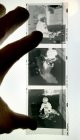
What is this streak on my negatives?

skysh4rk

Suspended / Banned
Messages
3,134
Name
RJ
Edit My Images
No
Hi all,

I was hoping to get some help regarding an issue on a roll of black and white I developed today. Through the entire roll, including between frames, there is a dark streak on the negatives, shown as a light streak on the right side of all images below. Yesterday I developed a roll from the same camera and chemistry (developer was mixed for each respective roll, but stop and fixer re-used) and everything was fine. The only difference I can think of between those two rolls is that the temperature of the chemicals was lower for the batch today, as room temperature was lower, but I adjusted development time accordingly.

I used fresh HP5, pushed three stops in Ilford DD-X. The stop and fixer had been used to develop two previous rolls that came out fine. It looks rather like a light leak to me, although I can't think how that would have happened and I've never had a light leak issue before. My other thought was that I might not have enough chemical in the tank, but I used the same amounts I usually do and the right edge of the images below seem to look fine...

Any thoughts? I thought I'd try to get to the bottom of this before I develop the next roll.

Thanks!


Roll 430 (4 of 12)-2.jpg
Roll 430 (12 of 12)-3.jpg
 

Attachments

  • Roll 430 (4 of 12).jpg
    Roll 430 (4 of 12).jpg
    131.5 KB · Views: 14
  • Roll 430 (12 of 12)-2.jpg
    Roll 430 (12 of 12)-2.jpg
    158.1 KB · Views: 13
Last edited:
Looks like a light leak to me.....camera related
 
Looks like a light leak to me.....camera related

Yeah, I had been thinking light leak, but the streak is so uniform and also appears between frames, before the first frame, and even after the last frame, so I'm struggling to see how an in-camera leak could produce such an effect. If the leak were in camera, shouldn't I expect to see changes in intensity where there was more exposure?

As you can see, this is an unchanging straight line through the negative:

IMG_0152.JPG
 
It might not be related to shutter actuation.

I'm struggling to see how it could be made during processing
Assuming the film wasn't bad before it was loaded, that leaves a loading anomaly or a light leak in the back, assuming again you're using veronica.
I'd be checking the back seals and the performance of the darkslide during use
 
It might not be related to shutter actuation.

I'm struggling to see how it could be made during processing
Assuming the film wasn't bad before it was loaded, that leaves a loading anomaly or a light leak in the back, assuming again you're using veronica.
I'd be checking the back seals and the performance of the darkslide during use

yeah...what camera are you using

This is a roll from my Hasselblad 2000FC.

I'm really struggling to see how this could be either a camera or development issue. The loading went really smoothly and the room was as dark as it ever is. I just re-examined the backing paper from that roll to see if there were any tears/rips or anything else unusual and it looks perfectly normal. I know that I had enough of the chemicals, as the bottles I poured in were full.

The camera has been working beautifully and no other rolls have shown anything remotely similar.

I'm wondering if that roll had been with me on a few holidays and this is some form of x-ray damage?
 
Last edited:
X-rays....nah
Its not chemicals, it wouldn't be a stripe in the frame.
prove it isn't the camera by shooting another roll..:D

if it isn't the camera......and your processing gear and method is sound......duff film
 
Definately a light leak as it is equally between the frames.
what is very unusual is that the intensity is so even down the length of the film. That usually only happens when it is a film fault, rather than in the camera or during processing.
Perhaps it will not happen again. Check the film batch number. It is very unlikely to happen on different batches.
 
It's so straight, it's hard to see it as anything other than a leak in the back.
 
Maybe a complaint to Iford about duff film? They must have seen this phenomenon before...well if they refute a duff film claim, would have thought they would give an explanation of what it could be.
 
Clutching at straws here - a pressure mark caused by a very tight rubber band used to hold the film after exposure?
 
X-rays....nah
Its not chemicals, it wouldn't be a stripe in the frame.
prove it isn't the camera by shooting another roll..:D

if it isn't the camera......and your processing gear and method is sound......duff film

It's so straight, it's hard to see it as anything other than a leak in the back.

Well, the back is relatively new (early 2000s) and both the camera and back were serviced six months ago, during which time the seals in the back were replaced. I've shot 60 rolls since then and not a problem, including a roll with the same camera just moments before the roll in question. I'm not saying it's definitely not the camera, but I'd think it'd be more likely to be something that I've done wrong, although I can't think of what that could be.

I have plenty of more rolls from this camera to develop, so we'll know more in this regard shortly.

Definately a light leak as it is equally between the frames.
what is very unusual is that the intensity is so even down the length of the film. That usually only happens when it is a film fault, rather than in the camera or during processing.
Perhaps it will not happen again. Check the film batch number. It is very unlikely to happen on different batches.

Yeah, it's the uniformity of the streak that really sticks out for me. I'm about to develop the next roll of HP5, although I'm not sure if it's from the same batch or not, as I don't have the box from the previous roll, unfortunately. Hopefully I can begin to narrow down the possible causes though.

Maybe a complaint to Iford about duff film? They must have seen this phenomenon before...well if they refute a duff film claim, would have thought they would give an explanation of what it could be.

I'll see how this next roll turns out and take it from there. In my experience though, most problems that I've thought were caused by duff equipment or other external factors seem to end up being something that I did...

Clutching at straws here - a pressure mark caused by a very tight rubber band used to hold the film after exposure?

I saw that suggested elsewhere on the internet, but all rolls that I've developed from Christmas were all secured by licking the standard paper bit included at the end of the roll.
 
Just for completeness of information, what was the developer used and the processing temperature; and how was the film developed (tank spiral/hanging, dish etc.)? Any squeegee used? What sort of clip used to suspend the film while drying and where placed? Were the marks visible when the film was hung up to dry?

I cannot immediately think of anything that would be suggested by knowing the answers to those questions, but you never know.
 
Just for completeness of information, what was the developer used and the processing temperature; and how was the film developed (tank spiral/hanging, dish etc.)? Any squeegee used? What sort of clip used to suspend the film while drying and where placed? Were the marks visible when the film was hung up to dry?

I cannot immediately think of anything that would be suggested by knowing the answers to those questions, but you never know.

The developer was Ilford DD-X at 16 degrees (I always do room temperature, but this was colder than usual) using a spiral reel in a Jessops developing tank. I did use a squeegee and bulldog clips to hang the film, but the marks were visible as soon as I took the film out of the tank, so those factors shouldn't have played any part.
 
Just thinking out loud....

The only causes I can think of are
1. Light leak (most likely cause in isolation)
2. Pressure mark
3. Defective film

If the streak wasn't uniform, various chemical causes could come into play, but usually as the film is hung up.

The presence of a very localised warmer band of developer seems a ridiculous hypothesis (N.B. if the developer contains hydroquinone (I don't know offhand if it does) this does have a variable response to temperature, and needs to be within 60 - 75 F (18-24 C) to be predictable) although it would explain it. Very difficult to achieve even if you tried, I'd guess.
 
The presence of a very localised warmer band of developer seems a ridiculous hypothesis (N.B. if the developer contains hydroquinone (I don't know offhand if it does) this does have a variable response to temperature, and needs to be within 60 - 75 F (18-24 C) to be predictable) although it would explain it. Very difficult to achieve even if you tried, I'd guess.

Hmmm... I think DD-X does contain hydroquinone. I'm not sure if that, combined with the low temperature, would lead to the perfectly straight line through the right side of the film though?
 
Well, I just developed my last roll of HP5 from the December holiday season and, as I expected, it came out perfectly fine. So, I shot and developed four rolls of HP5 in DD-X (three with the Hasselblad and one with my Holga 120N) and only the second roll in the Hasselblad exhibited the issue.

When anything goes wrong, I'm always inclined to blame myself, as I'm probably the weakest link in my photography, but I can't see what I could have done that would have resulted in that line across the entire film. Again, the only thing that was really any different about that roll was that the temperature was 16 degrees, but I did adjust the development to compensate according to Ilford's recommendations on the DD-X data sheet.
 
Hi, silly question I know but you are sure that this film did not go through Holga, I ask because I seen similar with old roll film cameras.
 
Hi, silly question I know but you are sure that this film did not go through Holga?

I'm 100% sure that roll was with the Hasselblad. I keep detailed records for nearly every frame of every roll, so I know that roll was with my Hasselblad. Even without that information, however, the results from my f/2 Hasselblad lens and my plastic-lens Holga are pretty easy to distinguish between.
 
OK on that, it was just a thought as you get something similar when the little red window on the back of roll film cameras lets light in but it us not as regular as your example.
 
OK on that, it was just a thought as you get something similar when the little red window on the back of roll film cameras lets light in but it us not as regular as your example.

Yeah, I've had light leaks like that through the little red window on my Lubitel 166, but they're not as straight and uniform as the streak found on this particular roll. Good question to ask though.
 
Well, I've just looked at the Ilford data sheet, and it certainly implies that you can use DDX between 56 and 76.

The Film Developing Cookbook states that hydroquinone shouldn't be used under 60 F (15.5 C); other sources state that the activity varies less predictably with temperture outside the 60-75 range.

Even so, it seems unlikely in the extreme that you had a narrow band of warmer developer that remained in situ during the development. It seems far more likely that there is some sort of light leak (intermittent due to some variation in seating of the back?) in the Hasselblad magazine. As the streak affects the entire film, it seems not be a shutter issue. I assume that the mark runs the complete length of the film?

Edit for typo.
 
Well, I've just looked at the Ilford data sheet, and it certainly implies that you can use DDX between 56 and 76.

The Film Developing Cookbook states that hydroquinone shouldn't be used under 60 F (15.5 C); other sources state that the activity varies less predictably with temperture outside the 60-75 range.

Even so, it seems unlikely in the extreme that you had a narrow band of warmer developer that remained in situ during the development. It seems far more likely that there is some sort of light leak (intermittent due to some variation in seating of the back?) in the Hasselblad magazine. As the streak affects the entire film, it seems not be a shutter issue. I assume that the mark runs the complete length of the film?

Edit for typo.

Yeah, the mark runs the entire length of the film.

Isn't the line just too perfectly uniform and straight to suggest a problem with the back though? I would expect differences in intensity at various points.

The back and body were serviced recently too and have never shown any similar problem in the dozens of rolls I've put through them.
 
Yeah, the mark runs the entire length of the film.

Isn't the line just too perfectly uniform and straight to suggest a problem with the back though? I would expect differences in intensity at various points.

The back and body were serviced recently too and have never shown any similar problem in the dozens of rolls I've put through them.


I've never developed a roll of film in my life, so maybe I'm missing something, but I totally agree that with this sort if uniformity the only explanation that makes sense (to me) is defective film.

If it was a leak, you'd expect that at some point in all the captures, it would have had more/less light on it.
 
If it was a leak, you'd expect that at some point in all the captures, it would have had more/less light on it.

Yes, those are my thoughts exactly regarding the possibility of an in-camera light leak.

That said, I suppose it could still be a leak from another time, such as the time of manufacture, loading, or development. If development though, I'm just struggling to think of a scenario where I could have exposed the film so uniformly over the entire roll. I would probably struggle to intentionally reproduce this effect, but it could probably be done.
 
Last edited:
Possibly worth a friendly e-mail to Ilford asking if there have been any issues with that batch of HP5. At worst you'll get nothing, at best they might lob some replacement film(s) your way.
 
If it was a leak, you'd expect that at some point in all the captures, it would have had more/less light on it.

The hardness of the edge of a shadow depends on how diffused the light is and also the distance of the object casting the shadow from the surface receiving it. If the light leak were very close to the film (almost in contact with it) I think you could get such an effect.

It's the same principle that lies behind the efficiency of focal plane shutters.
 
The hardness of the edge of a shadow depends on how diffused the light is and also the distance of the object casting the shadow from the surface receiving it. If the light leak were very close to the film (almost in contact with it) I think you could get such an effect.

It's the same principle that lies behind the efficiency of focal plane shutters.

...but surely that would mean a thin strip of nearly opaque plastic covering the film to cast a faint shadow....h'mm where would that be on a camera.......................................
So scraping the barrel:- if the film was outside the camera and box, what could cause that phenomenon..erm well in the film was behind something with a slit then someone using an arc welder nearby IMO the light would get throught the backing paper, but then it would get less towards the middle...erm someone parked the film in an Xray lab behind a lead sheet with a slot :eek: erm...stuck
 
Last edited:
...but surely that would mean a thin strip of nearly opaque plastic covering the film to cast a faint shadow....h'mm where would that be on a camera.......................................

No, the reverse; the "shadow" is the whole of the film apart from the thin strip which has developed to show a dark line, cause by (on this VERY BIG assumption) a light leak in the magazine (which could be a small (very small) hole. As long as the "hole" is small enough, or close enough to the film, the width would not be very great.

I'm not offering this as a solution, just as one possible cause to be eliminated.
 
No, the reverse; the "shadow" is the whole of the film apart from the thin strip which has developed to show a dark line, cause by (on this VERY BIG assumption) a light leak in the magazine (which could be a small (very small) hole. As long as the "hole" is small enough, or close enough to the film, the width would not be very great.

I'm not offering this as a solution, just as one possible cause to be eliminated.

Well I did say "nearly opaque" but think I see your point i.e. a small hole projecting light as the film winds but what happens when the film is not wound (or wound fast\slow) as the light intensity would vary and there would be a black spot at the stop position.
 
I'm guessing it's a problem at the point of manufacturing. We've all seen what a light leak looks like, and it's nowhere near as uniform, or quite as well defined and straight edged as that. I had a light leak from an Hasselblad A12 back, and it was far more diffuse, and even small light leaks are never quite that cleanly cut. With the additional information that there were rolls run before and after without the problem, I'd think the problem is pre-exposure.
 
Possibly worth a friendly e-mail to Ilford asking if there have been any issues with that batch of HP5. At worst you'll get nothing, at best they might lob some replacement film(s) your way.

I'm guessing it's a problem at the point of manufacturing. We've all seen what a light leak looks like, and it's nowhere near as uniform, or quite as well defined and straight edged as that. I had a light leak from an Hasselblad A12 back, and it was far more diffuse, and even small light leaks are never quite that cleanly cut. With the additional information that there were rolls run before and after without the problem, I'd think the problem is pre-exposure.

Hmmm... I've never had any problems before with film from any of the major manufacturers, but I suppose there's a first for everything. I might just send Ilford an email or letter to see what they think about it.
 
From Apug\Ilford photo (partner) forum......... a different problem, but address might be useful...... Note: this info was from a post 5 years ago and the address might have changed because:- http://www.ilfordphoto.com/pressroom/article.asp?n=211


Dear Yan,

Firstly, I am sorry you have experienced an issue with any ILFORD Photo product.

Within our QC regime any film faults are incredibly rare and at present we have no QC issue on any film product whatsoever. Similar faults across different products FP4+ and PAN F + are even rarer so this would normally indicate a processing issue of some type.

But we do not know in this case, so we can check it for you, our technical service can examine the film and ensure that no fault exists with the film, and if it does we will tell you :

We have 3 verdicts Justified complaint / Not justified and cause not certain and you will be told which one it is. It is almost impossible to tell from scans, you need to examine the films usually using an electron microscope.

You will need to send the film to us in England.

HARMAN technology Limited,
Ilford Way,
Mobberley,
Knutsford,
CHESHIRE.
WA16 7JL
UNITED KINGDOM. Mark it for the attention of TECHNICAL SERVICE.

Please make sure you put your full contact details in with the films.


It will help if you tell us where and when you bought the film, the circumstances of the exposure where and when, and most importantly your processing regime, we do not need the Batch numbers as they can be identified from the actual films.

From every single batch of film we make we hold back and store unprocessed examples so as if we get a complaint within 5 years of manufacture we can process or expose and process our own samples to see if we can replicate any customer issue.

Thank you for using and valuing ILFORD Photo products.

Simon ILFORD Photo / HARMAN technology Limited :

also more info http://www.apug.org/forums/forum246/124699-reply-ilford-photo-re-wavy-scratched-thread.html
 
Last edited:
Back
Top