UV Filter

lukey1965

Suspended / Banned
Messages
1,218
Name
Paul
Edit My Images
No
I often use a UV filter to protect the front element of my lenses.

Is there a noticeable difference between say one at £15, one at £45, and one at £75 or is it all a sales gimmick with more letters and abbreviations to make them sound 'exotic' please ?? (actually, sounds like lenses !!)

I ask as new lens arrives this week and want to put a UV on for protection (Please....no condom references !!).
 
Thorny subject often discussed...

Basically it comes down to being a waste of time and money.
You are far better off spending money on a good hood which will protect the lens and actually improve your pics.
Putting anything in front of your lens will degrade the image, especially a cheap filter.
The sensors have a UV coating on them anyway so why put another on?
You are more likely to get flare and artefacts if you use a filter.

If you are worried about protecting the front element put your lens cap on.

...and wear a hat :)
 
I see where you are coming from BUT you do mention 'especially a cheap filter'.

This would infer that a better quality (top brand ??) filter WOULD be preferential and there ARE differences ??, or am I really missing the point altogether and just don't bother. As you say, just take more care of the lens.
 
I used to be a great believer in UV filters, but now only use them if there is a chance of blown sand or grit. I now find myself with Ken on this subject, it is a bit like shooting through a window!
 
There are differences between filters, expensive ones are worth getting for specific needs.
A UV filter is just not worth it: it does nothing for the image. It was worth it in the days of 35mm film and non-coated lenses.

Save your money or buy a good quality hood that fits correctly. Hoods offer more protection apart from keeping stray light from your lens and therefore, image.
 
There are differences between filters, expensive ones are worth getting for specific needs.
A UV filter is just not worth it: it does nothing for the image. It was worth it in the days of 35mm film and non-coated lenses.

Save your money or buy a good quality hood that fits correctly. Hoods offer more protection apart from keeping stray light from your lens and therefore, image.

:agree:............Yet strangely in the days when I shot only with film I did not employ UV filters. Funny old world innit?
 
:agree:............Yet strangely in the days when I shot only with film I did not employ UV filters. Funny old world innit?
It might have improved your pics :)

We were all learning back then and probably couldn't afford them. (Poor student with my Contax...) {I didn't need one}
 
There's another good reason to have a UV filter, or at least a clear glass protection filter if you have any of these lenses

  • EF16-35mm F2.8L USM
  • EF16-35mm F2.8L II USM
  • EF17-40mm F4L USM
  • EF 50mm F1.2L USM
These lenses rely on having a front filter fitted in order to complete the weather sealing of the lens.
 
In days past I put UV filters on all my lenses.

However lenses for digital cameras not only resolve more detail, but definitely can be "spoilt" with poor quality filters.
I do have UV filters but not on compact cameras Those I have are the the top range Hoya/Kenko ones and stay on the lenses.
There is not much point in buying good lens and putting ordinary glass in front of them.
 
There's another good reason to have a UV filter, or at least a clear glass protection filter if you have any of these lenses

  • EF16-35mm F2.8L USM
  • EF16-35mm F2.8L II USM
  • EF17-40mm F4L USM
  • EF 50mm F1.2L USM
These lenses rely on having a front filter fitted in order to complete the weather sealing of the lens.
One would have thought that with the cost of these lenses they would come equipped. A bit like selling a car with no tyres.
 
In days past I put UV filters on all my lenses.

However lenses for digital cameras not only resolve more detail, but definitely can be "spoilt" with poor quality filters.
I do have UV filters but not on compact cameras Those I have are the the top range Hoya/Kenko ones and stay on the lenses.
There is not much point in buying good lens and putting ordinary glass in front of them.
Exactly. Why would one pay hundreds if not thousands of pounds for a lens then want to put something that's not the same quality in front of it. My camera has what is allegedly a Zeiss T* lens and it has a Zeiss T* filter on it. I accept the argument that filters are no longer really required but I'm old and set in my ways.......
 
Last edited:
Back in film days, I used to use Skylight filters rather than UV but now don't use them - WB is adjustable to compensate for the minor differences. I've seen damage that was exacerbated by a filter's shards scratching the front element of a lens but of course, the sacrificial nature of protection filters of any kind could have lessened the damage caused by the initial impact. If you DO fit them, go for the most best you can afford/justify since the cheapest ones can degrade images more than the better ones.
 
... or buy a rubber hood- they bounce/absorb impact.
 
There's another good reason to have a UV filter, or at least a clear glass protection filter if you have any of these lenses

  • EF16-35mm F2.8L USM
  • EF16-35mm F2.8L II USM
  • EF17-40mm F4L USM
  • EF 50mm F1.2L USM
These lenses rely on having a front filter fitted in order to complete the weather sealing of the lens.

Not (currently) using any of these.

Many thanks for your replies. Didn't use one on my 300 2.8 for obvious reasons, but do/have used on other lenses.

It would appear it is no longer a requirement so I will save my money (or find something else to spend it on !!).
 
I see where you are coming from BUT you do mention 'especially a cheap filter'.

This would infer that a better quality (top brand ??) filter WOULD be preferential and there ARE differences ??, or am I really missing the point altogether and just don't bother. As you say, just take more care of the lens.
I would say that rather than being better, they are "less worse". Lens hood is much more beneficial than a UV filter (with the exception being the weather sealing for certain lenses mentioned above).
 
Not (currently) using any of these.

Many thanks for your replies. Didn't use one on my 300 2.8 for obvious reasons, but do/have used on other lenses.

It would appear it is no longer a requirement so I will save my money (or find something else to spend it on !!).
Treat yourself to a meal out, it'll be more beneficial :)

Enjoy your hols.
 
I often use a UV filter to protect the front element of my lenses.

Is there a noticeable difference between say one at £15, one at £45, and one at £75 or is it all a sales gimmick with more letters and abbreviations to make them sound 'exotic' please ?? (actually, sounds like lenses !!)

I ask as new lens arrives this week and want to put a UV on for protection (Please....no condom references !!).

A very good question Paul & something I have often thought about.
However after these comments, I may start using my lenses without their UV protective filters.
(just hope I don't live to regret it)
 
It really depends on where and what you will be using it for. Echoing whats been said already, it degrades image quality but it does offer some protection.

Does the lens have a hood? What lens is it?
 
I admit that placing anything in front of a lens must degrade the image but is it a measurable amount? If I was to take two photos, one with a clear filter on and one without, could any of the above posters advocating the non use of filters tell the difference. Unless there was something obvious like flare then I very much doubt it.

I do a lot of landscape photography in mountains and always have a filter on as a protective measure, not so much against bumps or knocks but against dust,dirt, rain etc. Surely repeated cleaning of a lens element must risk scratching it so I prefer to clean filters and replaced if they are damaged.
 
I often use a UV filter to protect the front element of my lenses.

What from?

If you clean a lens properly (i.e., remove all grit with a blower/brush) then there's very little that could damage your front element except for things like flying rocks - which would probably shatter the filter anyway.

Is there a noticeable difference between say one at £15, one at £45, and one at £75

Yes, there is a difference. The £75 filter will only show image degradation under some circumstances. The £45 filter under more circumstances and the £15 one in most circumstances.
 
Surely repeated cleaning of a lens element must risk scratching it

Glass is hard, very hard. It's quite likely that the only thing harder in your house is in jewelery (expensive jewelery). Even steel is not as hard as glass. The only thing likely to be able to scratch your lens is quartz. You're likely to find quartz on your front element from two sources - sand/grit or a shattered filter. Sand/grit needs to be removed with a blower or a light brush before you start rubbing your front element.
 
One would have thought that with the cost of these lenses they would come equipped. A bit like selling a car with no tyres.

When I bought my EF 17-40 f/4L a couple of years ago in a shop in China they threw in an official Canon 'Protect' filter. which as far as I know is just a piece of clear glass.
 
Only because in all the years, I've never damaged a filter :D
 
I didn't use filters for years for the fear of degrading quality, but after buying the 70-200mm f2.8 with huge front element I was concerned I might accidentally damage it taking the hood on/off etc and so decided to buy a UV filter but being prepared not to use it if it affected IQ. I ran extensive tests on a tripod and could not determine any loss in sharpness or IQ. I was amazed tbh.

I then got to thinking, I do a lot of landscape and don't think twice about using CPL and grad filters, and even stacking them so why I was so concerned about using a UV filter God only knows ;)
 
I didn't use filters for years for the fear of degrading quality, but after buying the 70-200mm f2.8 with huge front element I was concerned I might accidentally damage it taking the hood on/off etc and so decided to buy a UV filter but being prepared not to use it if it affected IQ. I ran extensive tests on a tripod and could not determine any loss in sharpness or IQ. I was amazed tbh.

I then got to thinking, I do a lot of landscape and don't think twice about using CPL and grad filters, and even stacking them so why I was so concerned about using a UV filter God only knows ;)
So, looks like filters make no noticeable difference to perceived image quality.
 
Filters are essential for lens protection. The only lens I didn't have a UV filter on today was the one a chicken was intent on trying to peck. :D

750_3317.jpg


750_3319.jpg
 
Filters are essential for lens protection. The only lens I didn't have a UV filter on today was the one a chicken was intent on trying to peck.

And you really think that a chicken beak could have damaged your lens?

Try this..... Hack at a glass bottle with a penknife. Wipe the bottle with a cloth (to remove the bits of metal on the glass). Be amazed at the total lack of scratches.
 
Once again, many thanks for everyone's input.

The intended lens is a 100-400 and my concern is actually banging/knocking the front of the lens whilst carrying, for example, over my shoulder.

Judging by the general consensus, i am as likely to damage the lens element from a broken/shattered filter as i am through direct contact.

It would appear the moral is to make sure you have protection on the end of your moveable bits at all times to avoid accidents !!
 
The intended lens is a 100-400 and my concern is actually banging/knocking the front of the lens whilst carrying, for example, over my shoulder.

Two things about the 100-400 are relevant.

1. It comes with a nice deep hood that makes it extremely difficult for anything to get at the front element, let alone damage it.

2. The 100-400 is in famous for the way it doesn't play nice with 'protective' filters. The forums have dozens of posts where people were going to return the lens until they removed the filter.

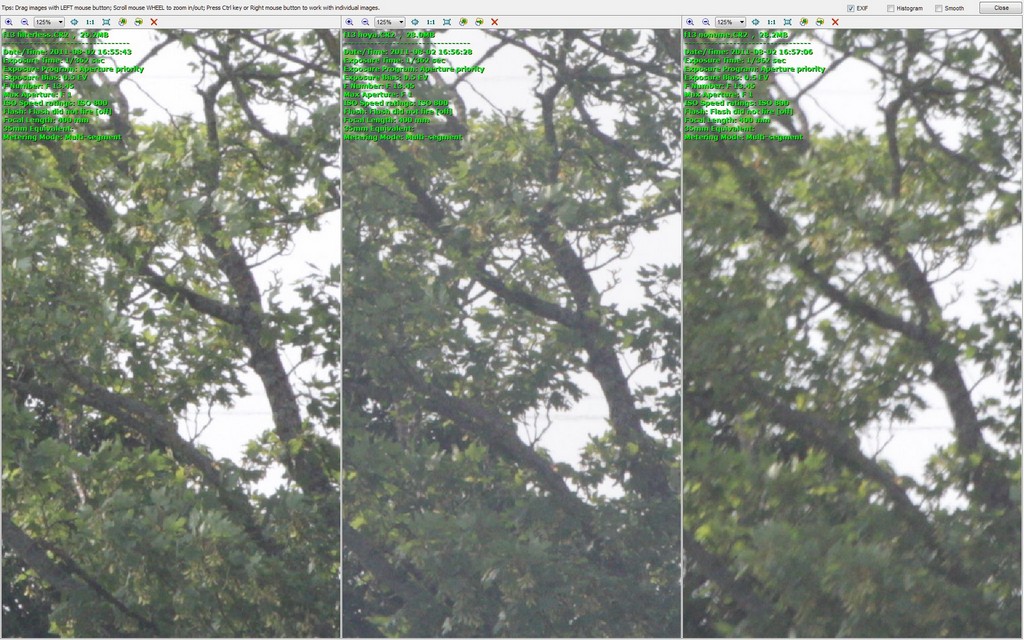
Here's my test - No Filter | Hoya HD | Cheap NoName

Filter%20Comparison%20100-400.jpg
 
So, looks like filters make no noticeable difference to perceived image quality.
They do, very much so.

Especially at long focal lengths.

That's before we even start talking about flare, light bouncing back off the sensor, onto the filter and back onto the sensor again. And ghosting....
 
Filters are essential for lens protection. The only lens I didn't have a UV filter on today was the one a chicken was intent on trying to peck. :D

750_3317.jpg


750_3319.jpg
I've never used a UV / "protection" filter and I've never damaged a front element. I wouldn't expect to though as I've never hit it / cleaned it with a diamond cutter :)

I do use a hood though. All the time.
 
Once again, many thanks for everyone's input.

The intended lens is a 100-400 and my concern is actually banging/knocking the front of the lens whilst carrying, for example, over my shoulder.

Judging by the general consensus, i am as likely to damage the lens element from a broken/shattered filter as i am through direct contact.

It would appear the moral is to make sure you have protection on the end of your moveable bits at all times to avoid accidents !!
You most certainly will notice an IQ drop with the 100-400, possibly the worst lens to use one on, at 400mm even the "best" UV filters will affect it negatively.
 
I've never used a UV / "protection" filter and I've never damaged a front element. I wouldn't expect to though as I've never hit it / cleaned it with a diamond cutter :)

I do use a hood though. All the time.

Have you had a lens pecked by a chicken though? A lens hood won't save you from that! :D
 
Have you had a lens pecked by a chicken though? A lens hood won't save you from that! :D
The chickens beak won't damage a front element, you need something a lot sharper and harder than that!
 
Back
Top