^^^ edit: beat me to it, but it took me a while to prep this post

1 Litre of petrol in 1962 6.5p
1 Litre of petrol in 2012 135p+
I wouldn't call that a reduction in cost of transporting ourselves.
True, those numbers look scary.
Of course, what that bare figure misses is to take account of inflation and the increased efficiency of newer vehicles compared with their counterparts of fifty years ago. It also assumes a straight line increase of cost, which is not the case.
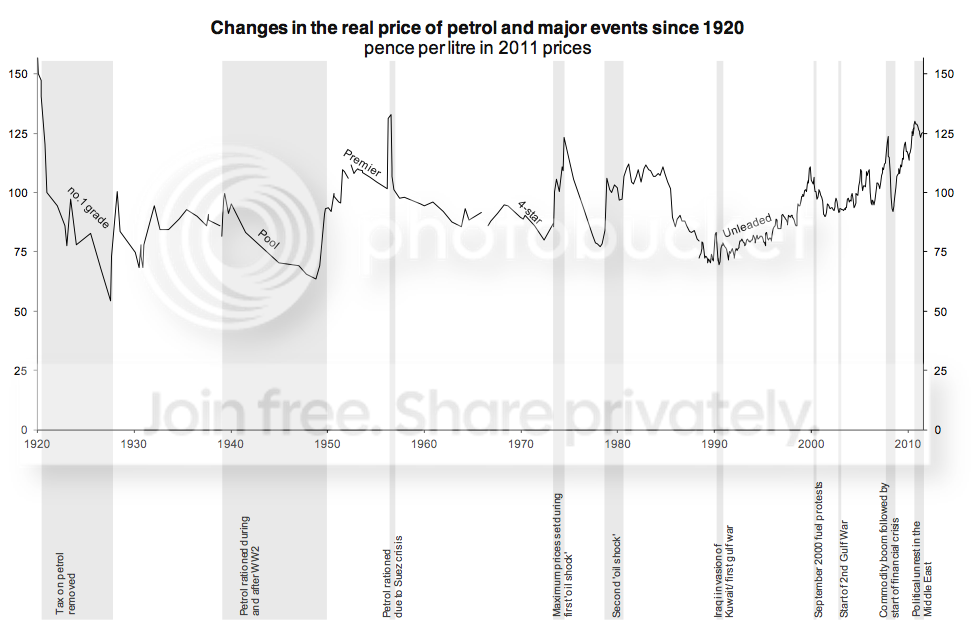
Stats presented from UK parliament, adjusted for inflation
http://www.parliament.uk/briefing-papers/SN04712
N.B. The Fuel Price Escalator was in place between 1993 and November 2000, raising duty on fuel to achieve a 3% rise in the price of fuel above inflation, later upped to 5% and then 6%, with the avowed aim of reducing pollution and traffic congestion.
Even allowing for the effects of the Escalator, you can see that fuel prices from the mid 80s through to 2000 were at a post-war low (indeed most of the 20th century with the exception of the late 40s, while petrol rationing was still in force until May 1950). Through the late 80s and 1990s, we got used to historically cheap fuel.
From the perspective of the the rise of out of town retail malls, it is also, perhaps not coincidentally as most of their customers would arrive by car, the most significant period of new development:
Merry Hill, Dudley opened in 1985
Metro Centre in Gateshead - 1986
Fosse Park, Leicester - 1989
Lakeside, Thurrock - 1990
Meadowhall, Sheffield - 1990
White Rose, Leeds - 1997
Trafford Centre in Manchester - 1998
Cribbs Causeway, Bristol 1998
Bluewater, Kent - 1999
Braehead, Glasgow 1999
These are just the headline acts - there were thousands of new, large supermarkets built on the edges of our towns. We are living with the consequences of that period of building out-of-town retail centres.
Even after the blip during the fuel crisis of 1999/2000, the price of petrol, adjusted for inflation, was about the same as it was through most of the 1960s.
Taking inflation and the improved fuel efficiency of cars into account, and the cost of fuelling a car for 12,000 miles for a year's motoring fell by 25% between 1980 and 1990, according to Which magazine's calculations.
http://www.which.co.uk/cars/driving/car-running-costs/find-the-cheapest-fuel/have-fuel-prices-risen/
In 2000, with the full effects of the Escalator, a year's worth of fuel was still 14% cheaper than in 1980.
In 2011, with inflation-adjusted fuel at a price only just short of its post-war high during the Suez Crisis in 1956, it is only 13% more expensive in real terms than thirty years previously, considerably less than your simple 6.5p -> 135p comparison suggests.
Of course, the general rise in living standards (UK
GDP per capita adjusted for inflation approximately doubled between 1980 and 2012) suggests that the price of fuel today should be a little over half what it was thirty years ago as a proportion of our incomes, taking into account the numbers above.