I think the advice given above by others on camera settings, filters etc is excellent. Nice to get the image correctly in the camera before PP.
Twenty years ago, I thought the 'sniffy-ness' of the old hands about a lot of stuff, actually.... zoom lenses for instance... they were a one-trick-dog, good only for long exposure 'racking' effects... you know, like when the milenium falcon jumps into hyper-space and leaves star trails.....
The goal of the photographer, then was to get it totally right 'in-camera', in one shot, 'clean'.
Even cropping was frowned on. And filters? Well, yellow, green and red filters to boost contrast in Black & White were 'just' about acceptable.... polarisers? Hmmm... maybe to saturate colour... BUT you ought to be using slide film and under-exposing to do that any way... and slide-film means it HAS to be done 'in-camera', because there's no chance to do much post-process, as once the films developed its chopped up and that's what the viewer gets to see.
Star-burst Filters? Soft-Focus filters? Centre-spots? Pah! Gimmicks! Mere Gimmicks. If the photo cant cut it shot straight, no stupid effects will make it presentable!
And grads? GRADS! Even worse, coloured grads... blue-grad to saturate skys, Tobacco-grads to tint sunsets, or green-grads to boost hills..... ?!?!?!?!?
"You want pictures like that...." They would say.... "go to Athena!" and they didn't mean somewhere in Greece.
Historical note: (For those who may only have been eligible to vote in the Cameron/Brown debacle) Athena was a Poster-Shop, that made famouse such 70's kitch as:-
But by the 80's had 'matured' into such delights of interior design as this:-
Colour provided by e-number!
Anyway... I found such photo-elitism, rather stiflling, stuffy and nonsensical... where's the creativity, if you are denied all the tools in the toy-box?
I wanted to get into the dark-room and 'play'... dodging & burning, montaging, tinting, toning, this was the stuff I reckoned made photo-fun!
Yes its nice to get the image correct first time, but for most amateurs and novices this doesnt always happen.
No, it doesn't... BUT... wisdom of experience.... if you dont get it right, or NEAR right 'in-camera'... then in post processing you are often flogging a dead horse. Silk-Purses and Sow's-Ears.
For all I found the pretensions of in-camera perfection, rediculouse, and stuffy, there was a HECK of a lot of wisdom behind it.
Mid-90's I discovered the digital dark-room; and paid a rediculouse amount of money to get a scanner, then a propper negative scanner to get images into it. My preffered photo-editing suite, is archaic, MicroGrafix Picture-Publisher, version one point something... that is how old it is! And I believe the company was bought by Adobe in the late 90's for thier masking tools. It was a remarkeably good bit of software and very intuative to a Dark-Room Jockey, and I still use it as there's a lot of stuff I can do in it, and do quickly and easily that I just cant in Photo-Shop, which I got a full version off when that was still in single digit versions... and have never fully got to grips with.
Any-how... dark-room trained, the revalation of the Digi-Dark-Room was I could suddenly do stuff in seconds that had taken minutes or hours in the dark room, AND mistakes could be corrected, and back-ups reverted to to save having to go back and repeat long and tiome consuming chores to re-create an image pre-error. It was 'great'....
BUT... when I started using a dark-room.... first I had to learn the tools and techniques, at a basic level, then having learned what I could do in the dark room....
I then had to work three times as hard on my in-camera image capture......... knowing what was and wasn't possible in post-processing, to either get it right first time, or make negatives that COULD be post-processed sucessfully.
Very few photo's I create for 'display' these days, even family snap-shots make it to screen without any post-processing.... most have to at least be re-sized to display resolution if nothing else, and along the way almost all get a little cropping to tidy them up, if nothing more.
But Post-Processing is NOT the answer to poor picture taking.
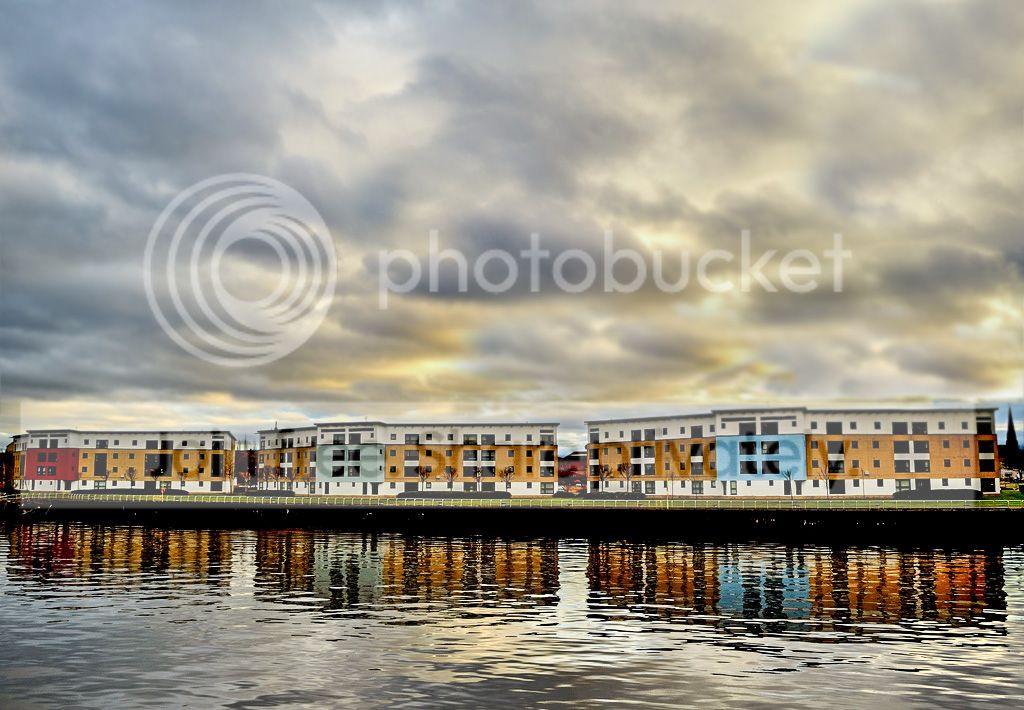
And that's the crux here. Collin's original blown-out sunset was a bit dissapointing. And his question was whether filters would have helped him get a cleaner shot.
The answer is no. ND filters would have pulled back the whole frame, and left everything but the hot-spots under exposed. Grads would have pulled back the top of the sky, and left the low sun hot spots, or, would have left 'banding' where the grad cut other subject matter leaving uneven under exposure in other parts of the shot.
Mystery, has made something of the shot, but, I have to say I'm not that keen on it.... the exposure over-lays have toned down the contrast in the sky, and saturated the colour in the buildings... which I think I like... that is the 'interest' in the picture.... but the reflected colour in the water is too strong and 'metalic' for my liking, and un-natural.
Yes, it has worked 'sort of'... BUT the prime-error here was at the capture stage.
Getting it clean-in-camera. And that is a matter of understanding exposure and looking at the scene and working out how to 'best' capture what you see or want to see.
This post-process 'salvage' has made a dissapointing shot a bit better; but not brilliant.
For the 'brilliant' shot, and exploiting post-processing, you would have shot TO post-process, and set up on tripod, and made three close timed exposures on manual, one exposing for mid-tones, one for high-lights, one for shaddows, at least two stops apart on shutter speed alone, to maintain Depth-of-Fiels on all three images... then used THOSE to create the post-process over-lays, from an extended exposure range, rather than trying to work within the exposure range captured in the single shot.
Collin admits that he is at an early elevation of the learning curve doing it in camera and has very little PP know-how. And after initial comments agreed that the problem probably was in the fact he is little more than point & press photo-taking.
Subject, I personally find a little 'boring'. It's got interest... but... what is it? Is it the drama in the sky? Is it the colour in those block-buildings? Is it the reflections in the water? Well, it is I suppose all three, but where should the attension be, and how to draw that out of the image?
Helping & encouraging Collin, then.... advice to mess with filters or post processing is somewhat diverting, and implying that fundemental capture errors aren't important and you can get a better picture with more toys or technology...... you can.... but 90% of the photo is in the eye that takes it and 9% more in the know-how behind that eye... only 1% in the hardware that translates it... better tools then will only make improvements in that 1%...... improving his know-how, so that he can get more out of the hardware he has, can give ten times the benefit, and improving his eye.... ten times more even than that.
It's not 'bad' advice, all adds to the know how so he might be able to plan his shots better and utilise some of those tools to better effect... but fundemental of getting it clean-in-camera remains, and already admitted, he didn't plan the shot.... so that's what ought to be tackled first.
And that starts by identifying the 'interest' in the scene, and working out best technique to draw it out.
Where to put the emphasis?
Being honest; I would probably have shot it much the same; but... I would probably have also shot a few perms on it.
First, ignoring the drama sky, and the problem of the hot-spots; framing low, to get the tops of the buildings accross the top of the frame and capture that sky, muted by the water in reflection.
There's also a church spire in the right side of frame next to the block-building. That detail interests me, and I cant walk around in the picture, but had it been me, I would as like explored some angles to see if I could get one that justopositioned that bit of gothic architecture between the two bits of modern.
Concentrating on the bold colour in the block-buildings; there is another bit of interest that might be drawn out by tighter cropping, to concentrate attension on that feature; and again, a different angle; perhaps raking obliquely down the fronts of the blocks from one side or other, would have shifted the direct lighting to the edge of frame or even out of it all together, and made a completely different and more interesting picture.
I cant say for sure, becouse I wasn't there.... but the possibilities are endless, AND all are shootable....
Back to primary problem.... not THIS shot, but getting A shot... from an 'interesting' scene.
This is the leap from snapper to photographer. Not just looking at something and going "Oh! Thats interesting" Putting camera to face and clicking... but going "Oh! That's interesting..... Hmm... WHAT makes it interesting? Now.... how can I BEST capture that interest?"
Questioning what you are doing, looking not just at what you see, but seeing how you MIGHT see it. Looking around the subject, taking in the little details and considering what to include, what to exclude, and how to emphasise or de-emphasise the different elements....
Planning.
Auto-Focus and Program exposure place an awful lot of expertise in the camera, and we CAN rely on it to do a pretty good job an awful lot of the time... no point taking manual control or trying to get clever with the programs just for the sake of it, especially if you dont really understand what they are doing or not doing for you... it's taking your attension away from whats important, the subject, just so you feel that you have done something!
This is actually rather perverse, and photography shouldn't be that hard! Especially if you have a fancy all singing all dancing digital SLR that can do pretty much everything for you BUT tell you were to point the camera!
And spending even more time to try and make something in Post-Processing? Well, even more work made for yourself, for the sake of just a LITTLE thought at the very beginning to get it 'Clean-In-Camera'....
That is why it was the soap-box of my mentors so many years ago.... and may have been a strained point, BUT getting the fundementals in place, putting in the time to aquire the core skills and discipline to use them.... is important.
You get good pictures straight away, least fuss, least effort, and you can use other tools and techniques to make THEM better.... rather than starting with something fairly poor and dissapointing, and fighting from behind JUST trying to make it 'OK'.