Shooting stars for a beginner

ThelVlenace

Suspended / Banned
Messages
101
Edit My Images
No
Is there anyone that can give some advice or link me to a guide when it comes to shooting stars (not star trails). Would like some tips on exposures/iso/aperture etc. I know it's a matter of experimenting, but a little help would be great!
Thanks :)
 
are you talking about taking a picture of a normal star or a shooting star ??
you could also try typing into the search facility at the top of the page.
 
holty said:
are you talking about taking a picture of a normal star or a shooting star ??
you could also try typing into the search facility at the top of the page.

Yeah just shorting stars with a dslr. Nothing fancy. I would use the search facility at the top of the page...however, I'm currently using my iphone and that doesn't have one :)
 
ThelVlenace said:
Yeah just shorting stars with a dslr. Nothing fancy. I would use the search facility at the top of the page...however, I'm currently using my iphone and that doesn't have one :)

I did find some helpful guides on star trails...but I just wondered about static shots of stars. (Not a shooting star) lol
 
Check out my signature, for the link to the guide on star trails, basically it covers shooting stars for star trails, but this can also be used for static stars too as basically to capture shooting stars you may as well shoot as if your doing a star trail :thumbs: and then you can if you wish merge all exposures with shooting stars into a single exposure :thumbs:

Any questions after reading the guide then please ask away and I'll be happy to help you :thumbs:

Matt
 
Thanks a lot for the help guys! Once I manage to get a good go at it, I shall post up the results for you to tear apart :thumbs:
 
Shooting stars?

I recommend this:

Svd_dragunov_russian_sniper_rifle_ryskt_vapen_kryppskyttar_russiaonline_se_ryssland.jpg


Which stars are you planning on killing? :D
 
Images without trails offer problems that images with trails do not have. The biggest issue is that you have a limited amount of time before the earth's rotation registers as trails. This varies depending on your focal length. The wider the lens, the longer you have, but a good rule of thumb is 600 divided by focal length = time in seconds. I find this gives a slightly generous figure though. With a 24mm lens for example, I find around 25 seconds the ABSOLUTE limit before movement becomes intrusive and you can still see movement when you zoom in at this.

The problem with this is you are limited to how much light you can gather in that time. Doing trails is easy, as there is no limit to how long you can leave the shutter open for (excluding battery life and light pollution), and even if you use shorter exposures you can stack them. This longer exposure allows more of the fainter stars to be recorded, and also allows for low ambient light to actually expose foreground detail.

With a 20 second exposure however... you often have to have a dark foreground, or you have to light it... or get a balance by shooting when there's a very new, or very waning moon. A full moon will give too much light in the sky, and too much environmental lighting will also give too much light pollution.

As a result, with sharp star shots without trails, you need a high ISO, and ideally a camera that performs well at high ISO.

As a starting point, assuming a 24mm lens or thereabouts, I'd suggest 25 seconds @f4 with ISO3200. Bracket around that and experiment. Conditions are variable, and some nights you'll need less... others more.

If you JUST want the sky and no foreground.. then invest in a driven equatorial mount such as those used with telescopes. This will track the earth's rotation and you can expose for much longer as a result. That's a learning curve and expense you may not want, or need though.

 
Last edited:
Of course if you go to one of the poles the speed-of-rotation problem virtually vanishes. And not much light pollution if you go at the right time of year.

Simples.:D
 
jon ryan said:
Of course if you go to one of the poles the speed-of-rotation problem virtually vanishes. And not much light pollution if you go at the right time of year.

Simples.:D

Apart from the moon - where I live, there is no light pollution from towns. Country dweller!
 
Pookeyhead said:
Images without trails offer problems that images with trails do not have. The biggest issue is that you have a limited amount of time before the earth's rotation registers as trails. This varies depending on your focal length. The wider the lens, the longer you have, but a good rule of thumb is 600 divided by focal length = time in seconds. I find this gives a slightly generous figure though. With a 24mm lens for example, I find around 25 seconds the ABSOLUTE limit before movement becomes intrusive and you can still see movement when you zoom in at this.

The problem with this is you are limited to how much light you can gather in that time. Doing trails is easy, as there is no limit to how long you can leave the shutter open for (excluding battery life and light pollution), and even if you use shorter exposures you can stack them. This longer exposure allows more of the fainter stars to be recorded, and also allows for low ambient light to actually expose foreground detail.

With a 20 second exposure however... you often have to have a dark foreground, or you have to light it... or get a balance by shooting when there's a very new, or very waning moon. A full moon will give too much light in the sky, and too much environmental lighting will also give too much light pollution.

As a result, with sharp star shots without trails, you need a high ISO, and ideally a camera that performs well at high ISO.

As a starting point, assuming a 24mm lens or thereabouts, I'd suggest 25 seconds @f4 with ISO3200. Bracket around that and experiment. Conditions are variable, and some nights you'll need less... others more.

If you JUST want the sky and no foreground.. then invest in a driven equatorial mount such as those used with telescopes. This will track the earth's rotation and you can expose for much longer as a result. That's a learning curve and expense you may not want, or need though.


Thanks for the advice ill have a play and take it in to consideration! :thumbs:
 
ThelVlenace said:
Apart from the moon - where I live, there is no light pollution from towns. Country dweller!

Where do you live then? As light pollution travels well in my experience :(
 
I'm a Shropshire lad...but I live well away from any towns. When it snows here I'm home! Lol :thumbs:
 
MWHCVT said:
Where do you live then? As light pollution travels well in my experience :(

Ya never know though! What I can't see, my camera might ;) lol. But here you can step outside an just see all the stars on a clear night...there's not a single street light. This is a problem leaving early for work and falling on your ass during the winter months though!
 
You're welcome.
 
I try not to worry too much about light pollution, obviously the further away from it that you can get the better, but that said if you spend to much time running away from light pollution, your going to miss out on so many fantastic locations, you can still get amazing results even under quite heavy light pollution ;)
 
I try not to worry too much about light pollution, obviously the further away from it that you can get the better, but that said if you spend to much time running away from light pollution, your going to miss out on so many fantastic locations, you can still get amazing results even under quite heavy light pollution ;)

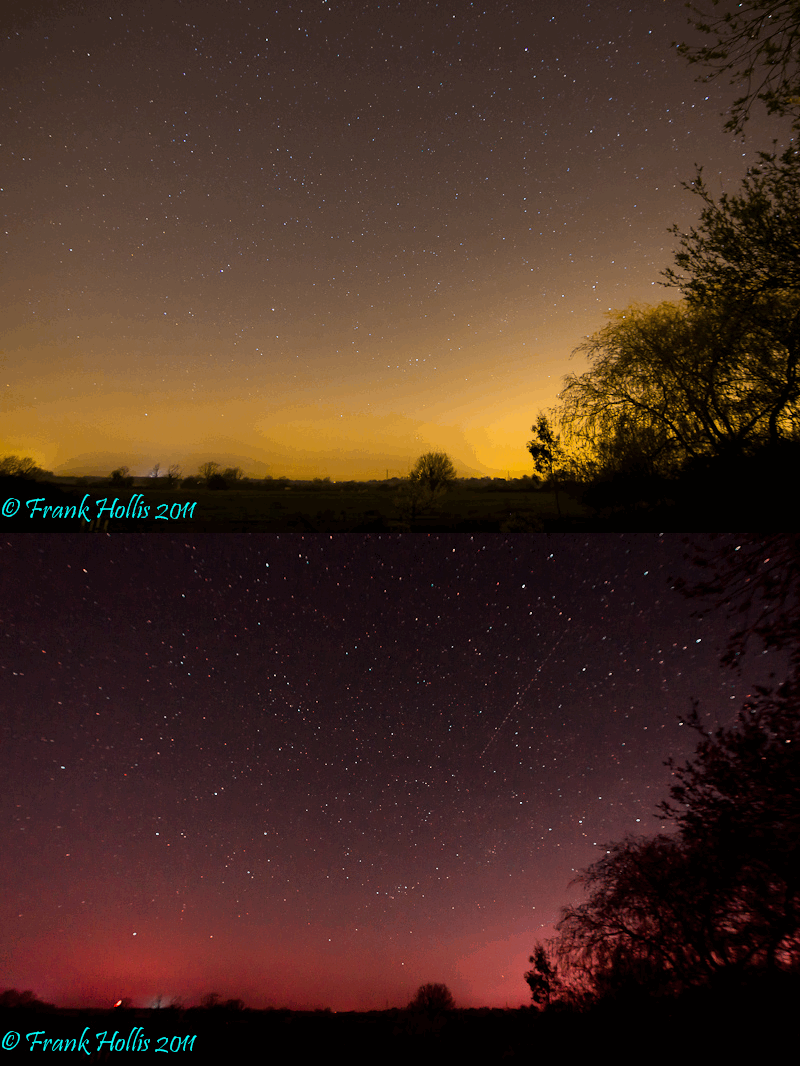
And if it really bugs you, and you're not using an EF-S lens, but you are using an APS-C camera, and you've got a bit of spare cash - then you can try a light-pollution filter. Here's the one I use - LINK. And here's what it does...

Light%20Pollution.gif
 
Appreciate all of the responses to the question! Got loads to get on with now!

Big thanks :thumbs:
 
And if it really bugs you, and you're not using an EF-S lens, but you are using an APS-C camera, and you've got a bit of spare cash - then you can try a light-pollution filter. Here's the one I use - LINK. And here's what it does...

Light%20Pollution.gif


Warning. These are only really effective with low pressure sodium (SOX) lamps, which have a very narrow spectrum. While they do work with high pressure sodium (SON) lamps, they are much less effective. Many areas in the UK now are exclusively SON. Another worrying trend is the quickly increasing take up of LED and Phillips CosmoPolis lighting, which is either broad, or full spectrum. This filter will have almost no effect on these types of lighting. Check the areas you are shooting in before spending money on this filter.
 
Warning. These are only really effective with low pressure sodium (SOX) lamps, which have a very narrow spectrum. While they do work with high pressure sodium (SON) lamps, they are much less effective. Many areas in the UK now are exclusively SON. Another worrying trend is the quickly increasing take up of LED and Phillips CosmoPolis lighting, which is either broad, or full spectrum. This filter will have almost no effect on these types of lighting. Check the areas you are shooting in before spending money on this filter.

I'll also add I wouldn't touch them either because most light pollution can be removed with a custom white balance either in camera or in PP if you shoot RAW
 
Not as effectively as a filter designed to remove the light at source, as once the ambient light pollution has been recorded to the same level or higher as the stars you are trying to capture, there is nothing to recover.
 
Don't waste money on filters, find somewhere dark without light pollution, you will also have more stars to view that way. Also don't worry about missing locations, especially when its the sky you are shooting.
 
But a shot of just the sky is very boring... unless it's a astro-photography image of something interesting. Just a shot of the sky though.. how dull would THAT be?
 
But a shot of just the sky is very boring... unless it's a astro-photography image of something interesting. Just a shot of the sky though.. how dull would THAT be?

I agree, I love a good astro shot, done with a scope but just stars with no other interest is just dull
 
Maybe dull to you two guys but not to me. All that light painting and star trails is boring stacking images. Now that's dull.
 
Maybe dull to you two guys but not to me. All that light painting and star trails is boring stacking images. Now that's dull.

I think may you and I are talking about a different types of star photography, surely your not thinking of just a dark image with just stars in it, something like this is stunning

astro.jpg


SOURCE: http://lerma.obspm.fr/indexEN.php?page=equipes/astro.php

But just a 17mm photo of a star covered sky with nothing else, you may as well just use a camera with a ruined sensor full of dead pixels IMO :(
 
But just a 17mm photo of a star covered sky with nothing else, you may as well just use a camera with a ruined sensor full of dead pixels IMO :(
:cuckoo:


You need to get out somewhere properly dark and see what a wide angle will do. Not just a few dots. Clearly you have never seen a great shot of the Milky Way. This is another reason you need to watch what you say about polluted skies.

http://www.flickr.com/photos/57078694@N04/6965889718/

14mm for example.
 
Last edited:
You need to get out somewhere properly dark And see what a 17mm will do. Not just a few dots. Clearly you have never seen a great shot if the Milky Way.

Oh I have and all of the decent ones that I've seen have and a stunning landscape or some other interest to go with them ;)

Something like this by my friend Gary : http://www.flickr.com/photos/rowdey/7555244052/in/faves-mwhcvt/

or this one by TP very own Andrew : http://www.flickr.com/photos/andwhynot/7865584404/in/faves-mwhcvt/
 
Pookeyhead said:
But a shot of just the sky is very boring... unless it's a astro-photography image of something interesting. Just a shot of the sky though.. how dull would THAT be?

I've got some pretty exciting sky around me!! :thumbs:
 
:cuckoo:


You need to get out somewhere properly dark and see what a wide angle will do. Not just a few dots. Clearly you have never seen a great shot of the Milky Way. This is another reason you need to watch what you say about polluted skies.

http://www.flickr.com/photos/57078694@N04/6965889718/

14mm for example.

Well I've re-quoted you since you post has changed significantly since I first quoted it, and I don't think I need to watch what I say about anything all of my points were perfectly valid, and see my quoted post below to show I can appreciate a stunning star scape but I maintain you need more than just a star scape to make a stunning image

Oh I have and all of the decent ones that I've seen have and a stunning landscape or some other interest to go with them ;)

Something like this by my friend Gary : http://www.flickr.com/photos/rowdey/7555244052/in/faves-mwhcvt/

or this one by TP very own Andrew : http://www.flickr.com/photos/andwhynot/7865584404/in/faves-mwhcvt/
 
MWHCVT said:
Well I've re-quoted you since you post has changed significantly since I first quoted it, and I don't think I need to watch what I say about anything all of my points were perfectly valid, and see my quoted post below to show I can appreciate a stunning star scape but I maintain you need more than just a star scape to make a stunning image

Do I need to quote again what you said? You said you need a ruined sensor and you would just get a few pixels. You are very wrong on the subject. Stick to your light painting where you are a professional at that. And leave the stars to the big boys ;)

And I changed my post because I replied in sheer quickness on my phone at how wrong you were. And edited it on my laptop.
And no you don't need a landscape in a star photo at all. Who makes up the photo rules? Certainly not you.

I'm out. I can't deal with all these know it all's, people really are fighting a losing battle sometimes replying to certain people on here.

Good day.
 
Do I need to quote again what you said? You said you need a ruined sensor and you would just get a few pixels. You are very wrong on the subject. Stick to your light painting where you are a professional at that. And leave the stars to the big boys ;)

And I changed my post because I replied in sheer quickness on my phone at how wrong you were. And edited it on my laptop.
And no you don't need a landscape in a star photo at all. Who makes up the photo rules? Certainly not you.

I'm out. I can't deal with all these know it all's, people really are fighting a losing battle sometimes replying to certain people on here.

Good day.

Really? I know nothing about capturing stars?

Okay, this is a little one from in the middle of one of the most light polluted areas of the country


323/366 (688) by mwhcvt, on Flickr

only a few stars in the ;)

or how about this, I'll admit not the most amazing photo of the milky way probably not even in the top 1,000,000 photos of the milky way, this one was shot even closer to the light pollution of Warwick, Leamington, Coventry and most of all Birmingham, with a little bit of Banbury and Oxford thrown in for good measure


286/366 (651) by mwhcvt, on Flickr

Or how about this, not a million stars but this one broke all the rules, a full moon, and actually facing Birmingham and all it's light pollution and being only 16 miles from the centre of Birmingham


257/365 (Explored) by mwhcvt, on Flickr

As to the rules I cannot tell you who makes the rules up but I can tell you what most the people I've ever talked to on the subject wish admitably is probably only a few hundred people and the mass consensus is that a decent landscape makes the images better than just stars
 
Back
Top