Scanning Negatives

Merlin5

Suspended / Banned
Messages
2,295
Name
Lee
Edit My Images
No
Hi all. I don't do film photography but have been interested in learning a little about the process of developing negatives and scanning them with a scanner or taking high resolution photos of them.

Here's my question. Is there any loss of information by using a scan or photo of a negative? In other words, if a print isn't made directly from the actual negative with a darkroom enlarger, is a scan or photo of a negative equivalent to working with a jpeg instead of a raw file?
 
Last edited:
Interesting questions in that do we see everything that is actually on the neg and the best way to see that info, I often thought the best way was some gadget that could produce an image from grains that a microscope sees...................
Well what info you get from a neg depends on the equipment used e.g. just scanning a family snap shot with a cheap scanner would be reasonable for a print that most people would acccept, but if say you wanted to see more details on a brooch that one was wearing then you would need the best scanner available (which a lab would have) for a crop. But using consumer film, the size of the neg is important as well e.g. you would get more detailed info (for crops) from Medium format (MF) or large format (LF) neg than 35mm .
Same for an enlarger in the darkroom in that using a cheap enlarging lens would give poorer results than a high quality one.
 
Hi all. I don't do film photography but have been interested in learning a little about the process of developing negatives and scanning them with a scanner or taking high resolution photos of them.

Here's my question. Is there any loss of information by using a scan or photo of a negative? In other words, if a print isn't made directly from the actual negative with a darkroom enlarger, is a scan or photo of a negative equivalent to working with a jpeg instead of a raw file?
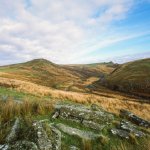
I've never tried to scan my own so this is only half an answer but I have my films developed and scanned at the same lab and I ask for their best quality TIFF scans (not from a Drum Scanner) which come in at 131mb (for 120 MF slide film). In lightroom I can then do everything to them as if they were a RAW file then save to jpg for output (small prints or web posting) or indeed save them as large TIFF for bigger printing.

Here's one from my last film, Provia 100F done in that exact way.

003 Tavy Cleave from Nat Tor 01-051930010010 PS Adj.JPG
 
The simple answer to your question as first posited is yes, information is lost by scanning. The caveat is that information is also lost when making a conventional darkroom print.

In the second formulation, the answer is yes and no. If scanned from a negative, I'd go with "it's the equivalent of a raw file; if from a print, it's a jpg equivalent".

Reasoning.
For the first form of the question. No lens is perfect, so details (to look no further than simple resolution) will be lost by scanning. So, yes, detail will be lost by scanning. As it will by making a print in a darkroom, but here the losses will actually be greater, as a darkroom print cannot hold the same subject brightness range as either a negative or a scan from a negative.

For the second form of the question, my reasoning runs:
A jpg has a reduced level of detail and tonal information compared to a raw file, A print similarly has a reduced level of detail and tonal information compared to the negative. In the best case, and in rough figures, the resolution of detail on a glossy print (the highest possible) will be about (just under, in fact) one third that of a medium speed black and white film and considerably less than some of the higher resolution (and slower) films available, So, scanning (or photographing) a print is closer to jpg than raw. But - another caveat. Obviously, the larger the degree of magnification used to obtain the print, the less detail will be lost - a 10"x15" print from 35mm will contain more information than a contact print, even with image breakup, at this degree of enlargement so the resolution loss will be less than scanning/photographing a contact print.

When using a negative, the scanner will lose detail and tonal information, but in the latter case less will be lost than when making a darkroom print, so I'd go with a raw equivalent - you can pull back a lot of information in the shadows and/or highlights from a negative scan than is easily possible in a darkroom, and almost certainly end up with better tonal separation from a scanned digital print. Again, the size caveat will apply. Resolution loss from a larger negative will be less evident (if at all) on a scanned digital print from a larger negative then a smaller one.

Edit. I missed the important "one third" out, and implied contact print and negative were roughly comparable in resolution..

 
Last edited:
There is no one size fits all answer to your question there are so many variables in both the pure analogue process and hybrid analogue-digital - digital or analogue-digital-analogue work flows.
A good scan can give a file with far more tones than can be reproduced on either colour or monochrome prints be they dye, pigment or silver ( dye formation or dye destruction for colour print).
The biggest trap to fall into is expecting the print to look like the screen image, it will never do this in the same way that a good E6 transparency never looked like the print made from it.
A film scan will give you the opportunity to alter local contrast or dodge and burn like a darkroom god, something most of us could only dream of in the home darkroom.
Make some scans or get a film scanned and experiment with the output, come back and ask specific questions, repeat, is the only advise I can give.

My scanned film album Flickr BandW film is here most of which is tagged for film / dev and camera / lens used or search o Flickr for groups dedicated to your favourite film, join the group and ask questions.

But most of all have fun and try to avoid the rabbit holes.
 
In days gone by I was often required to make copy negatives and prints from existing prints and positives. What ever process you used there were always losses in quality. But done well the results were acceptable.
Today Digital film or print scanning can be very good indeed, but is often less than optimal because of the equipment chosen or indeed available.
It stand to reason that the larger the magnification and the larger the original the greater the detail capture can be. But Practical considerations usually are the deciding factor. All things being equal it makes sense to save such digital files as raws rather than jpegs..

However saving raws will not get back any losses, it can only maximise the data that is actually captured.

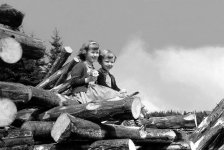
This was scanned from a negative taken in about 1953 taken an an Agfa Solinette with apotar lens and retains a great deal of the original tonality.

lottgirls.JPG
 
Thanks very much for all the detailed replies! I understand much better now. My initial thoughts were that working with a photograph or scan of a negative would be similar to working with a photograph of a raw file in that there wouldn't be as much embedded detail/information and dynamic range in the scan/photo as the original negative and so be like editing and processing with a jpeg.

But from what has been said, there are many variables, and processing a scan or high resolution photo of a negative in lightroom or photoshop can produce really good quality positives and prints. Nice photos Jak, Paul, Terry and Keith.(y)
 
Thanks very much for all the detailed replies! I understand much better now. My initial thoughts were that working with a photograph or scan of a negative would be similar to working with a photograph of a raw file in that there wouldn't be as much embedded detail/information and dynamic range in the scan/photo as the original negative and so be like editing and processing with a jpeg.

But from what has been said, there are many variables, and processing a scan or high resolution photo of a negative in lightroom or photoshop can produce really good quality positives and prints. Nice photos Jak, Paul, Terry and Keith.(y)
Keep in mind Lee that a lot depends on the film you have used.
 
the final neg image you get will be only as good as the weakest link e.g. camera bottle glass lens or cheap scanner or bad dev etc etc

not to mention the idiot behind the camera... thought at least that should be common to film and digital :headbang:
 
Last edited:
...also (which I forgot to mention) the final neg image you get will be only as good as the weakest link e.g. camera bottle glass lens or cheap scanner or bad dev etc etc
This is true to an extent but careful sharpening, use of the clarity slider and curves can work wonders. You can perk up a flat scan but you can not recover what is not in the file.
 
Hi all. I don't do film photography but have been interested in learning a little about the process of developing negatives and scanning them with a scanner or taking high resolution photos of them.

Here's my question. Is there any loss of information by using a scan or photo of a negative? In other words, if a print isn't made directly from the actual negative with a darkroom enlarger, is a scan or photo of a negative equivalent to working with a jpeg instead of a raw file?
As usual @StephenM has a good, thoughtful answer. Not sure it's pertinent, but to me it seems crucial that a raw file is a digital representation of sensor data; there's no way to get better results for that sensor. A negative though is a thoroughly analogue thing. Every time you scan it, every different scanner you use, every different scanner operator, every different "digicam-scan" setup you use, every different digital camera you use, coming back and doing the exact same thing in few years time, all of these will get something slightly (or very) different from that negative.

I think to make sense of the answers to your question (or even to reformulate it), that stark digital/analogue difference has to be at the heart of the matter.
 
Back
Top