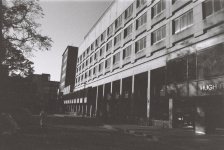
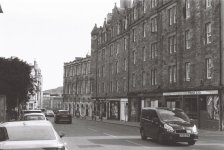
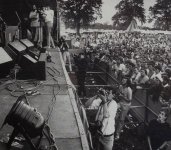
Thank you for the detailed response. Very helpful thoughts. I've ordered a spot meter to give me more control over the choice. I've gotten too reliant on digital cameras making all the choices for me. Which is fine, they're really good at it. But, it's not what I want to do at the moment. I want to make my images and not ask the camera to make one for me, if that makes sense.
Hi Tilly, like Phil above, I'm another old'un who started with film and at one time did a lot of printing too, colour and mono.
First question - is that a raw scan file from the people who processed your film, or did you make that scan after developing the film yourself? Reason I ask is that I've had scans of negatives come back looking quite a bit like that even though they were correctly exposed and very printable in the normal way of things. Don't worry.
And this is where the second part of your reply that I've copied about comes into play - you need to treat this like a digital negative and not a finished print. What you need to do is import this into a digital development package like Lightroom and then develop the image yourself: start off by setting the overall exposure and adjust highlights and shadows to where you like what you see, then set black and white points to control the brightest and darkest points of the image. If I had a low-contrast image to print in a wet darkroom then I would select a paper that had a high contrast to give it some punch. OTOH if my negative was very contrasty then I'd choose a soft contrast paper that would manage the highlights and shadows in the way I wanted. In some cases of very high contrast I might even pre-flash the paper to bring up highlight detail. Where there were areas that were very bright (i.e. the negative was dark and dense) then these could be burned in, and areas that were dark would be held back for part of the exposure by masking them during the exposure. Printing from film is not just about 'getting it right in camera' and with the exception of slide film, is much more about knowing how to get the best from a negative.
And talking of digital, that is also true in that medium.
The digital RAW film is your negative, and the starting point, not the finish for your image. All the requirements of printing from film apply to digital too, but it's just easier, faster and cheaper. Instead of masking with your hands under the enlarger while counting to get the right exposure, now you just brush with the mouse. No more carefully retouching a print to remove dust marks, because I can do that in software. But I still have to do it. In many ways, image development is much more like film printing now we have digital cameras with a wide dynamic range, since I can go finding details in highlights and shadows that would be lost in a Boots print or the modern equivalent - a .jpeg file SOOC.
For a scene like this, average metering is fine with film because you have lots of bright bits and lots of dark bits. Metering of one or the other is going to cause more problems, although you could meter off the bright bits and then open up a stop or 2 for more exposure.
Hope that's useful.