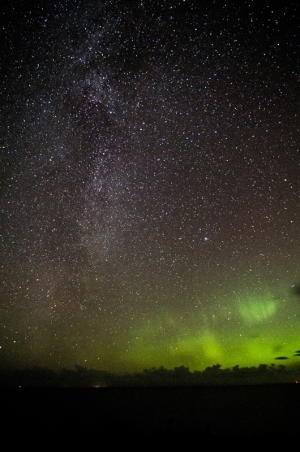
Photographing the milky way

minimace

Suspended / Banned
Messages
94
Name
Aaron
Edit My Images
No
Hi all, im after some tips on taking photos of the milky way, I had a go at it last year, but the quality of the photos is not brilliant.

Just want to know what type of lens is best to use and is there any filters that help with taking pictures of the night sky?
 
I found when I've tried you need as wide as possible and preferably as fast as possible. What system do you use?
 
I used a canon 70d, i tried a few different lenses, the results with a 50mm 1.8 was probably the best, but i did also try zooming in with a 55-250mm lens to capture smaller sections of the sky.
 
I think to get anything decent you need a full spectrum conversion.
No you don't.

All you need is a wide, fast lens with a tripod and as little light pollution as possible. I use a Canon 6d and and Samyang 14mm f/2.8 which gives very good results, but even my 50d with the 10-22 does the job.
 
Last edited:
Agree with Jim.

Use the 500 (or 600) rule to work out the maximum exposure to use before the stars start to appears as trails rather than points.

500(or 600)/(focal length of the lens x the crop factor) = maximum exposure in seconds to prevent star trails. For your 50mm lens that gives a maximum exposure of about 6 seconds. This is more a guideline than a rule as it depends where in the sky you are pointing the camera but it is a good starting point.

Zooming will magnify a small area of the sky but you'd need a pretty big lens (or a telescope) to make any significant difference and via the rule above the exposure would be very short indeed.

A wide angle lens would help, (a) because the exposure can be longer and (b) it allow more in the field of view so more of the MW can bee seen and some foreground too; as would a high ISO

My shots of the MW are a long way from the best I've seen but it is possible to get something reasonable. The attached was taken with Pentax K5, a lens at 18mm and, I think, f3.5, 20 seconds and an ISO of either 3200 or 6400.


Dave

13440-1444296380-2ec582604b439ec2b548f54caeba8966.jpg
 
The biggest factor in shooting the Milky Way is the location, the more you can get away from light pollution the more you and see and the easier it is to capture

The next factor is when to shoot, the optimum time of the month is your new moon nights as you'd be amazed how much of an effect the moonlight has on the amount of visible stars in the sky, in addition to the time of the month, while the milk way is visible year round the optimum months are July and August as in the best and brightest sections of it are most visible at this time of the year

So once you've got yourself to a nice dark location you need to think about your camera settings, it's pretty much the same as shooting star trails so it might be helpful to you to read my guide to those linking in my signature, with the only key difference being your going to be trying to avoid star trails so you want to consider the 500 rule, as such take 500 and devide it by your focal length in 35mm format the resulting number is what you can use as a exposure length before you start to see visible star trailing..

Set up, ideally your going to have a nice fast wide angle lens, myself I use a 14mm 2.8 on my 5D3 now settings wise you really want to use as higher ISO as your comfortable using, to ensure your correctly exposing the scene without blowing out any of the sky..

Finally comes processing as pretty much all Milky Way photos require some degree of processing to really make them pop...but it would be best to know what software you have before linking to a tutorial suitable for you

 
Thanks for all the advice some interesting things to consider.

How about focusing the camera? Is there a easy way to do that?
 
Thanks for all the advice some interesting things to consider.

How about focusing the camera? Is there a easy way to do that?
Manual focus using live view, enlarged on the screen. You'll need to focus to infinity, some lenses will have that marked on the barrel to help but still check it on the screen as they're not always 100 % accurate!
 
Thanks for all the advice some interesting things to consider.

How about focusing the camera? Is there a easy way to do that?

Focus is not cut an dry as to what is best, it really depends on your composition as to how you choose to focus, if your planning on having a visible foreground in the image such as a building, structure, tree etc then I'm a firm advocate of focusing on that rather than the stars, as an out of focus subject but pin sharp stars just looks silly, where as if your point of interest is sharp, and the stars acceptable in focus that looks perfectly good

Where as if all you have in the scene is the stars or the stars and a silhouetted foreground/landscape then by all means focus to infinity

What is important is to focus at the same focal length as you plan on shooting at, only use digital zoom on live view to establish focus as physically zooming in with your lens to focus changes the position of the elements such that when you zoom back out to your shooting focal length you'll find you are now out of focus..

Depending on the situation, a decent torch can be an absolute god send for confirming focus as you can illuminate where you want in focus and then use single shot auto focus to focus, and once confirmed in focus you can then switch to manual focus

On a similar vain, remember to switch off IS on your lens or camera as applicable as you'll be on a tripod and leaving it on will actually negatively impact image quality
 
Interesting thread, I've been thinking of trying so Milky Way and star trail images for a while. Trying to find somewhere without light pollution is hard in Bedfordshire. Off to the lakes and skomer later in the year so I'm hoping it may be darker there.
 
Interesting thread, I've been thinking of trying so Milky Way and star trail images for a while. Trying to find somewhere without light pollution is hard in Bedfordshire. Off to the lakes and skomer later in the year so I'm hoping it may be darker there.

For star trails I wouldn't worry too much about getting to full dark sky areas for shooting as frankly it's not so important as it is to Milky Way photography in fact sometimes star trails in very dark locations can ironically present the issue of the number of stars making the result trail image look too busy IMO
 
For star trails I wouldn't worry too much about getting to full dark sky areas for shooting as frankly it's not so important as it is to Milky Way photography in fact sometimes star trails in very dark locations can ironically present the issue of the number of stars making the result trail image look too busy IMO
If that's the case I have a windmill near me that would be a great foreground.
 
Agree with Matt - sometimes you really can have too many stars and sometimes a bit of light pollution can be your friend too. You can get some great images by emphasising city glow at the base of an image going up to dark blue skies.
 
Back
Top