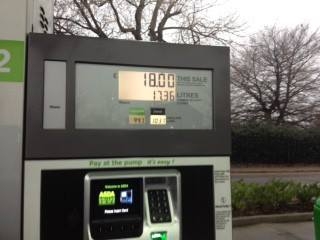
Petrol / fuel should fall to £1 a litre before Xmas

Not overly keen on the stop start as I approach roundabouts, it is nice to have the car responsive and ready to go quickly, as there tends to be a slight pause..
Yes exactly that. I've been caught out a few times with both the vehicle behind me and the one on the round-about being justifiably annoyed....But to put in context, only so when really busy and you have to quickly merge in...
 
CBA about fuel prices, don't use enough these days to make a difference.

Knew someone in the days before free phone calls who would spend ages phoning arounf for cheapest tyre deals and
travel miles when he found them !!!
 
CBA about fuel prices, don't use enough these days to make a difference.

Knew someone in the days before free phone calls who would spend ages phoning arounf for cheapest tyre deals and
travel miles when he found them !!!

You get more miles out of your tyres than you do on your fuel :)
 
Not overly keen on the stop start as I approach roundabouts, it is nice to have the car responsive and ready to go quickly, as there tends to be a slight pause..
If you are ready to pull away, you'll be in gear with the clutch near bite point. The stop/start shouldn't activate.
 
If you are ready to pull away, you'll be in gear with the clutch near bite point. The stop/start shouldn't activate.
Unfortunately it is an automatic so you have to hold it with footbrake, there is a slight delay in firing up when you release brake :)
 
Unfortunately it is an automatic so you have to hold it with footbrake, there is a slight delay in firing up when you release brake :)
I'd have thought if the car was still in gear the stop start wouldn't activate.
 
I'd have thought if the car was still in gear the stop start wouldn't activate.
Yep, if its in drive and I touch footbrake engine cuts out, and I quickly have to let foot off brake to keep engine running, otherwise I have to disable stop start function. Stop start function re activates to on when engine is switched off.
 
Yep, if its in drive and I touch footbrake engine cuts out, and I quickly have to let foot off brake to keep engine running, otherwise I have to disable stop start function. Stop start function re activates to on when engine is switched off.
That sounds a really odd system.
 
That sounds a really odd system.
Cuts out when car goes very slow and I press foot brake, assuming I am stopping. A pain at roundabouts and other give way instances, it has the feel of stalling and holding the car behind up a little, assuming they don't have the stop start also :)
 
Cuts out when car goes very slow and I press foot brake, assuming I am stopping. A pain at roundabouts and other give way instances, it has the feel of stalling and holding the car behind up a little, assuming they don't have the stop start also :)
On Ford's manual cars it doesn't activate until the car has stopped, out of gear and foot off the clutch. I assume the Ford automatic system is similar, car stopped, and out of gear. Pretty sure it doesn't activate just because the car is barely moving, seems pointless.
 
It was only around 93 when cars had to have a catalytic converter, most cars on the road today are after that date and are far cleaner, so again why didn't we have "global warming and extreme weather" before then when there was much more pollution instead of now when even though with more cars on the road, they are much more cleaner?
Three reasons.

1. Cars aren't the major contributor to greenhouse gas emissions. They're not insignificant - I believe they are about 10% of the total, globally - but obviously trends in other industries could have a bigger effect.

2. Whilst individual cars have been getting cleaner and more efficient, there are far more of them around now and it's the total emissions that counts, not the emissions per car. In round numbers, there were around 400 million cars on the roads around the world in 1980, 600 million in 1990, 750 million in 2000, and maybe 1200 million now.

3. Manufacturing a car creates broadly the same quantity of emissions as using a car over its lifespan. So the massive increase in car manufacturing in recent years has caused increased emissions, even if the cars are more efficient to use.
Everything around us has been geared up to be more efficient and use less energy for years,
But you're totally overlooking the fact that global energy use has increased hugely. Yes, we're using that energy more efficiently, but we're still using more of it. You can't deny that global emissions of so-called greenhouse gases have steadily increased.
 
On Ford's manual cars it doesn't activate until the car has stopped, out of gear and foot off the clutch. I assume the Ford automatic system is similar, car stopped, and out of gear. Pretty sure it doesn't activate just because the car is barely moving, seems pointless.
Assumption is the mother of all f*** ups. ;)

All automatics that I've driven operate exactly like that. You come to a halt, and depending on how long you have to hold the brake the stop/start could kick in just about when you are about to pull out.

Generally on all automatics I've driven the time it takes to engage stop/start also depends on how hard the brake is pressed.

The effect is not that noticeable when you have a hybrid as the electric motor obviously doesn't required starting.

Yup, actually having these kind of vehicles does make a difference to talk from experience. But granted I've not had a Ford, nor would I get on. :thumbs:
 
Assumption is the mother of all f*** ups. ;)

All automatics that I've driven operate exactly like that. You come to a halt, and depending on how long you have to hold the brake the stop/start could kick in just about when you are about to pull out.

Generally on all automatics I've driven the time it takes to engage stop/start also depends on how hard the brake is pressed.

The effect is not that noticeable when you have a hybrid as the electric motor obviously doesn't required starting.

Yup, actually having these kind of vehicles does make a difference to talk from experience. But granted I've not had a Ford, nor would I get on. (y)

Might do a little testing next time I am driving, and see if I can press brake gentle without it cutting out.
 
Three reasons.

1. Cars aren't the major contributor to greenhouse gas emissions. They're not insignificant - I believe they are about 10% of the total, globally - but obviously trends in other industries could have a bigger effect.

2. Whilst individual cars have been getting cleaner and more efficient, there are far more of them around now and it's the total emissions that counts, not the emissions per car. In round numbers, there were around 400 million cars on the roads around the world in 1980, 600 million in 1990, 750 million in 2000, and maybe 1200 million now.

3. Manufacturing a car creates broadly the same quantity of emissions as using a car over its lifespan. So the massive increase in car manufacturing in recent years has caused increased emissions, even if the cars are more efficient to use.
But you're totally overlooking the fact that global energy use has increased hugely. Yes, we're using that energy more efficiently, but we're still using more of it. You can't deny that global emissions of so-called greenhouse gases have steadily increased.

Straight from the governments website
"Emissions of these air quality pollutants from road vehicles have been reduced by improving the quality of fuels and by setting increasingly stringent emission limits for new vehicles. As an example, it would take 50 new cars to produce the same quantity of air quality pollutant emissions per kilometre as a vehicle made in 1970. Over the last twenty years increasingly stringent emission limits have been set at a European level, starting with the "Euro1" limits in 1993. From September 2015 all new cars currently have to meet the Euro 6 standard. Since 1st January 2011 all models sold have had to meet the Euro 5 standard. "
1980's cars wouldn't be much cleaner so there would have to be a lot more than 1200 million cars on the worlds roads to be anywhere near the pollution levels of the 1980's.
Car factories are a lot more efficient and use far less energy than they did in the 80's, many using wind turbines and solar energy to drastically reduce emissions. Ford's Dagenham Engine plant for example is powered solely by 3 large wind turbines (the largest in the UK) and surplus energy is put back into the national grid.
 
Last edited:
Thought experiment. Put the plug in your bath and turn the taps full on for five minutes. Then turn the taps down to a slow flow rate. After quite a while the bath will overflow. But wait! Why has it overflowed when the taps were only running slowly? Surely if running the taps slowly caused it to overflow, it should have overflowed when the taps were full on? Obviously the overflow must have been caused by something other than the taps.
But how could it overflow (warm up because of man) before baths/plugs/taps were invented?
Well, this thread is turning into a good one for connoisseurs of logical fallacies. This one is called the fallacy of the single cause.

Your error is in assuming that there is only one possible cause of global warming. But of course there could be many, and the current debate is about which one(s) are causing the observed warming in recent years.

What you're saying is like saying that people dropping matches doesnt cause forest fires, because there have been forest fires since long before matches were invented. But that ignores the possibility that forest fires can be caused by lightning strikes.
 
...As an example, it would take 50 new cars to produce the same quantity of air quality pollutant emissions per kilometre as a vehicle made in 1970.... 1980's cars wouldn't be much cleaner so there would have to be a lot more than 1200 million cars on the worlds roads to be anywhere near the pollution levels of the 1980's.
Interesting and commendable, but irrelevant.

We're not talking about air quality or pollutant emissions here, we're talking about greenhouse gases, which for the automotive industry means CO2. The Euro standards relate emissions like NOX and PM, but they're not significant greenhouse gases and therefore they're irrelevant to the climate change debate.

You knew that, surely?
Car factories are a lot more efficient and use far less energy than they did in the 80's, many using wind turbines and solar energy to drastically reduce emissions. Ford's Dagenham Engine plant for example is powered solely by 3 large wind turbines (the largest in the UK) and surplus energy is put back into the national grid.
That's very interesting, and again highly commendable, but mostly irrelevant.

Firstly we weren't talking about the carbon footprint of car manufacturing in the 1980s, we were talking about the current situation. Secondly, the energy used in car assembly plants (and therefore the potential emissions arising from them) isn't a particularly large proportion of the total carbon footprint of a car. This Guardian article suggests it's only 12%, and that metal extraction and processing is far more significant:
http://gu.com/p/2jzzk
 
Interesting and commendable, but irrelevant.

We're not talking about air quality or pollutant emissions here, we're talking about greenhouse gases, which for the automotive industry means CO2. The Euro standards relate emissions like NOX and PM, but they're not significant greenhouse gases and therefore they're irrelevant to the climate change debate.

You knew that, surely?

That's very interesting, and again highly commendable, but mostly irrelevant.

Firstly we weren't talking about the carbon footprint of car manufacturing in the 1980s, we were talking about the current situation. Secondly, the energy used in car assembly plants (and therefore the potential emissions arising from them) isn't a particularly large proportion of the total carbon footprint of a car. This Guardian article suggests it's only 12%, and that metal extraction and processing is far more significant:
http://gu.com/p/2jzzk
Whilst all car manufacturers are obligated to reduce all emissions, Vehicle EU regulations are based on CO2 emissions. Why do you think vehicles are taxed on their CO2 output?
As for carbon footprint, I see that article is from 2010, I wonder how old the information they have used is, possibly another 5 years maybe even 10yrs. I can't comment on other car manufacturers, but I assume many do likewise, but a high percentage of the materials used in Ford cars are recyclable and a lot of that material has been recycled in the first place. Manufacturers continue to make use of more and more recycled material all the time.
Before moving to powertrain development I worked in automotive manufacturing for 30yrs, you'd be surprised how it has changed in that time and the level of waste etc and energy used has dropped right down.
 
Well, this thread is turning into a good one for connoisseurs of logical fallacies. This one is called the fallacy of the single cause.

Your error is in assuming that there is only one possible cause of global warming. But of course there could be many, and the current debate is about which one(s) are causing the observed warming in recent years.

What you're saying is like saying that people dropping matches doesnt cause forest fires, because there have been forest fires since long before matches were invented. But that ignores the possibility that forest fires can be caused by lightning strikes.


???????????

I don't presume any such thing. (unlike the man made global warmists) it's natural `climate change`.

I'm not saying anything of the sort! :confused:


CO2 is a result of warming seas etc, not THE cause. Water vapour is a far bigger contributor.

I found it amusing this week, when scientists were saying that they hadn't even factored in the millions of tons of atmospheric dust, into the equation.
Oh & what is more amusing about it, they can't decide whether the dust warms, or cools, but yet they are sure man made CO2 is damaging the planet.
 
Last edited:
Just checked my fuel level, it's a little on the low side. Time to fill up with this so called cheap fuel. If I have the time that is :-)
 
thrupance
A thruppeny bit.
Thrupp'ny bit
I bet the younger than 40's have no idea what we are on about. :LOL:
And which ever way you look at it, or pronounce it, its still rhyming slang :thumbs:
:D

As to whether or not global warming is a man made phenomenon, were all gonna die, whether that's slowly, or fast.
By our hand, the hand of god
or just the circle of life (/ Elton John playing in the background :D
 
If I used our car a great deal, I would look into bio diesel. Got a friend who does a good bit of mileage and he sometimes uses bio diesel. Not too sure if it's any good for engines.
 
If I used our car a great deal, I would look into bio diesel. Got a friend who does a good bit of mileage and he sometimes uses bio diesel. Not too sure if it's any good for engines.
If you don't do many miles, why did you buy a diesel? It's not really worth it unless you do more than average miles.
As for biodiesel. I'd avoid it. Supermarket and a lot of the smaller brand diesel contains a higher biodiesel content than the big names. I believe it's something like 7% against 5% content, but the 2% is noticeable, engine doesn't run so well, slightly down on power and economy plus some garages have reported finding a green substance in fuel systems which has been attributed to the use of higher content biodiesel.
 
If you don't do many miles, why did you buy a diesel? It's not really worth it unless you do more than average miles.
As for biodiesel. I'd avoid it. Supermarket and a lot of the smaller brand diesel contains a higher biodiesel content than the big names. I believe it's something like 7% against 5% content, but the 2% is noticeable, engine doesn't run so well, slightly down on power and economy plus some garages have reported finding a green substance in fuel systems which has been attributed to the use of higher content biodiesel.

It had the right spec at time of getting the car :)

Just an idea with the bio diesel, as a friend uses it without problems, or so he says..
 
indeed diesel for small distances is a great way to spend a fortune on DPF.

diesel still well over £1 here.

re supermarkets and biodiesel, on the rare occasion i use morrisons fuel i always find my diesel performs like a bag of spanners.
 
13996-1450184962-4ca32c0d679c454e226c4416be2e86f5.jpg


Done a bit of shopping today, so I thought I would top up some fuel. It is only Petrol that has dropped it is 99.7 per litre. Diesel is 103.7 per litre :(
 
indeed diesel for small distances is a great way to spend a fortune on DPF.

diesel still well over £1 here.

re supermarkets and biodiesel, on the rare occasion i use morrisons fuel i always find my diesel performs like a bag of spanners.


Morrisons is the only fuel I've ever had problems with.

Diesel still up around 104p/l but petrol just under the quid (at Sainsbury's.)
 
Filled up with Shell V power nitro + petrol today, £1.17 / litre, I'm sure it was cheaper a fortnight ago.
 
Filled up with Shell V power nitro + petrol today, £1.17 / litre, I'm sure it was cheaper a fortnight ago.
Well they have to subsides the other fuel price drop some how ;)
 
I don't recall seeing any subsidence. ;)
b****r! :D
subsidise
subsidise
subsidise
subsidise
subsidise
subsidise
subsidise
subsidise
subsidise
subsidise
subsidise

subsidise
subsidise
subsidise
subsidise
subsidise
subsidise

subsidise
subsidise
subsidise
subsidise

subsidise
subsidise

subsidise
subsidise
subsidise
subsidise
subsidise
subsidise

subsidise
subsidise
subsidise
subsidise

subsidise
subsidise

subsidise
subsidise
subsidise
subsidise

subsidise
subsidise

subsidise
subsidise
subsidise
subsidise

subsidise
subsidise

subsidise


Last edited:
Diesel cost me Mrs Nod 99.9p/litre earlier. She had to use a 7p/litre voucher though! Hoping petrol's still cheap next week when hers needs filling. Would do it sooner but the brake light switch is FUBAR so not using it other than to take it down to get the switch replaced. (Would do it myself but I can't get at the bloody thing!)
 
Diesel cost me Mrs Nod 99.9p/litre earlier. She had to use a 7p/litre voucher though! Hoping petrol's still cheap next week when hers needs filling. Would do it sooner but the brake light switch is FUBAR so not using it other than to take it down to get the switch replaced. (Would do it myself but I can't get at the bloody thing!)
Try mixing your diesel with Biodiesel, you might be able to get the price to an average of 75/85p per litre or even less. Might look into it myself :)
 
A little research tells me that the extra I could spend on more filter changes etc. could quickly wipe out any savings. If the s***box Clio was a Diesel, I might try it but it's a petrol. (On a motorway run, my 3l Diesel is more economical than the 1.2 petrol, not to mention far more civilised!)
 
Back
Top