"Panasonic G series" Owners Thread

I'm talking about lenses with no stabilisation apart from the 12-35 which haa ois.
More specifically the Olympus 12-45 and 12-40, both excellent lenses which work well on Panasonic cameras.
so the Olympus lenses use the in built IBIS on a Panasonic? Is this good stabilisation without the Power OIS of the Pana lenses?
 
I take it Prime lenses have a fixed single point?
Do you have to double all the zoom specs on Pana lenses? For instance my 100 - 300 is actually a 200 - 600

Prime lenses have a fixed focal length such as 12 or 60mm, whereas zooms cover a range of focal length like 12-60mm.

Advantages of primes can include a wider aperture and sometimes they can be smaller than zooms and traditionally they had better image quality but that may not always be true as there are some excellent zooms these days. Zoom lenses have the advantage of being able to give you different focal lengths without changing lenses.

Panasonic and other Micro Four Thirds cameras use a smaller sensor than that used in FF cameras and they have a x2 crop factor compared to "Full Frame 35mm" so a 17mm lens on MFT equates to a 34mm lens on FF.

For old fuddy duddies who grew up with film it's sometimes helpful to think about the crop factor to help understand it all. For example I liked my 35mm lens on my RF but on MFT that would be the equivalent of 70mm so I'd need to buy a 17mm lens to use on MFT to get the same field of view I'd get from a 35mm on that old film RF. So, in that sense although your 100-300mm is definitely a 100-300mm lens and nothing can change that... because that's what it is... it gives the same field of view as a 200-600mm lens would on FF because MFT uses a smaller sensor. The crop factor also works for depth of field and a 17mm lens at f4 will give the same depth as a 35mm lens at f8 on FF.

Light gathering is the same across formats and it doesn't change and there's no crop factor for exposure. If a MFT set up gives a good exposure at 17mm, f4, 1/200 and ISO 200 the FF set up to get the same field of view and exposure will be 35mm, f4, 1/200 and ISO 200. The only difference will be that the FF system will have shallower depth of field.

This is all just for people like me who're stuck in the past and younger people and those who don't have to think back 30 years to understand things needn't bother too much with all this unless they move to another format like APS-C or FF and want to use similar lenses. They then might want to think about crop factors to work out what lenses they want to buy.

Hope that helps :D
 
Prime lenses have a fixed focal length such as 12 or 60mm, whereas zooms cover a range of focal length like 12-60mm.

Advantages of primes can include a wider aperture and sometimes they can be smaller than zooms and traditionally they had better image quality but that may not always be true as there are some excellent zooms these days. Zoom lenses have the advantage of being able to give you different focal lengths without changing lenses.

Panasonic and other Micro Four Thirds cameras use a smaller sensor than that used in FF cameras and they have a x2 crop factor compared to "Full Frame 35mm" so a 17mm lens on MFT equates to a 34mm lens on FF.

For old fuddy duddies who grew up with film it's sometimes helpful to think about the crop factor to help understand it all. For example I liked my 35mm lens on my RF but on MFT that would be the equivalent of 70mm so I'd need to buy a 17mm lens to use on MFT to get the same field of view I'd get from a 35mm on that old film RF. So, in that sense although your 100-300mm is definitely a 100-300mm lens and nothing can change that... because that's what it is... it gives the same field of view as a 200-600mm lens would on FF because MFT uses a smaller sensor. The crop factor also works for depth of field and a 17mm lens at f4 will give the same depth as a 35mm lens at f8 on FF.

Light gathering is the same across formats and it doesn't change and there's no crop factor for exposure. If a MFT set up gives a good exposure at 17mm, f4, 1/200 and ISO 200 the FF set up to get the same field of view and exposure will be 35mm, f4, 1/200 and ISO 200. The only difference will be that the FF system will have shallower depth of field.

This is all just for people like me who're stuck in the past and younger people and those who don't have to think back 30 years to understand things needn't bother too much with all this unless they move to another format like APS-C or FF and want to use similar lenses. They then might want to think about crop factors to work out what lenses they want to buy.

Hope that helps :D

Very interesting Alan, thank you.
 
If you decided to go for a 14-42, be patient, look on ebay, and find one with a camera attached.
From the middle of last December, up until Easter, I bought a G2, two G3s and a G5 all with 14-42 Mega OIS lenses for £50-£60, by bidding in the last few seconds. I lost dozens as well from being outbid, but patience eventually wins :)

And yes, Mega OIS "takes over" but it is still very good.

I also have an Olympus 14-42 that retracts when not in use and is very small, that cost less, no stabilisation but works OK on the G80, but distortions are not corrected.
I don't know which Olympus lenses fully integrate with Panasonic cameras.


The 12-60 is still the best though.
 
so the Olympus lenses use the in built IBIS on a Panasonic? Is this good stabilisation without the Power OIS of the Pana lenses?
Yes, the IBIS is very effective and works on five axis as opposed to the three with just the lens stabilisation.

Lens correction is an across brands MFT standard, I use Olympus lenses almost exclusively on my Panasonic cameras.
Can assure you that lenses such as the 12-45 and 12-40 make for excellent distortion free combinations.

One misnomer is an Olympus lens with ois automatically overrides the Panasonic camera IBIS
Its lens ois or nothing, using the 12-100 on a G9 is a good example of this.
Fortunately the lens stabiliser is very good and I never have any issues, probably my most used combo.

So much misinformation, another example being the Olympus Lens Fn button doesn't work with Panasonic, it does.
 
Lens correction is an across brands MFT standard, I use Olympus lenses almost exclusively on my Panasonic cameras.
Can assure you that lenses such as the 12-45 and 12-40 make for excellent distortion free combinations.

If lens corrections are standard, Ithat is good to know, but change my statement to the 14-42 Olympus lens I have, that I mentioned in my previous post, does not provide as good correction as the Panasonic 14-42.

pan.jpg
Panasonic 14-42


oly.jpg
Olympus 14-42


I was talking about the specific lens I have, I don't have any other Olympus lenses apart from the ones from me e510 many years ago :), so I have no idea what others are like.
 
Prime lenses have a fixed focal length such as 12 or 60mm, whereas zooms cover a range of focal length like 12-60mm.

Advantages of primes can include a wider aperture and sometimes they can be smaller than zooms and traditionally they had better image quality but that may not always be true as there are some excellent zooms these days. Zoom lenses have the advantage of being able to give you different focal lengths without changing lenses.

Panasonic and other Micro Four Thirds cameras use a smaller sensor than that used in FF cameras and they have a x2 crop factor compared to "Full Frame 35mm" so a 17mm lens on MFT equates to a 34mm lens on FF.

For old fuddy duddies who grew up with film it's sometimes helpful to think about the crop factor to help understand it all. For example I liked my 35mm lens on my RF but on MFT that would be the equivalent of 70mm so I'd need to buy a 17mm lens to use on MFT to get the same field of view I'd get from a 35mm on that old film RF. So, in that sense although your 100-300mm is definitely a 100-300mm lens and nothing can change that... because that's what it is... it gives the same field of view as a 200-600mm lens would on FF because MFT uses a smaller sensor. The crop factor also works for depth of field and a 17mm lens at f4 will give the same depth as a 35mm lens at f8 on FF.

Light gathering is the same across formats and it doesn't change and there's no crop factor for exposure. If a MFT set up gives a good exposure at 17mm, f4, 1/200 and ISO 200 the FF set up to get the same field of view and exposure will be 35mm, f4, 1/200 and ISO 200. The only difference will be that the FF system will have shallower depth of field.

This is all just for people like me who're stuck in the past and younger people and those who don't have to think back 30 years to understand things needn't bother too much with all this unless they move to another format like APS-C or FF and want to use similar lenses. They then might want to think about crop factors to work out what lenses they want to buy.

Hope that helps :D

Very nicely explained Alan.

And here's a simple illustration showing how different sensors sizes at the same focal length give a different field of view (fov). The narrower fov equals more magnification.

daec5154644d4b4397b09de2ea588d25
 
If lens corrections are standard, Ithat is good to know, but change my statement to the 14-42 Olympus lens I have, that I mentioned in my previous post, does not provide as good correction as the Panasonic 14-42.

View attachment 357473
Panasonic 14-42


View attachment 357474
Olympus 14-42


I was talking about the specific lens I have, I don't have any other Olympus lenses apart from the ones from me e510 many years ago :), so I have no idea what others are like.
Possibly not so well corrected with older lenses and/or bodies, I take your point about being specifically about the 14-42.

Tried to find a photo with plenty of verticals and some depth to show how newer combinations work together.
This is taken with a Panasonic GX9 and Olympus 12-40, all looks ok to me and the raw would be corrected in Lightroom.

P1002944 1.jpg
 
As I understood it, the Mega OIS takes control and you don't get the IBIS?
Not necessarily. Panasonic's lens stabilisation (power or mega) work in conjunction with in-body stabilisation to give an increase in stabilisation effect, unlike using an Olympus stabilised lens on a Panasonic body. Although the benefits are often small. Personally I'm generally in favour of using Panasonic lenses on Panasonic bodies, and Olympus on Olympus, as sometimes strange effects can occur, such as the infamous Panasonic 7-14mm lens which can give strange artefacts if used on an Olympus body. That said, I do have some Oly lenses for my G9. Sometimes it's just an irrational feeling. :p
 
"Not necessarily. Panasonic's lens stabilisation (power or mega) work in conjunction with in-body stabilisation to give an increase in stabilisation effect,"

I don't think that is correct, only the Power OIS works with the in body stabilisation.

Neither the G80 or the G9 allow you to turn off the lens stabilisation and allow you to use just the inbody stabilisation with a Mega OIS lens (I don't think with either type of lens in fact)

If there is a way, I would be very pleased to hear how (as I think many people would be) :)
 
And here's a simple illustration showing how different sensors sizes at the same focal length give a different field of view (fov). The narrower fov equals more magnification.
Which brings us to the misconceptions around sensor size. :naughty:

In the days of film, it was generally accepted that, as the film area was reduced, the image quality was reduced. This was because there were only so many crystals in a given area of emulsion (although this could be mitigated with various techniques).

Digital sensors do not exhbit this effect. If there are 20 million pixels on a full frame sensor and 20 million pixels on a Micro Four Thirds sensor, the resulting images will be, largely speaking, the same in terms of sharpness and detail. This is because a pixel records much the same level of information whatever its size. There are, of course, variations between the light level data recorded by different sensors but these are seldom of importance in general photography.
 
"Not necessarily. Panasonic's lens stabilisation (power or mega) work in conjunction with in-body stabilisation to give an increase in stabilisation effect,"

I don't think that is correct, only the Power OIS works with the in body stabilisation.

Neither the G80 or the G9 allow you to turn off the lens stabilisation and allow you to use just the inbody stabilisation with a Mega OIS lens (I don't think with either type of lens in fact)

If there is a way, I would be very pleased to hear how (as I think many people would be) :)
Agree about being unable to turn off just one variety of stabilisation, but as far as I remember (haven’t the energy to check) Panasonics own explanation of stabilisation is ambiguous about Power OIS versus Mega. I thought that it was simply a matter of one being newer and therefore better than the other. Can’t remember which is which though. However, for practical purposes I suspect there’s little in it. Stabilisation has so many variables you would have to try exactly the same camera with exactly the same lens at exactly the same time with the same user to discover which was better :D
 
Which brings us to the misconceptions around sensor size. :naughty:

In the days of film, it was generally accepted that, as the film area was reduced, the image quality was reduced. This was because there were only so many crystals in a given area of emulsion (although this could be mitigated with various techniques).

Digital sensors do not exhbit this effect. If there are 20 million pixels on a full frame sensor and 20 million pixels on a Micro Four Thirds sensor, the resulting images will be, largely speaking, the same in terms of sharpness and detail. This is because a pixel records much the same level of information whatever its size. There are, of course, variations between the light level data recorded by different sensors but these are seldom of importance in general photography.
I think the issue is, or was, that the tighter the pixels are packed together the more electronic interference there would be. But with technological advances this interference has undoubtedly been significantly reduced.
 
you would have to try exactly the same camera with exactly the same lens at exactly the same time with the same user to discover which was better :D
I think that's about right.(y)
 
I think the issue is, or was, that the tighter the pixels are packed together the more electronic interference there would be.
That is part of it but the more common argument is that the smaller the "pit" in each pixel the fewer photons will be captured in each pixel, reducing the information available from the array.

This sort of technology moves along so fast that, almost before someone finishes writing that sort of criticism, the parameters have changed.
 
Agree about being unable to turn off just one variety of stabilisation, but as far as I remember (haven’t the energy to check) Panasonics own explanation of stabilisation is ambiguous about Power OIS versus Mega. I thought that it was simply a matter of one being newer and therefore better than the other. Can’t remember which is which though. However, for practical purposes I suspect there’s little in it. Stabilisation has so many variables you would have to try exactly the same camera with exactly the same lens at exactly the same time with the same user to discover which was better :D
I don't remember where I saw an "official" difference, but I think there was only one Mega OIS that supports Dual IS, and I think that was a short zoom.
Otherwise only the lens OIS is in operation.

I agree it is hard to measure precisely, but it is easy to see when you can use the 100-400 and get consistently better results at low shutter speeds :)
 
This sort of technology moves along so fast that, almost before someone finishes writing that sort of criticism, the parameters have changed.
This true.

I bought a 16mp GX80 over a 20mp GX9 because I went along with the theory that bigger pixels are better than small. I don't know if it was true at the time, I don't know if it was true five minutes later.
 
This true.

I bought a 16mp GX80 over a 20mp GX9 because I went along with the theory that bigger pixels are better than small. I don't know if it was true at the time, I don't know if it was true five minutes later.
I have had both and its not correct, G9 is definitely a step up too.
Detail is a bit better, contrast and colour more markedly so.
Another advantage is the ability to print A3 at 300 dpi with no upscaling.
 
G9 is definitely a step up too.
I like my G9 a great deal but I can't see that its output is noticeably better, for my needs, than the GX7 or the G5, to name just two. In fact, I'm still very happy with the output from my GH2.
 
I like my G9 a great deal but I can't see that its output is noticeably better, for my needs, than the GX7 or the G5, to name just two. In fact, I'm still very happy with the output from my GH2.
Looking back on some of my old GH1 and indeed G1 shots, some were mighty fine!
 
This true.

I bought a 16mp GX80 over a 20mp GX9 because I went along with the theory that bigger pixels are better than small. I don't know if it was true at the time, I don't know if it was true five minutes later.
I bought a TZ70 because I thought it might have lower noise than the TZ60. It didn't :)

I have a G80 and a G9, in good light without too much cropping, they are quite similar, but if you need to crop, the G9 is better, and I don't notice any extra noise, in fact it feels like there is less.
I wouldn't part with the G80 though.
 
Looking back on some of my old GH1 and indeed G1 shots, some were mighty fine!

I really liked my G1 and at lower ISO's the output can IMO be outstanding.

I have the GM5, GX80 and GX9 and to me there is little difference between them. Maybe I don't see much difference because I shoot raw and process each picture for best effect or maybe it's because I'm not too picky but even if the IQ is identical (and I'm not saying it is) that means that the extra pixels that the 20mp sensor brings are free and you get a bigger picture with no downside :D I believe the 20mp does have a little bit more DR though but in reasonable light I'd happily use any of these cameras without wishing I'd used another.
 
Quick snap from my new 9/1.7, too hot to linger longer, with the wind blowing it feels like an oven out there.
Taken wide open, looks good so far, photo is heavily compressed under 500kb to display here/
Lens feels very low rent compared to the 15/1.7, all plastic (apart from the mount) with a skimpy little hood
Not convinced its staying yet, seems like a lot of cash for such a cheap feeling lens, more tests to come.

church (1 of 1).jpg
 
Last edited:
Quick snap from my new 9/1.7, too hot to linger longer, with the wind blowing it feels like an oven out there.
Taken wide open, looks good so far, photo is heavily compressed under 500kb to display here/
Lens feels very low rent compared to the 15/1.7, all plastic (apart from the mount) with a skimpy little hood
Not convinced its staying yet, seems like a lot of cash for such a cheap feeling lens, more tests to come.

View attachment 357522
No sign of mine yet :(. My understanding is that it's a great lens, and very light. With lightness usually comes a "cheap" feel, but my reasoning is that something so light will always be with me, unlike my late 8-18, which I always had to make a conscious effort to take.

PS it's not burning hot here, just very warm, partly overcast, and blowing a hooley.
 
No sign of mine yet :(. My understanding is that it's a great lens, and very light. With lightness usually comes a "cheap" feel, but my reasoning is that something so light will always be with me, unlike my late 8-18, which I always had to make a conscious effort to take.

PS it's not burning hot here, just very warm, partly overcast, and blowing a hooley.
I agree about the carrying it with you, still got my 8-18 so no rush one way or another.
Ultimately it will be performance that's the deciding factor, we shall see

Weather station currently showing 32.9c and that's without the convection effect.

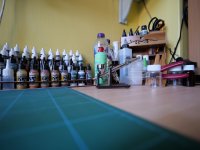
Another one, indoors now and a test of its semi close performance.
Focus is on the front of the airbrush stand, colours seem good when compared to the paint pots.

P1005612 1.jpg
 
I agree about the carrying it with you, still got my 8-18 so no rush one way or another.
Ultimately it will be performance that's the deciding factor, we shall see

Weather station currently showing 32.9c and that's without the convection effect.

Another one, indoors now and a test of its semi close performance.
Focus is on the front of the airbrush stand, colours seem good when compared to the paint pots.

View attachment 357529
Looking good, precious little distortion
 
Looking good, precious little distortion
Found it to be a much better fit on my GX9, can see it working very nicely with the 15/1.7
Its staying, cash is spent now and would only waste it on something else I didn't really need.
Very impressive close up, not quite sure why i would use it like that, but you never know.
Reckon it could be very good for night skies, might have to check out my milky way app.
 
Found it to be a much better fit on my GX9, can see it working very nicely with the 15/1.7
Its staying, cash is spent now and would only waste it on something else I didn't really need.
Very impressive close up, not quite sure why i would use it like that, but you never know.
Reckon it could be very good for night skies, might have to check out my milky way app.
Well done! I'm sure you can do lots with that.
 
Harsh sunlight today ... 12-60 at 12mm, close focusing, A mode at f/14, -2 EV

could be a lot sharper, I know, but I like it.

AM-JKLW9u7AQm9Q_6FFlYjAQ7XxrSx4E7zas_yKP2n_XtERqU5fkHxM43a1SnM64QcIVehhNnkRbNXx-dHxJ8CQonyY9_wA0ToMdcuUEYfyLP-n5vmRTqKLrcgLFtG9vcWptA4JaCWLinqgnoLRX7OfYokyFkQ=w698-h866-no
It's an interesting photo, two strong colours in the foreground and background plants, and the shadows to the right.
It has a mysterious element but calming at the same time.
 
Not really my thing, but its certainly a very good lens for that type of photo.
I'll see if I can find something similar to post on here, no flowers in my garden though.
Always suffered badly with hay fever and I detest gardening, limit it to mowing the grass.
Found this little berry hiding in an overgrown pot, very good wide open and close in.
P1015670 1.jpg
 
Last edited:
such as the infamous Panasonic 7-14mm lens which can give strange artefacts if used on an Olympus body
this was in fact a contributory factor to leaving m43 as my primary system narly 9 years ago. At that time, there wasn't a suitable alternative lens. Quite different situation nowadays, of course.
 
Just checked with UK Digital re the 9mm. Apparently they had 2 last week, out of a total of 40 into the UK. They hope to get their next delivery next week. :p
 
Back
Top