


ancient_mariner
Moderator
- Messages
- 27,766
- Name
- Toni
- Edit My Images
- No
Apologies If I upset anyone by putting it in the film section.
Not at all - it just warranted a wider audience.
Apologies If I upset anyone by putting it in the film section.

I've been thinking about this, and while we both know that scientific testing of this sort only draw conclusions likely to be applicable to the (very large) majority, I'm still surprised that in the tiny sample of this thread, you, and @Barney and @AndrewFlannigan all seem to be outliers.FWIW the whole assembly appears different lengths if one glances, but a moment spent looking at the *lines* will tell you they are the same length. The cause would appear to be that this is a trick question and many will look at the assembly and not the lines.

:max_bytes(150000):strip_icc()/muller-lyer-illusion-5672bd393df78ccc15f7d08d.jpg)
Can I confirm you are all now looking at the real illusion (as I subsequently posted a link to) and not the indicative diagram I first posted.
Thanks, the example with the red lines is meant to "break" the illusion, so it shouldn't be ambiguous.I just went to the link - not sure I can tell any more because I 'know' the right answer. The version with the red line is less ambiguous because you can see the line itself rather than the line merging with the arrows.

I did and that's when the idea of the camouflage effect occured to me.Can I confirm you are all now looking at the real illusion (as I subsequently posted a link to) and not the indicative diagram I first posted.


Thanks, I'll try and have a look at these.I did and that's when the idea of the camouflage effect occured to me.
I think it's worth reading up on this subject and especially how it was used in conflict. A couple of articles to provide a starting point (but there's a great deal more on the subject) ...
Military deception - Wikipedia
en.wikipedia.org
Middle East Command Camouflage Directorate - Wikipedia

In reality, all of this is "theoretical" in that very little is known about how we actually see. And that area of study is ongoing/evolving. I read a recent study that showed humans perceive an object's location with only one half of the brain. This is very similar in function/purpose as to how a duck can sleep with one eye open while the other eye and half of it's brain sleeps.I've been thinking about this, and while we both know that scientific testing of this sort only draw conclusions likely to be applicable to the (very large) majority,
I agree. I also think that most of a human's initial visual interpretation is based on survival instinct and previous knowledge.Having looked at the page you linked to, it seems to me that the illusion works (when it does) because our brains build gestalts from objects of interest, which would be an important survival tool in many environments.
Seems reasonable. I have mentioned elsewhere that as we understand more about the brain, the idea of a left brain and right brain is no longer considered likely and that most activity appears to be shared across both sides of the brain. This seems to be a good evolutionary strategy as it should offer some survival benefits if an animal suffers a minor brain injury.In reality, all of this is "theoretical" in that very little is known about how we actually see. And that area of study is ongoing/evolving. I read a recent study that showed humans perceive an object's location with only one half of the brain. This is very similar in function/purpose as to how a duck can sleep with one eye open while the other eye and half of it's brain sleeps.
Of course the girl is part of the overall image, and I am trying to work out what compositional techniques lead me to those feelings and impressions so that I can use them myself,
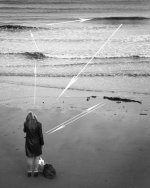
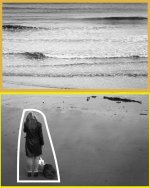

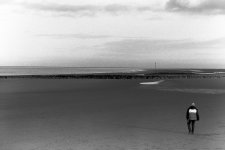
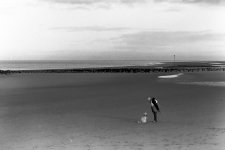
I don't see a man scolding the dog either, as SK66 said it looks to me as though he's bent forward to talk to his friend.What drew me to this scene, which transpired over approximately 5-10 seconds was of course man and dog on beach with his jacket picked out by the light, but as I watched and processed what was going on (the dog had been running about trying to contact a group of three other dogs away to the right) I determined he was scolding the dog, his posture stiff, domineering and bent forward from the hip arms thrust behind him rigidly - he was not reaching out with a treat, happy pat or kind word. The dog sat there contained, but indifferent to the owners posturings, But, still, despite being hero lit he was the villain, the pair of them in their own worlds insulated from the beauty, expanse and freedom of their surroundings, the dog sat captive in a prison created by his master. The master, isolated within the freedom of the scene (a happy beech dog walk), ignored by the dog, constrained and contorted by his own emotions. I made the decision to place them in a corner of the vast open space to reflect the stark contrast and their confinement .
The title I could not make up my mind, "Prisoners" or "Freedom ?"
I think after, a day or two, That "Freedom ?" would be better, and possibly encourage the viewer to consider the scene more thoughtfully. Is it even interesting? or is it even worth looking at at all.
Thanks for all the constructive advice and helping me better understand why the photo does not communicate my intentions, I am grateful of the suggestions, particularly for the "gloom" aspect, I had not identified that and only goes to reflect the gloom of the participants and enhances the photo. IMV.
The bright spot on the left is in another couple of snaps, must have a leaky seal.
Moving to the right, I feel, would have reduced the impact of the owners aggressive posture and negated the story if not entirely but substantially, and I enjoyed the tension between the posture and the hero lighting, but anecdotally the lighting may have caused a misinterpretation.
The owner and dog carried on running about and strolling in the last of the sunshine so a happy ending, the photo is only a glimpse into what I saw in those few moments.
It's might be worth reflecting on whether a single photograph can adequately tell a story? I often think not. What we see is a slice of time that has been frozen - 125/1 perhaps, but things have happened in the 10 secs before and after the photograph was made, things you've seen / emotions you felt, which we the viewers don't see or feel because we were not there. Are there pictures on your contact sheet that you can present alongside your original photo that help explain the story?What drew me to this scene, which transpired over approximately 5-10 seconds was of course man and dog on beach with his jacket picked out by the light, but as I watched and processed what was going on (the dog had been running about trying to contact a group of three other dogs away to the right) I determined he was scolding the dog, his posture stiff, domineering and bent forward from the hip arms thrust behind him rigidly - he was not reaching out with a treat, happy pat or kind word. The dog sat there contained, but indifferent to the owners posturings, But, still, despite being hero lit he was the villain, the pair of them in their own worlds insulated from the beauty, expanse and freedom of their surroundings, the dog sat captive in a prison created by his master. The master, isolated within the freedom of the scene (a happy beech dog walk), ignored by the dog, constrained and contorted by his own emotions. I made the decision to place them in a corner of the vast open space to reflect the stark contrast and their confinement .
The title I could not make up my mind, "Prisoners" or "Freedom ?"
I think after, a day or two, That "Freedom ?" would be better, and possibly encourage the viewer to consider the scene more thoughtfully. Is it even interesting? or is it even worth looking at at all.
Thanks for all the constructive advice and helping me better understand why the photo does not communicate my intentions, I am grateful of the suggestions, particularly for the "gloom" aspect, I had not identified that and only goes to reflect the gloom of the participants and enhances the photo. IMV.
The bright spot on the left is in another couple of snaps, must have a leaky seal.
Moving to the right, I feel, would have reduced the impact of the owners aggressive posture and negated the story if not entirely but substantially, and I enjoyed the tension between the posture and the hero lighting, but anecdotally the lighting may have caused a misinterpretation.
The owner and dog carried on running about and strolling in the last of the sunshine so a happy ending, the photo is only a glimpse into what I saw in those few moments.

Of course, this is just my interpretation of the image. I can't say if any of it is actually why the image was composed like this. And it is quite likely the "why" wasn't even known or considered in any great detail to start with.
I don't see a man scolding the dog either, as SK66 said it looks to me as though he's bent forward to talk to his friend.
It's might be worth reflecting on whether a single photograph can adequately tell a story? I often think not. What we see is a slice of time that has been frozen - 125/1 perhaps, but things have happened in the 10 secs before and after the photograph was made, things you've seen / emotions you felt, which we the viewers don't see or feel because we were not there. Are there pictures on your contact sheet that you can present alongside your original photo that help explain the story?
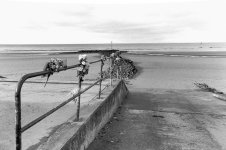
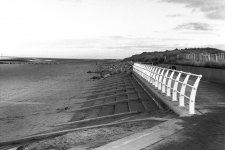
I would say neither, unless it's staged no scene appears with the intention of it being photographed, we as photographers see an opportunity to record what is there. Sometimes you're trying to convey a story, sometimes we just think it looks nice, and sometimes we're trying to 'show off' a skill.Did the scene appear before me so that I could take a photograph of it, or did the photo appear so I could learn about seeing and understand how better to communicate my intentions
A a good point, which I agree with. but its also worth reflecting on how it can also apply to a single photograph and ask "what is it's story", which could be a simple one.It's might be worth reflecting on whether a single photograph can adequately tell a story? I often think not. What we see is a slice of time that has been frozen - 125/1 perhaps, but things have happened in the 10 secs before and after the photograph was made, things you've seen / emotions you felt, which we the viewers don't see or feel because we were not there. Are there pictures on your contact sheet that you can present alongside your original photo that help explain the story?
I do believe it is important to "create images" rather than just document random moments in time; that's where the art aspect comes into it. But I tend to be more of a technician, and less of an artist in general.I do not know if your interested in what I "see" but since you are reading this I will carry on trying to explain, to you it may well be quite meaningless and poppycock, and you could well be right.
A single image is certainly capable of telling "a story." But "what that story is" is never certain; because it depends on the viewer's state and prior experience/knowledge.So either intellectually or/and emotionally (intuitively) your can choose your framing and moment of exposure to try and make a single photograph that tells the story of what you saw and felt at that instant.

I also tend to have trouble with the art aspect of images as well... like when you describe the first image. I didn't get any of that from the image, but after reading your description I can see why you did. And I can see unrealized potential to be explored as well; if that's what you felt/saw, and purposefully wanted to convey, I think you probably could have done better. Digital does have an advantage here in that you can review the execution of the idea immediately.
I'm getting confused with which thread is which now but I've recently posted about this, just not sure where :-(A single image is certainly capable of telling "a story." But "what that story is" is never certain; because it depends on the viewer's state and prior experience/knowledge.
I know what I wanted to convey with this image, but I can also see an entirely different interpretations/feeling. I saw it representing the pointless struggle of the human condition (life). Someone else could see it as hopeful and leading to something unseen but pleasant/happy (i.e. the stairway to heaven).
Stairway to Nowhere by Steven Kersting, on Flickr
When I first saw the image I didn't even notice the flowers really. Part of that is simply due to size as viewed here. The smaller individual aspects are, and the closer together they appear, the more they are combined as a single element (Gestalt grouping), and the less they are perceived/considered individually. On my computer the image is about 6" wide and almost 2ft away; by standard viewing conditions I should be viewing it from about 7" away, or it should be ~ 16" wide.Thanks for your opinions Steven as there is much I am agreement with, in this reply, however, I would like to concentrate on the above part of your post and would welcome your extrapolation if possible.
 www.independent.co.uk