- Messages
- 3,043
- Name
- Wayne
- Edit My Images
- No
ok by me if you think it may of broader interestI wonder if this discussion might not be best continued in 'Talk Photography'?
How would participants feel about it being relocated?
ok by me if you think it may of broader interestI wonder if this discussion might not be best continued in 'Talk Photography'?
How would participants feel about it being relocated?
Well it was a little ambiguous really as I was mainly directing the comment towards myself, for instance I used to keep RAW files of my images but was constantly re-visiting them to change this or that with rarely any improvement, till one day I decided to process the images how I felt at that time and delete the RAW file. Mistake? maybe but I feel happier for it.
Take your point about this being a F&C forum and as I haven't shot film for about 15 years I'll bow out now.
To me, the answer is "I see, therefore I see".This has led me to new questions, do we see with our eyes or see with our brain, essentially two lumps of meat, three if you count each eye, or see with our consciousness?
I thought about that Andrew, and pondered if the gas in the pipe knew it was cooking a pan of spaghetti !To me, the answer is "I see, therefore I see".
Other responses are, I'm sure, available.
I think we already started to discussed this:I am still looking at your photo Jack, in my mind of course. It really is very good IMO, I think I have figured out why my brain could not complete it, because of the focal length and the relatively flat depth of field, i originally concluded, somewhat hastily in hindsight, that the ellipses and the wave crest were leading lines into the girl which they are of course, but they also have the added complexity of adding serious weight to the top of the image bearing down on her and crushing her into the crumpled heap of baggage, the seaweed to the right also is acting as a restraint, forcing her further into the corner.
This has led me to new questions, do we see with our eyes or see with our brain, essentially two lumps of meat, three if you count each eye, or see with our consciousness?
I am still looking at your photo Jack, in my mind of course. It really is very good IMO, I think I have figured out why my brain could not complete it, because of the focal length and the relatively flat depth of field, i originally concluded, somewhat hastily in hindsight, that the ellipses and the wave crest were leading lines into the girl which they are of course, but they also have the added complexity of adding serious weight to the top of the image bearing down on her and crushing her into the crumpled heap of baggage, the seaweed to the right also is acting as a restraint, forcing her further into the corner.
This has led me to new questions, do we see with our eyes or see with our brain, essentially two lumps of meat, three if you count each eye, or see with our consciousness?
Doesn't worry me that much, though I don't feel comfortable posting digital images in the F&C forum.I wonder if this discussion might not be best continued in 'Talk Photography'?
How would participants feel about it being relocated?
I don't get into many philosophical discussions Graham but will jump into it with abandon. Much like my photography, I dont fully understand the terminology or the basic foundations on which it stands.I think we already started to discussed this:
In any meaningful way, we see with our brains, but we still need eyes to provide the raw data for the brain to interpret.
What we "see" is complex, but maybe you are asking a subtler question, as all of us is a collection of meat.
Your second post on spaghetti suggests a more existential question.
Damn right I got something out of it Jack, and for that I sincerely thank you. I had considered the question of weighting, balance and proportion at its most simplistic, ie interesting sky 2/3 of image, interesting foreground 2/3 of image, but had not considered before the mood that can be created by the weighting of items within a photo. It took me a while to get there, but it will feature in future appreciation of photographs and the skills of the photographer.Morning Wayne, hope you are well. Quite the imagination you have therebut that's good and I'm glad you got something out of the image.
As to your question, I think we 'see' with our eyes but 'imagine' with our brains and between both, we make a picture.
Neither do I really. I am interested in the psychology of how we see, and its implications on taking and viewing photographs, as well as in other aspects of life. But I thought, your spaghetti allusion was going down a philosophical route.I don't get into many philosophical discussions Graham but will jump into it with abandon. Much like my photography, I dont fully understand the terminology or the basic foundations on which it stands.
Edit, I had to look up existential.
Thanks for the Link Graham. At the risk of making myself sound foolish for incorrect understanding, terminology or phrasing,Neither do I really. I am interested in the psychology of how we see, and its implications on taking and viewing photographs, as well as in other aspects of life. But I thought, your spaghetti allusion was going down a philosophical route.
I used the Muller-Lyer illusion that I posted about in the other thread as part of the warning to my statistics students on how difficult it is to collect reliable data i.e. " I saw it with my own eyes, so it must be true".
Where, in this example, once you measure the lines, rather than relying on your visual judgement, you realise what you see is clearly false.
I now realise that posting my indicative diagram of what the Muller-Lyer illusion looks like was a mistake, so I have linked to the real thing below:
![]()
Müller-Lyer Illusion: What Do You See?
The Müller-Lyer illusion is an optical illusion used in psychology to study human perception. Here's an explanation of how it works.www.verywellmind.com
Having looked at the page you linked to, it seems to me that the illusion works (when it does) because our brains build gestalts from objects of interest, which would be an important survival tool in many environments.I now realise that posting my indicative diagram of what the Muller-Lyer illusion looks like was a mistake, so I have linked to the real thing below:
When, NOT if, it identifies the human condition, AI will be able to look at the one most important idea that reaches down into the psychology of that person, on a whole population scale, and AI will use that to promote its own self interest to a gleeful and willing audience who are unable to link together even the most simplistic aspects of reality.
Australia have got the right idea, they will be one of the few counties in the world with a generation of independent thinking population. its a shame really as the internet is the biggest ever resource for knowledge that mankind has, thus far, been able to establish to see it taken over by large corporations who want to take it to the lowest moral denominator is a shameful reflection on governments around the world.Looking at social media, I'd wonder if human intelligence hasn't found a way to do that en masse already.
No, the question is which line does a person see as being longer, and as a follow up, people have been asked how much would you need to add to the "apparent" shorter line to make them the same length. The length that people say needs to be added varies with individual, but with some patterns emerging.Thanks for the Link Graham. At the risk of making myself sound foolish for incorrect understanding, terminology or phrasing,
Going back to my original reply - From my own perspective, its a comprehension problem for many, the question clearly asks how long is the line, any or all other stuff tacked onto the end is the trick and should be ignored for an accurate analysis. How can you see the answer if you cannot see the question?
Is this fundamentally the Nihilistic interpretation that things have no meaning and no relationships, and perhaps the philosophical route is essential to understanding that which we wish to portray and to whom, unless we are getting paid to create nihilistic images for a nihilistic audience.
I read an interesting quote attributed constable "The public has no right to judge the veracity of a painting because its vision is clouded by ignorance and prejudice"
Maybe so, but the point of the example is that the apparent difference is illusory, the explanation is interesting but the wider point is about how easily the eye/brain can fooledHaving looked at the page you linked to, it seems to me that the illusion works (when it does) because our brains build gestalts from objects of interest, which would be an important survival tool in many environments.
In such situations, being able to identify a dangerous predator despite its camouflage would be selected for. Those unable to do so would be a lot less likely to reproduce. That's why the line with the inward pointing arrows is perceived as longer - the whole of the object is clearly much longer than the line with the outward pointing arrows.
A better example is big business marketing, which hasn't needed AI to force us into behaviours that are damaging our mental and physical health.Looking at social media, I'd wonder if human intelligence hasn't found a way to do that en masse already.
I dont get it, if you tell your brain to look at the lines how does it become distracted by other bits which are not a line?Maybe so, but the point of the example is that the apparent difference is illusory, the explanation is interesting but the wider point is about how easily the eye/brain can fooled
And that is why advertising is so heavily regulated and restricted to prevent subliminal messaging etc, AI is not thus far and unlikely too be.A better example is big business marketing, which hasn't needed AI to force us into behaviours that are damaging our mental and physical health.
Because that is how the brain works. Andrew gave a possible explanation, (I don't know what the official theories are) but there are lots of examples where the brain is fooled like this. Colours are another good one, where the colour we "see" depends on the colours next to it.I dont get it, if you tell your brain to look at the lines how does it become distracted by other bits which are not a line?
They are the same length, and obvious instantly at a single glance, but if I consider which image overall appears longer then thats a different instruction and for me the middle one appears longer.Because that is how the brain works. Andrew gave a possible explanation, (I don't know what the official theories are) but there are lots of examples where the brain is fooled like this. Colours are another good one, where the colour we "see" depends on the colours next to it.
Do you see the lines as the same length?
I've shown it to hundreds of students over the years, and never come across anyone that doesn't see one line as longer the other one, even though they are told that it's the length of the line between the lesser than/greater than signs at each end they have to assess.
That is fascinating, as I said, I have never come across anyone who sees these lines as being the same length, or when reading about it come across any mention of people not being fooled by it.They are the same length, and obvious instantly at a single glance, but if I consider which image overall appears longer then thats a different instruction and for me the middle one appears longer.
I am sixty odd graham and been measuring by eye most of my life, i don't need to measure nuts or bolts etc I can see the sizes, i can look a gap and estimate its width quite accurately upto several feet, in golf for example I was always very good at measuring distance from the green and was very accurate upto about 120 yds, taking advantage of the yardage indicators Usually 100, at the side of the fairway. Despite the odd angles from the marker posts I usually managed to visually draw parallel lines across the fairway from the posts and accurately guess the distances from the lines I had drawn in my head, I then used the Peltz method for club selection.That is fascinating, as I said, I have never come across anyone who sees these lines as being the same length, or when reading about it come across any mention of people not being fooled by it.
I've only checked on Wikipedia but they say this illusion is recorded as being common to all human beings and animals (that have been tested)
To me, even though I know they are the same length, one line appears distinctly shorter than the other.
I don't see any leading lines in the image. And I often find explanations of composition rather forced... i.e. someone applying the golden spiral to an image with no rotational movement/flow.I am still looking at your photo Jack, in my mind of course. It really is very good IMO, I think I have figured out why my brain could not complete it, because of the focal length and the relatively flat depth of field, i originally concluded, somewhat hastily in hindsight, that the ellipses and the wave crest were leading lines into the girl which they are of course, but they also have the added complexity of adding serious weight to the top of the image bearing down on her and crushing her into the crumpled heap of baggage, the seaweed to the right also is acting as a restraint, forcing her further into the corner.
This has led me to new questions, do we see with our eyes or see with our brain, essentially two lumps of meat, three if you count each eye, or see with our consciousness?
My students are just my personal experience with a very non-random sample, the important bit is the scientific studies that have been done on the illusion. It's been subject to multiple studies since it's inception in 1889, and everything I've read suggests it’s a "universal" phenomenon across all humans.I am sixty odd graham and been measuring by eye most of my life, i don't need to measure nuts or bolts etc I can see the sizes, i can look a gap and estimate its width quite accurately upto several feet, in golf for example I was always very good at measuring distance from the green and was very accurate upto about 120 yds, taking advantage of the yardage indicators Usually 100, at the side of the fairway. Despite the odd angles from the marker posts I usually managed to visually draw parallel lines across the fairway from the posts and accurately guess the distances from the lines I had drawn in my head, I then used the Peltz method for club selection.
your student probably did not have anywhere near that level of experiences of measurement or length or distance.
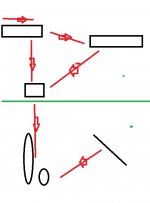
This is how I see it, Start top left is normal for me in images and point reached either change direction or change then carry. Are you familiar with flow diagrams or flow charts?I don't see any leading lines in the image. And I often find explanations of composition rather forced... i.e. someone applying the golden spiral to an image with no rotational movement/flow.
In terms of seeing images I think Gestalt principles are much more relevant; along with subconscious 2D visual cues (e.g. linear perspective, vertical position, etc). But I think another key point is that we don't really "see" at all; at least not initially. Because the brain has to process as much as possible as quickly as possible it offloads as much "processing/interpretation" as possible. And to do that it relies on related grouping and recognition (instead of identification/detail) based on previous knowledge/associations.
E.g. that's why you might not notice your significant other's new haircut; you don't notice because you already know what they look like, and so you don't see the change.
It's also why the Muller-Lyer illusion works; because the brain groups the associated lines as a single thing (i.e. the ends are part of the line).

Not many people look at things with much attention, so maybe this is why the "trained" Barney saw the lines as the same length, where as the people involved in the scientific studies see them as different. I've only ever asked students to look at them long enough to show the point I am illustrating, but even though they know from the context they know things will not be as they appear, no one has ever said they think they are the same length. Except the occasional student who is familiar with the illusion.FWIW the whole assembly appears different lengths if one glances, but a moment spent looking at the *lines* will tell you they are the same length. The cause would appear to be that this is a trick question and many will look at the assembly and not the lines.
Yes, I am familiar with flow charts. I am also very familiar with composition, human vision/ visual interpretation, etc.This is how I see it, Start top left is normal for me in images and point reached either change direction or change then carry. Are you familiar with flow diagrams or flow charts?
Really, the cause is that the brain groups the lines as a whole; even if asked to interpret only the horizontal line. But if you know it's a trick that needs additional consideration, then many (most?) can turn that subconscious response off.The cause would appear to be that this is a trick question and many will look at the assembly and not the lines.
Of course the girl is part of the overall image, and I am trying to work out what compositional techniques lead me to those feelings and impressions so that I can use them myself, it may be luck, but we all deserve a bit of luck. to me it is not just a picture of a girl on a beach, its a subtlety menacing image, and I want to know why and how those feeling came about when looking at the Photo. so I have tried to understand that.Yes, I am familiar with flow charts. I am also very familiar with composition, human vision/ visual interpretation, etc.
I would bet that the vast majority of people's focus would almost immediately jump to the woman if you just showed them the image as a whole. That's because she is a large area of contrast in what is otherwise "negative space"... she doesn't "fit" the scene and therefore needs additional identification (thought/focus). There's really no "flow" or "reading" involved/required in identifying the subject of the image. And there's no need/benefit for additional compositional aids; in fact, they might well detract from the image if they existed.
Now, most things that happen subconsciously can be disabled/overridden... e.g. the brain's tendency to auto correct white balance/colors. So if you've trained yourself to evaluate images from the top left first, then maybe the image flows for you in the way you have drawn it. But that would seem to be counter productive to me... E.g. viewing an image with a strong (useful/purposeful) leading line which starts near the viewer (low in frame) and leads "into" the image towards the chosen point of focus (subject).
Of course the girl is part of the overall image, and I am trying to work out what compositional techniques lead me to those feelings and impressions so that I can use them myself, it may be luck, but we all deserve a bit of luck. to me it is not just a picture of a girl on a beach, its a subtlety menacing image, and I want to know why and how those feeling came about when looking at the Photo. so I have tried to understand that.
HA ha, there is no Nihilism there is there,It's the bleakness that creates an existentialist dread.![]()

Same place on Film (I don't like my image BTW):
Isolation - New Brighton Beach by Fraser White, on Flickr
To me the heavy grain & blocked shadows in your pic I find very distracting and I don't like the vignette; sorry Wayne but not for me.
It absolutely ought to be! Hasn't it got there yet?I wonder if this discussion might not be best continued in 'Talk Photography'?
There's nothing like a good kick upstairs for a good topic!It has now.![]()
Apologies If I upset anyone by putting it in the film section.There's nothing like a good kick upstairs for a good topic!