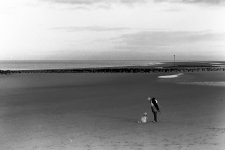
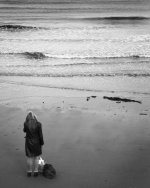
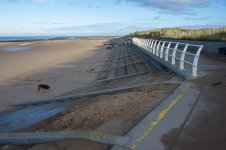
Its tricky isn't it, with a cast of thousands and a budget to suit you could more clearly "tell the story" of what your seeing, but in situations where you quickly have to make some kind of sense of an emotional real life situation I think there will always have to be some compromises. If its a fence post in a field you have all the time in the world to wander around look for differing perspectives and recompose. Your observant Jack and next time there is always hope that the scene may not be as ambiguous. where is the photo?
This is all part of the art and craft of photography.
Some pictures are only ever going to mean something to the photographer because he or she is the only person where the image triggers memories of the original experience that prompted the photograph.
Other photographs will mean something to the viewer that is totally unexpected by the photographer, because they are looking at it with their own experiences and memories.
And some will allow the viewer to see and feel what the photographer saw and felt when making the photograph.
As I said in another post, context can often help with interpretation, as well as some knowledge of the photographer and their body of work as a whole.
As regards photographing fence posts and "all the time in the world". Capturing the "decisive moment" applies equally to landscape and object photography in the wild.
It's different, as for example it's about the speed that the lighting can change, and the effect that any wind might have on foliage, and how the exact position of leaves can make or destroy an image. Not just when the photograph is about the leaves, but also about what the leaves are doing in the background, or how they might hide and reveal important parts of the subject. But because you don't have pictures dominated by a human interaction, the expectation of "perfection" in all aspects of the composition is higher. It's also different, because it's easier to realise that a picture won't work and just not take it.
The genius of Cartier Bresson was his perfect timing of both the action and the "geometry" of his pictures, hence our appreciation of the decisive moment, being that moment when action and geometry are aligned. What we hear very little about are the thousands of photographs that these great photographers with this skill of perfect timing, throw away. In saying this, I'm not in any way belittling their skills, but when you listen to them speaking, it's comforting to realise that they seem to struggle just as much as the rest of us.
Ansel Adams said "Twelve significant photographs in one year is a good crop".
As a final aside, it's amazing how fast snails can move. Multiple times I have set up to take a photograph where a snail plays an important compositional role, only to abandon the picture because the snail has moved so far out of position that the picture no longer exists.
This also means that when taking photographs I am working even slower than at a snail's pace. :-(