On Seeing

FWIW the whole assembly appears different lengths if one glances, but a moment spent looking at the *lines* will tell you they are the same length. The cause would appear to be that this is a trick question and many will look at the assembly and not the lines.
I've been thinking about this, and while we both know that scientific testing of this sort only draw conclusions likely to be applicable to the (very large) majority, I'm still surprised that in the tiny sample of this thread, you, and @Barney and @AndrewFlannigan all seem to be outliers.

I've looked at this illusion often, and I have just spent some time yesterday and today "studying" it, and even though I know the lines are the same length, they still look different lengths to me: making me "normal", and you lot abnormal :)

Some of the studies recorded people perceiving a less than 2% difference in length (which might be an average) so maybe that's close enough to "no difference" for us all to be considered "normal".

Can I confirm you are all now looking at the real illusion (as I subsequently posted a link to) and not the indicative diagram I first posted.

I think you are correct about the effect of looking at the whole assembly, and the reason my indicative diagram didn't recreate the illusion is because the separate segments make it easy to correctly interpret.

I still think it applies to this thread on seeing, because the scientific studies on this still show how easily the brain can be fooled, and how individuals see things differently. ie the difference in line length that people perceive varies between individuals.

The link to the actual illusion (posted in the other thread) is below:

 
Can I confirm you are all now looking at the real illusion (as I subsequently posted a link to) and not the indicative diagram I first posted.

I just went to the link - not sure I can tell any more because I 'know' the right answer. The version with the red line is less ambiguous because you can see the line itself rather than the line merging with the arrows.
 
I just went to the link - not sure I can tell any more because I 'know' the right answer. The version with the red line is less ambiguous because you can see the line itself rather than the line merging with the arrows.
Thanks, the example with the red lines is meant to "break" the illusion, so it shouldn't be ambiguous.

But even then, if I glance away from the one without the red lines, and then glance back, I see the lines as different lengths again. At least until I force myself to see them as the same length.
 
Can I confirm you are all now looking at the real illusion (as I subsequently posted a link to) and not the indicative diagram I first posted.
I did and that's when the idea of the camouflage effect occured to me.

I think it's worth reading up on this subject and especially how it was used in conflict. A couple of articles to provide a starting point (but there's a great deal more on the subject) ...


I did and that's when the idea of the camouflage effect occured to me.

I think it's worth reading up on this subject and especially how it was used in conflict. A couple of articles to provide a starting point (but there's a great deal more on the subject) ...


Thanks, I'll try and have a look at these.

As it so happens I've read read a fair amount about camouflage, but with reference to wearing camouflage clothing for wildlife survey work and photography.

Not the same of course, and wild animal vision varies across species.
 
I've been thinking about this, and while we both know that scientific testing of this sort only draw conclusions likely to be applicable to the (very large) majority,
In reality, all of this is "theoretical" in that very little is known about how we actually see. And that area of study is ongoing/evolving. I read a recent study that showed humans perceive an object's location with only one half of the brain. This is very similar in function/purpose as to how a duck can sleep with one eye open while the other eye and half of it's brain sleeps.
 
Having looked at the page you linked to, it seems to me that the illusion works (when it does) because our brains build gestalts from objects of interest, which would be an important survival tool in many environments.
I agree. I also think that most of a human's initial visual interpretation is based on survival instinct and previous knowledge.

In terms of survival the concern is imminent threat. And that would be whatever is closest, immediately in your path, or otherwise threatening. In terms of an image that would be low, central, and contrast (incongruent). I.e. a central composition is dominant (static), using contrast to draw the eye elsewhere, and leading lines that start near (low) and lead into an image are usually best.
 
In reality, all of this is "theoretical" in that very little is known about how we actually see. And that area of study is ongoing/evolving. I read a recent study that showed humans perceive an object's location with only one half of the brain. This is very similar in function/purpose as to how a duck can sleep with one eye open while the other eye and half of it's brain sleeps.
Seems reasonable. I have mentioned elsewhere that as we understand more about the brain, the idea of a left brain and right brain is no longer considered likely and that most activity appears to be shared across both sides of the brain. This seems to be a good evolutionary strategy as it should offer some survival benefits if an animal suffers a minor brain injury.

Arguably, all scientific conclusions are theoretical; it's just that some conclusions have a higher probability of being nearer to the truth than the alternatives do. At least for now; with additional evidence, the most likely answer may well change over time. And, as they say, the more we know, the more we know we don't know.

I was listening to a professor of nutrition a few weeks ago who specialises in protein (considered a world expert). He was saying that current studies show that almost everything they thought they knew about protein 10-15 years ago is almost certainly wrong. He also added that he now realises he has been giving out incorrect dietary health advice to his patients for several decades. The main reason, is that the tools used in modern nutritional science have only recently become available, and it's affecting our scientific understanding across every aspect of nutrition

Wearing my behavioural ecologist hat, this also applies to my own field (or ex field), where things like affordable DNA testing and satellite-based survey work have revolutionised our understanding of how things work. And wearing my statistician's hat, it also applies to advances in analytical techniques which allow more robust and insightful analysis of data than was possible in the past.

But the point I was specifically making was that most studies draw conclusions based around averages, with an acceptance there will always be outliers where a particular explanation or observation won't apply. Although, this might be very rare, it still means you are likely to find individual examples that contradict a mainstream theory, which might just reflect the natural variability between people/animals or, if it happens often enough, force a rethink of the theory.
 
Of course the girl is part of the overall image, and I am trying to work out what compositional techniques lead me to those feelings and impressions so that I can use them myself,
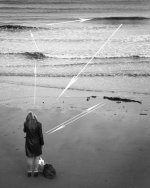
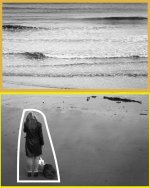
That makes perfect sense. But I would suggest that the woman is immediately seen as being "the subject" because she is closest, and incongruent with the scene. From there the flow is something more like this.

Untitled-.jpg

The eye goes to the other strongest point of contrast, that is a bit farther away, and recognizes it as inconsequential and at the limit of the "negative space", so the eye returns to the subject to consider it again. In a sense, it is a distraction in the overall composition. Likewise the eye moves to the other points of contrast moving "through" the image until reaching the limit and returns again. Because these points serve to draw the eye through the image to see/consider that area, they are more beneficial to the composition than distracting.

In terms of overall composition I see it as an area of contrast within an area of negative space with another "heavier" busier area. And due to the large depth of field (distance perception), and the more aerial perspective (flattening) the heavier area feels/interprets as more like it is above her (oppressive) rather than just more distant.

Untitled-.jpg

Of course, this is just my interpretation of the image. I can't say if any of it is actually why the image was composed like this. And it is quite likely the "why" wasn't even known or considered in any great detail to start with.
 
Last edited:
What drew me to this scene, which transpired over approximately 5-10 seconds was of course man and dog on beach with his jacket picked out by the light, but as I watched and processed what was going on (the dog had been running about trying to contact a group of three other dogs away to the right) I determined he was scolding the dog, his posture stiff, domineering and bent forward from the hip arms thrust behind him rigidly - he was not reaching out with a treat, happy pat or kind word. The dog sat there contained, but indifferent to the owners posturings, But, still, despite being hero lit he was the villain, the pair of them in their own worlds insulated from the beauty, expanse and freedom of their surroundings, the dog sat captive in a prison created by his master. The master, isolated within the freedom of the scene (a happy beech dog walk), ignored by the dog, constrained and contorted by his own emotions. I made the decision to place them in a corner of the vast open space to reflect the stark contrast and their confinement .

The title I could not make up my mind, "Prisoners" or "Freedom ?"

I think after, a day or two, That "Freedom ?" would be better, and possibly encourage the viewer to consider the scene more thoughtfully. Is it even interesting? or is it even worth looking at at all.

Thanks for all the constructive advice and helping me better understand why the photo does not communicate my intentions, I am grateful of the suggestions, particularly for the "gloom" aspect, I had not identified that and only goes to reflect the gloom of the participants and enhances the photo. IMV.

The bright spot on the left is in another couple of snaps, must have a leaky seal.

Moving to the right, I feel, would have reduced the impact of the owners aggressive posture and negated the story if not entirely but substantially, and I enjoyed the tension between the posture and the hero lighting, but anecdotally the lighting may have caused a misinterpretation.

The owner and dog carried on running about and strolling in the last of the sunshine so a happy ending, the photo is only a glimpse into what I saw in those few moments.
I don't see a man scolding the dog either, as SK66 said it looks to me as though he's bent forward to talk to his friend.
 
What drew me to this scene, which transpired over approximately 5-10 seconds was of course man and dog on beach with his jacket picked out by the light, but as I watched and processed what was going on (the dog had been running about trying to contact a group of three other dogs away to the right) I determined he was scolding the dog, his posture stiff, domineering and bent forward from the hip arms thrust behind him rigidly - he was not reaching out with a treat, happy pat or kind word. The dog sat there contained, but indifferent to the owners posturings, But, still, despite being hero lit he was the villain, the pair of them in their own worlds insulated from the beauty, expanse and freedom of their surroundings, the dog sat captive in a prison created by his master. The master, isolated within the freedom of the scene (a happy beech dog walk), ignored by the dog, constrained and contorted by his own emotions. I made the decision to place them in a corner of the vast open space to reflect the stark contrast and their confinement .

The title I could not make up my mind, "Prisoners" or "Freedom ?"

I think after, a day or two, That "Freedom ?" would be better, and possibly encourage the viewer to consider the scene more thoughtfully. Is it even interesting? or is it even worth looking at at all.

Thanks for all the constructive advice and helping me better understand why the photo does not communicate my intentions, I am grateful of the suggestions, particularly for the "gloom" aspect, I had not identified that and only goes to reflect the gloom of the participants and enhances the photo. IMV.

The bright spot on the left is in another couple of snaps, must have a leaky seal.

Moving to the right, I feel, would have reduced the impact of the owners aggressive posture and negated the story if not entirely but substantially, and I enjoyed the tension between the posture and the hero lighting, but anecdotally the lighting may have caused a misinterpretation.

The owner and dog carried on running about and strolling in the last of the sunshine so a happy ending, the photo is only a glimpse into what I saw in those few moments.
It's might be worth reflecting on whether a single photograph can adequately tell a story? I often think not. What we see is a slice of time that has been frozen - 125/1 perhaps, but things have happened in the 10 secs before and after the photograph was made, things you've seen / emotions you felt, which we the viewers don't see or feel because we were not there. Are there pictures on your contact sheet that you can present alongside your original photo that help explain the story?
 
Of course, this is just my interpretation of the image. I can't say if any of it is actually why the image was composed like this. And it is quite likely the "why" wasn't even known or considered in any great detail to start with.

Thanks for that explanation, That may well be how I perceived it, I don't know, I did not know why the photo gave me the impression that It did. That's why I started to consider it more carefully. And I started in the top left, because I usually start there, I suppose I tried to read it like a page and not the awareness of where my vision was originally drawn or the how and why.

I don't see a man scolding the dog either, as SK66 said it looks to me as though he's bent forward to talk to his friend.

Thanks for that, it appears that I have totally failed in my intention. But now it seems I have more questions,

Did the scene appear before me so that I could take a photograph of it, or did the photo appear so I could learn about seeing and understand how better to communicate my intentions
 
Last edited:
It's might be worth reflecting on whether a single photograph can adequately tell a story? I often think not. What we see is a slice of time that has been frozen - 125/1 perhaps, but things have happened in the 10 secs before and after the photograph was made, things you've seen / emotions you felt, which we the viewers don't see or feel because we were not there. Are there pictures on your contact sheet that you can present alongside your original photo that help explain the story?

Thanks Ben for your input,
I don't have a contact sheet so went back and looked at my negatives, And was surprised to find that I had put them in the sleeve in the wrong order, They were disorganized so I reflected if that was symbolic of my thoughts and ideas on seeing and communicating my intentions.
So I went to look over the scans of the negatives, more intrigue as somehow the scans had been mixed up in my file folders and the images from that hour and a half on the beach had been placed with some of my first film shots from earlier in the year. It was worse, my ideas are more mixed up than I had thought. Or was it an indication that I was back at the begining, a new beginning, :)

I took nine photographs in that session, some I have already placed in the film section so apologies if you have seen them before, I could not decide in which order to place them, so they are as they fell, photos first, Title I gave it, and ideas(if the were any) that led to the photos third. Because this is a photography forum and I am trying to make my photo's talk, the message, communication of what I see.


1, Previously posted here on TP in film section and what started off my exploration in "seeing" and attemting to communicate that.


On Seeing.jpg

Slip Away.

I have been told in no uncertain terms that I overthink and over complicate things in my photography, That is just characteristic, which I have found both a blessing and a curse.
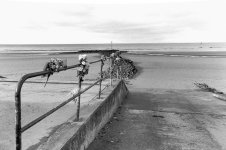
In another thread the photographic skill of "seeing" has been mentioned. I sat here on the sea wall and had a reet good chat with a fellow photographer who had been collecting interesting stones, shells and pieces of driftwood for a "still life" section of the photography course he was undertaking, I found it quite ironic that we discussed still life in the shadow of death.

I do not know if your interested in what I "see" but since you are reading this I will carry on trying to explain, to you it may well be quite meaningless and poppycock, and you could well be right.

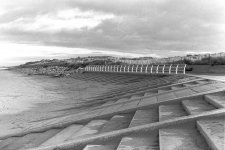
Symbolism I see , the handrail is significant in respect to life, it provides support and guidance and no more so than in a time of grief where the need of support is at its most profound. The temporary nature of the flowers, in this photo, signify the raw transient nature of grief until eventually in the distance it blends seamlessly into the hard rock, unobtrusive but ever present. The slipway, mirrors that progression forcing us unavoidably to the flat sand of acceptance. The warning triangle features in so many of our seaside photography images, usually it depicts sewerage out flow, the last dispatch point of waste, and that is where these raw emotions end up, flushed away.

Would anyone else interpret this scene in the same way, I don't think so. Its just a crap grainy snap of a bit of railing and a ramp. And why should they?


Slip Away.

2.

On Seeing-2.jpg

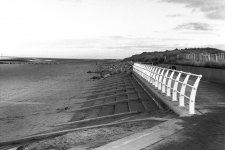
White railing at the beach

I was lucky here on this afternoon, was approx 2:30-3:00 pm and the sun was occasionally breaking through the patch cloud, I was originally drawn to the picket fence, I was walking between the fence and the railing when I turned and saw the railing glowing, I moved back to the steps to take in the whole railing picked out by Low sun (back right, shadows just visible on the beach)


3, Not shown as needed for future project...Though I had become preoccupied with the spectacular light, It now amazes me that the photographer I chatted to had no camera and was collecting shells etc.

On Seeing-3.jpg


4.

On Seeing-4.jpg

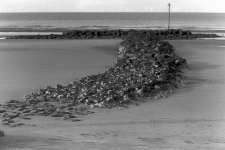
no title (discarded)

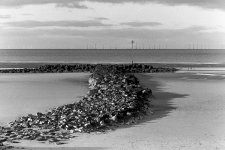
I Saw the shape that the rocks made lead to the horizon but the light had gone.


5


On Seeing-5.jpg


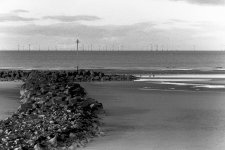
No Title (Discarded)


I had seen something here and tried to zoom in to emphasise it, but the light was still a bit soft and mushy. while I was waiting for the light to change I wandered off a bit.


6

On Seeing-6.jpg


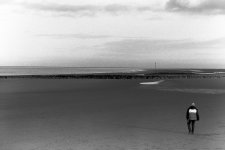
No Title (Discarded)

This man was Isolated in the landscape, more so because he had lost his mate who he was walking with and chased after him but that was not important for this shot, It was all about isolation, could just as easily have been about enjoying the view.


7

On Seeing-7.jpg

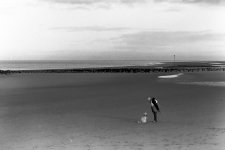
Freedom ?

(The photo that I started off this thread with)


What drew me to this scene, which transpired over approximately 5-10 seconds was of course man and dog on beach with his jacket picked out by the light, but as I watched and processed what was going on (the dog had been running about trying to contact a group of three other dogs away to the right) I determined he was scolding the dog, his posture stiff, domineering and bent forward from the hip arms thrust behind him rigidly - he was not reaching out with a treat, happy pat or kind word. The dog sat there contained, but indifferent to the owners posturings, But, still, despite being hero lit he was the villain, the pair of them in their own worlds insulated from the beauty, expanse and freedom of their surroundings, the dog sat captive in a prison created by his master. The master, isolated within the freedom of the scene (a happy beech dog walk), ignored by the dog, constrained and contorted by his own emotions. I made the decision to place them in a corner of the vast open space to reflect the stark contrast and their confinement .

8.

On Seeing-8.jpg

Some rocks with histogram


The light had changed again so I went back to the shot to I had visualised earlier and it was better defined this time (back to the light theme again I suppose), no message, no second meanings just a simple interesting (to me) visual appearance.


9

On Seeing-9.jpg

No Title (discarded)

In the earlier shot of the railings I had consided that the steps could form into the representation of the shadow of the railings, It worked at the far end, but quickly beacame"wrong" as I lost the peaspective, I tried several positions and angles but could not figure out how to get it "right" I blame the great architechts lack of forsight and the poor imagination of the designer.:)


Thanks for your comments Ben, when I put in order the thoughts and process through that session, which at the time I thought were haphhazard, perhaps they were more structured than I recalled,

But that was not my doing, I just followed my imagination. Who put it there is my question. Was that initial scene in this thread put there for me to photgraph? Or for you you to discuss?

Am I the pan of spaghetti or the gas in the pipe?
 
Last edited:
Did the scene appear before me so that I could take a photograph of it, or did the photo appear so I could learn about seeing and understand how better to communicate my intentions
I would say neither, unless it's staged no scene appears with the intention of it being photographed, we as photographers see an opportunity to record what is there. Sometimes you're trying to convey a story, sometimes we just think it looks nice, and sometimes we're trying to 'show off' a skill.

As you've found, when trying to convey a story it's very much open to interpretation and one shouldn't be disappointed if it's not the same story as we intended. If a photo creates enough interest for the viewer to creative a narrative then I would take that as a success.
 
It's might be worth reflecting on whether a single photograph can adequately tell a story? I often think not. What we see is a slice of time that has been frozen - 125/1 perhaps, but things have happened in the 10 secs before and after the photograph was made, things you've seen / emotions you felt, which we the viewers don't see or feel because we were not there. Are there pictures on your contact sheet that you can present alongside your original photo that help explain the story?
A a good point, which I agree with. but its also worth reflecting on how it can also apply to a single photograph and ask "what is it's story", which could be a simple one.

As a simplistic example, all I could think of right now, might be the difference between a passport photograph and an environmental portrait. The former tells you what the person looks like, and the latter tells you something of "the story" behind the person.

So either intellectually or/and emotionally (intuitively) your can choose your framing and moment of exposure to try and make a single photograph that tells the story of what you saw and felt at that instant.

Although contrived, even the passport photograph could tell a story if it was actually in a passport sitting on a suitcase, with a guidebook to France beside it.

It depends on context, and the complexity of the story being told whether one photograph is enough, but I'm not disagreeing with your post, just expanding on it, and it could well be that @Barney has a photograph before and after the one he posted (dog and man) that could better tell the story he is seeing, that I am not.
 
I do not know if your interested in what I "see" but since you are reading this I will carry on trying to explain, to you it may well be quite meaningless and poppycock, and you could well be right.
I do believe it is important to "create images" rather than just document random moments in time; that's where the art aspect comes into it. But I tend to be more of a technician, and less of an artist in general.

I also tend to have trouble with the art aspect of images as well... like when you describe the first image. I didn't get any of that from the image, but after reading your description I can see why you did. And I can see unrealized potential to be explored as well; if that's what you felt/saw, and purposefully wanted to convey, I think you probably could have done better. Digital does have an advantage here in that you can review the execution of the idea immediately.

I have even greater trouble with some "expert" explaining the how/why/meaning in someone else's images... it almost always seems like made-up BS presented as fact to me (because it mostly is).

It's also relevant to understand that a forum like this is really not the best place to evaluate images; because they are viewed too small. It is interesting that the human primary field of view is approximately 45˚ horizontal (60˚ diagonal), that a "standard lens" records that same field of view, and that standard image display/viewing is done at a distance where the image occupies that same field of view once again. Yet when we view images online they are very rarely (never?) viewed large enough. And that minimizes details that may be important in conveying the meaning you intend; it certainly alters the perception of the scene overall.
 
Last edited:
So either intellectually or/and emotionally (intuitively) your can choose your framing and moment of exposure to try and make a single photograph that tells the story of what you saw and felt at that instant.
A single image is certainly capable of telling "a story." But "what that story is" is never certain; because it depends on the viewer's state and prior experience/knowledge.

I know what I wanted to convey with this image, but I can also see an entirely different interpretations/feeling. I saw it representing the pointless struggle of the human condition. The harsher edits and monochrome conversion were intended to help convey "my story," but there is no guarantee as to how successful it is. Someone else could see it as hopeful and leading to something unseen but pleasant/happy (i.e. the stairway to heaven).


Stairway to Nowhere by Steven Kersting, on Flickr
 
Last edited:
I also tend to have trouble with the art aspect of images as well... like when you describe the first image. I didn't get any of that from the image, but after reading your description I can see why you did. And I can see unrealized potential to be explored as well; if that's what you felt/saw, and purposefully wanted to convey, I think you probably could have done better. Digital does have an advantage here in that you can review the execution of the idea immediately.

Thanks for your opinions Steven as there is much I am agreement with, in this reply, however, I would like to concentrate on the above part of your post and would welcome your extrapolation if possible. I am here trying to learn and appreciate that you think I could have done better, I don't mean to be rude but "how", is it technically wrong from a perspective standpoint for instance, or are there perhaps other better ideas that would represent what I was trying to achieve contained in the scene there that I have overlooked?

I did look at the straightforward flower on the railing scenairio with a huge distance behind it but thought it unimaginative with the railing only signifying support and the emptiness, a never ending impression. I purposely wanted to show an "ending" to grief.

Edit: looking at your photo I suspect that you may think that film is not the right medium for that message?
 
Last edited:
A single image is certainly capable of telling "a story." But "what that story is" is never certain; because it depends on the viewer's state and prior experience/knowledge.
I'm getting confused with which thread is which now but I've recently posted about this, just not sure where :-(

We all bring our own life experiences and "mood of the moment" into what we read from a photograph, how we interpret it and what we get out of it. Of course, this not only applies to photographs but also to books, poems, paintings, etc.

I've also posted recently about the idea of three photographic categories: Descriptive, Documentary and Expressive, where the first is a photograph that tells us something about what the subject looks like, the second shows us something about the subject's story, and the third shows us something about the photographer's story. All photographs are made up of these three categories, but usually one category dominates.

None of them are inherently superior to the other two, as each serves its own purpose. But I think it helps to work out "how" we should look at a photograph, as does some knowledge of the photographer, and the context of where and how we are viewing it.

I also think that the photographer might not be conscious of the story behind why they felt compelled to make a particular photograph. But it might become clearer at a later date, after extended personal reflection, or feedback from peers, an editor or critic.

Once we share a photograph, we no longer "own" the story and for the reasons above, it shouldn't be unexpected that the story may well be different for different people.

I don't see a pointless struggle in your photograph, or a stairway to heaven. I start by enjoying the geometry and tonality of the photograph, as it's the sort of scene that would have grabbed my attention. I feel an empathy with the photographer and see it as an expressive photograph with a story that goes beyond it being "just" a photograph of steps.

I like the solidity of the steps, and the security provided by the handrails, and how the highlighting provides a clear pathway upwards towards the sky. I don't see the sky as being necessarily happy, but more as a "reaching for the sky" type of ambition, with the lit steps providing a safe and steady climb ((avoiding the unknown of the shadows either side) to achieve it.

I don't know what the sky represents, but I associate a journey that goes upwards is good, compared to one that goes downwards.

But I'm a bit shallow with these things, and mainly I just like the photograph because it’s the sort of subject that I am photographically attracted to. I'm primarily looking more for a gut reaction to a photograph than an articulated story. For me the story is often only "this photographer seems to see the world the same way as I do" or this photographer shows me the world in a way I have never experienced before".

I'm oversimplifying this a bit: I would be looking for more of a story from a "documentary" photograph.

EDIT: on reflection I think the harshness and gritiness of the rendering suggests that in spite of what I said "the climb" is likely to be difficult and tedious, so it rcertainly reflects your life being a struggle interpretation


I know what I wanted to convey with this image, but I can also see an entirely different interpretations/feeling. I saw it representing the pointless struggle of the human condition (life). Someone else could see it as hopeful and leading to something unseen but pleasant/happy (i.e. the stairway to heaven).


Stairway to Nowhere by Steven Kersting, on Flickr
 
Last edited:
Thanks for your opinions Steven as there is much I am agreement with, in this reply, however, I would like to concentrate on the above part of your post and would welcome your extrapolation if possible.
When I first saw the image I didn't even notice the flowers really. Part of that is simply due to size as viewed here. The smaller individual aspects are, and the closer together they appear, the more they are combined as a single element (Gestalt grouping), and the less they are perceived/considered individually. On my computer the image is about 6" wide and almost 2ft away; by standard viewing conditions I should be viewing it from about 7" away, or it should be ~ 16" wide.

What I first noticed prominently was the heavy area of contrast leading to the water (the stone berm). And while I perceived the railing/ramp edge, they also lead to the stone berm and horizon, and therefore I didn't start there to see it in more detail. And that's about as far as I went with it as I was more reading what was written than contemplating images. And if something doesn't grab right away, most people will just move on rather than contemplate/study farther (except maybe at an art museum?)

Another part of the issue is that most of the flowers along the railing blend into the BG, other than the first two on the top railing. And of those, the first one is placed rather far to the side. While the railing is a leading line, perceptually one does not need to start at the beginning of it, and therefore there is no particular/strong reason for the eye to focus on the first bunches. I feel like the strong leading lines actually reduce the likely perception/focus/relevance of/on them.

A human can only focus on ~ 1-2˚ FOV, everything else is some degree of defocus/blur and it's meaning/relevance is more assumed/recognized. While one can go back and scan the image and start at the beginning of the railing after the initial perception, there is no requirement to do so; unless one wants to "study the image." I.e. "leading lines" often do not lead the eye "through" an image... they more just point and do not require any particular consideration on their own (i.e. "look here dummy"). For a line to actually be leading in terms of perception/flow/reading it's beginning has to be dominant (draw the most attention/focus).

When I view the image at a more appropriate size/distance (full screen), the second bunch of flowers becomes much more prominent and the idea/composition works somewhat better. I.e. my eye is drawn to the second bunch of flowers much more, and so my perception of it/the image starts closer to the intended beginning (assumed).
But I still feel that the stone berm dominates and detracts overall. So I would have looked for a perspective that didn't include, or minimized the impact of it.

Of course, this is all just my opinion...
It has nothing to do with film vs digital vs painting really. The more you have the final image/effect pre-visualized, the easier it is to produce. It's just that digital allows you to evaluate the result much more quickly. And the less solid the concept is, the more important it is to "work the scene" to find the best image (or realize it's just not going to work.
 
Last edited:
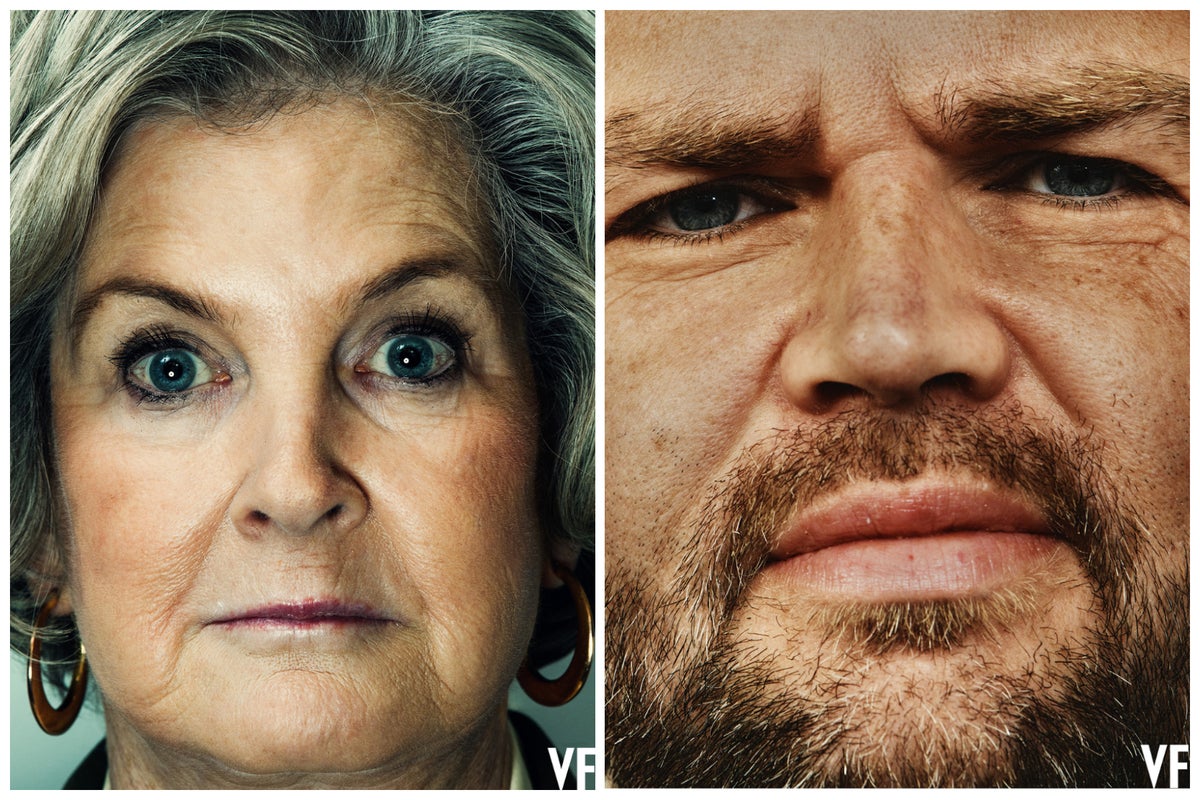
This video is rather long (for what it is) and I'm not fond of the style of presentation, but it's an interesting discussion on 'interpreting a photograph".

It's discussing photographs taken for Vanity Fair to illustrate an article on the top people in the Trump administration (It's 22 minutes).

View: https://www.youtube.com/watch?v=z2g-wqlkT1A


There is an article in the Independent about the photographer/article, and it's interesting that Vanity Fair probably chose Christpher Anderson as the photographer because his style would suit the article they had in mind.

 
Back
Top