Kell
Suspended / Banned
- Messages
- 5,130
- Name
- Kell
- Edit My Images
- Yes

Last edited:

Nice Lens, good reach that.
Nice Lens, good reach that.
Ah right I see perhaps I have used the incorrect terminology.
I meant the 7m on the distance scale.
For some daft reason I usually try to keep the subject in the range that the lens was designed for, probably ill-considered. I have just tried to remember where I obtained that information but cannot, so I must have made it up.
The other way round I think.Oh I see. More likely my lack of knowledge than your explanation.

For some daft reason I usually try to keep the subject in the range that the lens was designed for, probably ill-considered. I have just tried to remember where I obtained that information but cannot, so I must have made it up.

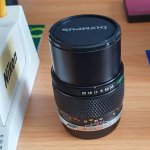

The distance scale on the lens is a selection of distances that are useful to use, up until the point that anything beyond 7m/20’ is deemed to be in focus up to infinity.Ah right I see perhaps I have used the incorrect terminology.
I meant the 7m on the distance scale.
For some daft reason I usually try to keep the subject in the range that the lens was designed for, probably ill-considered. I have just tried to remember where I obtained that information but cannot, so I must have made it up.

With zooms it's "know your lens" as they vary e.g. close up exc but distance OK and vice versa, and some could be near to a prime at a ?mm setting.Lenses are designed to give optimum performance at a specific distance. As a very simple example, some lens aberrations are eliminated entirely if the lens is perfectly symmetrical about the central stop. However, that also means that they work best at 1:1... In practice, "symmetrical" lenses (the most obvious series being the Schneider Symmars fro large format) are slightly unsymmetrical. The biggest "however" though is that you are unlikely to get optimum performance without a tripod and cable release, a very slow film (preferably one of the discontinued ones like Technical Pan - although Adox make a similar product) and some luck - or a test chart indoors....
Is that specific distance for each lenses optimum performance documented anywhere? Or is it as Brian suggests trial and error. One of the things I miss with Film photography is exif data, hence buying notebooks to try and obtain physical records rather than relying on memory.Lenses are designed to give optimum performance at a specific distance. As a very simple example, some lens aberrations are eliminated entirely if the lens is perfectly symmetrical about the central stop. However, that also means that they work best at 1:1... In practice, "symmetrical" lenses (the most obvious series being the Schneider Symmars fro large format) are slightly unsymmetrical. The biggest "however" though is that you are unlikely to get optimum performance without a tripod and cable release, a very slow film (preferably one of the discontinued ones like Technical Pan - although Adox make a similar product) and some luck - or a test chart indoors....
Apologies.Is that specific distance for each lenses optimum performance documented anywhere? Or is it as Brian suggests trial and error. One of the things I miss with Film photography is exif data, hence buying notebooks to try and obtain physical records rather than relying on memory.
I have tried my best to understand the rest of your, no doubt, simplified response but it's going straight over my head
1:1 i thought was macro
no idea what symmetrical or unsymmetrical lenses are
there is however a glimmer of hope as I do not mind using tripod and cable release, in fact prefer it where possible.
The distance scale on the lens is a selection of distances that are useful to use, up until the point that anything beyond 7m/20’ is deemed to be in focus up to infinity.
I’m not an optical designer but I haven’t seen anything suggesting that the distance markings correlate to the best optical performance.
Higher quality zoom/prime lenses generally perform better than lower quality zoom lenses (higher optical quality/tolerances/built to price etc), and superzoom style lenses generally don't focus particularly close, even though they have a relatively wide angle field of view because of their compromised design to be a catch-all option.Hello Steve, thanks for trying to help,
I think I came to the conclusion that the distance scale was important when using a 28-200 where the lens was admirable but would not focus on anything closer than about six feet, this became so annoying that I started to pay attention to the distance scale regarding the lenses close focus distance. Lo and behold close focus distance seemed proportional to price and to get the shortest close focus distance for any given focal length you ended up having to pay a lot more money.
I then, probably in my own mind, extrapolated this empirical evidence to the long focus distance reading, reasoning that the lens would be more suited to the longer end if it had a longer distance than a comparable lens of XXX distance.
My 180mm prime has long distance of 20m, yet my 300mm f 4.5 has long distance range of 50m.
I cannot for certain state that there is a difference, but its just something I have always tried to take into account, rightly or wrongly.

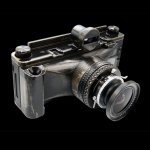
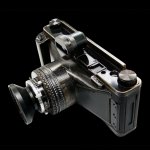
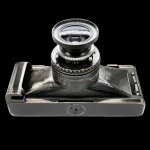
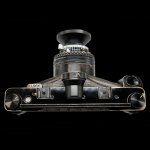
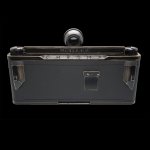
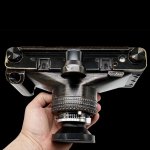
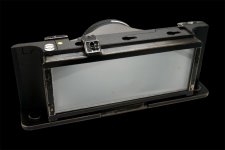
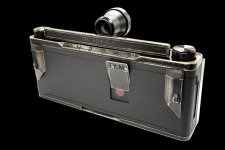
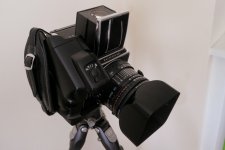
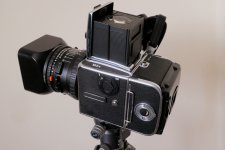
It looks fantastic in the photos. I am assuming that is a dark slide we can see in the last shot, needed to protect the film when using the ground glass to focus.Not necessarily a new toy, but it is a new custom Six17 that I built myself last week that I’m really happy with.
Everyone likes a classic ‘brassed’ camera, so I built this one with champagne metallic parts then painted them satin black and aged them by hand, followed by a top coat to seal it;
View attachment 461603View attachment 461604View attachment 461605View attachment 461606View attachment 461607View attachment 461608View attachment 461609View attachment 461610
As much as it’s “Disney Brassing” (according to a photographer friend of mine) I think it’s quite effective. I’m not building another one though, took way too long!
Cheers
Steve
Thanks for that suggestion,Apologies.
1:1 means that the image on the film (or sensor, if you're a deviant) is the same size as the subject. "Macro" might have a slightly different connotation, as if you have a coffee table, a 1:1 image on a 20"x24" sheet of film would include the whole table top.
"Symmetrical" in this context means that the lens elements in front of and behind the stop (shutter and/or diaphragm) are mirror images. Take a look at the lens schematic for a Symmar 150mm lens for example.
Thanks, and yes, my cameras have removable film backs to switch to the ground glass or to use multiple backs with different films loaded. CheersIt looks fantastic in the photos. I am assuming that is a dark slide we can see in the last shot, needed to protect the film when using the ground glass to focus.

Thanks for that suggestion,
I spent a happy hour poring over the various schematics, causing me to ask the question what is the advantage of having the shutter in between the lens arrangement? Does the increased distance between the two sets of lenses benefit in some way? why not just have the shutter at the back near the film plane?

 intrepidcamera.co.uk
Thanks for that suggestion,
I spent a happy hour poring over the various schematics, causing me to ask the question what is the advantage of having the shutter in between the lens arrangement? Does the increased distance between the two sets of lenses benefit in some way? why not just have the shutter at the back near the film plane?
Thanks for that Nige, a very interesting read.With large format lenses, they split into two parts which are screwed together separated by the lens board and then the whole lot fits at the front of the bellows arrangement, with the rear part of the lens on the inside. If the shutter was at the back of the lens it would be inside the bellows of the camera and would need a much more complicated means to fire it.
This page shows how it works:
Buying A Lens For Your 4x5 Camera
You can't just use any lens on your large-format camera - it has to be specially designed for the job, but don't worry, this guide will quickly teach you everything you need to know and where to find the perfect lens at surprisingly good value!
This is crossing over into the sort of information I was going to put into a new optics chapter in my book, before being persuaded that it wasn't wanted. The brief reply is that it makes more sense to have the shutter blades where the aperture stop is, and the position of the aperture stop affects distortion. More than this needs to be discussed elsewhere I think.
Edit to add - and the separation of the two sets has a bearing on optical corrections - again, discussion is well outside this thread. I had intended to cover it in the new chapter.

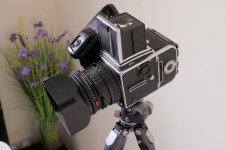

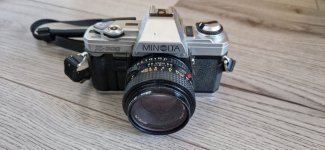
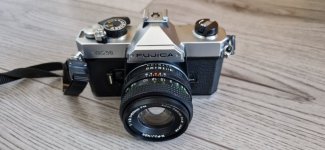
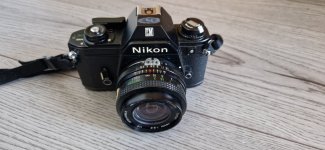
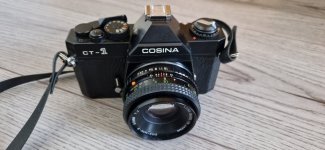
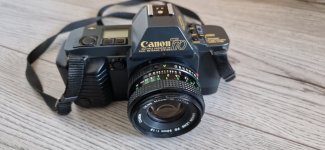
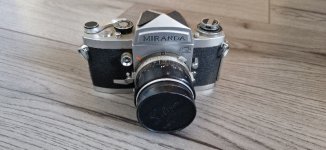
On the T70 when you press the Battery check button you should get up to 3 black bars on LCD, same if you put a film in the black bars show it's loadedIn a fit of G.A.S I bought these "For parts or not working" cameras from eBay in a job lot.
From initial tests, the Minolta and Fujica both seemed to work OK. The Nikon worked after cleaning the battery contacts. All three probably need new light seals.
The Cosina seems to work mechanically, but I can't currently get the meter to operate (although I can always use it with an external meter / sunny 16).
The Canon, while in nice condition, seems to be knackered. The LCD display comes on, but nothing else happens. Pressing the battery test buton makes a clicking noise. I don't have any fresh batteries though, so maybe it will work with some at full power. I'll give it a go when I get some more.
The Miranda is the worst condition of the bunch and probably a lost cause.
I'm not sure why I bought them.
It will be handy to have a couple of rough'n'tumble SLRs that I can take out in poor conditions without being afraid to use them, I guess.
View attachment 462268View attachment 462269View attachment 462270View attachment 462271View attachment 462272View attachment 462273
On the T70 when you press the Battery check button you should get up to 3 black bars on LCD, same if you put a film in the black bars show it's loaded
Well I never knew the T70 could make a beeping sound, but then I've had two for about 12 years with no problems and also without my hearing aids I can't hear much anywayIt's now started making a beeping sound. Looking online this seems to indicate a well-known Wind/Rewind Jam/Beeping fault with the camera. I'll look into it more if I get the chance.
It feels like a nice solid camera - I always thought the "T" line looked a bit clunky, but it does feel very nice in the hand.


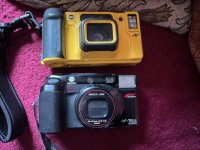
Also as a last resort, without taking it apart, with cameras with motors and gears...give the camera a wack into your hand erm not with a hammer
Two working is a result..for EM take the bottom plate off and poke around carefully it might need just a drop of oil? For the T70 I wouldn't know how to get to the moving parts to unjam other than giving it a whallop, anyway I always considered it a throwaway camera as they are so cheap to buy e.g. sold on ebay a T70 tested £10.51 and untested 99p etcThe current status is that, of the six cameras in the batch, only two of them work. I thought the Nikon EM was working ok, but then I ran a sacrificial roll through it and found that the rewind button on the bottom of the camera is completely jammed. The Cosina CT-1 (which seemed to work, but with no meter operation), has now locked up completely too.
The Fujica STX-1 works ok - I've shot a full roll with it and have been scanning the results today. The Minolta X-300 also seems to work, but it's possible the power might be slightly dodgy as I occasionally had to switch it off and back on again for it to operate when I tested it with a dummy roll the other day (although it seemed to work fine when I tried it again just now).
Thanks Brian. I've already seen that video, plus downloaded a copy of the maintenance manual, but to no avail. Someone more skilled than I might be able to get it going again, but it's likely beyond the amount of time I'm prepared to spend on it.Two working is a result..for EM take the bottom plate off and poke around carefully it might need just a drop of oil? For the T70 I wouldn't know how to get to the moving parts to unjam other than giving it a whallop, anyway I always considered it a throwaway camera as they are so cheap to buy e.g. sold on ebay a T70 tested £10.51 and untested 99p etc
This looks easyView: https://www.youtube.com/watch?v=zzTXLbBAcaA
Well there is always the T90, why pay loadsa money for say AE1 when you could have picked up a mint T90 with FDN 50mm f1.8 for £35..some lucky guy bought it in July:-Thanks Brian. I've already seen that video, plus downloaded a copy of the maintenance manual, but to no avail. Someone more skilled than I might be able to get it going again, but it's likely beyond the amount of time I'm prepared to spend on it.

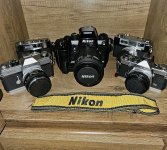

If you move them closer together there will be room for more.
and there is room for a shelf.If you move them closer together there will be room for more.

There are shelves, but they also have other important stuff on themand there is room for a shelf.