Not Guilty

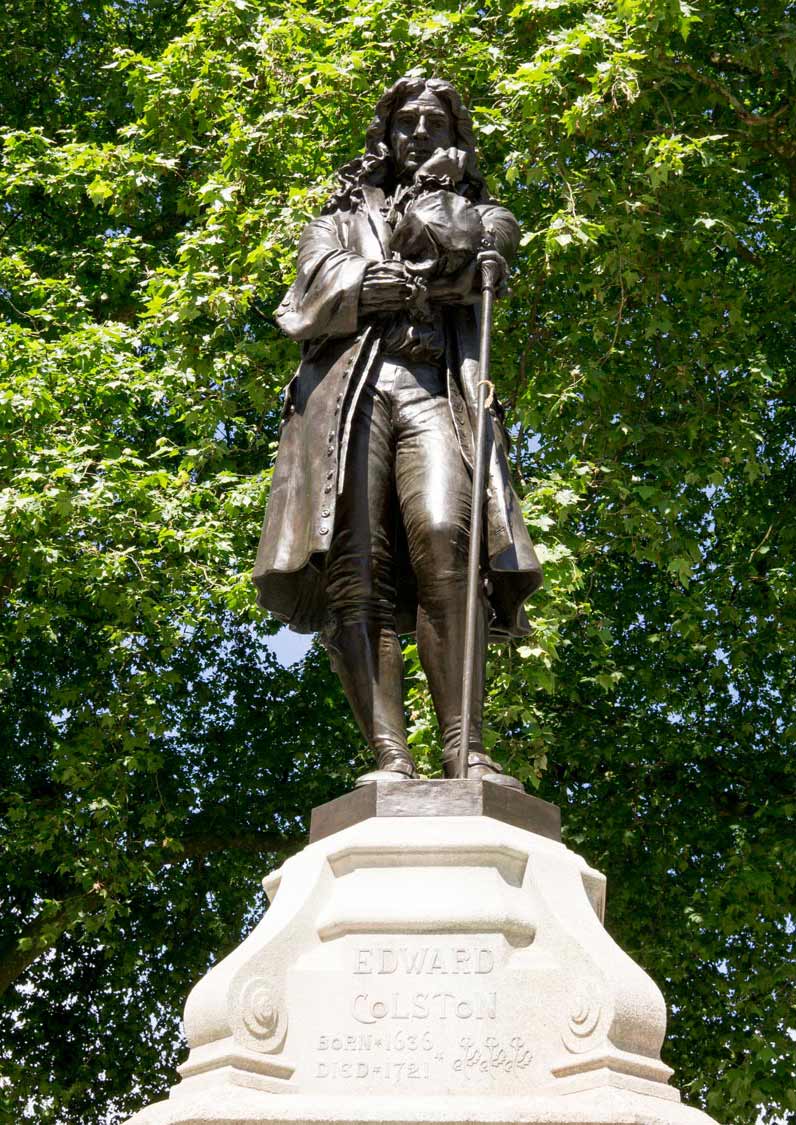
Was it to hero-worship him or simply to identify to financial contributions he made to the city?

However repulsive slavery now is, back in the day it was normal. Slaves were the technology of the day (high capital cost, low running cost, disposable when worn out and part of an inferior species [as taught by the church] and were regarded in much the same way as farm animals of today). The people who grew rich from exploiting them didn't see anything wrong with their behaviour, and many contributed to society (or at least to white society) with their generosity.

So, what has actually changed? Wealthy people still exploit the people who have no power, by paying low wages, providing zero hours contracts, moving production to cheaper labour countries and getting dodgy contracts from governments. They often use their ill-gotten gains by buying influence, a peerage and setting up fake charities to gain even more money and a false respectability.

Even our greatest national hero, Nelson, once wrote a letter in support of slavery, even as late as the early 19th century, slavery was normal and acceptable.

Nobody, myself included, can support slavery now but we should not, IMO, judge the past by current standards. What we should be doing now, instead of removing old statues, is to get rid of modern slavery, which exploits illegal immigrants and other vulnerable people.

Great post!
 
Pretty sure getting rid of the statue did help the cause.

What have you done to help it?
I can tell you, as a resident of Bristol, that it has done absolutely nothing for "the cause" but has polarised the city and inflamed feelings on both sides. Many of us that actually live in this beautiful city are totally bemused by this verdict - who knew that not liking something gives you the right to destroy it. Where does this end? How far can this defence be pushed - is it only material things that are at risk or human lives too?

The future of this statue has been going on for decades. As Mervyn Rees, the Mayor of Bristol, said today; claiming that the Council weren't listening is not true. There were discussions ongoing with community leaders about several statues in the city. Yes, the discussions were taking longer than most of us would have liked but it's not easy finding middle ground when feelings and opinions on both sides are so deeply felt.

Would you hold the same view if it had been a statue of Nelson Mandela? After all, he was a convicted terrorist - someone who actually broke laws before becoming the darling of the world. Edward Colston never broke any laws and ploughed most of his fortune into making Bristol a better place to live for the poor (providing housing and education among other things) and helped to lay the foundations that make it the thriving city that it is today.

It is to be hoped that the CPS will appeal this verdict as a clear miscarriage of justice.
 
Would you hold the same view if it had been a statue of Nelson Mandela? After all, he was a convicted terrorist - someone who actually broke laws before becoming the darling of the world.


I can't let this pass.. this is a real bugbear of mine.. We built a statue and sang songs about him while the rest of the world looked on bemused... even from his prison/farm he sanctioned a bombing that killed innocent men women and children... undisputed fact! he should never have been let out let alone glorified :(

Sorry just needed to get that out... Carry on everyone :)
 
I think I heard somewhere they caused £5k of damage and actually I don't think that sounds too bad but I'd need to see a quote from someone who'd normally be contracted to take down a statue. £5k might be a bit of a bargain for all I know.
I think the £5K was what it cost the city council to remove the statue that was (illegally) erected on the Colston plinth afterwards.
 
What he did is irrelevant. Whether you agree with the cause is irrelevant.
A jury should not be making judgments based on their support of the accused, or otherwise. A very slippery slope.
Couldn't the judge order them to return a guilty verdict?
 
They are clearly guilty of property damage, I don't see any way around that except through leftoid activist kangaroo court.
I'd make them pay for the damage they caused, probably give them a 5h1t load of community service since they've got ****all else to do, whilst the fate of the statue is decided by the adults of Bristol.
 
Really???
That would make a trip to Rome, Athens or any other historical place a tad boring.
Or Plymouth to look at a car park?

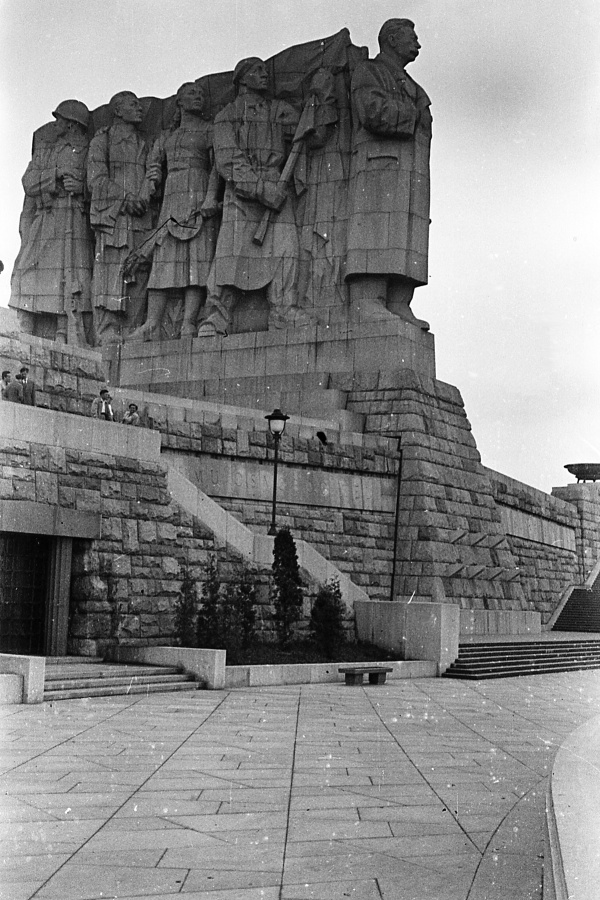
More seriously I doubt there’s many who haven’t heard of what Stalin did. Not many statues though
 
Last edited:
Or Plymouth to look at a car park?

More seriously I doubt there’s many who haven’t heard of what Stalin did. Not many statues though

Please, get a f****g grip, comparing a 16th century seafarer to Stalin.
Anyway, Stalin's home has been preserved, you can visit it.


There are plenty of statues of Stalin.


Maybe you should pay some attention to a Ukranian cemetary in Edmonton Canada, which is dedicated to Hitler's Waffen SS? You won't see anything about this on the BBC or Guardian.

 
Really???
That would make a trip to Rome, Athens or any other historical place a tad boring.
Correct me if I'm wrong but didn't the Romans have 1 or 2 slaves?
 
Correct me if I'm wrong but didn't the Romans have 1 or 2 slaves?

Of course they did, which simply highlights the total hypocrisy of this whole situation. We also shouldn't forget, that it was black African chiefs selling their own people to Europeans (and others). In the last 50 years, black Africans have committed genocide against their own people.
 
Perhaps people also conveniently forget that the Barbary Coast pirates captured people from Cornwall and Ireland for their masters in North Africa. Also in the 7th century Irish ships used to cross to Wales and North West England to capture slaves. Of course the Irish might justifiably claim that they were under the control of Vikings at that time. We cannot change the past though clearly some rioters think they can. List any countries/empires that have never been involved with slavery at some time?

Dave
 
Couldn't the judge order them to return a guilty verdict?
As I understand things, the whole point of the jury system is that the jury doesn't have to accept the judge's directions on how they should vote but the judge must accept the jury's decision. The only way a judge can avoid accepting a jury's decision, I believe, is to stop the trial before the jury states its decision.
 
Last edited:
Whilst we’re pointing fingers I’m pretty sure The Jolly Fisherman had ties to Al-Qaeda…
 
As I understand things, the whole point of the jury system is that the jury doesn't have to accept the judge's directions on how they should vote but the judge must accept the jury's decision. The only way a judge can avoid accepting a jury's decision, I believe, is to stop the trial before the jury states its decision.

But shouldn't the jury deliver the factual verdict and the sentence is up to judge (i.e. is it possible to be found guilty of something and not get a punishment at all). For example if I had killed someone deliberately but in an act of self defence I could be guilty of murder but not get punished?
 
However repulsive slavery now is, back in the day it was normal. Slaves were the technology of the day (high capital cost, low running cost, disposable when worn out and part of an inferior species [as taught by the church] and were regarded in much the same way as farm animals of today). The people who grew rich from exploiting them didn't see anything wrong with their behaviour, and many contributed to society (or at least to white society) with their generosity.
Slavery was never normal or acceptable, it may have been legal but it was and is morally reprehensible. Its also worth noting, that there were abolitionists even in the 1600's who saw it for exactly what it was . It was never normal or acceptable to force millions of people away from their home under threat of violence or death, into forced labour, transport them around the world in conditions thousands didn't survived. It was never acceptable or normal to rape women, simply because of the colour of their skin. Slavery was not acceptable now or then, and to have a statue in a multicultural city that celebrates a man who had a major part in bringing such misery to thousands of people, is an affront to many who live there and really should be an affront to everyone else.
 
Slavery was never normal or acceptable,
That's simply not true.

Enslaving populations following a war was pretty much standard practice in Africa and the Middle East well into the 19th century. The serf system, which was slavery by another name, was only abolished in Russia by Alexander II's 1861 Edict of Emancipation. Slavery as an institution was legally recognised in China until the first decade of the 20th century and it survived as a de facto system until 1949.

It is a mistake to underestimate the slowness of humans to fix bad things.
 
Slavery was never normal or acceptable, it may have been legal but it was and is morally reprehensible. Its also worth noting, that there were abolitionists even in the 1600's who saw it for exactly what it was . It was never normal or acceptable to force millions of people away from their home under threat of violence or death, into forced labour, transport them around the world in conditions thousands didn't survived. It was never acceptable or normal to rape women, simply because of the colour of their skin. Slavery was not acceptable now or then, and to have a statue in a multicultural city that celebrates a man who had a major part in bringing such misery to thousands of people, is an affront to many who live there and really should be an affront to everyone else.

But it was something that existed in various forms for thousands of years, it was normal, and at the time acceptable. You are looking at it from todays perspective.

Lots of things hundreds of years ago were normal and acceptable to people of the time, but we find that different now. Maybe look to the future, we may all be vegans in 200 years time and people think its disgusting we would raise and kill animals for meat. But I would describe that today as normal and acceptable.
 
But it was something that existed in various forms for thousands of years, it was normal, and at the time acceptable. You are looking at it from todays perspective.

Lots of things hundreds of years ago were normal and acceptable to people of the time, but we find that different now. Maybe look to the future, we may all be vegans in 200 years time and people think its disgusting we would raise and kill animals for meat. But I would describe that today as normal and acceptable.
We'll just have to agree to disagree on what is 'normal and acceptable'.
 
That's simply not true.

Enslaving populations following a war was pretty much standard practice in Africa and the Middle East well into the 19th century. The serf system, which was slavery by another name, was only abolished in Russia by Alexander II's 1861 Edict of Emancipation. Slavery as an institution was legally recognised in China until the first decade of the 20th century and it survived as a de facto system until 1949.

It is a mistake to underestimate the slowness of humans to fix bad things.

1955, just three years before I was born, this happened to Rosa Parks on board a bus in Montgomery Alabama.

 
About time those rotters who pulled down Saddam Hussein's statue got their just desserts
Criminal damage if ever I saw it, what did that bloke ever do wrong, didn't even have any WMD's

OK, little bit of chemical warfare, but maybe that was just normal in that region at the time.
 
Last edited:
They were not trial for the rights or wrongs of slavery but for the damage they caused to a statue, quite farcical to be found not guilty, it would have been possible to guilty and then freed from the court with no punishment other than a record. Seems it’s not over, an appeal is forthcoming although any findings will not affect them but future similar situations.
 
I suggest you read The Secret Barrister, if you haven't...
 
In hindsight, perhaps Bristol City Council should have considered the protests and proposed a solution. The solution might have been to officially remove the statue to a more appropriate place (museum?) and or considered a Slavery Museum like Liverpool. The advantage is the the history of Bristol can be truthfully told for future generations. If acts of vandalism were to be overlooked, then there will be few statues and works of art that did not offend somebody.

Dave

A plaque explaining the history was supposed to be placed next to it, but the merchant society that owns it removed all references to slavery, had they not, it might have still stood there.
 
A plaque explaining the history was supposed to be placed next to it, but the merchant society that owns it removed all references to slavery, had they not, it might have still stood there.
I think you'll find that the City Council owns the statue and the replacement plaque did reference slavery. (although there were strong reasons for the replacement's words being criticised, and it not being accepted)

Oh, and also (I think) that the statue would have come down.
 
I think you'll find that the City Council owns the statue and the replacement plaque did reference slavery. (although there were strong reasons for the replacement's words being criticised, and it not being accepted)

Oh, and also (I think) that the statue would have come down.

The city council decided not to place the plaque after the merchant venturers watered down what it said.

"The original wording of the ‘corrective’ plaque in June 2018 read:

From 1680-1692, Bristol-born merchant, Edward Colston was a high official of the Royal African Company which had the monopoly on the British slave trade until 1698.[4] Colston played an active role in the enslavement of over 84,000 Africans (including 12,000 children) of whom over 19,000 died en route to the Caribbean and America.[5] He also invested in the Spanish slave trade[6] and in slave-produced sugar.[7] Much of his fortune was made from slavery and as Tory MP for Bristol (1710-1713), he defended the city’s ’right’ to trade in enslaved Africans.[8]
Local people who did not subscribe to his religious and political beliefs were not permitted to benefit from his charities.
"
But this was watered down to:


"A significant proportion of Colston’s wealth came from investments in slave trading, sugar and other slave-produced goods. As an official of the Royal African Company from 1680 to 1692, he was also involved in the transportation of approximately 84,000 enslaved African men, women and young children, of whom 19,000 died on voyages from West Africa to the Caribbean and the Americas"


So it does mention slavery - which I corrected you on. I also queried your comment on the ownership, since it is owned by the City Council

These points are a sideline to the debate about statues and what they stand for, but it does help to be accurate in discussion.

A plaque explaining the history was supposed to be placed next to it, but the merchant society that owns it removed all references to slavery, had they not, it might have still stood there.
 
Regardless of who the statue was or why it was erected they damaged it without permission so surely that’s criminal damage?
Criminal damage is not a strict liability offence. It requires mens rea. A lot of people commenting with certainty about this case don't seem to understand that important legal concept.
I think you are right about the next defence. Case law is powerful.
and
There are two things to this - Firstly the way it was done, it sets a precedent for people to do criminal damage on things they don't like/agree with.
Criminal trials do not set legal precedent. Case law is powerful, but is only created in the senior courts, not in jury trials. So, no case law, no legal precedent.

Decisions in senior courts that set precedent have a large amount of legal reasoning set out by the judges as to why they have reached the decision they have, what statute and previous cases they have relied on and so forth so that future barristers and judges that seek to rely on that precedent can fully understand it. A jury verdict has none of that.

I think that would have been a better outcome, but, as far as I know, juries in this country do not determine sentencing that is the jurisdiction of the judge, and there is no guarantee he would have given a unconditional discharge.
Correct. Judges always set the sentence, within the limits laid down in statute and taking into account the sentencing guidelines.

Couldn't the judge order them to return a guilty verdict?
No. A judge can direct the jury to acquit, but never to convict. See Bushel's case from 1670 where that was established. That case also confirmed that jury nullification (aka a perverse verdict) is absolutely allowed, no matter what the jurors' oath says.

But shouldn't the jury deliver the factual verdict and the sentence is up to judge (i.e. is it possible to be found guilty of something and not get a punishment at all). For example if I had killed someone deliberately but in an act of self defence I could be guilty of murder but not get punished?
If you kill someone, testify that it was in self defence and the jury accepts this, you are found not guilty. No crime has been committed, you are not guilty of murder or any other crime.


For those talking about appealing the verdict, a "not guilty" verdict cannot be appealed by the CPS, or anyone else. This used to be informally known as the double jeopardy rule, but there is now a mechanism created by the Blair government in 2003 where if significant new evidence later comes to light a case can be reopened against someone found not guilty. This basically came about due to DNA testing becoming available which brought new evidence in some old cases. However the legal threshold to overturn a not guilty verdict is (rightly) very, very high. Firstly the crime must be one of the most serious, like murder or rape. Then the DPP has to personally consent to the case being reopened. Then if it finds new evidence, the prosecution has to persuade the DPP to consent to the case being brought back to the court of appeal, and the CPS have to convince the court of appeal to quash the original acquittal and order a retrial. The court will not do this is the acquittal was due to police or CPS incompetence, for example, there must be compelling new evidence, so this has only happened a handful of times in almost 20 years. If the court of appeal orders a retrial, this is a complete new trial of the crime, not an appeal.

What the Attorney General is considering is whether to refer the case to the court of appeal so senior judges can determine if there was an error in law in the directions given to the jury by the judge, but this would not affect the outcome of the original trial at all. The danger for the AG is that the court says there was no error, and that very much would be a precedent. Given her complete lack of criminal law background, I hope she takes advice from people that know what they are talking about. At the moment I find myself in the very unusual (for me) position of agreeing with Jacob Rees-Mogg who said that said juries were the "great sublime protector of liberties".

 
For those talking about appealing the verdict, a "not guilty" verdict cannot be appealed by the CPS, or anyone else.
Indeed.

However, the internet is Topsy Turvy Land, where what I tell you is true, even when it is not, :naughty:
 
Indeed.

However, the internet is Topsy Turvy Land, where what I tell you is true, even when it is not, :naughty:
I’m not sure you meant to say that, even if you did.
 
So it does mention slavery - which I corrected you on. I also queried your comment on the ownership, since it is owned by the City Council

These points are a sideline to the debate about statues and what they stand for, but it does help to be accurate in discussion.

Seems like both of us are wrong.


They don't actually know who *owns* it, but the Council have been responsible for maintaining it.

It mentioned slavery, but almost in passing, massively diluted from the original factual statement that was proposed.

Either way, the toppling of this statue has led to discussions all around the country about whether certain statues are appropriate or not, where someone achieved nothing other than earning money through slavery, I'd like to think no one had a real argument for continuing to glorify them though. But people on this forum never cease to amaze me.
 
Seems like both of us are wrong.


They don't actually know who *owns* it, but the Council have been responsible for maintaining it.

It mentioned slavery, but almost in passing, massively diluted from the original factual statement that was proposed.

Either way, the toppling of this statue has led to discussions all around the country about whether certain statues are appropriate or not, where someone achieved nothing other than earning money through slavery, I'd like to think no one had a real argument for continuing to glorify them though. But people on this forum never cease to amaze me.
That's an interesting slant. I'd read (can't find where) that as it was on Council land, with previously unclear ownership, it was considered to be the Council's.
 
Why are the vandals who are determined to erase history, not bothered about the present day slavery which goes on in Saudia Arabia, UAE and Qatar?

Came here to say that so :agree: but will add “modern slavery” is common in more countries, I fancy India leads the pack, India :(.
 
Came here to say that so :agree: but will add “modern slavery” is common in more countries, I fancy India leads the pack, India :(.
As I pointed out in an earlier post, it exists in the UK too - illegal immigrants and other vulnerable people are the main targets.

Personally, I know of a few manufacturing businesses in the Bradford area who pay their workers just £3 per hour, and a friend has told me that they're the lucky ones, some work just for their food and a space on the floor to sleep.

But we don't need dodgy contacts to see what's happening. Very close to me is a hand car wash that charges just £8 for a full car wash, polish, internal clean and vacuum - how can any business that pays its staff do it for the money?

It's easy to report suspicions, the Home Office has a special department that deals with modern slavery and I can tell you that they DO investigate complaints https://www.nationalcrimeagency.gov.uk/what-we-do/crime-threats/modern-slavery-and-human-trafficking

Why do so many people get upset about history and yet ignore what's happening right now?
 
Perhaps people also conveniently forget that the Barbary Coast pirates captured people from Cornwall and Ireland for their masters in North Africa. Also in the 7th century Irish ships used to cross to Wales and North West England to capture slaves. Of course the Irish might justifiably claim that they were under the control of Vikings at that time. We cannot change the past though clearly some rioters think they can. List any countries/empires that have never been involved with slavery at some time?

Dave
Actually much later too, up to 18th Century and Bristol would have been in the area of their depredations though being a large town likely didn’t suffer except that a lot of English sailors had ships captured in the Med and were sold into slavery if not ransomed.
 
Back
Top