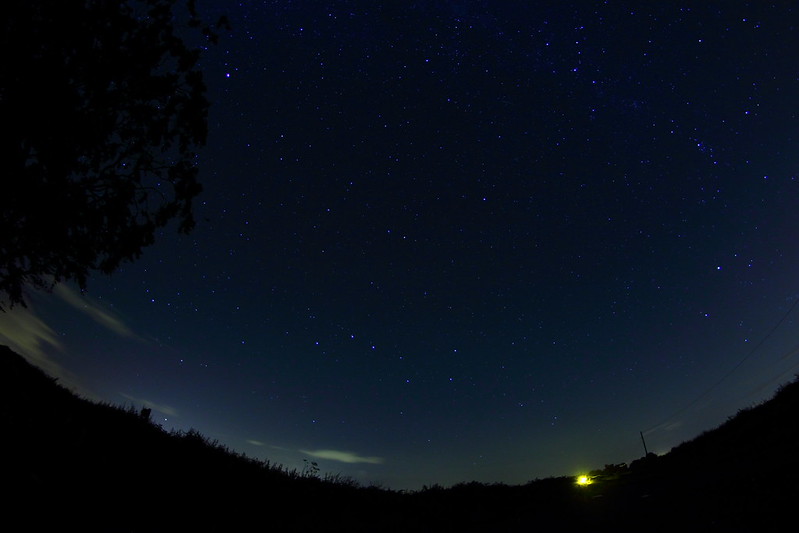
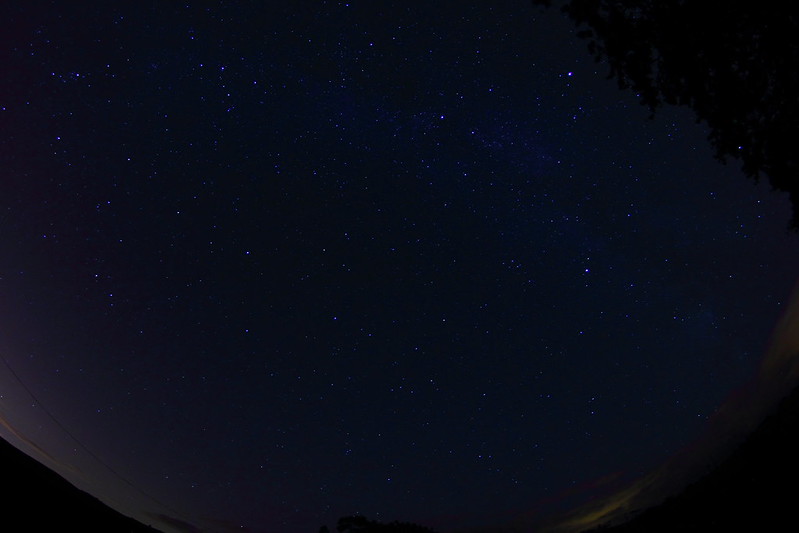
METEOR SHOWER!!

For many reasons, a cheap intervalometer is a great investment.
For example, I've used mine to take a group shot with the following recipe - wait two mins, then take 10 shots two seconds apart. This gave me long enough to climb back up to the group and we used a phone to judge when the shots were being taken.

I've been thinking about trying ML as it also offers motion detection good enough to capture lightning and focus peaking which would be useful with my tilt-shift lens.

I haven't given it a go as a lot of the good stuff has been waiting on this release.
At the moment, the documentation is rubbish, but I'm sure that will change!
And there is always the big catch stated in the Important Notes section of the Installation Guide "And, remember that this software can damage or destroy your camera."

I don't doubt it, you can pick one up for less than a fiver and always have it in your bag handy. I just thought I'd mention ML in case he decideed it had features he would use and end up negating the need for a separate one.

ML has loads of features I've never even used yet, I mostly use it for time-lapse.

I see the disclaimer but so far I've loaded it on and off my 5DMKIIs loads of times with no issues as well as a 60D. looking forward to the release for the 5DMKIII.
 
Cloud cover was an issue here yesterday for me......as you can see :lol:

Taken with the Pentax K5 | 16-45mm @16mm | f4 | 20 seconds | ISO 1600 | Cable release | Tripod

7783822850_d365efe00b_c.jpg


Not sure if this another meteor but this is the one that flashed like a firework and was in roughly the same place as the first image. Not sure if its ISS ?
7783813554_369b87bedf_c.jpg
 
Advice needed for me I think. My pictures look nothing compared to any of the ones on here lol..

Equipment wise I've got a Canon 500D, with the 18-55mm kit lens, plus the Canon 55-250 lens too.

I took the photographs using the 18-55, with various different ISO settings, from 400 - 1600 just so I could test, and on my tripod using remote shutter release, 30 secs. It picked up the stars + meteorite, but the picture was very blurry and you can barely make out the meteorite. I did have it on manual focus, which I though was focus'd in (perhaps this was my problem). Any tips please?
 
Advice needed for me I think. My pictures look nothing compared to any of the ones on here lol..

Equipment wise I've got a Canon 500D, with the 18-55mm kit lens, plus the Canon 55-250 lens too.

I took the photographs using the 18-55, with various different ISO settings, from 400 - 1600 just so I could test, and on my tripod using remote shutter release, 30 secs. It picked up the stars + meteorite, but the picture was very blurry and you can barely make out the meteorite. I did have it on manual focus, which I though was focus'd in (perhaps this was my problem). Any tips please?

For me, there are two easy ways to focus at night - both use Live View and manual focus.
1) Use Live View to zoom in a streetlight or other point of light - make it look sharp - job done! This can work by sending a friend into the scene with a torch; any reasonable distance will do as long as the depth of field is enough to keep the horizon sharp.
2) Use a laser pointer, zoom in on the dot and make the dot look as small as possible. If you use a green laser, then you can see the beam which makes it much easier to locate. I've managed to use this to focus up to half a mile away though that was just for a challenge as anything over 100m will do!
 
Did you turn off IS on the lenses? I've forgotten to do it before on long exposures!
 
Rico said:
Did you turn off IS on the lenses? I've forgotten to do it before on long exposures!

Just had to check, i dont remember turning it off but must have, as its still off lol
 
DuncanDisorderly said:
For me, there are two easy ways to focus at night - both use Live View and manual focus.
1) Use Live View to zoom in a streetlight or other point of light - make it look sharp - job done! This can work by sending a friend into the scene with a torch; any reasonable distance will do as long as the depth of field is enough to keep the horizon sharp.
2) Use a laser pointer, zoom in on the dot and make the dot look as small as possible. If you use a green laser, then you can see the beam which makes it much easier to locate. I've managed to use this to focus up to half a mile away though that was just for a challenge as anything over 100m will do!

Great tip thankyou! Going to dig out a laser pointer and give it a go at the weekend
 
Not sure if this another meteor but this is the one that flashed like a firework and was in roughly the same place as the first image. Not sure if its ISS ?

First one sure looks like a meteorite, I'm pretty sire the second is a planes lights flashing, you see loads of them on long exposures , especially if you live where I do close to an airport.
 
I don't doubt it, you can pick one up for less than a fiver and always have it in your bag handy. I just thought I'd mention ML in case he decideed it had features he would use and end up negating the need for a separate one.

ML has loads of features I've never even used yet, I mostly use it for time-lapse.

I see the disclaimer but so far I've loaded it on and off my 5DMKIIs loads of times with no issues as well as a 60D. looking forward to the release for the 5DMKIII.

I have been using ML for a fair while now on my 550d, I was unsure at first, but gave it a go. It has never given me a problem. The motion detection, sound trigger and focus trap are great, and the intervalometer is brilliant.
 
Hey all,

I went out tonight to see what I could see. My first time doing this sort of thing.

I headed to the park to illiminate light pollution. I stood near the gates for 30 seconds and then I heard
a cat crying so I piddled myself back home haha. The sound of fighting cats have always scared the hell out of me!
A shame because it was completely pitch black at the park.
(am I a man, or a muppet!)

So back to the back garden it was...

Overall.. I captured 2 or 3 meteors. And saw 1 with my own eyes.
Fairly clear sky tonight. But I need a bit of practise with long exposures.
I found it difficult to find anything to focus on. And I forgot to turn off IS!

Hopefully there will still be more tomorrow and I can have another go
 
Hey all,

I went out tonight to see what I could see. My first time doing this sort of thing.

I headed to the park to illiminate light pollution. I stood near the gates for 30 seconds and then I heard
a cat crying so I piddled myself back home haha. The sound of fighting cats have always scared the hell out of me!
A shame because it was completely pitch black at the park.
(am I a man, or a muppet!)

So back to the back garden it was...

Overall.. I captured 2 or 3 meteors. And saw 1 with my own eyes.
Fairly clear sky tonight. But I need a bit of practise with long exposures.
I found it difficult to find anything to focus on. And I forgot to turn off IS!

Hopefully there will still be more tomorrow and I can have another go

Muppet.... :D
 
For me, there are two easy ways to focus at night - both use Live View and manual focus.
1) Use Live View to zoom in a streetlight or other point of light - make it look sharp - job done! This can work by sending a friend into the scene with a torch; any reasonable distance will do as long as the depth of field is enough to keep the horizon sharp.
2) Use a laser pointer, zoom in on the dot and make the dot look as small as possible. If you use a green laser, then you can see the beam which makes it much easier to locate. I've managed to use this to focus up to half a mile away though that was just for a challenge as anything over 100m will do!

Why not focus on infinite?
 
squarepeas said:
Why not focus on infinite?

Because the infinity mark on a lens is rarely accurate.

I usually look for the biggest, brightest star (or planet) in the sky, zoom in as far as I can with live view and adjust focus until it's the smallest possible size I can achieve.

If your taking long exposures, you also might find you need to check and adjust focus over the course of an evening.
 
Most lenses need to be refocused whenever the zoom ring is touched and focus can be knocked when moving the camera around.
I presume you don't mean when hands off during timelapse?

I was thinking about went to sleep for a good few hours and only collect the kit in the morning :lol:
 
has anyone tried laying the camera flat on it's back on a table facing straight up to the sky, then locking a cable release on 30 sec exposures? I did about 5 shots the other night this way and they looked pretty good, but forgot i had to go and pick my daughter up from her friends and didn't want to leave the camera outside in case it rained :bonk:

i would have thought this would be a bomb proof way of making sure the camera doesn't move though over long durations :shrug:
 
has anyone tried laying the camera flat on it's back on a table facing straight up to the sky, then locking a cable release on 30 sec exposures? I did about 5 shots the other night this way and they looked pretty good, but forgot i had to go and pick my daughter up from her friends and didn't want to leave the camera outside in case it rained :bonk:

i would have thought this would be a bomb proof way of making sure the camera doesn't move though over long durations :shrug:

Hi Leigh,

you could've put an unmbrella up to protect it from said elements :D
 
has anyone tried laying the camera flat on it's back on a table facing straight up to the sky, then locking a cable release on 30 sec exposures?

Great idea. Resting it on a beanbag (or a small cushion) would make it less likely to move about.
 
has anyone tried laying the camera flat on it's back on a table facing straight up to the sky, then locking a cable release on 30 sec exposures? I did about 5 shots the other night this way and they looked pretty good, but forgot i had to go and pick my daughter up from her friends and didn't want to leave the camera outside in case it rained :bonk:

i would have thought this would be a bomb proof way of making sure the camera doesn't move though over long durations :shrug:

I've never had a problem with anything moving when I've had it on a tripod or rig before. You just need to make sure that what you have is suitable for the job and lock things off.
 
Also, don't extend the tripod legs. There's no need to have the legs fully extended once you are set and it will be more stable when it's not at full height.
 
Had a go on Monday night using my 8mm Samyang, saw loads of meteors over about 1 1/2 hours but only caught bits of them at the edge of my shot bar one, see if you can see it lol-

7792068610_2d4fdb2424_c.jpg


Quite like this one, Milky way (I think)

7792060032_8b8fcd8de0_c.jpg
 
Last edited:
Yeah that's the Milky Way in the second, very nice!
 
nice lens Chris!

a lot of the meteors can be quite faint, so bumping up the iso can be helpful... even if it gets a bit noisy, a bit of tidying up in LR can work wonders :)
 
Aye, I could have upped the ISO another notch, I also didnt have it wide open to help with focus for a lot of the shots I took initially. Definitely a leaning curve this astrotogging malarky
 
By the way if anyone cant find the meteor in my first shot, here is a clue- top quarter, just right of centre :)
 
Hi Leigh,

you could've put an unmbrella up to protect it from said elements :D


LOL! Put an umbrella above the camera that is pointing up to ensure the rain from the clear sky (behind the umbrella) doesn't go onto the camera which is on your garden table? LOL! :bang:
 
Sorry bad plug, not taken at meteor time but like this shot I took at work so thought I'd share!

wash.jpg
 
Not quite reading his blog.

it's an impressive feat in terms of time and effort, but the amount of hacking about and the fake look to it ruins it for me.

it's massively overstepped the line of "wow" in my opinion and has really cheapened all his hours out in the cold and in front of the computer.
 
I posted right at the start of the tread that i'd never seen a good shot of the Perseids Meteor Shower, well I have to withdraw that comment now.

http://www.flickr.com/photos/davidkingham/7769126492/

Fantastic image - good find!
Huge dedication and commitment went into that shot.

i think you can keep on looking, just a horribly photoshopped creation.

Really?
I'm curious as to what sort of meteor shower images you have seen that would top that.
Got any links?

Remember it was taken with moonlight for the second half of the night. My own attempts under moonlight looked more like mid-day than mid-night.
I've also tried correcting for the rotation of the Earth and failed; the lens distortion means it is not a circular correction; every image needs to be warped to overlay. I'd thought you could only do this with an equatorial platform (here's an article).
 
Really?
I'm curious as to what sort of meteor shower images you have seen that would top that.
Got any links?

Remember it was taken with moonlight for the second half of the night. My own attempts under moonlight looked more like mid-day than mid-night.
I've also tried correcting for the rotation of the Earth and failed; the lens distortion means it is not a circular correction; every image needs to be warped to overlay. I'd thought you could only do this with an equatorial platform (here's an article).

it's all personal preference, but for me the best meteor shot will be pure and simple, maybe an impressive landscape which captures a couple of meteors in one frame.

the one that was linked starts to fall into the HDR / over-constructed category for me. not what i like.

there's not always direct correlation between time spent and better quality of image.
 
Last edited:
it's all personal preference, but for me the best meteor shot will be pure and simple, maybe an impressive landscape which captures a couple of meteors in one frame.

the one that was linked starts to fall into the HDR / over-constructed category for me. not what i like.

there's not always direct correlation between time spent and better quality of image.

I tend to agree to be honest, It just looks too ott.
 
it's all personal preference, but for me the best meteor shot will be pure and simple, maybe an impressive landscape which captures a couple of meteors in one frame.

the one that was linked starts to fall into the HDR / over-constructed category for me. not what i like.

there's not always direct correlation between time spent and better quality of image.

The image is good, well planned and well taken. Have you ever taken an Astro shot? Most are combined images and it would be almost impossible to take a single shot as you describe :thinking:
 
I wouldn't know where to start creating something like that, but its a bit OTT and cheesey for me.
 
The image is good, well planned and well taken. Have you ever taken an Astro shot? Most are combined images and it would be almost impossible to take a single shot as you describe :thinking:

yeah I took some 30sec meteor shots (linked earlier in the thread). simple and straight out of the camera.

i can understand combined images for shooting star trails. but that chap's photo just looks like a nice landscape with a load of photoshop meteor brushes/custom shapes randomly stuck on top :thumbsdown:
 
Nail-Head-Hit
They are not random!

Problem is that the Perseids move in the sky with the rotation of the Earth.
So a star trails type shot would indeed make the meteors look random.

But they actually emerge from a single point, the Perseids, hence the name.
This photographers technique is getting close to illustrating that is what is happening.
It's kinda cool; but I still think I'd have gone with the star trails approach as it is WAY easier to execute.
But that's just me being lazy :)
 
Back
Top