Medium format with adjustments

You will never be able to use extreme movements of any sort, as your lens does not provide a very large image circle.

This is the key unfortunately. In an ideal world I'd use a LF lens with a much larger image circle but as with most projects I have to work with what I have. At the moment I don't shoot a lot of architectural shots (although I do enjoy it) so the main benefits for me will be in the tilt for front to back focus in landscapes and rise and fall if I need it for composition. This is more than likely going to be the MK1 to several other versions so I'll keep it simple for the time being and see exactly how much image circle I've actually got to play with. In the future I might look to replace the lens with something more suitable though.

Cheers
Steve
 
Some of these early folders have symetrical lenses such a rapid rectilinear, these have a fairly good image circle and get less vignetting and are sharper well stopped down. A modern derivative would be the symmar which has a very generous circle.
 
I've been drawing up some different revisions before I start any laser cutting of components. My initial design housed the roll film holder in a portrait orientation to keep the camera slim (more of a design thought than any major benefit).

ImageUploadedByTalk Photography Forums1453825523.529186.jpg

I've flipped the bracket holding the front standard to the rear 90 degrees so the film plane is now fixed and the front standard tilts on axis. My understanding is that rear tilt can lead to more obvious distortion than front tilt. I'll mount the tripod bracket to the rear standard and hang the lighter front off it. The main issue with this orientation is that the lens image circle will have the most flexibility side to side whereas the front standard is setup for rise/fall.

As an alternative, I've now rotated the rear standard 45 degrees to mount the film plane in a landscape orientation. This allows for rise/fall on the front standard due to the greater adjustment on the lens image circle top to bottom.
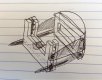
ImageUploadedByTalk Photography Forums1453825736.902846.jpg

The front standard is still made with 3 sheets of 3mm acrylic sandwiched to create a channel for the lens board to slide up and down. I'll embed magnets into the lens board and matching metal plates into the front standard so the lens can be set to any position without having to unscrew any brackets etc.

The front tilt is locked using a single threaded rod that goes right through the lower section and is locked at one end using a threaded wing nut. When this is released, the front standard can rotate around its central axis in relation to the film plane. The wing nut can then be tightened at any point to hold it in place.

A final thought is to have another holder that can be clipped into the rear standard which contains an adaptor tube that my Sony A6000 (digital) can be attached to. I can then shoot a cropped digital image using the same movements. I would just need to replace the two brackets that hold the front standard in place with shorter ones to move the lens backwards and account for the sensor being further back than the film plane.

ImageUploadedByTalk Photography Forums1453825996.631411.jpg

Cheers
Steve
 
Last edited:
Very impressive. I was trying to work out by what magic "rotat[ing] the rear standard 45 degrees" helped, but I suspect you actually meant 90 degrees, as it's gone from portrait to landscape!

Have you worked out the image circle yet? Presumably this can be seen with the lens out of the camera... would it work holding it the right distance from some paper, and move a torch around on the "world" side?
 
Well spotted Chris, that was my deliberate maths mistake...Yes, supposed to say 90 degrees! I haven't worked out an exact image circle but my logic is if I overlay a circle over a 6x9 rectangle, it has to cover somewhere in the region of 9x9 (at maximum edges obviously). I'm only looking for rise/fall and a small amount of tilt so I reckon it's worth a go. If I had any budget I'd be looking at a LF lens but is also be looking at a larger/heavier front standard which negates the idea of a smaller light field camera.
 
An older small light 54 lens wouldn't be too expensive and give decent coverage. My fujinon 125mm is tiny though it only really covers with out too many movements.
 
Thanks for the tip Steve. I'll keep an eye out for some bargain lenses. I've just finished making a 1:1 card mock up of the camera body using my original bellows. My main concern is that these bellows are around 90 years old so not the most flexible so I think I might have to make my own if I want rise/fall.

ImageUploadedByTalk Photography Forums1453849623.222168.jpg

ImageUploadedByTalk Photography Forums1453849630.774073.jpg

ImageUploadedByTalk Photography Forums1453849638.361445.jpg

ImageUploadedByTalk Photography Forums1453849647.352656.jpg

Obviously, 3mm acrylic won't flex like the card I'm using so everything will stay in square :0)
 
Back
Top

