Medium format with adjustments

stevelmx5

Suspended / Banned
Messages
10,176
Name
Steve
Edit My Images
No
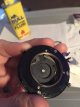
Quick question for those more knowledgeable then me :0). If I used a 55mm or 70mm Mamiya M645 N/L lens on a custom body, can I lock open the in-lens shutter using either a B or T mode for focussing/composition?

Feels like it might be a stupid question but all of the manuals I can find show it being used in combination with the focal plane shutter to cover the film until the exposure is taken.

Cheers
Steve
 
I can use my 645 shutter lenses with the focal plane shutter in the camera I just lock the shutter open and use
as a normal, not often because its just as easy to use a normal lens.........
 
Thanks for that. The reason I ask is because I'm looking at another custom camera which will be similar to a Hasselblad Flexbody. I've always liked the look of them for their (small) adjustments along with light weight but my bank manager isn't in agreement with the £1k price tag! I'd need to be able to lock open the shutter to compose/focus on a ground glass then close it before taking the image with the film holder in place like I do with my large format kit.

I started drawing up a design today using a Mamiya M645 lens mount on the front standard (so I can use the leaf shutter) and a Kiev rear mount so I can use the 120 6x6 roll film holder which has the built in ability to wind the film on so I don't need a crank. My original design is along the lines of a Flexbody but using a half-circle bracket on both the front and rear standards instead of just the rear like the Hasselblad so Tilt can be adjusted on either front/back or both.

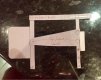
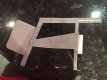
I was looking at laser cutting the brackets but then came across this original Flexbody Prototype which is even simpler to replicate;

200811118031.jpg


The single screw on the film back side is a pivot point for the rear tilt which is kept level by the brass bracket at the top. With this design there isn't too much custom bodywork to be made so it should be relatively straight forward. I reckon the parts needed are;

Mamiya M645 55mm or 70mm N/L Lens
Mamiya M645-Canon EOS adaptor (so I can butcher the lens mount from it)
Kiev 120 6x6 film holder
Acrylic front standard with lens mount embedded
Acrylic rear mount with clips built in to mount the film holder
Short bellows
Assorted plate brackets

Potentially, it could include some rise/fall on rear standard if the pivot screw was fitted into a channel with a threaded nut to hold it in place. The nut could then be loosened and the rear standard moved up/down. I'll mount a 6x6 ground glass screen into a holder which can be clipped on using the same mounts as the film holder for focussing/composing then switch it out when ready to take the picture.

So the question is....am I mad? ;0)

 
Last edited:
Lol, thanks mate :0). It would be much easier if I just fitted a large format lens with shutter but I like the idea of using the Mamiya lenses for both focal length and built in helicoid for focussing (and price!)
 
Last edited:
Me too but the only way I'm getting one is if I make it!

I'm just going to wait and hope that I can afford a Flexbody someday in the not-too-distant future. I already have the lens that I want to use with the Flexbody, so now I just need to be patient...

Potentially very patient.
 
OK, so we're all in agreement that I'm mad... ;0)

Back to the Mamiya N/L lenses, does anyone here have one? If so, can they confirm if it's possible to hold the shutter open to allow focussing/composing with a ground glass then close the shutter but leave it cocked so I can attach a film holder and remove the dark slide ready to expose the properly timed shot like a large format shutter?

Cheers
Steve
 
I've realised that I've got an Ensign 6x9 folder that has a helicoid built into the lens so I'll 're-purpose' that. Just drawing up a basic design using the 6x8 Graflex rollfilm back I was going to use on my Polaroid 110A.

ImageUploadedByTalk Photography Forums1449766103.136636.jpg

The lens would be housed in a basic lens board with a strong magnet embedded on each side. I could then embed matching magnets at 5mm intervals to provide rise/fall. The rollfilm holder would then be mounted on a pivoting bracket to give some tilt.

If I mount the film holder into a plate I could switch between portrait and landscape quickly. Similar embedded magnets would hold it in tightly as well.

ImageUploadedByTalk Photography Forums1449766255.517002.jpg

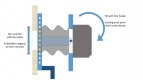
(Film holder on the right with the camera rear plate on the left). I'm looking at this being 135mm square to keep the camera as small and light as possible.
 
You know how in the Olden Days, rich people used to give patronage to Mozart and Bach and whatnot to write music for them? Well, if I was a billionaire, I think I'd fund Steve to make crazy cameras for me. Imagine the fun getting a new one every few months. "This one is an underwater large-format field camera", etc.
 
You know how in the Olden Days, rich people used to give patronage to Mozart and Bach and whatnot to write music for them? Well, if I was a billionaire, I think I'd fund Steve to make crazy cameras for me. Imagine the fun getting a new one every few months. "This one is an underwater large-format field camera", etc.

Bwhahha!
 
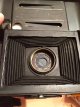
I'm appalled, who'd have thought a lens that's only 90 years old would be so mucky inside...

ImageUploadedByTalk Photography Forums1449779354.490280.jpg

ImageUploadedByTalk Photography Forums1449779361.577210.jpg

Guess I'll be breaking out the lighter fluid to clean the blades!
 
Mamiya N/L lenses.

OK had a play with mine this evening and the answer is yes you can close the lens and then fire the shutter.

You fix a remote release to the lens, cock the shutter which opens the lens for focusing. You then hit the shutter release on the camera and that lifts the mirror and closes the lens. Then you operate the remote shutter release and it fires the shutter in the lens.

You will need to find a way simulate the cameras shutter release as that is to only way to shut down the lens in order to remove the dark slide prior to operating the lens shutter.

Hope this helps......
 
Thanks a lot for testing that for me. Unfortunately it looks like I thought from the manual and the interlink with the body would need to be bypassed/imitated so might be more difficult than I hoped.

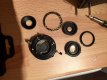
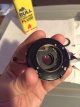
I've just done a light CLA on the Ensign 20 lens I've got here and it's now firing cleanly and stopping down so I'll start by building this lens into the camera and see how it goes.

ImageUploadedByTalk Photography Forums1449784793.632202.jpg

ImageUploadedByTalk Photography Forums1449784801.534031.jpg

ImageUploadedByTalk Photography Forums1449784810.806069.jpg

Cheers
Steve
 
I've been sketching up the front standard today and have come up with a 3-layer design. If I laser cut it from 3mm acrylic sheet it will be strong but keep the weight down.

1) First two layers. The lighter orange layer has embedded magnets and the central cutout is narrower than the lens board. The middle layer has a wider central cutout so the lens board can slide up and down and be held in place by the embedded magnets 10mm apart.

ImageUploadedByTalk Photography Forums1450202498.326250.jpg

2) Third layer which will be bonded on top to form a solid front standard with a channel for the lens board to slide up and down.

ImageUploadedByTalk Photography Forums1450202616.072907.jpg

The lens i'm using has a 50mm outer diameter with 30mm centre so will overhang the lens board hence the semi circle cutout so it can fit as low down as possible to give the biggest range of rise/fall without having to make the standard too big.

As well as being light I'm trying to build the camera as small as possible so it's not too much of a hassle to carry around. I'm also looking at making it modular so it can be broken down into a few smaller parts for storage in a small bag.
 
Last edited:
Looks fun. The problem with using complex movements is that the bellows soon become the limiting factor. You will probably find bag bellows more accommadating.
can you not use two magnets each side of the lens plate so that four are engaged at each position.
 
Last edited:
I looked at at bag bellows but with the short space between standards i'm not sure if there'd be a risk of the bellows blocking the lens? I'm also being a bit lazy and building around the parts I've got but it's easy enough to replace the bellows if I need to.

Good idea with the four staggered magnets for the lens board. The image doesn't show it too well but I was planning on having two magnets on each side of it to lock it in place but splitting them may give more support.

I've spent a bit of time thinking about the rear standard. I was originally planning to just have tilt with a simple pivot point but if I mount the rear plate inside two separate surrounds I could have both tilt and swing, just need to decide on the best way to latch them in place. A simple nut/bolt is the simplest option but I never seem to go down the simple route!
 
Last edited:
I looked at at bag bellows but with ùthe short space between standards i'm not sure if there'd be a risk of the bellows blocking the lens? I'm also being a bit lazy and building around the parts I've got but it's easy enough to replace the bellows if I need to.

Good idea with the four staggered magnets for the lens board. The image doesn't show it too well but I was planning on having two magnets on each side of it to lock it in place but splitting them may give more support.

I've spent a bit of time thinking about the rear standard. I was originally planning to just have tilt with a simple pivot point but if I mount the rear plate inside two separate surrounds I could have both tilt and swing, just need to decide on the best way to latch them in place. A simple nut/bolt is the simplest option but I never seem to go down the simple route!

It is not often that you need swing and tilt at the same time. If you can remount the camera at 90 degrees you can use tilt as swing.
However you do need to be able to slide the lens either sideways or up and down.
In some wooden cameras this was achieved by having the rising front on the lens panel, so as to be able to insert it at 90 degrees also.

In the past I often used a mpp for photographing shop interiors and needed a lot of drop front.(on a high tripod)
I made a heavy square frame and mounted the camera upside down inside it. I then used the rising front as drop front.
 
Thanks Terry, I think you're on to something with remounting the camera to use tilt as swing. The whole body will be light so I should be able to swing it 90 degrees on a ball head.

I'm also building the rear plate so I can mount the rollfilm holder in either orientation so it's much simpler to just flip the camera over than make a more complex multi-adjustable rear standard.

The front standard will give me an up/down or left/right slider for the lens depending on orientation of the body too so should cover most requirements.
 
I've been looking at the fasteners for the frame as well as ways to incorporate both axis and base tilt into the rear standard without complex brackets. I want to be able to break the camera down into components easily but still keep the rigidity required for solid focussing.

Most field/monorail cameras use a selection of screw fasteners which can all be loosened to slide the various plates/brackets to get the focus required. Instead of using multiple screws which could get fiddly on such a small camera I've started to look at simple pop fasteners (bare with me!)

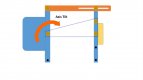
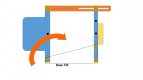
If I have three fasteners on an adjustable bracket it will provide a solid mount from the front standard and a rotating mount on the rear standard. There is no adjustment on a pop fastener so the rotating point will always be square to the frame and I can simply un-clip the bracket and move it down to give base tilt or use it centrally for axis tilt.

ImageUploadedByTalk Photography Forums1450336824.945005.jpg

ImageUploadedByTalk Photography Forums1450336832.227120.jpg

The top support bracket will also be attached to the rear standard with a pop fastener and have a sliding bracket on the front standard with a screw thread lock to keep the film holder in the position required.

Axis tilt;

ImageUploadedByTalk Photography Forums1450336914.573711.jpg

ImageUploadedByTalk Photography Forums1450336930.411385.jpg

ImageUploadedByTalk Photography Forums1450336953.506509.jpg
 
Base tilt;

ImageUploadedByTalk Photography Forums1450336970.999410.jpg

ImageUploadedByTalk Photography Forums1450336977.367781.jpg

ImageUploadedByTalk Photography Forums1450336990.440003.jpg

I'd appreciate any thoughts on the need for both axis and base tilt from anyone who shoots with these adjustments.

Cheers
Steve
 
I don't know about many monorails but there are three versions of mine, axis base and both. I'm not sure if it's necessary to have both tbh I think it just depends what you're familiar with. I'd be inclined to do one or the other and which ever is simplest. Also you almost certainly don't need as much moment as you think, unless you're shooting table top.
 
Thanks Steve. I've been watching various youtube videos on camera movements and the only difference I can pick up between axis/base tilt is that one is best for keeping lines parallel (axis?) and focuses on the front subject then tilt to the rear whereas the other (Base) doesn't retain verticals as well and focuses on the rear subject then tilt for the front.

If I do use the pop fasteners it's pretty simple to switch between Axis and Base tilt in a few seconds although there's no way to use both together. If I only need a few degrees of movement in either direction that makes it easier too. My only concern is the unknown image circle size of the lens I'm using. It's designed for 6x9 so I'm not expecting a lot of adjustment potential but if I can get a few degrees I'll be happy.
 
I'm also changing the front standard to use a metal slider plate instead of individual magnets to hold the lens board in place. I've tested out the strength of some 5mm x 0.5mm neodymium magnets and if I mount four of those onto the board I can slide it into any position and it will hold securely.

ImageUploadedByTalk Photography Forums1450345390.092040.jpg
 
You do not need base tilt at all.
It is only used on some cameras to allow the Darkslide to be pulled in either orientation. but on your configuration that is not a problem anyway.
In architectural photography the important movements are.
the ability to get the back parallel to the plane of the building.
The ability to swing the lens to bring that plane into focus.
The ability to raise/lower and shift the lens side to side to correct the position of the resultant focussed image.

In landscape work the ability to tilt the lens forward to increase the apparent plane of focus depth of field.

Back movements are less useful than front movements as you can set the back and entire camera square to what ever you want. before you start adjusting movements.
You can then adjust the lens to give focus over that back plane and adjust it up down left and right to position the image.

If you have back movements as well, the front movements can sometimes be less extreme.
The back position always corrects for architectural distortion... and the lens for focus.

Up down and side to side movement (back or front) only adjust the image circle on the film.
When you fully understand this... setting up a field or monorail camera is a matter of moments.


On a monorail tilting the rail up or down and making the back and lens vertical can substitute for extreme rise or fall front. But in many instances would exceed the image circle of the lens.
 
Last edited:
That's an excellent post Terry, thanks again for sharing your knowledge :0) Looking back on the original Hasselblad Flexbody prototype which I'm basing my design around I see that they just allowed for on Axis tilt as well. With my current design I've got;

- Rise/Fall on the Front Standard
- Tilt on the rear standard axis

It would be difficult to add swing to the front standard due to the two support brackets on the side which the rear standard is mounted to. It would be much simpler if I fitted both standards to a base like a normal view camera but as usual I'm trying to re-invent the wheel!
 
You can probably live with out swing, it has fairly niche uses. I think I've used it two or three times in the field and only once was it genuinely needed.
 
That's good to know mate, keeps the frame simple and neat. I think I'll just get the rise/fall and tilt in place and see how I get on.
 
Front swing and side shift are very often used in architectural photography, whilst tilt is rarely used.
tip the camera on its side and that tilt becomes swing and the rise and fall becomes side shift. Which is what is needed.
but at the back in your design you have nothing. If you could add side shift that would provide the necessary rise and fall when tipped at 90 degrees. That combinationwould provide most of the necessary movements, but in a rather unusal configuration.
You will never be able to use extreme movements of any sort, as your lens does not provide a very large image circle.
 
Back
Top