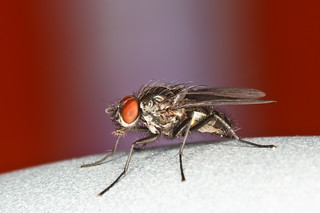
For what its worth - this is what i used on my panasonic and now on my d5100 (cannot remember where the idea came from but its not mine - but it does work)
This is the macro 'set up' and procedure i use on the panasonic:-
Overall pic of the kit
from the top down - My home made pringles diffuser attached to a non dedicated flash gun (ie the camera cannot control the flash output or detect and ensure correct exposure) . The camera with a raynox dcr-250 macro lens clipped to the font of the lens. The Manfrotto slide sitting between camera and tripod . Electronic wire remote shutter release is dangling.
The most important part of the kit - The pringles diffuser
Because i'm working very close to the subject the built in flash is not usable and a standard external flash gun cannot be angled correctly and also is far too bright even at small apertures - what is needed is a close diffused flash and pringles do the trick . I cut a square hole in the bottom of a pringles tube just big enough to take the flash head - than cut the top down at a slight angle - making the tube short enough to suit the distance from flash head to front of lens. used the plastic top of the pringles tube to make a diffuser (its translucent) stuck it on with sellotape blue peter style. (the bottom and inside of a pringles tube is aluminium and ideal to 'bounce' the flash down to the diffuser).
The Raynox macro close-up lens
Because my panasonic does not have interchangeable lenses i have to use a close up lens on the front of the camera lens - these raynox lenses are about the best. They clip on to the filter screw with the supplied adapter or can be screwed in with a suitable step up/step down ring. The lenses give max enlargement when used with the cameras max zoom - in my case 420mm. Like all close ups they produce a very limited depth of field (DOF) .
Procedure
Macro photography can be a bit hit and miss without some very expensive kit - i try to do it on a bit of a shoestring - as you will by now be aware. The basic minimum spec that i would recommend for the camera you use is :-
Aperture control on the camera. (aperture priority AE mode).
Manual focus.
hot shoe for ext flash gun.
You can of course get great pictures without, but it becomes even more hit and miss and the macro setting on a standard camera is not really macro - its more close up so check what the minimum focus distance is and keep to it - the dof will still be small and you may not have control on what the camera is focussing on.
I either find a suitable subject or drag the kit to where a subject may turn up - patience is very useful here as the object of your desire may be elusive - bugs / spiders etc are a bit territorial and if you find a good subject and he/she goes away chances are they will return! sometimes next week!!!!! i have found just a few granules of sugar good for keeping them happy/and/or attracting them - caterpillars are usually on their source of food and don't travel very fast.
Always set the camera to the smallest aperture (in my case its f11) F16 would be better.
For best quality and to combat in-camera noise (speckles) set camera to iso 100 or 200.
Set the camera for external flash on manual control (at its lowest, least powerful *setting if that is possible).
Set the flash to its lowest power (im lucky with mine i have an option for 1/16 full power) or M - If pictures come out consistently overexposed - use the auto setting and experiment with the asa/iso setting - the higher the iso setting the less powerful the auto flash will be but remember the flash in auto is trying to read the subject and will not see what you see through the viewfinder.
THE FLASH SETTING IS THE MOST HIT AND MISS BIT AND ONLY BY EXPERIMENTING WILL YOU FIND A SETTING THAT SUITS THE CAMERA WHEN TAKING MACROS - BUT ONCE YOU FIND IT - ITS PROBABLY OK FOR ALL MACROS YOU DO.
Take time to get manual focus correct - if you haven't got manual focus make sure you are out side the minimum distance.
Caterpillar
This little chap/chapess only has a DOF of about 1/4 inch and even with the manfrotto slide was tricky to focus on as he was wriggling a bit. I saw him inching his way up a stem and set up the camera and focussed on the end of the leaf he was making for - got him mostly focussed with manfrotto then with a bit more manual focus then more tweaks with manfrotto - pressed the release but still he moved a tad - took several like this and none were IMO that good - anyway after his feed off he went and i packed up!! patience is definately what you need. Its worth doing though.
DONE POSTING FOR TIME BEING BUT MAY RETURN IF I FIND OR ANYONE POINTS OUT GLARING ERRORS OR NEED MORE CLARITY! DARK ROOM FOR ME NOW!