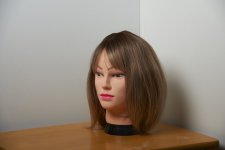
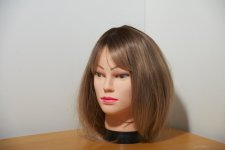
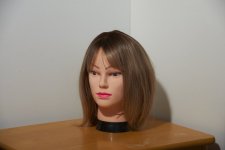
Lighting Challenge 7, Beauty Lighting

Garry Edwards

Moderator
Messages
13,475
Name
Garry Edwards
Edit My Images
No
Despite the limited participation in the earlier lighting challenges, I’ve decided to post another, and see whether the level of participation justifies the time . . .

Lighting for beauty often involves more than one light, for example there may also be a fill light, a hair light, a back light and so on, but sticking to my own “rules” There’s just one light here. This makes sense because it’s always one light that does about 90% of the work anyway.

This is going to be a long and detailed post (my apologies) because the results will vary depending on the lighting modifier used, and we’ll all have different gear, so there are 3 different modifiers used here, a large softbox, a large beauty dish and a standard reflector. The softbox and the beauty dish are in fact the same tool, a 100cm beauty dish that comes with 2 diffusers, turning it into a softbox.

100cm is too large for just a headshot, but it’s what I have. I say that it’s too large because the sculptured effect is reduced by the size, with the light coming from such a large area and, therefore, from different directions. People who have met me know that I’m not Uriah Heep, I’m not ever so humble and I always KNOW that I’m right – but feel free to get better results than I can with a really large light:)

The whole idea of beauty lighting is that it shows the qualities of the subject’s bone structure, and to show these qualities at their best we need a fairly hard light, placed at the angle that creates the right shadows in the right places – under the cheekbones, under the nose, under the lips and under the chin. Flat lighting doesn’t do this.

It needs the right model, of course, because this fairly hard lighting also emphasises poor complexion and we also need, if possible, a model with high cheekbones, often found with African and East Asian people, but less often with British people.

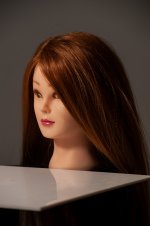
Sadly, the only “model” I have to hand in my cheap and cheerful eBay mannequin head, not ideal because she’s made of plastic, but it’s what it is. Ignore the catchlights, which are painted on and which aren't created by the lighting.

My own tool of choice would be a 40cm metal beauty dish, and I know that my own one is at the back of the Lencarta warehouse somewhere, but I decided against it because they have now fallen out of fashion and very few TP members are likely to have one, so I’ve gone with the tools I mentioned earlier.

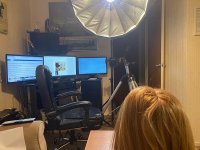
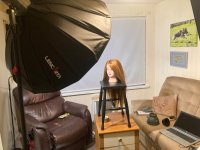
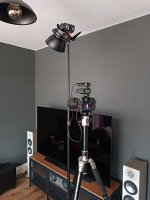
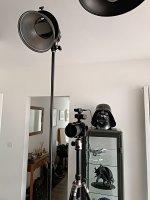
And, typically, I would have the light on a boom arm, which would have allowed me to light the model from the front without the lighting stand getting in the way, but most of us don’t have a boom arm so for most of these shots I’ve shot my “model” with the light off to the side and with her face at an angle, to match. But, it was (just) possible to shoot it straight on, but the light had to be either behind or immediately next to the camera, which was a bit of a challenge because to maintain the angle I had to lower the "model" because I ran out of ceiling height, and I also ran out of background:)
distant.jpg

Having the light 2 1/2 times further away did make it effectively 2 1/2 times smaller, which helped, but it wasn't easy in a small room . . .
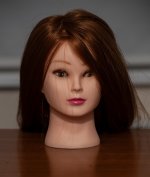
full frontal.jpg

It’s all about the light position and distance – high enough to sculpt the shadows, close enough for the inverse square law to make a real difference, distant enough not to create ugly highlights.

I’ve also taken each shot with and without a reflector, which has worked too well because I couldn’t get it far enough away. A correctly-positioned reflector would have created a very similar effect to clamshell lighting.

One small point – the depth of field varies because I changed the lens aperture to compensate for the differing light output with different modifiers, which especially shows up with the diffused standard reflector shot, instead of changing the flash power.

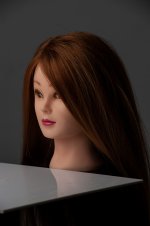
So, the first example is with the softbox, but each example is with the light in exactly the same position – but please experiment with different angles, positions and distances
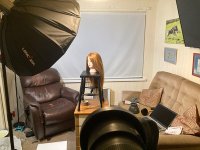
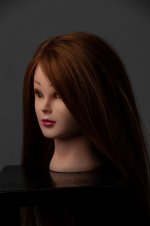
image1.jpeg

softbox.jpg
softbox_reflector.jpg


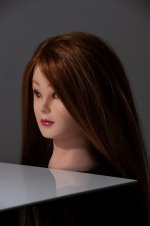
Moving on, here “she” is with the beauty dish, which inevitably creates harsher shadows with more clearly defined shadow edges
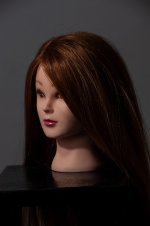
beauty dish.jpg
beauty dish_reflector.jpg


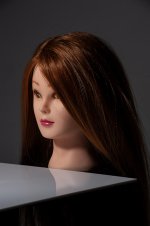
And now with the standard reflector. The result is even more dramatic, but the lighting is pretty uneven because of the reflector design. I've always felt that standard reflectors are seriously under-appreciated
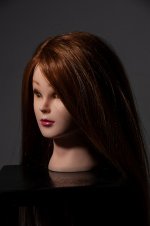
standard.jpg
standard_reflector.jpg


So, I put a diffuser over the light to even out the inconsistent light delivery. Diffusers don’t soften the light, they just even out inconsistencies.
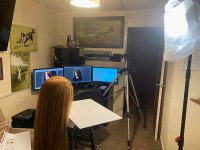
image5.jpeg

Here it is, without the reflector shown in the stepback shot above
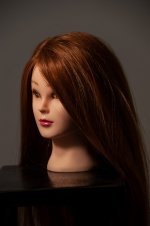
diffused standard.jpg
And with it
diffused standard_reflector.jpg


Over to you!
 

Attachments

  • image3.jpeg
    image3.jpeg
    128.1 KB · Views: 2
So now I have 5 to catch up on.

I'll see if I can loan a Girls World head from one of the granddaughters
 
Well I know it`s later than pronised, but I did have a good reason ;)

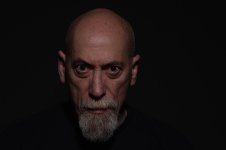
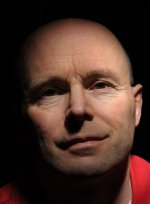
As you said, Garry. It`s not easy as a SP, but hey ho. My mug again I`m afraid haha

Lighting was godox 685 (1/32) in a cone thing with bracket. But I stuck a diffuser on it to try and open up the light a bit more. Not got a lot of space to work in. No pp other than removing a zit :ROFLMAO:

Me sml for tp.jpg
setup 1.jpgsetup 2.jpg
 
Very interested in trying this but will struggle before Thursday/Friday.
 
I dont know how I missed this,

Will read up and have a go.
 
Well I know it`s later than pronised, but I did have a good reason ;)

As you said, Garry. It`s not easy as a SP, but hey ho. My mug again I`m afraid haha

Lighting was godox 685 (1/32) in a cone thing with bracket. But I stuck a diffuser on it to try and open up the light a bit more. Not got a lot of space to work in. No pp other than removing a zit :ROFLMAO:

View attachment 443633
Not the ideal subject :exit:
But your technique seems to be spot on, if you'd photographed a beautiful 20 year old girl . . .
But anyway, you didn't have one available. This lighting technique (or at least the hard and fairly small light at an acute angle part of it) also works very well when we want to create "character" lines on older people, e.g. fishermen or farmers who've spent the last 60 years outdoors in all weathers, it's a useful tool to have in the box.
Very interested in trying this but will struggle before Thursday/Friday.

Don't worry, it took Darwin over 20 years to publish his theory of evolution:)
 
Not the ideal subject :exit:
But your technique seems to be spot on, if you'd photographed a beautiful 20 year old girl . . .
But anyway, you didn't have one available. This lighting technique (or at least the hard and fairly small light at an acute angle part of it) also works very well when we want to create "character" lines on older people, e.g. fishermen or farmers who've spent the last 60 years outdoors in all weathers, it's a useful tool to have in the box.
:ROFLMAO: well I did warn you...
Thanks, Garry as always (y)

I kinda got the angle by using, of all things a torch in a mirror ;)

I for one am really liking these challenges, albeit I am aware, and surprised there are so few taking advantage of your knowledge.
 
Last edited:
Had a try but need a higher stand for the light. It works better if I face downwards, but that isn't the point of it.
 
My Attempts. I don't think my face is so good for this lighting.

Picture 1 was a my flash with my big big Fresnel lens up as high as I could get it (at about 50 degrees). The light is designed to be used at about 4 meters so the spot was a bit small. It is also a pretty hard light. I don't think it was flattering on me. I am blaming my lack of well defined cheek bones and wrinkles.

2025 February Lighting 3.JPG
Picture 2 was a cheap small silver umbrella at about the same angle and placement. I think this is a much more forgiving light. As a picture I prefer this but I think the first one was more the effect I am meant to get. The height brings out the lines in my smile a bit

2025 February Lighting 1.JPG

Both pictures had +1Ev brightening added but that is it.
 
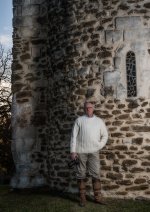
Like most photographers, I hate being in front of the camera. The only times I will reluctantly do it is when a photo of myself is required to be published somewhere to accompany an article or another such material. Then I do my best to dissolve myself into the old stones of the background, as in this one below. The lighting was just one Indra500 strobe on a light stand to camera right, firing through a double-diffused round softbox. Taken at dusk in February 2022. The camera was a Nikon Z7 fitted with a Micro-Nikkor 45mm, ƒ/2.8 D ED tilt-shift lens.


self_fev2022.jpg


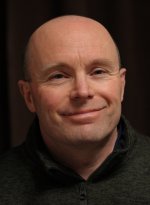
And this second (and last!) one is a portrait I needed for online icons or mug shots, such as here on TP. There were two lights, on camera left one Indra500 at ½ power firing through a double-diffused round softbox and a half-stop scrim to make a gradient light and eliminate reflections in my glasses. That strobe bounced into a large white card reflector quite some way away from me so as to not over-illuminate the other part of my face. Finally, there was a rim light (a Phottix Mitros+ cobra flash) on a stand behind me, to camera right. The camera was a Nikon Z7 fitted with a Nikkor Z 85mm, ƒ/1.8 S lens.


portrait_carré.jpg


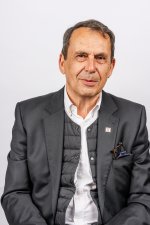
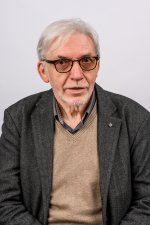
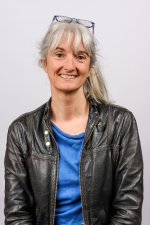
Finally, in June 2024, I was asked to take standardized portraits (to be integrated in a “Who is Who and Who Does What in the Team” document) of all the volunteers in the regional team of the Fondation du Patrimoine, one of those non-profit organizations I work for as a pro bono photographer. That was a daunting task, not only because of the sheer number of portraits involved (over one hundred of ’em!) to shoot in rapid succession in between the sessions of a seminar day, but also because I have no experience at all at that sort of photography. Moreover, I was supposed to make them all look more or less similar, while of course retaining each person’s individuality and trying to make them look not too much like prison mug shots... :rolleyes:

I lit them very simply: two Indra500s in Rembrandt position to camera left and right, more or less symmetrical, shooting through double-diffused softboxes. My subjects were siting on a chair in front of a large white paper backdrop and background. The results would not make the cover page of Vogue, but everyone thought they were more or less acceptable. They were shot with a Nikon Z7 II and a Nikkor Z 85mm, ƒ/1.8 S lens stopped down to ƒ/10 for safety, depth of field–wise...

There were difficulties with different skin tones, different colors of clothing, the presence of reflective glasses, etc. Not to mention shooting in a cold and damp improvised “studio” is an old military fort of the late 1870s and paying attention to technical details while trying to casually chat up the guys and gals and make them relax...!

Here are a couple of those shots which, all things considered, I am quite happy with.

_Z729127-Edit.jpg

_Z729147-Edit.jpg

_Z729181-Edit.jpg

lea3.jpg
 
My Attempts. I don't think my face is so good for this lighting.

Picture 1 was a my flash with my big big Fresnel lens up as high as I could get it (at about 50 degrees). The light is designed to be used at about 4 meters so the spot was a bit small. It is also a pretty hard light. I don't think it was flattering on me. I am blaming my lack of well defined cheek bones and wrinkles.


Picture 2 was a cheap small silver umbrella at about the same angle and placement. I think this is a much more forgiving light. As a picture I prefer this but I think the first one was more the effect I am meant to get. The height brings out the lines in my smile a bit
Thanks for your post. My reply to you is basically the same as my comments to @Paulie-W - the wrong subject but it doesn't matter. What matters is that readers can understand how to create specific lighting effects.

Fresnel spots are very specific lighting tools, very few people have them and most of the fresnels' that are currently available are less than ideal anyway, far too small to be useful.
Here's a very old photo, now very dated, sorry about the text but it was a magazine advert.
jewellery.jpg
We used a Bron fresnel, it measured 14" diameter and was great, but unbelievably expensive and massive. It wasn't mine but I used it a lot. I later got a Lencarta one, which did the job but it was only 9" diameter and nowhere near as good, but the demand for these very specialist tools has pretty much died and, last time I looked, most of the few that are still offered for sale are tiny. There's always a sweet spot for distance, but 4m is a pretty massive distance, and creates extremely harsh shadow transition. Also, the sweet spot for angle is probably the height/angle that just about places a catchlight at the top of the eyes - obviously catchlights can be added in PP but it generally makes sense to place the light at the height/angle that creates the catchlight . . .

And the comment about height/angle also applies to your second shot.

I have - somewhere - another old shot, this one taken in Malaysia, that illustrates the benefit of a large fresnel even better, I'll post it if I can find it.

The whole point of these lighting challenges is to provide readers with extra lighting tools that they can use in the future, regardless of whether they actually contribute to the threads or not. It the understanding of the physics that matters, the results don't matter at all.
 
Thanks Gary. I need to try with it a bit lower. I don't think it is going to make me grow a pretty sculpted face but that isn't the point.

Plastic Fresnel lenses are really cheap because of modern manufacturing techniques. The flexible ones (sold as reading magnifiers) cost less than a pint and the hard plastic ones are about £30. The one I got was technically 15" but I think only the middle 10" is working. Focal length is typically about 8". They are no good for continuous lighting (they'll melt) but pretty easy to set up on a flash.. They are also a bit of a fire hazard as even a few square inches of sunlight focussed into a point will melt plastic and start fires.
 
Thanks for that. Not my best language, but it doesn't seem to state the diameter, which is a crucial element. I've looked at the user manual, and 150mm is mentioned, if correct then that's just under 6", which is disappointing. I once used an 8" one, which was too small, I found 9" to be about the minimum useful size, at least when used as the key light, but other people's views/experience may be different.

We've wandered a bit off-topic and I should really move this conversation into the lighting challenge discussion thread, but I'll leave it here, as the thread isn't exactly crammed with participation.
 
I will not be using any models for the next month or two so ordered a dolls head so I can have a go at this.
 
Here's some tests I did with an A4 plastic Fresnel (from Rymans - about £5). Used it to light up a glass ball a model was holding.

and to remove the excess light wash, I later mounted it in some black foam-board.
 
The Dolls head has arrived, On the search for wigs now. I think I will have traipse round the charity shops in the morning.
 
@Garry Edwards

The first image where you say its with the softbox.

is it the bare silver reflective one or is the diffuser fitted as well.

I plan on softbox
24" reflective umbrella
7" Reflector
10" reflector
 
@Garry Edwards

The first image where you say its with the softbox.

is it the bare silver reflective one or is the diffuser fitted as well.

I plan on softbox
24" reflective umbrella
7" Reflector
10" reflector
The first image is with a 100cm folding beauty dish/softbox - one of those (now popular) combi tools that is a beauty dish when used with a deflector but no diffusers and a softbox when fitted with diffusers, usually both inner and outer diffusers, but different results can be obtained depending on whether only the inner diffuser, or only the outer diffuser, or both together, are used.

For that first shot, I used it without either diffusers or the deflector, so basically it was just a 100cm silver reflector, if that makes sense.

A tip, but please feel free to ignore me . . . if you're going to shoot this with different modifiers, start with the smallest, which is the least forgiving of positional error, making it easier to get the position spot on.
 
Thank you!
 
First attempt with a lowish softbox set back approx 4ft and two foot above head height.

Softbox low.jpg

Second attempt small reflector 4ft back and four foot above head height.

Reflector High.jpg


I found the shadows very revealing here and can totally appreciate the reason Garry commented on good skin here, the slight creases at the eyelids were harsh.


Next reflector lower about 2 ft above head height same distance.

Reflector Lowish.jpg

Very slight adjustments seem to make a noticeable difference, particularly height wise.

The pictures might not be very good but I have learned something, I think I will be able to apply the principles to all my photography, outdoors as well.

Thanks for the lesson Garry.
 
Thanks for posting.
Yes, IMO they all work, obviously the greater the angle and the smaller the light source, the more dramatic the effect, and increasing drama = a greater need for the right skin complexion/bone structure and for good makeup and editing.

Like me, you've gone for a combination of beauty lighting and short lighting, and I suspect for the same reason - lack of working space - but it's a good combination:)

Yes, these are lessons masquerading as challenges, I make no apology for this because I feel that most of us learn more easily by doing things themselves, it's just a pity that so few people participate.

And yes, all lighting principles apply to all types of photography, we tend to train ourselves in the studio simply because it's easier to have full control. For possible interest, here's a small extract from expert evidence that I produced for the CPS in a criminal case "Experienced photographers are entirely detached from their subjects and remain professional at all times. For example, it makes no difference to a photographer whether the subject is a naked body, a tree, a building or a product, it’s all about the light and creating the right shadows in the right places, and skilled photographers apply their thought processes to the 3-dimensional physics and the trigonometric ratios involved and not to the actual subject".
 
Yes, these are lessons masquerading as challenges, I make no apology for this because I feel that most of us learn more easily by doing things themselves, it's just a pity that so few people participate.
Challenges or lessons, either way I for one am enjoying them. I agree it's a shame so few people participating. But don't let it dissuade you :)

Thanks, Garry (y)
 
Challenges or lessons, either way I for one am enjoying them. I agree it's a shame so few people participating. But don't let it dissuade you :)

Thanks, Garry (y)
Thanks, but the problem, as I've pointed out several times, isn't just the low participation rates. I need other people to step up to the plate and create challenges, I simply can't do it all myself.
 
Thanks, but the problem, as I've pointed out several times, isn't just the low participation rates. I need other people to step up to the plate and create challenges, I simply can't do it all myself.
If I knew enough about it, I would. But unfortunately I'm a total novice :(
As much as I like playing with lights (flash). With me it's all guesswork.
 
Last edited:
Thanks, but the problem, as I've pointed out several times, isn't just the low participation rates. I need other people to step up to the plate and create challenges, I simply can't do it all myself.

If I knew enough about it, I would. But unfortunately I'm a total novice :(
As much as I like playing with lights (flash). With me it's all guesswork.
That comment wasn't aimed at you, or at any other individual.
We do have quite a few people here who are more than capable of setting challenges, but nobody has offered yet. I fully appreciate that people are busy with work, family, life etc and I'm not blaming anyone for having the good sense not to take on any extra commitments.

But, the reality is that although I have a fair bit of knowledge and experience of lighting, it's all pretty specialised, and age and lack of space also limit what I can do. I don't, for example, have anywhere near enough space to do a 2 or 3-light shoot at home, I can always pop into the Lencarta warehouse, but I don't want to be a nuisance, it's always pretty hectic there, nearly 600 different products just from Godox, with people rushing around assembling orders and so on, and I don't want to get in the way of the guy with the fork lift truck . . .

Another thing I can't do is simple outdoor shots with a flashgun, used to create different levels of fill lighting, simply because I don't have anyone available who can model for me, I have lots of kids and grandkids, but they all have enough sense to live a long way away from me, including New York and Adelaide:)

I hope that all of these challenges have been useful, I think that the current one, beauty lighting, may be the most useful of all, and certainly one of the easiest techniques, but apart from the low level of participation, it's only had 1000 views so far, compared with 2000 views on a thread about synching 2 flashes, and 154,000 views on the Donald Trump thread in hot topics, which should be telling me something:)

So, either other people set some challenges, or we're done.
 
I wasn't implying you were, Garry. Just stating a fact :)
I actually think the smaller space is beneficial for those like me, who don't have a lot of space to work in.
 
Last edited:
Back
Top