Lighting challenge 2, a shiny subject

Garry Edwards

Moderator
Messages
13,475
Name
Garry Edwards
Edit My Images
No
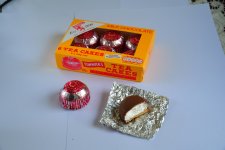
2nd Lighting challenge – Something shiny.

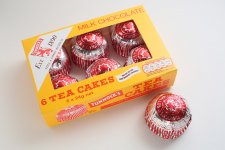
Standard rules apply here – use just one light, and post the results with no post processing (which tends to hide faults), and I shot it in a small room, to show that very little space is needed,

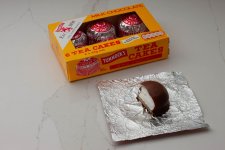
This is a bit like a product shot, in that it sets out to show the subject at its best, but if it was a product shot then it would have had to show all 6 lumps of squishy sugar, my angle only shows 3 of them. And as it’s all about the lighting I didn’t bother to use a “suitable” background, I just used a sheet of reflective plastic that I happened to have around.
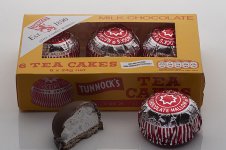
final.jpg

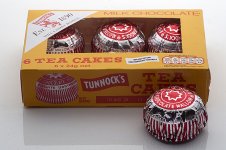
If you want to use the same item for your own contribution, you can get these Tunnock’s tea cakes just about everywhere, and they cost just £1 in Poundland. Or you can use something different, but shiny, it doesn’t matter. The reason I chose this item (despite being an insulin-dependent diabetic who can’t eat them) is that the convex shape and the shiny metal foil makes controlling the reflections more difficult, and difficult subjects can be a better learning experience than easier ones.

A good starting point is always to look at what other people have done, so let’s see what a really large Company, which presumably has the best people and the best equipment, has achieved – so I looked at Tesco, here https://www.tesco.com/groceries/en-...wGTAeH_9JC7j-uKfx-xoCWuQQAvD_BwE&gclsrc=aw.ds No comment from me because I’m polite, but if I did comment then I might say that my cat could do a better job if I had a cat, and if my non-existent cat can do better then you can do much better too . . . But I mustn't be evil, their photos show what the product looks like, which is all that they need to do.

There are a couple of obvious challenges.

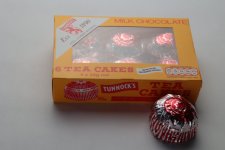
Firstly, unwanted reflections are bound to occur when a box is fitted with a clear plastic cover, and even if the reflection can be avoided there will still be a loss of contrast so, as always with this type of subject, we simply get rid of the plastic cover. But I left it in place at first, so you can see why it's important to remove it.

Secondly, this subject has a convex shape, wrapped in shiny foil, so we need a big light, which needs to be both very close to the subject and 3 –4 times the subject size. But, to make it easy for everyone, a subject this small (7cm long) is easily photographed with even a small softbox, measuring say 30cm. I used a much larger (100cm) folding beauty dish, but fitted with diffusers to effectively convert it to a softbox, because that’s what I have. A window, with a shower curtain or plain white sheet covering it, will do just as well if the angle allows.

The flash head I used for this is . . . a bit flashy and high-tech – battery powered, TTL, high-speed sync, strobe flashes and a powerful 400 Ws output and lots of other features, none of which are needed for this. Any flash head will do, or you can use a flashgun, a continuous light or anything else, it makes no difference. It also has a powerful LED modelling lamp, this really is useful because we can see a good approximation of the finished result, but although not having one will slow the job down, it won’t affect the quality.

I used a standard lighting stand, because that’s what most people have. A boom arm would have been better because the angle adjustment is more limited with a lighting stand, but it was enough for this shot. If push comes to shove, we can always change the angle by propping up the subject.

So, we start off by deciding what we want to show, and then place it in position. Then we decide on the camera height and angle of camera tilt required, and stick the camera on a tripod, The final part is to place the light in position, because the “correct” angle of the light depends entirely on the subject and camera position.

So, we start off with the softbox above and behind, angled forward so that the subject is basically backlit, and the angle on the plastic see-through window (which is still there at this point) diffuses the reflection of the light source (the specular reflection). The lighting angle and position isn't quite perfect for the plastic cover, but that doesn't matter because my Stanley knife will take care of that:)
back_03.jpg

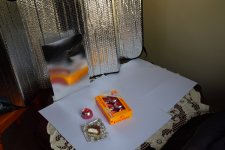
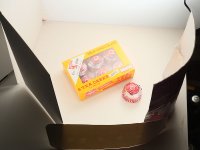
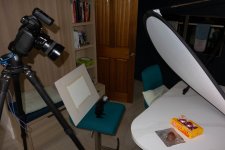
And this stepback shot shows the lighting arrangement etc
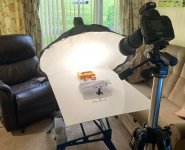
setup_2.jpg

I shot at f/16 for adequate depth of field*, the flash power was just 1/128th (of 400 Ws), so just over 3 Ws, we don’t need much lighting power for close lighting. ISO was 200 and the camera lens was F200, to minimise perspective distortion.

*I pushed my luck a bit with the depth of field, I could have (and maybe should have) shot at f/22 to gain a bit more, but didn’t want to introduce diffraction limitation. If this had been an actual product shot then I would have avoided the problem by using a tilt/shift lens. My camera is full-frame, if you use a smaller format then you should be fine.

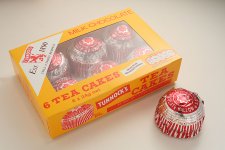
And here we are, from the other end of the set
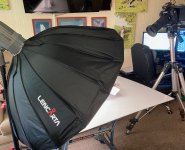
image2.jpeg
image0.jpeg
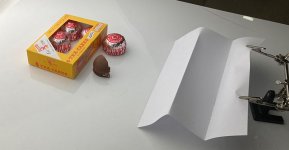
These stepback shots show my fill card, which is a bit of folded white paper, held in place by a “third hand” gizmo from eBay.

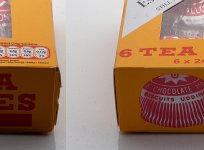
This was essential because the angle of the light didn’t allow any light at all to reach the front elevation of the box, which made it far too dark

This simple paper reflector made a world of difference, see below, without and with it.

with without reflector.jpg

The inverse square law tells us that the spare light, which has travelled some distance beyond the subject before hitting the reflector, and then travelled the same distance back, has lost a lot of power and so cannot “match” the lighting that directly lights the subject, but then we don’t want it to.

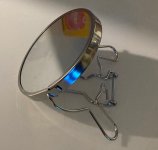
Sometimes though we may need a bit more than a piece of white paper (which reflects most but not all of the light) can give us, so we can use a mirror instead, which is more efficient.
mirror.jpg
This cheap makeup mirror is great, it has a convex side, which concentrates the light into a small “spotlight” area, and a plain side. I also have a roll of plastic mirror material, easily cut to size and shape with scissors, but I didn’t need either of these here.

Once I’d tested the setup, I added an individual cake, and then I added another (both removed from the box), cut it in half and added the half that hadn’t collapsed , ending up with the final shot.
back_01.jpg
“No post processing” is a rule with these challenges, but real-world I would have either tidied up or removed the product base/background, adjusted curves and would have cleaned up that jagged area of the box, front (and back) right, which is the perforated bit that makes the box easy to open. I would also have burned in the dark unlit bits showing on 3 of the cakes, and would have lightened the white gooey stuff inside the cut example, plus a bit or sharpening and so on.

So, over to you, please photograph something similar and post it here. A very easy shoot, as long as the light is big enough and the angle is right.

Previous challenge (still open) here https://www.talkphotography.co.uk/threads/lighting-challenge-1-coffee-cup.759315/
 
I'll start this off.
The pen is hand made from a couple of 7.62mm rifle cartridges and the cutlery is from Ikea.
As I did not have anything like a white sheet or shower curtain and could not get near a window I settled on a shoot through umbrella with flash.
This was not successful as I could not get the light sufficiently diffuse to show the dark barrel of the pen without getting glaring reflections as below

p805916360-4.jpg


So I resorted to a light tent with a continuous light-20watt LED white bulb

p649751654-4.jpg


With ( to me ) much better results

p615955660-4.jpg


and
p945905585-4.jpg


Thanks to LR I can clean the background up to be white instead of the rather odd colour it is at the moment.
 
A very good effort and a very interesting subject - I also have 7.62 cartridges but I always re-load them, it's never occurred to me to do something creative with them:)

It's a tough subject, much harder than my example subject. I'm vaguely thinking of setting a challenge with a similar subject, easily dealt with but using a very different technique.

The trick here is not to surround the subject with light, which is what a light tent does. It's to have a light above and behind the subject that
1. Diffuses the specular highlights (the reflections of the light source) and
2. Directs those reflections to a place where the camera can't see them.

I think that the results may have been better if both the light and camera positions had been lower, but that's just a guess. This guess is based on the position of the specular reflections on the cutlery, and I may be wrong.
 
Hi Gary

I tried the tea cake (Poundland sold out, Asda was £1.10!)

I tried direct flash and it was horrible.

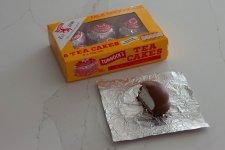
I then went for light from a North facing patio door with a big sparkly reflector on the other side (car windscreen cover) with a bit of a lighting boost on to the front using a piece of A4 silver card. The tea cakes were put on a few sheets of A3 card. In-camera picture control was designed to replicate a D80 on vivid as I like the colours- it doesn't change the lighting.

I probably spent too long trying to get the light to sparkle on the silver paper around the tea cake at the front. F/13 wasn't quite enough for the depth of field.

Tea cake 1.JPG

The light was coming from directly behind me in this picture.
Tea cake 3.JPG
 
I tried direct flash and it was horrible.
It will have been, it's the worst possible lighting for this. I meant to take a direct flash photo myself and should have done, for illustration, but as usual I forgot:(
Hi Gary

I tried the tea cake (Poundland sold out, Asda was £1.10!)

I tried direct flash and it was horrible.

I then went for light from a North facing patio door with a big sparkly reflector on the other side (car windscreen cover)
View attachment 425703
These car windscreen covers can be incredibly useful as reflectors. Another option, less dramatic, is to get some baking foil, scrunch it up, then flatten it as far as possible and cover a piece of card with it, and it will be even more subtle if you don't scrunch it up at all and use the dull side outwards as a cover - it can never be completely flat so will always produced some unevenness, which is generally a good thing. Using odds and sods like this is very normal in pro studios, not so much for many amateurs who like everything to be neat and tidy, but pro photographers tend not to care about that:)

Your light was basically coming from the wrong direction,it should have been coming from above and behind, and one easy way of achieving that (as you have a flashgun) would be to have the card above and behind and bounce the flash off of it, but you achieved a surprisingly good results, which just goes to show that there's always more than one way of doing things:)
 
Thanks Gary. I really aught to do it with the light coming from behind to see what the difference is.
 
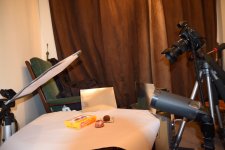
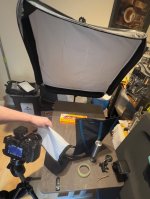
I’ll not go through all the explanations as per previous; just to say I found this tricky, and didn’t have time to totally get rid of the flare on the top of the box.
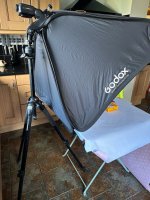
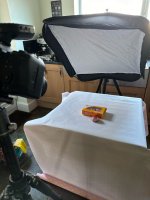
BTS. And the final image, shot with a speedlight, in a Godox pop up softbox
Bts2.jpegBts1.jpegTunnocks.jpeg

Didn’t show the silver reflector in the BTS as I was holding it up by hand.
 
Last edited:
2nd Lighting challenge – Something shiny.

Standard rules apply here – use just one light, and post the results with no post processing (which tends to hide faults), and I shot it in a small room, to show that very little space is needed,

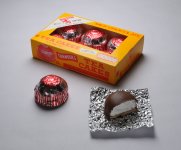
This is a bit like a product shot, in that it sets out to show the subject at its best, but if it was a product shot then it would have had to show all 6 lumps of squishy sugar, my angle only shows 3 of them. And as it’s all about the lighting I didn’t bother to use a “suitable” background, I just used a sheet of reflective plastic that I happened to have around.
View attachment 424526

If you want to use the same item for your own contribution, you can get these Tunnock’s tea cakes just about everywhere, and they cost just £1 in Poundland. Or you can use something different, but shiny, it doesn’t matter. The reason I chose this item (despite being an insulin-dependent diabetic who can’t eat them) is that the convex shape and the shiny metal foil makes controlling the reflections more difficult, and difficult subjects can be a better learning experience than easier ones.

A good starting point is always to look at what other people have done, so let’s see what a really large Company, which presumably has the best people and the best equipment, has achieved – so I looked at Tesco, here https://www.tesco.com/groceries/en-...wGTAeH_9JC7j-uKfx-xoCWuQQAvD_BwE&gclsrc=aw.ds No comment from me because I’m polite, but if I did comment then I might say that my cat could do a better job if I had a cat, and if my non-existent cat can do better then you can do much better too . . . But I mustn't be evil, their photos show what the product looks like, which is all that they need to do.

There are a couple of obvious challenges.

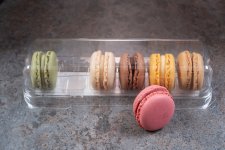
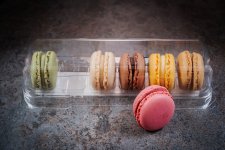
Firstly, unwanted reflections are bound to occur when a box is fitted with a clear plastic cover, and even if the reflection can be avoided there will still be a loss of contrast so, as always with this type of subject, we simply get rid of the plastic cover. But I left it in place at first, so you can see why it's important to remove it.

Secondly, this subject has a convex shape, wrapped in shiny foil, so we need a big light, which needs to be both very close to the subject and 3 –4 times the subject size. But, to make it easy for everyone, a subject this small (7cm long) is easily photographed with even a small softbox, measuring say 30cm. I used a much larger (100cm) folding beauty dish, but fitted with diffusers to effectively convert it to a softbox, because that’s what I have. A window, with a shower curtain or plain white sheet covering it, will do just as well if the angle allows.

The flash head I used for this is . . . a bit flashy and high-tech – battery powered, TTL, high-speed sync, strobe flashes and a powerful 400 Ws output and lots of other features, none of which are needed for this. Any flash head will do, or you can use a flashgun, a continuous light or anything else, it makes no difference. It also has a powerful LED modelling lamp, this really is useful because we can see a good approximation of the finished result, but although not having one will slow the job down, it won’t affect the quality.

I used a standard lighting stand, because that’s what most people have. A boom arm would have been better because the angle adjustment is more limited with a lighting stand, but it was enough for this shot. If push comes to shove, we can always change the angle by propping up the subject.

So, we start off by deciding what we want to show, and then place it in position. Then we decide on the camera height and angle of camera tilt required, and stick the camera on a tripod, The final part is to place the light in position, because the “correct” angle of the light depends entirely on the subject and camera position.

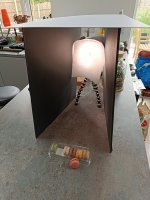
So, we start off with the softbox above and behind, angled forward so that the subject is basically backlit, and the angle on the plastic see-through window (which is still there at this point) diffuses the reflection of the light source (the specular reflection). The lighting angle and position isn't quite perfect for the plastic cover, but that doesn't matter because my Stanley knife will take care of that:)
View attachment 424527

And this stepback shot shows the lighting arrangement etc

View attachment 424528

I shot at f/16 for adequate depth of field*, the flash power was just 1/128th (of 400 Ws), so just over 3 Ws, we don’t need much lighting power for close lighting. ISO was 200 and the camera lens was F200, to minimise perspective distortion.

*I pushed my luck a bit with the depth of field, I could have (and maybe should have) shot at f/22 to gain a bit more, but didn’t want to introduce diffraction limitation. If this had been an actual product shot then I would have avoided the problem by using a tilt/shift lens. My camera is full-frame, if you use a smaller format then you should be fine.

And here we are, from the other end of the set
View attachment 424529
View attachment 424530
These stepback shots show my fill card, which is a bit of folded white paper, held in place by a “third hand” gizmo from eBay.

This was essential because the angle of the light didn’t allow any light at all to reach the front elevation of the box, which made it far too dark

This simple paper reflector made a world of difference, see below, without and with it.
View attachment 424531

The inverse square law tells us that the spare light, which has travelled some distance beyond the subject before hitting the reflector, and then travelled the same distance back, has lost a lot of power and so cannot “match” the lighting that directly lights the subject, but then we don’t want it to.

Sometimes though we may need a bit more than a piece of white paper (which reflects most but not all of the light) can give us, so we can use a mirror instead, which is more efficient.
View attachment 424532
This cheap makeup mirror is great, it has a convex side, which concentrates the light into a small “spotlight” area, and a plain side. I also have a roll of plastic mirror material, easily cut to size and shape with scissors, but I didn’t need either of these here.

Once I’d tested the setup, I added an individual cake, and then I added another (both removed from the box), cut it in half and added the half that hadn’t collapsed , ending up with the final shot.
View attachment 424533
“No post processing” is a rule with these challenges, but real-world I would have either tidied up or removed the product base/background, adjusted curves and would have cleaned up that jagged area of the box, front (and back) right, which is the perforated bit that makes the box easy to open. I would also have burned in the dark unlit bits showing on 3 of the cakes, and would have lightened the white gooey stuff inside the cut example, plus a bit or sharpening and so on.

So, over to you, please photograph something similar and post it here. A very easy shoot, as long as the light is big enough and the angle is right.

Previous challenge (still open) here https://www.talkphotography.co.uk/threads/lighting-challenge-1-coffee-cup.759315/
Only an animal would bite into a Tunnocks tea cake
Everyone knows the correct method is to remove the chocolate shell, eat the marshmallow and then finish with the biscuit.
 
Only an animal would bite into a Tunnocks tea cake
Everyone knows the correct method is to remove the chocolate shell, eat the marshmallow and then finish with the biscuit.
I'm an insulin-dependent diabetic, I set this challenge in a spirit of sacrifice. If you look at my own image carefully you'll work out that I didn't bite into it, I stuck it into the freezer to harden it up and then cut through it with a serrated knife.

You've done a good job with this one too. My own light source was much bigger, which made it easier to diffuse the light. I may be wrong, but I think that your light may have been a bit too far away and also wasn't perhaps at the best angle, which again wouldn't help.

The trick is always to leave the plastic cover in place until the reflections are at their best, those horrible plastic covers are great for getting the light and subject in the best possible combination. I think that you probably forgot to remove it once the lighting was in place - something for other people to think about when they do their own version. Overall though, a very good result.

Everyone in this thread is showing me up - and I'm very happy about that.
 
Thanks @Garry Edwards i considered whether removing the plastic was cheating. And I definitely feel I could have done a better job. Bit gutted I didn’t now.
I’m certainly not sure I did a better job than you (except for the coffee ;) )
 
Last edited:
My attempt at the tea cake, had to go out and buy them specially as my usual Tunnock's Caramel just weren't shiny enough.

Similar setup with the light source behind a big diffuser lighting the subject from behind.

I used a couple bits of card for reflector/ bounce cards and another makeshift one I made using the shiny inside of cocoa powder tube/ tins. ( the right side curved one)

To remove some of the dark reflections in the foil I also introduced a small speed light pointing into the curved cocoa reflector.

5P8A3110.jpg

Would have cleaned up the light fall off on the upper corners in post normally but here was the finished result.
Canon 5D with CZJ Pancolar 50mm f1.8 @f16 ISO200 1/200 Rear flash 1/8th overhead flash 1/16th power.
5P8A3099.jpg
 
The reflector use was a nice touch and worked really well.

The light at the rear wasn't at the best angle, the trick is to angle it so that the light causes the minimal reflections on the plastic insert, and then when it's at its best it's then time to remove the horrible bit of plastic.
Firstly, unwanted reflections are bound to occur when a box is fitted with a clear plastic cover, and even if the reflection can be avoided there will still be a loss of contrast so, as always with this type of subject, we simply get rid of the plastic cover. But I left it in place at first, so you can see why it's important to remove it.

I don't keep banging on about this because of my personality disorder, I do it because it really matters:) Plastic packaging is always removed once the lighting is as good as it can be, and we always leave it in place until we're happy that we've done everything possible with the lighting.
One of the very basic rules of physics is that the angle of reflectance must equal the angle of incidence. This means that any reflection will be at the same angle as the angle of the light that hits the (flat) surface., We can't get rid of reflections, they are always there, but we can and must make sure that the light is angled so that the reflection doesn't reach the camera lens and so can't be seen in the shot - which we do, as far as we can. But sometimes we simply can't, and that's why I leave the clear packaging in place until I'm sure that I can't reduce the reflection any further, and then of course it goes.

I can see why you used a second flash to remove/lighten the dark area on the individual teacake, and it worked well - but we're only using one light for these challenges, Real world, either extra lights are needed, or a completely different lighting arrangement is made and the results are comped in, or the dark bits are dealt with in PP, I tend to go for lighting solutions, some other people actually enjoy using PS and deal with the problems that way, and sometimes the best solution is to send the files to those nice people in Thailand, who do such a good retouching job for so little money - there are no wrong answers.

Overall, a very good result, and if you try it again without the horrible bit of plastic you'll see how well you've done!
 
The reflector use was a nice touch and worked really well.

The light at the rear wasn't at the best angle, the trick is to angle it so that the light causes the minimal reflections on the plastic insert, and then when it's at its best it's then time to remove the horrible bit of plastic.


I don't keep banging on about this because of my personality disorder, I do it because it really matters:) Plastic packaging is always removed once the lighting is as good as it can be, and we always leave it in place until we're happy that we've done everything possible with the lighting.
One of the very basic rules of physics is that the angle of reflectance must equal the angle of incidence. This means that any reflection will be at the same angle as the angle of the light that hits the (flat) surface., We can't get rid of reflections, they are always there, but we can and must make sure that the light is angled so that the reflection doesn't reach the camera lens and so can't be seen in the shot - which we do, as far as we can. But sometimes we simply can't, and that's why I leave the clear packaging in place until I'm sure that I can't reduce the reflection any further, and then of course it goes.

I can see why you used a second flash to remove/lighten the dark area on the individual teacake, and it worked well - but we're only using one light for these challenges, Real world, either extra lights are needed, or a completely different lighting arrangement is made and the results are comped in, or the dark bits are dealt with in PP, I tend to go for lighting solutions, some other people actually enjoy using PS and deal with the problems that way, and sometimes the best solution is to send the files to those nice people in Thailand, who do such a good retouching job for so little money - there are no wrong answers.

Overall, a very good result, and if you try it again without the horrible bit of plastic you'll see how well you've done!
I must say I forgot the remove the plastic step, luckily I hadn't taken any of the setup down.(or opened my second box of subject matter :) ) So I removed the plastic, changed the angle of the light, removed the second flash and rearranged my reflector/ bounce cards.
Exact same settings as my first attempt but upped the aperture to f22
5P8A3296.jpg
 
I must say I forgot the remove the plastic step, luckily I hadn't taken any of the setup down.(or opened my second box of subject matter :) ) So I removed the plastic, changed the angle of the light, removed the second flash and rearranged my reflector/ bounce cards.
Exact same settings as my first attempt but upped the aperture to f22
That's a massive improvement isn't it?
 
That's a massive improvement isn't it?
Yeah, got to agree thanks for the tips. Apologies for mucking up with the second flash. I had been using the second 2.4ghz flash to optically trigger my main flash and thought I would use some of the light as it was firing anyway but for this one I aimed it out of the shot where it wouldn't interfere but could still register for the trigger.
 
Struggled a bit with this one. Poor choice on subject, but gave it a go, albeit very adhoc.

XT-5
ISO 800
1/20th Hand held
Rotolight Neo (with napkin)
 

Attachments

  • SOC 1.jpg
    SOC 1.jpg
    453.6 KB · Views: 19
  • set up.jpg
    set up.jpg
    353.6 KB · Views: 19
  • Edit.jpg
    Edit.jpg
    394 KB · Views: 18
Another go
This time as basic as you can get. no flash just natural daylight

p921010300-4.jpg


p889124045-4.jpg
 
Struggled a bit with this one. Poor choice on subject, but gave it a go, albeit very adhoc.

XT-5
ISO 800
1/20th Hand held
Rotolight Neo (with napkin)
I'm not going to comment on your Rotolite Neo (far too polite):) but it simply isn't big enough - the light source needs to be at least 3x bigger than the subject for this type of lighting arrangement, but seems to be smaller than the subject.

It's also too far away, it needs to be literally as close as possible. Having it too far away effectively reduces the size of the light source dramatically, The inverse square law applies here, everytime we double the distance we halve the effective size.

The light also needs to be angled downwards, so that the inevitable reflections bounce off where the camera lens can't see them.

I'm not sure that the structure around the light helps at all, although the white "ceiling" may help a bit.

On a positive note, the background seems to me to be a perfect choice, far better than my bog-standard bit of shiny plastic.

So, if you still have the biscuits you could try again, taking my comments on board, and you'll get a much better result.

These challenges are intended to get people to think outside the box, to experiment with subjects that are outside of their normal photography type, and to learn from the process - it's about the learning experience, not about the results, and everyone who actually tries it will learn a lot more than the people who don't, so thanks for posting it. It's the same with my very poor attempts at watercolour painting, I have zero ability but constant practice means that I very slowly improve. Unfortunately, I'm far too much of a coward to actually show anyone my work:(
 
Another go
This time as basic as you can get. no flash just natural daylight
Natural light can be good, but getting the angle right can be a challenge, as windows have a nasty habit of being vertical, and we need the light to be angled downwards to illuminate the subject at the required angle. But, there's a workaround - we can place the subject on a tilted background - not ideal because the subject may slide out of position - but that's what blu-tak is for:)

More to the point, the light needs to come from behind, not from in front.
 
I'm not going to comment on your Rotolite Neo (far too polite):) but it simply isn't big enough - the light source needs to be at least 3x bigger than the subject for this type of lighting arrangement, but seems to be smaller than the subject.

It's also too far away, it needs to be literally as close as possible. Having it too far away effectively reduces the size of the light source dramatically, The inverse square law applies here, everytime we double the distance we halve the effective size.

The light also needs to be angled downwards, so that the inevitable reflections bounce off where the camera lens can't see them.

I'm not sure that the structure around the light helps at all, although the white "ceiling" may help a bit.

On a positive note, the background seems to me to be a perfect choice, far better than my bog-standard bit of shiny plastic.

So, if you still have the biscuits you could try again, taking my comments on board, and you'll get a much better result.

These challenges are intended to get people to think outside the box, to experiment with subjects that are outside of their normal photography type, and to learn from the process - it's about the learning experience, not about the results, and everyone who actually tries it will learn a lot more than the people who don't, so thanks for posting it. It's the same with my very poor attempts at watercolour painting, I have zero ability but constant practice means that I very slowly improve. Unfortunately, I'm far too much of a coward to actually show anyone my work:(
Thanks, Garry. Always will appreciate your knowledge (y)
Yeah the neo was an impulse buy at the NEC a few years ago. Oh do please comment on them
As for the macaroons... My daughter has snagged them already.

I have a bigger godox foldy box thing, but will have to find all the bits (moved house) ;)

Will try harder on the next one :)
 
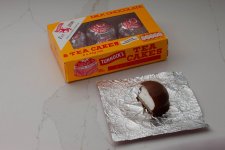
Try 2 with something nearer what Garry suggested:

Teacakes try 2 1.JPG

Flash was set at 200mm with a black tube around it to make a directed light, which was bounced off an A3 sheet of card above the teacakes.

I put a couple of silver card reflectors to the front and to the right. I think I also needed a bot more reflected light from the front left to get more on the foil wrapped teacake.

The open foil wrapper was replaced with a normal piece of tin foil, which was brighter and stronger.

Teacakes try 2 2.JPG
 
That's a very good result, achieved in a very unusual way - but bouncing a frontal light off of a reflective surface works just as well as using a softbox in the same position:)
 
So I've made another video, in the (very) faint hope that it will encourage more participation.

I'm slowly learning the process, I wouldn't say that I'm getting any better but I think that I may be less bad than I was . . .
The main problem is with the sound, partly because of my incompetence but partly because 2 of the mics that I bought didn't work at all, one sort of did but with terrible quality and one good one only lasted for a couple of weeks. Hopefully that problem is now solved, but time will tell.

Another beginner mistake was taking the still photos with continuous light and forgetting that the camera was on auto iso, horrible noisy images that would normally go in the bin but, I think, good enough to include in the video for illustration.
 
Another challenge complete with my new flash setup. Excuse the BTS mess as I said in the previous challenge the rooms a mess post Christmas and has become a dumping ground :-( Also it's shot wide with an iphone so quite distorted however hopefully you'll make out the pop up softbox with off camera flash lighting the main subject from above and behind, took a few test shots to get the lighting to how I wanted, especially as I had no white surface to put it on so using the motorhome table pressed into service at Christmas lol.

bts.jpg


Eagle eyed among you will note I could only find 10 pack of tea cakes, I say I but it was the wife and she loves these, so I suspect she knew what she was doing!

So first shot was this

_1144281 by Donnie Canning, on Flickr

which has the reflection on the plastic but also the facing part of the box is too dark so I introduced the white surface of my newly aquired flashbender (from this forum thanks @LongLensPhotography ) to reflect some light back into it resulting in this shot, held up by the pepper mill.

_1144282 by Donnie Canning, on Flickr

Which seems quite a bit better BUT we still have the reflection on the plastic packaging, so time to get rid of it and start again.

So, once the plastics removed as carefully as I could, another shot with the flash above and behind and the white flashbender and we get this.

_1144290 by Donnie Canning, on Flickr

But for some reason it doesn't feel quite right and end up using another part of the flashbender (white diffuser this time) which I hold in my hand to reflect a little more light both onto the box front and the left side of the lone teacake ending up with this shot which I think meets the brief. Only editing is the crop, otherwise straight out of camera.

_1144291 by Donnie Canning, on Flickr
 
A very good effort, but a couple of suggestions . . .

You've used the reflectors to very good effect, but you've used them to correct basic setup problems that could have been avoided:)

1. The softbox is too high, it needs to be level with or below the table. This can be a struggle, if we don't have a low-level lighting stand, but can always be worked around.
2. The softbox needs to be tilted far more, so that the light is coming from above as well as from behind. It's worked out pretty well (thanks to your reflectors) in the final shot, but the wrong angle is strongly demonstrated in the shot that includes the plastic cover. Those plastic covers are horrible, but they're useful for getting the angle right.
3. The combination of 1 and 2 has, in effect, made the softbox further away and therefore smaller. Size matters a lot when creating diffused specular highlights, and especially when the subject is larger, as in this case - my 6-pack was smaller and easier, I appreciate that I'm an insulin-dependent diabetic who can't eat them and your wife likes them, but the larger pack and made it even more important to get the softbox as close as possible:)
 
Ah yes, looking at your setup I now realise that your light was a lot lower and closer! Missed that completely. I think I'll go hunting for the 6 pack lol and pretend its a treat for the wife and try again!
 
Trying again after finding a 6 pack :)

BTS - Softbox lower and angled from above, straight on setup and could only find a piece of white wrapper of some envelopes as a reflector this time, for some reason the reflector of the flashbender didn't cut it as I couldn't get it close enough to fill the front of the teacake box.


IMG_9409 by Donnie Canning, on Flickr

Shot with the plastic in place - think I got the angle ok


_1164305 by Donnie Canning, on Flickr

Now with film removed and a crop no other processing.


_1164347 by Donnie Canning, on Flickr

Is this what we were after?
 
Better:)
But the softbox angle still isn't right. I can't be sure of that from the stepback shot, but the dark areas at the rear of the inside of the box, together with the black areas on the foil show that it isn't tilted enough. This is confirmed by the very strong reflection on the plastic, before you removed it.

Make your wife happy and try again:exit:
 
First thing Im thinking of when I wake up! starting to get obsessed lol with this.

OK, BTS - readjusted the angle again of the box, reflector moved closer and angled and the camera moved closer too


IMG_9410 by Donnie Canning, on Flickr

I think Im there (or close enough that I get it but my small space is starting to make this a pain in the proverbial) I've gotten rid of most of the black bits on the foil compared to the previous shot, so here they are starting with the newest...


tea2 by Donnie Canning, on Flickr

Compared to the previous effort


_1164347 by Donnie Canning, on Flickr
 
First thing Im thinking of when I wake up! starting to get obsessed lol with this.
Be careful, if you really do get obsessed then people will start calling you Garry:)

This one is just so much better. You now understand the principles, job done.
 
Here's my attempt.

I don't have a softbox, so hung a reflector over the box, with a flash to the side and below.

Here is the initial set up shot with natural light to get the framing right:
Shiny Surface (1 of 4).jpg

Second shot is the final one with the cellophane window still in place:
Shiny Surface (2 of 4).jpg

This is the finished image, with the cellophane window removed:
Shiny Surface (3 of 4).jpg

These images only edited for colour balance and sensor dust bunnies.

Here is the behind the scenes shot (NB the mount card was used as a front reflector, held up beside the camera, but I couldn't be in two places at the same time):
Shiny Surface (4 of 4).jpg

Another informative challenge.
 
I think that's a great result! Brain power and care trumps gear every time:)
 
Back
Top