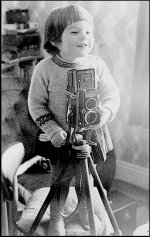
How important is the camera?

On "quality" as appled to cameras.... Or indeed anything. You can use a phrase "poor quality" to refer to workmanship; you can poetically say "the quality of mercy is not strained"; you can refer to "a lady of quality" (well, if you're a 19th century novel writer). Probably a few different meanings of the word in play there.

In my own mind, with cameras as mechanical devices I think of the smooth and refined quality of the wind on lever of the Nikon F3 compared to any other 35mm camera I've used, or the ease of firing the shutter on my Olympus XA. In these instances, for "quality" substitute "attribute" and the denotation is unchanged, but with a subtle shift in connotation.

Augustine said of the concept of time that he knew what it is - until asked to define it. Some words and ideas are like that; a gut feeling rather than a scientific definition which is far harder to enunciate.
 
I have not once.........

When I look at a previous image I am rarely satisfied. Often I think to myself, that this or that could be better; a longer lens, a wider angle lens. the perspective is not quite right, light straying into areas I wouldn't like, objects creeping in that I had not spotted etc etc..

I do not think ever I thought "that would have been better with camera Y"
 
There's neither right nor wrong involved. You just have to define your use of the word, so that people understand your claim.
Ok then:- A selection of old photos in Shorpy's collection https://www.shorpy.com/ and https://www.shorpy.com/Large_Format_Kodachromes this explains quality as you can just see it.
Anyway I'm sure every one knows what I mean and I just don't understand your version of "quality", whether its "quality" for the time/era OR max "quality" achievable by a box brownie ( but then if a Rollei etc camera was taken at the same time would show a difference) and so on......
 
Quality can also pertain to the artistic, or other intangible aspects of a photograph. Robert Capa's famous pictures of the D-Day landings are of terrible quality, technically, but still have unquestionable quality in terms of what they show.

There's also that Ansel Adams quote: "there is nothing worse than a sharp image of a fuzzy concept".
 
Anyway I'm sure every one knows what I mean
That may be true or it may be false, depending on who you define as being part of "every one".
and I just don't understand your version of "quality",
Because I didn't define "quality", as your quotation from my post clearly shows.
whether its "quality" for the time/era OR max "quality" achievable by a box brownie ( but then if a Rollei etc camera was taken at the same time would show a difference) and so on......
Those are two partial definitions, which you've supplied, just as I suggested people should do if that word is to convey useful information to the reader.
 
Last edited:
Quality can also pertain to the artistic, or other intangible aspects of a photograph. Robert Capa's famous pictures of the D-Day landings are of terrible quality, technically, but still have unquestionable quality in terms of what they show.

There's also that Ansel Adams quote: "there is nothing worse than a sharp image of a fuzzy concept".
Well some of them are VG quality, but my point from the beginning is "quality results" for pictures/images/scans and prints and what can go wrong using even the best combo of camera and lens.......post # 12 (re the weakest link).
 
That may be true or it may be false, depending on who you define as being part of "every one".

Because I didn't define "quality", as your quotation from my post clearly shows.

Those are two partial definitions, which you've supplied, just as I suggested people should do if that word is to convey useful information to the reader.
Well I give up as for me I can see the difference in paintings for quality for the end result.......using crappy cameras in the fifties (would you like to see them o_O), and even dare could mention results from digi cameras. :(
 
Well I give up as for me I can see the difference in paintings for quality for the end result.......using crappy cameras in the fifties (would you like to see them o_O), and even dare could mention results from digi cameras. :(
I'm not at all sure where you're going with this.

All I;m saying is that the word "quality" needs to be used as part of a more detailed definition. On its own, it's effectively meaningless, at least in these contexts.
 
I'm not at all sure where you're going with this.

All I;m saying is that the word "quality" needs to be used as part of a more detailed definition. On its own, it's effectively meaningless, at least in these contexts.
Well let's leave it as in my mind I use the word quality whether its a shirt etc or a scan/print.................. even if no one agrees with me.
 
Why should Google be right? It's just a committee of robots.
Well join a camera club and see other guys equipment, for info and results although you probably find they are all now using digi cameras........ my experience many moons ago was I had VG 35mm Pentax lenses and a VG enlarging lens and quite good at printing large prints, but my prints were blown away with guys using Rolleis and larger format cameras for "quality" of prints for comps and never got anywhere no matter the subject.
 
Well join a camera club and see other guys equipment, for info and results although you probably find they are all now using digi cameras........ my experience many moons ago was I had VG 35mm Pentax lenses and a VG enlarging lens and quite good at printing large prints, but my prints were blown away with guys using Rolleis and larger format cameras for "quality" of prints for comps and never got anywhere no matter the subject.

And therein lies the problem with camera clubs. Judged largely on technical merit. If the judges were choosing peoples images based on the merits that a larger format brings, they weren't judging the photographs but the technical aspects combined with possibly not many interesting photos.

I'm not at all sure where you're going with this.

All I;m saying is that the word "quality" needs to be used as part of a more detailed definition. On its own, it's effectively meaningless, at least in these contexts.

I have read your replies in this thread and completely agree with what you are saying but it seems to be misinterpreted by some.

My friend and I used to have the same discussion when he compared his digital photos to film photos. He said digital was 'better' and when I asked him to quantify what better meant, his response was that they were sharper. That's as far as it went.
 
And therein lies the problem with camera clubs. Judged largely on technical merit. If the judges were choosing peoples images based on the merits that a larger format brings, they weren't judging the photographs but the technical aspects combined with possibly not many interesting photos.
..and also learnt "a big one would always beat a little one" on the same subject esp static, later on dumped 35mm for a Rollei, 6X4.5 and 6X7.
 
..and also learnt "a big one would always beat a little one" on the same subject esp static, later on dumped 35mm for a Rollei, 6X4.5 and 6X7.

You seem to be missing the point though raised by @AndrewFlannigan above. Beat them how? How are we quantifying beat them? Resolution and detail? If that's the only benchmark then I agree. Bigger will always be better in that respect but sometimes taking and shooting medium format or large format is not possible, therefore it isn't better as you can't set it up for the shot.

If we talk about photography (hence the name of the forum), then it can be quantified in many different ways. Photography is something different to many people. I see people throughout history who choose to work with different cameras. Capa shot 35mm as did Cartier-Bresson. Those were better for them. The latter tried a Rollei and disliked having a WLF, ergo it wasn't better. Sally Mann preferred to use an 8x10. Meyorowitz used (and still uses) a 35mm Leica but my favourite body of work of his was taken on 8x10.

Better is quantified in different ways.
 
Beat them how?
Well I did mention "static" shots and the guys using 35mm were at a disadvantage (for static shots) when prints were shown on a board compared to MF and LF as they just stood out whether you call it clarity, sharpness or quality or whatever. And the phrase " a big one would always beat a little one" was used about 50 years ago and just stuck in my memory.
Anyway why do many pros use MF and LF film cameras (some to day) in the past....for wedding shots, portraiture etc and some press photographers using Rolleis etc.........afterall a Kodak brownie can take shots;)
 
Last edited:
Well I did mention "static" shots and the guys using 35mm were at a disadvantage (for static shots) when prints were shown on a board compared to MF and LF as they just stood out whether you call it clarity, sharpness or quality or whatever. And the phrase " a big one would always beat a little one" was used about 50 years ago and just stuck in my memory.
In the 1960s, I met a bloke who did technical photography of engine components, for a sub-contractor. He did all his shots with a pair of screw mount Leicas and a Visoflex. He borrowed my boss's darkroom once, when there was a problem at his own premises and I helped him make some 20x30 inch prints for a trade exhibit. The images were as sharp and detailed as you could possibly wish and anyone not in the know would certainly believe they were made on 5x4. He was using some Agfa film rated ridiculously low, about 10 ASA I think.
Anyway why do many pros use MF and LF film cameras (some to day) in the past....for wedding shots, portraiture etc and press photographers using Rolleis etc.........afterall a Kodak brownie can take shots;)
Also during the 1960s, I did a stint at a London local newspaper and although I was on the advertising staff I was friendly with the cameramen, especially after it dawned on them that I could print. The senior photographer used a Canon 7 and his junior used a Rolleiflex "T". Both got the job done. On the national newspapers, equipment purchasing was decided centrally and the camera manufacturers competed for the contracts. In the 1950s, Franke and Heidecke's British distributor went all out for the press market, so a lot of Rolleiflexes were to be seen at press calls.. in the 1960s, Rank Photographic pulled the same trick with Nikon equipment, so most press packs were full of Nikons. The important thing to note is that, fine as the cameras and lenses were, the contracts were about far more; all the expensive darkroom equipment, for example.
 
AAMOI looking at some adverts for scanning and prints and even they say "Providing the highest quality photo prints" so maybe someone should argue with them on what they mean o_O;) as surely it depends on the neg. https://www.digitalab.co.uk/photographic-prints/
 
Last edited:
In the 1960s, I met a bloke who did technical photography of engine components, for a sub-contractor. He did all his shots with a pair of screw mount Leicas and a Visoflex. He borrowed my boss's darkroom once, when there was a problem at his own premises and I helped him make some 20x30 inch prints for a trade exhibit. The images were as sharp and detailed as you could possibly wish and anyone not in the know would certainly believe they were made on 5x4. He was using some Agfa film rated ridiculously low, about 10 ASA I think.

Also during the 1960s, I did a stint at a London local newspaper and although I was on the advertising staff I was friendly with the cameramen, especially after it dawned on them that I could print. The senior photographer used a Canon 7 and his junior used a Rolleiflex "T". Both got the job done. On the national newspapers, equipment purchasing was decided centrally and the camera manufacturers competed for the contracts. In the 1950s, Franke and Heidecke's British distributor went all out for the press market, so a lot of Rolleiflexes were to be seen at press calls.. in the 1960s, Rank Photographic pulled the same trick with Nikon equipment, so most press packs were full of Nikons. The important thing to note is that, fine as the cameras and lenses were, the contracts were about far more; all the expensive darkroom equipment, for example.
You probably remember Victor Blackman using tri-x but can't remember if he mainly used 35mm or a rollei. I used to enjoy his articles in AP, but strangely can't ever remember being persuaded to use Tri-x...... if I did, it was probably once or twice as I preferred FP3 or FP4.
 
Mainly 35mm, I think, given the necessity for different focal lengths. I recall he had a Rollei in both standard and tele forms.
 
Mainly 35mm, I think, given the necessity for different focal lengths. I recall he had a Rollei in both standard and tele forms.
Aaahh The Tele Rollei - why did I ever sell mine?

Oh Yes! it was the money... :naughty:
 
Aaahh The Tele Rollei - why did I ever sell mine?

Oh Yes! it was the money... :naughty:
Well I thought my tele rollei was crap, a fixed 135mm lens, not very good for close ups, the film would wind all the way through even when I took it back to Fox Talbot to be repaired, eventually they took it back and was so happy I bought a RB67 instead, but agree a good tele rollei was a good investment looking at prices today.
 
Well I thought my tele rollei was crap, a fixed 135mm lens, not very good for close ups, the film would wind all the way through even when I took it back to Fox Talbot to be repaired, eventually they took it back and was so happy I bought a RB67 instead, but agree a good tele rollei was a good investment looking at prices today.
Some Rolleis were tougher than others. The "T" had a paper strip to display the speeds and stops, which was known to break if you were too enthusiastic with that lever on the side of the lens shield. On the other hand, the often derided "Magic" was surprisingly tough, as I proved to myself over several years.

My daughter assisted in the stress testing...

Kirsten with Rollie Magic.jpg
 
Oh, is that what they do ...? :ROFLMAO:
Looked at my local camera club and in looking at photos they all had digi cameras, but it would be fun turning up with a Ilford sporti around my neck to see there faces. :D
 
I am late in on this but a camera is probably the most important part. Without a camera of some sort you are going to be pretty well stuffed! It is a bit like asking how important is an operating theatre without a team of highly trained staff
 
I am late in on this but a camera is probably the most important part. Without a camera of some sort you are going to be pretty well stuffed! It is a bit like asking how important is an operating theatre without a team of highly trained staff
Well that's obvious :D and from then:- what camera, lens, film etc etc and so many answers from members, and hopefully not to confuse a newbie trying the use of a film camera for the first time.
 
And a tripod I'll bet too.
Not really. He had a "portable camera stand" that must have weighed 20 Kilos in modern money. The story (from my boss) was that he had it made by the engineering company he worked for. It seemed to have dozens of adjustments and looked like an explosion in a metal tube warehouse! I suspect he was the only person who knew how to use it. ;)
And used camera shop windows were full of Rolleiflexes.
Not that I ever noticed. Most of them were probably sold to wedding photographers and portrait studios :)
 
Then traded in when they slipped from fashion ...

I remember a non-photographer friend querying why a shop window we passed was so full of used tlrs, mainly Rolleis ... mid 70's, it would be.
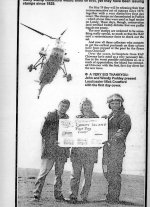
I dare say that, in the 1970s, a lot of non-professionals would be swapping in TLRs for 35mm SLRs. At the same time, most of the weddings, in the West Country at any rate, were still recorded on 6x6 film, just going by my own experience. A lot of the local press guys were also sticking with them. You could do most of the stuff an editor would buy on a decent TLR, like pictures of people with helicopters and huge postage stamps...

Lundy Helicopter story and picture.jpg
 
But you haven't defined what qualities you're speaking of. Come on, man, spill the beans!

I also suggest that it's irrelevant because we can take & make meaningful photographs with anything. So is it the 'thing' that you like, or the picture? Because the picture is communicable - something that can be shared - but the equipment used is just something that you bought, and private.
The photograph means very little, sometimes (quite a lot of the time) I wonder why I took a pic & yes a shoe box with a pin hole can render an image.

But the camera is what inspires me, it has to be tactile and if you can't feel a difference in quality as an adult photographing for many years then your nerves must be dead!

Is it important? To me yes; if I had a crap clunky thing I wouldn't take photos at all.

HTH
 
Is it important? To me yes; if I had a crap clunky thing I wouldn't take photos at all.
That's an interesting and if I may so, an unusually honest statement.

I agree with it in many ways, because I too feel like I get pictures, which I like more, with cameras that I enjoy using. However, I enjoy using different types of camera on a regular basis. Yesterday, as I was going to a funeral, carrying an obvious camera was not a polite option, so I had the tiny Ixus 70 in my jacket pocket. On the way to the funeral and on the way back I managed to record a few images that I liked, such as this...

Woman on the bus Exeter Ixus 70 IMG_4496.jpg
 
Photography is quite a broad church and there is plenty of room for people to enjoy different aspects, whether that be the photographs themselves, perhaps the experience of going out making pictures or using equipment they enjoy and find satisfying. For some it's the production of images - whether that be through development, printing, or post processing, and for others it might be the act of collecting photographic equipment. There will be other reasons galore, any many people will draw enjoyment from a range of them. How important the camera is will be subjective depending on the drivers of the individual.
 
for others it might be the act of collecting photographic equipment.
A great time for me in the past when I now have about 25 -35mm cameras and about 40-35mm lenses (not counting a lot more cameras/lenses that I threw/gave away).......all going for peanuts at the bootie and ebay. When film (film at the bootie was going from 10p to 50p) and Asda (found an excellent one) scan/dev was cheap it was a great hobby testing the cameras and lenses out.
I miss that time :crying:
 
I haven't read through all the responses in this thread yet, though I will.

For me, the camera is important for a variety of reasons....

If it's a fixed lens camera, then the lens matters in terms of field of view, rendering and overall performance. If it's an interchangeable lens camera such as an SLR or rangefinder, then the camera matters in terms of providing access to glass that I like or find interesting or useful for a variety of reasons.

Camera functionality matters too... a wide range of shutter speeds coupled with a range of available lens apertures provides great flexibility for shooting different subjects in various conditions. Then again, a limited range of shutter speeds and/or apertures - or even just a single shutter speed and aperture, as found on the most basic cameras - can enforce limitations that produce different results than I would normally aim for (sometimes those results aren't great, but other times they can be a nice surprise). A good viewfinder doesn't impact the rendering of the image, but it can make photography much more enjoyable and/or practical, and that might influence the process leading to that image. Auto-focus, and manual focus (with or without focusing aids) have different benefits and limitations, and also contribute to the enjoyment of the process, based on individual preferences. The ability to trigger and sync a flash opens up a variety of additional use-cases.

Lastly, the camera's ability to feed film without scratching or damaging it is important, and not always a given.

I'm sure there are plenty of other aspects I've forgotten that might come to me later... but in a nutshell, yes: I think the camera - and lens - are very important (to me at least).
 
Last edited:
Yes and no. I will start with the No first.

No because I like to think I have the skills these days to compensate the shortcomings of the camera and able to maximise of whatever gear I have in my hand. I know the limitations of the camera and able to use it within it's limitation. So if I have only a X100VI, I am not going to even attempt to start shooting birds in flight unless I want to see a dot on screen.

Yes it is important because it allows me to open more doors in terms of the photos I can take. Like the birds in flight, I need the lens for that.
 
I think it's a slightly loaded question. And I think lots of people have used it as an excuse to go off on a tangent.

But the way I took it was purely physics: If everything else was the same - lens, photographer, film, subject and lighting, does changing the camera (to another, similar camera) make any discernible difference? i.e. if you could fit the same lens to both cameras, would you be able to tell that a photo was taken on a Canon A-1 rather a Nikon F3? Would one be better than the other in the same situation?

I'd argue that there are probably tiny, maybe even imperceptible, differences that would appear if you changed the camera. Changing any one of the others would/could/should have more impact.

How good the exposure meter is, how accurate the shutter speed is. But these 'should' only be very small differences.

It's something I've been thinking about recently when it comes to Leicas for instance. If everything else was the same, would the photo be any better?

I think that there are many of the other things already mentioned however, that DO come into play once/if you establish that the camera is just a box. Ergonomics, functions, price, build quality all have a role to play in your enjoyment of the kit, but they're all subjective.
 
I think it's a slightly loaded question. And I think lots of people have used it as an excuse to go off on a tangent.

But the way I took it was purely physics: If everything else was the same - lens, photographer, film, subject and lighting, does changing the camera (to another, similar camera) make any discernible difference? i.e. if you could fit the same lens to both cameras, would you be able to tell that a photo was taken on a Canon A-1 rather a Nikon F3? Would one be better than the other in the same situation?

I'd argue that there are probably tiny, maybe even imperceptible, differences that would appear if you changed the camera. Changing any one of the others would/could/should have more impact.

How good the exposure meter is, how accurate the shutter speed is. But these 'should' only be very small differences.

It's something I've been thinking about recently when it comes to Leicas for instance. If everything else was the same, would the photo be any better?

I think that there are many of the other things already mentioned however, that DO come into play once/if you establish that the camera is just a box. Ergonomics, functions, price, build quality all have a role to play in your enjoyment of the kit, but they're all subjective.
A black plastic Casio tells the time more accurately than a JLC, Rolex, Omega etc but do you get the same feeling wearing that Casio?

To some it doesn't matter but to others it does!

To whom it matters know they would take better pictures with equipment that inspires them.
 
Last edited:
A black plastic Casio tells the time more accurately than a JLC, Rolex, Omega etc but do you get the same feeling wearing that Casio?
But that wasn’t the question.

Because you’re not comparing like with like. If you were to compare the Rolex to the Omega and then ask the question it would be more on par. Does one brand tell the time significantly and noticeably better than the other?

The answer is probably not at that level. Then it comes down to which you’d rather have on your wrist.
 
The image is the thing! The camera's just a tool. It could be a pinhole camera home-made out of cardboard box. And I'll repeat - if you're going to mention quality, especially of an image, then remember to define your use of the term - it's meaningless otherwise.
 
Back
Top