How important is the camera?

Barney

Suspended / Banned
Messages
3,043
Name
Wayne
Edit My Images
No
In film cameras how important is the actual contribution of the camera towards the actual image produced.

IT might seem that 90% of the quality of the image is coming from the film and processing itself and has little to do with the camera.

Surely this cant be right.
 
The lens will play an important part.. and I suppose the camera depending on the subject; ie a Leica M8 of a brick wall, with a Nikon F5 of a brick wall and equivalent lens will probably look similar; but an F5 of a bird in flight alongside an M8 with again as similar lens as possible… the F5 will win, right?
 
Depending on the subject you're shooting, pick the correct tool for the job, landscape, street etc pretty much any camera will do the job, sports & wildlife you're going to need something with a fast shutter and high frames per second, other than that, then yes, the quality will come from a decent quality lens and good film stock and professional processing.
 
It could also be factors like a full mechanical camera will work without batteries. In the case of Don McCullin his well built Nikon F stopped a bullet saving his life.
 
Well, it's an interesting point. But, given that most cameras will do the job I would argue that the lens is just as important as the film and developing.
 
Film cameras may be basically a box to mount a lens on and run the film through but they have to be light leak free and they have to transport the film well enough and keep it relatively flat. Oh, and the shutter has to work too :D For actual image quality though does the camera matter?
 
As others have said, it's a box to hold the lens and film. Unless it's a rangefinder.

However the boxes can have features you might need or want, like a quick (or automatic) film advance/rewind, in built metering, auto-focus, aperture/shutter priority or "full auto".
As others have said, some cameras don't work at all, or properly without a working battery, some are purely mechanical.

Fully mechanical, fully manual cameras are quite slow to use, which is fine for some situations. Not for others though which is why there are variants with more features. How many digital photographers do you know, shoot fully manual (plus manual focus) with a fixed ISO? People like (or even need) convenience and speed. Yes, it's just a box, but having features makes life much easier for some photographers.
 
In film cameras how important is the actual contribution of the camera towards the actual image produced.

IT might seem that 90% of the quality of the image is coming from the film and processing itself and has little to do with the camera.

Surely this cant be right.

Film, lens and the D&P matter - the camera, not so much as its merely a box to hold film and let light in through the lens

Back in my film days, I never did really want the 'best' cameras as I couldn't see the point; they did little more than my cheap Pentax copies (Chinon) managed
 
Film, lens and the D&P matter - the camera, not so much as its merely a box to hold film and let light in through the lens

Back in my film days, I never did really want the 'best' cameras as I couldn't see the point; they did little more than my cheap Pentax copies (Chinon) managed

I had a couple of Chinon lenses. A 50mm f1.4 and a 28mm f2.8. I thought the 28mm was ho-hum or even a bit below par but I thought the 50mm was very good and matched just about any other film era 50 I had.
 
Last edited:
Whether the media is film or digital, whether the subject is landscape, steet, portrait, fashion, wildlife or sports, let's not overlook the contribution made by the photographer ! Michael Kenna can make great images with a Holga whilst there are plenty examples online of people who use Leicas to produce images that are not likely to be considered great by most viewers.
 
Assuming that the camera is light tight and holds the film in the correct place, and has a working shutter, then that's all it needs to produce a photograph. Some subjects might need a motor drive to make things easier, autofocus if it helps etc., but the camera is just a box to hold the film at one end and a lens at the other. One of my favourite quotes is Edward Steichen's "no photographer is as good as the simplest camera".

The image produced is down to the lens technically and the photographer artistically. The print will be influenced by the degree of enlargement, which is down (for a given print size) to the format of the camera.
 
Quite simple really (as like most other mechanical/electrical things in life in comparison)..the quality of a shot depends on its weakest link and it could be lens, shutter speed, aperture (wide open is worse), correct exposure, film (e.g. using a crappy colour film that that has been badly stored is a problem for colours)...and development, scan, printing, 35, MF. LF. There is not many poor prime lenses by the major manufacturers so that reduces that problem, a fast shutter speed or tripod is best Then there is dev, scan or printing and the choice of which company to choose?
Finally choice of 35mm, MF, LF of course a big one will always beat a little one for quality.
 
Last edited:
Thanks for thought provoking replies, this is as much as I thought.

However I am starting to change my mind, perhaps its very important initially. Most photographers start off with a little old "Box" that was given to them by their father or grandfather and before you know it we were looking at the glossy adverts for fantastic cameras which subsequently appeared in our in our dreams and manifested itself as a burning desire to get out there and take photographs. Without that creative burning desire, forged in the raging furnace of the heart, there are no photographs.
 
I am at odds with most of the above posts, whilst I agree that expensive is not always better I do find some cameras I jell with and use instinctively other cameras are hard to get on with.
To put it crudely I needed to flirt a bit before I found the right one for me, and a bit on the side can be fun on occasions.
 
Ergonomics must also come into play with the camera body, you are not going to be messing about with something that does not take well to the hand.

I am also a sucker for a well engineered piece of equipment, that has been manufactured with durable materials and robust components with an eye to longevity.
 
  • Like
Reactions: Nod
Perhaps we need to go back to basics and remember what the word "camera" means.

It comes via Latin from a Greek word that meant "a vaulted room". This was recycled in the late middle ages to refer to the process of blacking out a room and lieaving a tiny hole, through which an image of the outside could be seen on a flat surface inside the room. Thus "a camera" can best be described as a box with a hole in it.

We've now extended the meaning, to describe a box with a lens that projects an image onto a light sensitive material. So, the answer to the original question has to be "the image is formed by the optical system acting on the sensitive material, hence the camera, especially a camera using photosensitive chemical image recording, has no purpose other than to hold those two elements in a fixed relationship".

Everything else, in a modern camera, is there just to make that relationship between lens and sensitive material more suited to a particular user's requirements. In that sense, the design of the camera as a whole may well play a very important role in the images that the user records with it.
 
I am at odds with most of the above posts, whilst I agree that expensive is not always better I do find some cameras I jell with and use instinctively other cameras are hard to get on with.
To put it crudely I needed to flirt a bit before I found the right one for me, and a bit on the side can be fun on occasions.
Tart!!
 

Mutato nomine, fabula de te narratur (Horace)? :D *

Serious, Keith does make a valid point. To misquote another author, and this time in English, "all cameras are equal but some are more equal than others". I personally prefer a waist level finder to a pentaprism when I have a choice as I don't work as well with a camera held up to my eye for a straight through view. And it also depends on where the camera is used - if on a tripod, mounted to a microscope, and just used without any support other than the photographer's hands.

I personally find I get better results the larger the format, because as the format size goes up, so does the amount of care I put into each exposure. There's no reason why this should be the case, except the personal equation - I could get the same results with a small format if I used in the same way as a large format camera. But if I use a smaller camera (admittedly in my case, medium format not 35mm) I do so for extra freedom it gives - and freedom from tight composition and careful thought beforehand seem in my case to go with that. :(

* Edit to add the translation. Literally, "by changing the name, the story is told about yourself", more freely "ya boo sucks, same to you mate". Tongue firmly in cheek.
 
Last edited:
The camera's importance will come down to the photographer's needs, including a number of things not limited to: Available shutter speeds; autofocus capability, lens choice, burst speed; weatherproofing, size and weight, reliability etc. You could add cosmetic appeal to the list too for some photographers. The available features of the camera (but also the lens and film choice) will place some limitations on what can be achieved technically, which may, or may not, affect artistic output.

If you don't have specific technical needs, then the camera probably makes little difference to the look of the end result, certainly much less so than the choice of film and how it is processed. Whether that is the quite specific 90% mentioned, I'm not certain.

As @Kevin Allan has already alluded to, I agree that the most important factor in the final result is the photographer.
 
With film the biggest difference is either features like depth of field preview, motor drive, or things like the various modes, or it's the accuracy of the shutter speeds that make the difference between bodies.
As others have said is more about the lens with film for a quaity boost.
 
Ergonomics must also come into play with the camera body, you are not going to be messing about with something that does not take well to the hand.

I am also a sucker for a well engineered piece of equipment, that has been manufactured with durable materials and robust components with an eye to longevity.
A good user interface helps the photographer use the settings they want, so yes the actual camera can make a difference, particularly when the shot is time critical.
Even if the lens mount is temperamental, and the ergonomics very poor it is still possible to get good results from a bad camera., but then good results can be achieved with crap lenses too!

Most photographers prefer to use gear that is convenient, and suits a range of situations, though a few enjoy the challenge of finding the role that a pile of junk can cope with.
(I suspect this is the main reason I still occasionally use my Nikon J2 It's a struggle to use this on anything other than Auto, even with native lenses.)
It seems I'm not enough of a glutton for punishment to take out my Box brownies, but I plan on using my Billy Record over the summer.
 
The camera's importance will come down to the photographer's needs,
I agree with that particular point but my list is...
  1. Loading film has to be simple and smooth,
  2. The viewfinder must be big and bright.
  3. Aperture and shutter setting must not require you to take your eye(s) from the finder.
  4. The shutter button and film wind must be easy to find and use without taking your eye from the finder.
  5. Changing film has to be fast.
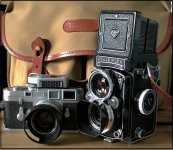
No camera ticked all the boxes for me but the least bad were the later Rolleiflexes - particularly the E and F series. The most disappointing camera, overall, was the Leica M3 - superb picture taker, utter pig to change the film and too hard to change the settings with the camera to my eye. The Nikon F was somewhere in between, with that removable back but excellent otherwise.

Leica and Rollei from right.jpg
 
Last edited:
I agree with that particular point but my list is...
  1. Loading film has to be simple and smooth,
  2. The viewfinder must be big and bright.
  3. Aperture and shutter setting must not require you to take your eye(s) from the finder.
  4. The shutter button and film wind must be easy to find and use without taking your eye from the finder.
  5. Changing film has to be fast.
No camera ticked all the boxes for me but the least bad were the later Rolleiflexes - particularly the E and F series. The most disappointing camera, overall, was the Leica M3 - superb picture taker, utter pig to change the film and too hard to change the settings with the camera to my eye. The Nikon F was somewhere in between, with that removable back but excellent otherwise.
Oh, definitely. My list was meant to be an example, not exhaustive, as there are a whole range of functions that cameras can have which may or may not be of importance depending on needs. Mirror lock up is another, as is an ability to take (or protect against) multiple exposures. Professionals will likely have a whole extra set of needs that might just be luxuries to an amateur.
 
That's a blanket assertion!

There are many types of quality, not all mechanical, so I think you should define your term to make it meaningful.
Well I'm only talking about the quality of the final picture from scan or print and nothing else, and I would like to see someone to show that the quality of a shot is the same for 35mm compared to MF or LF for a decent size print. As you know there are many reasons (as I have mentioned) that can affect the final picture (for quality), and for a newbie e.g. Use a top lens and perfect camera and well under expose a VG film and .......................
 
Last edited:
In terms of the image quality, the body has very little impact, as long as the film is held parallel to the lens mount and the shutter speeds are reasonably accurate. Of course, it also helps if the box is light tight!

Ergonomics is a whole different area.
 
Well I'm only talking about the quality of the final picture ...
Oh dear, once again we come back to the question of what "quality" means, in this context.
 
In film cameras how important is the actual contribution of the camera towards the actual image produced.

IT might seem that 90% of the quality of the image is coming from the film and processing itself and has little to do with the camera.

Surely this cant be right.

I wouldn't say 90%, but the actual number depends on a number of factors and the one mentioned a few times is whether the film chamber is fully light-sealed. A camera that allows easy and accurate shutter speed selection is another important factor. I do think that apart from the photographer's own vision and imagination the more important contributions are that of the lens and film emulsion used; the choice depends on the subject matter.
 
Ansel Adams wrote three books; The Camera, The Negative, and The Print. Each book was dedicated to the choice of and use of each of the elements including in the third book the development process. In the first book he was mainly concerned with the tilt & shift aspect of the camera along with the pros and cons of the formats available in the day. Conveniance, weight, etc. If you were an architectural or landscape photographer back then the tilt & shift camera would have been very important, just as fast, reliable autofocus is today for wildlife and sports photography. Those features allow the photographer to extend the range of photography beyond what is available to most people. An SLR camera with mirror up facility is a similar example.

For bog standard photography the actual camera element might not seem important. But for many it is.
 
Last edited:
Oh dear, once again we come back to the question of what "quality" means, in this context.
HUH! Well can you think of a word that shows the difference between a correctly exposed shot/picture of say a 1950's coronet with plastic lens compared to say a Roleiflex?
I can see the difference from all the crappy cheap cameras I bought in the fifties to the ones I have now.
 
HUH! Well can you think of a word that shows the difference between a correctly exposed shot/picture of say a 1950's coronet with plastic lens compared to say a Roleiflex?
There's no single word, because there are far too many variables in such a comparison.
I can see the difference from all the crappy cheap cameras I bought in the fifties to the ones I have now.
We could all see that, IF we were comparing, for example, the circle of confusion of each camera/lens combination.

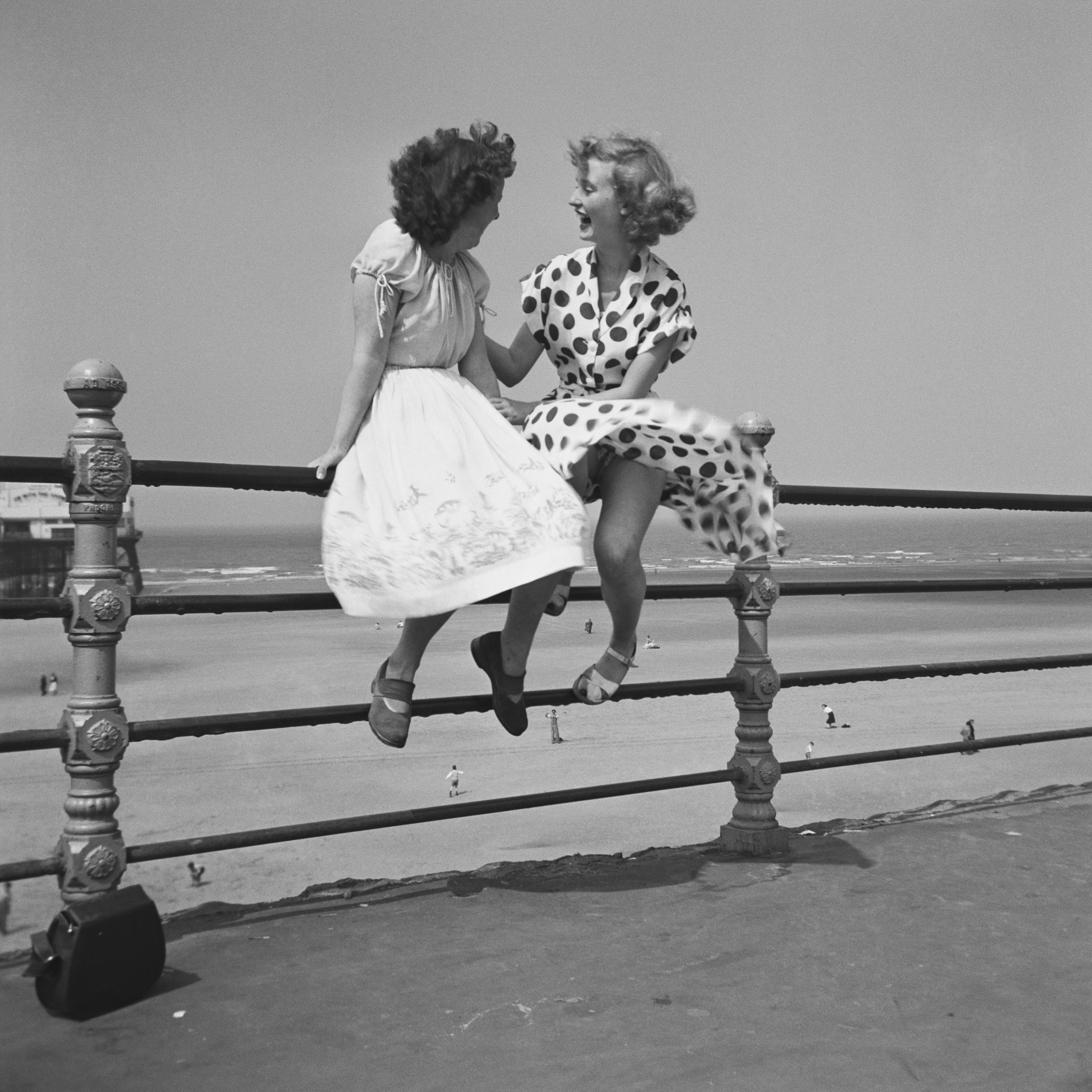
However, Bert Hardy showed that there are many more important features of a photograph than sharpness. In 1951, using a Box Brownie, he produced a picture of two girls at Blackpool. This has become a highly regarded image, frequently published and generally considered an iconic image of 1950s Britain...


I think that "quality" isn't a word that can sensibly used to describe any image, unless carefully qualified to explain what it refers to.
 
There's no single word, because there are far too many variables in such a comparison.

We could all see that, IF we were comparing, for example, the circle of confusion of each camera/lens combination.

However, Bert Hardy showed that there are many more important features of a photograph than sharpness. In 1951, using a Box Brownie, he produced a picture of two girls at Blackpool. This has become a highly regarded image, frequently published and generally considered an iconic image of 1950s Britain...


I think that "quality" isn't a word that can sensibly used to describe any image, unless carefully qualified to explain what it refers to.
Oh well google has it wrong as well when you type something like "camera for quality pictures" OR e.g. https://shuttermuse.com/glossary/image-quality/
 
To me it is incredibly important, I have to love the camera I am using and enjoy using it otherwise I wouldn't take any picures.

I love to feel quality.
But you haven't defined what qualities you're speaking of. Come on, man, spill the beans!

I also suggest that it's irrelevant because we can take & make meaningful photographs with anything. So is it the 'thing' that you like, or the picture? Because the picture is communicable - something that can be shared - but the equipment used is just something that you bought, and private.
 
Last edited:
I have (somewhere) a photograph from the early 1960s, printed by a professional printer from my uncle's workplace, taken with a Brownie Flash20 box camera, a night photograph taken at the shore end of one of Blackpool's piers of a star from the pier theatre as he signed my autograph book. The print was/is half plate (4.75 by 6.5 inches). The quality of that print is at least as high as anything I've produced with a large format camera. The Flash20 was 6x6cm negatives on 620 film.

I also have a 10x8 print from a 6x9 negative exposed in a Coronet box camera in the summer of 1968. The image simply isn't sharp- soft focus in extremis. What the result would be like at half plate I don't know. I assume that it isn't camera shake causing the blur, but I have no flash shots from this camera. A contact print is fine...

My point is that technical quality can depend on the camera, but possibly at least as much as the degree of enlargement. Artistic quality - well, that's down to the photographer, but some cameras offer more creative possibilities than others.
 
But you haven't defined what qualities you're speaking of. Come on, man, spill the beans!

I also suggest that it's irrelevant because we can take & make meaningful photographs with anything. So is it the 'thing' that you like, or the picture? Because the picture is communicable - something that can be shared - but the equipment used is just something that you bought, and private.
Not even worthy of a reply :confused:
 
Back
Top