How do you shoot birds in flight?

I would be happy with that. Not sure I can crop 50% though with 100-300 and only 16MPs ?

The GM5 is an old 16mp camera.

I suppose it depends on the light and how sharp the final result is but I regularly crop to 100%.

For example this picture was taken with my GX80 and 45-150mm lens at 150mm. The original file is 4592 x 3448.

A 100% crop of the visible area in Adobe CS5 is 1579 x 905 which is enough to fill my screen and look ok.

jtmejJf.jpg


This is a 1,000 pixel wide version of the 100% crop, hopefully posting it here wont mangle it too much.

hKbHxAz.jpg


I suppose it depends what you want. That crop above wont make an A3 print unless you view it from a short bus ride away but if "all" you want is a picture that'll look nice on your screen and be ok posted on line maybe a crop and even a heavy crop will be acceptable?

PS.
Hmmm. I think it looks a bit softer here than on my screen but you'll have to believe me as I don't think I can prove it :D
 
Last edited:
ROFPMSL. I would be totally ashamed to post photos as bad as that .. just stick to being a barrack room lawyer
Wow. A charmer AND a gear snob.
 
Not sure I can crop 50% though with 100-300 and only 16MPs ?
How many MP's the sensor has is quite low on the list of things that will make a usable picture... a human cannot even see 16MP in an image when viewing it normally (from an appropriate/comfortable distance). And "the standard" for acceptable sharpness requires less than 2MP of resolution for any sized output image. When an image is obviously lacking detail it's probably not due to *sensor resolution.


(*sensor size is more relevant, and related)
 
How many MP's the sensor has is quite low on the list of things that will make a usable picture...
I agree.

Sometimes the maximum amount of data is essential in the image, for example: technical studies. In many situations, though, I think the "image quality" is secondary to the impact the image makes on the viewer.

Once again we're back to that catch all phrase: "circumstances alter cases".
 
I can't comment on the abilities / limits of your own equipment, but here's a few more ideas not yet mentioned (unless I've missed them)

- Make sure you've some space around you
- When possible, have the sun behind your back
- Track from far out, but only shoot when in range.. and stop as soon as the bird has passed
- Get to know your subject - they give free hints 'I'm ready to take off'
- Pre-zoom. More than enough other things to fiddle with already
 
Like Steve (sk66) says, even having high level camera equipment doesn't guarantee success with BIF. A couple of days ago I was fortunate to come across some Red Kites feeding and out of 500+ shots over a twenty minute period got less than 30 that were worthy of post processing ... and I consider myself reasonably competent at BIF.

My technique is to have the camera set to manual, with auto-iso. Depending on the bird I set the shutter to something between 1/1000 and 1/2000 (smaller bird = faster shutter) with the aperture at f/8 to give sufficient depth of field to compensate for not being able to focus on the bird's head every time. The other camera settings are continuous focus with a group of 9 focus points and continuous shooting at 6 fps and if shooting with the sky as the background I set the exposure compensation to between +1 and +2.

Keep practicing and trying different techniques and you will find the process that suits you and gives the results you are looking for (y)
500 shots in a 20 minute period. That is why I am keeping my feet on the ground and not expecting too much. I don't have the gear to do that, so I realise my success rate will be low. I'll persevere though, just for odd golden shot.
 
Practice with swallows and swifts, once you’ve cracked tracking those, everything else is walk in the park ;)

Seriously practice is key. Maybe try the same birds from the same spot getting used to their behavior so you can begin to anticipate the direction of travel. Starting with a wider angle of view definitely helps.

Final tip - keep the wallet safely locked away to avoid temptation of more gear. Searching for the grail of perfect bird in flight images can be very costly.
 
500 shots in a 20 minute period. That is why I am keeping my feet on the ground and not expecting too much. I don't have the gear to do that, so I realise my success rate will be low. I'll persevere though, just for odd golden shot.

I'm pretty sure 500 shots would come & go quickly enough - if you cmera will do 3 frames per second in continuous that's only a couple of minutes shooting while tracking a flying bird. While I'm not an advocate of 'spray and pray' you might do well to treat it more like a video than a stills camera, and just keep shoting all the time the target is in the frame at a useful size.
 
Last edited:
The GM5 is an old 16mp camera.

I suppose it depends on the light and how sharp the final result is but I regularly crop to 100%.

For example this picture was taken with my GX80 and 45-150mm lens at 150mm. The original file is 4592 x 3448.

A 100% crop of the visible area in Adobe CS5 is 1579 x 905 which is enough to fill my screen and look ok.

jtmejJf.jpg


This is a 1,000 pixel wide version of the 100% crop, hopefully posting it here wont mangle it too much.

hKbHxAz.jpg


I suppose it depends what you want. That crop above wont make an A3 print unless you view it from a short bus ride away but if "all" you want is a picture that'll look nice on your screen and be ok posted on line maybe a crop and even a heavy crop will be acceptable?

PS.
Hmmm. I think it looks a bit softer here than on my screen but you'll have to believe me as I don't think I can prove it :D
It looks superb
 
Practice with swallows and swifts, once you’ve cracked tracking those, everything else is walk in the park ;)

Seriously practice is key. Maybe try the same birds from the same spot getting used to their behavior so you can begin to anticipate the direction of travel. Starting with a wider angle of view definitely helps.

Final tip - keep the wallet safely locked away to avoid temptation of more gear. Searching for the grail of perfect bird in flight images can be very costly.
I like the tip. I want the 12-60 lens for the G80 and then that's it.
 
@Crotal Bell : As Toni says, 500 shots was something like 100 bursts - my strike rate is about 1 in 4 being in focus so I tend to shoot bursts of 5 - so maybe 2 minutes of actual shooting. This method isn't really spray and pray as I can track the birds okay (although there is a degree of pleading with a higher being for some good shots) but it allows for the camera and lens to focus correctly. My lens is f/6.3 wide open so it ain't the fastest thing on the planet :)

When you get good enough to track and shoot Swallows and Swifts you can come and show me how it's done - I've not managed it yet :(
 
How many MP's the sensor has is quite low on the list of things that will make a usable picture... a human cannot even see 16MP in an image when viewing it normally (from an appropriate/comfortable distance). And "the standard" for acceptable sharpness requires less than 2MP of resolution for any sized output image. When an image is obviously lacking detail it's probably not due to *sensor resolution.


(*sensor size is more relevant, and related)
So a MFT sensor and 16MP may not be a great combo?
I can see a dangerous situation here, me chasing rainbows on a budget that can't find them.
Perhaps it's time to thank my lucky stars I can have what I have, and just enjoy it.
 
@Crotal Bell : As Toni says, 500 shots was something like 100 bursts - my strike rate is about 1 in 4 being in focus so I tend to shoot bursts of 5 - so maybe 2 minutes of actual shooting. This method isn't really spray and pray as I can track the birds okay (although there is a degree of pleading with a higher being for some good shots) but it allows for the camera and lens to focus correctly. My lens is f/6.3 wide open so it ain't the fastest thing on the planet :)

When you get good enough to track and shoot Swallows and Swifts you can come and show me how it's done - I've not managed it yet :(
You'll be waiting a long time :) To be honest my "holy grail" is a nice shot of a Red Kite, that would make me very happy.
Is it important to travel with the bird, or do you get better sharpness if you keep the camera still and let the bird pass through a static window of capture?
 
So a MFT sensor and 16MP may not be a great combo?
I can see a dangerous situation here, me chasing rainbows on a budget that can't find them.
Perhaps it's time to thank my lucky stars I can have what I have, and just enjoy it.
My Nikon 1 V2 is 16MP on an even smaller sensor...
Don't go chasing rainbows... IMHO, there is nothing more demanding, and equally more expensive, than wildlife/BIF photography. And nobody makes money selling wildlife pictures...
 
My Nikon 1 V2 is 16MP on an even smaller sensor...
Don't go chasing rainbows... IMHO, there is nothing more demanding, and equally more expensive, than wildlife/BIF photography. And nobody makes money selling wildlife pictures...
Sound advice. I think I should just be happy that I can afford a nice camera and enjoy the hobby.
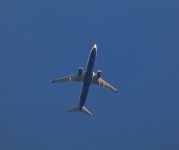
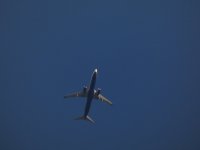
I had a close call tonight but missed a birdie. Then the battery went low, and I grabbed the fZ82. Ironically that cheap bridge camera won the evening with the best picture of a "bird in flight" :)
Aeroplane.jpg
 
I think you will find there would be far less noise using the G80.
Need a couple of spare batteries :)
Do you live near an airport? Not nearly as many planes here as there were a few years ago, despite them saying things are back to normal.
 
I think you will find there would be far less noise using the G80.
Need a couple of spare batteries :)
Do you live near an airport? Not nearly as many planes here as there were a few years ago, despite them saying things are back to normal.
Yeah there's some noise in that image Steve, but that was way up there and 1200mm full zoom on the FZ82.
It was just a fun post but the 100-300 on the GX80 can't do that, I know as I've tried.
Nearest airport is 20 miles away, Luton. That airliner was lower than most but still way up there. Here's the original 1200mm zoom with no crop.
The G80 is a better camera, but when it comes to getting an image at very long distance (on a small budget) The fZ82 is a lot of fun. :)

AA original.jpg
 
You'll be waiting a long time :) To be honest my "holy grail" is a nice shot of a Red Kite, that would make me very happy.
Is it important to travel with the bird, or do you get better sharpness if you keep the camera still and let the bird pass through a static window of capture?
You forgot Kingfisher with a Stickleback and Puffin with a Sandeel :)

Where my daughter lives they have Red Kites overhead most days, some circling quite low.
My technique was so poor just finding them through the evf was a challenge, didn't actually enjoy it either.

Every now and then I think about getting a long lens, but know it would be a waste of money.
Much more interested in the upcoming Panasonic 9/1.7, now that will get some use.
 
Wildlife and bird photography doesn't have to cost the earth. I'm not familiar with the equipment you use Keith but I've recently sold a D7200 and Sigma 150-600 for £800, a combo that proved its self worthy of competing with higher end, more expensive equipment. time and time again.

Assuming you're on your way to using correct settings, exposure, ss, ect, technique is the next thing to master.

The reference to using a shotgun earlier in the thread isn't that far off the mark, two of the most important techniques apply to using both, getting on the bird quickly and keeping the camera moving through whilst panning.

Where to start? Have you got any binoculars Keith? If you have, focus your eyes on an object, lets say the top of a fence post. Without taking your eyes off the post, bring your bins up, the post top should be in the bins. Practise this at different distances until you feel you're getting it right 90% of the time.

Next, do the same with moving objects, start with something easy. If its possible, stand at distance, 90 degrees to a road, pick up a car with your eyes, bring the bins up without taking your eyes off it. The car should be in the bins.........do you see where I'm going with this :)

Start trying it on birds, if you can quickly get on a bird in flight with binoculars, you're on your way to doing it with the camera. It takes practise, it'll come easier to some than others but it does work, I've been using the technique as long as I've been shooting BIF.

When you do think you're getting it right with the bins, start again with the camera on static objects. Fix the eyes on the subject, lift the camera to your eyes without looking away, what you were looking at should be in the VF. Same again start with large moving objects than onto birds.

Getting onto birds in flight quickly is a must in my book, getting it wrong is frustrating but practise, practise, practise until you feel happy (happier) :)

Razorbills and Guillemots off the cliffs at Flamborough have to be one of the trickiest, they come from no-where and fly like bullets, I like the challenge and have 100's of photos I'd be more than happy to show, plenty on me Flickr (link below) and a lot were taken with the D7200 and Sigma 150-600c.

So, just to briefly summaries, lock on with the eyes, bring the camera up without looking away from subject, subject should still be in VF

Keith, if any of the above is of help but doesn't make sense just ask me, I'm not the best at putting practical into words but happy to help.

atb, Phil

 
Last edited:
Is it important to travel with the bird, or do you get better sharpness if you keep the camera still and let the bird pass through a static window of capture?

Pan with the bird to reduce motion blur. If the object you want to photograph, be it bird, car, plane etc is traveling rapidly through the frame then you may never have a fast enough shutter speed to freeze it.
 
You'll be waiting a long time :) To be honest my "holy grail" is a nice shot of a Red Kite, that would make me very happy.
Is it important to travel with the bird, or do you get better sharpness if you keep the camera still and let the bird pass through a static window of capture?
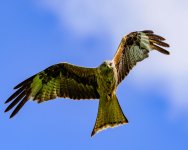
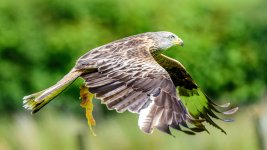
I wasn't going to post any images here as they won't be representative of what you can expect from your equipment but here are a couple for you :)
Both shot with a Nikon D750 and Sigma 150-600 Contemporary. They look better in full size on my computer.
DSC_0149_2.jpg
DSC_0150_2.jpg
 
Wildlife and bird photography doesn't have to cost the earth. I'm not familiar with the equipment you use Keith but I've recently sold a D7200 and Sigma 150-600 for £800, a combo that proved its self worthy of competing with higher end, more expensive equipment. time and time again.

Assuming you're on your way to using correct settings, exposure, ss, ect, technique is the next thing to master.

The reference to using a shotgun earlier in the thread isn't that far off the mark, two of the most important techniques apply to using both, getting on the bird quickly and keeping the camera moving through whilst panning.

Where to start? Have you got any binoculars Keith? If you have, focus your eyes on an object, lets say the top of a fence post. Without taking your eyes off the post, bring your bins up, the post top should be in the bins. Practise this at different distances until you feel you're getting it right 90% of the time.

Next, do the same with moving objects, start with something easy. If its possible, stand at distance, 90 degrees to a road, pick up a car with your eyes, bring the bins up without taking your eyes off it. The car should be in the bins.........do you see where I'm going with this :)

Start trying it on birds, if you can quickly get on a bird in flight with binoculars, you're on your way to doing it with the camera. It takes practise, it'll come easier to some than others but it does work, I've been using the technique as long as I've been shooting BIF.

When you do think you're getting it right with the bins, start again with the camera on static objects. Fix the eyes on the subject, lift the camera to your eyes without looking away, what you were looking at should be in the VF. Same again start with large moving objects than onto birds.

Getting onto birds in flight quickly is a must in my book, getting it wrong is frustrating but practise, practise, practise until you feel happy (happier) :)

Razorbills and Guillemots off the cliffs at Flamborough have to be one of the trickiest, they come from no-where and fly like bullets, I like the challenge and have 100's of photos I'd be more than happy to show, plenty on me Flickr (link below) and a lot were taken with the D7200 and Sigma 150-600c.

So, just to briefly summaries, lock on with the eyes, bring the camera up without looking away from subject, subject should still be in VF

Keith, if any of the above is of help but doesn't make sense just ask me, I'm not the best at putting practical into words but happy to help.

atb, Phil

Thanks great Phil, thank you.
 
I think that everyone jumping in with sample shots from there dslr equipment is less than helpful to Keith .. he is shooting with a panasonic MFT camera that is pretty basic and slow and is not coupled with the fastest lens either ..combine the two and go back to my original post where I stated his camera was not fast enough for b.i.f on a consistent basis .. yes he will have some success but as we all know the better the gear the higher the success rate ..
stick with it Keith learn some field craft ,visit a nature reserve locally . learn to anticipate bird behaviour eventually it falls into place and remember we all started in the same place your in now
 
I do like a bird of prey :)

I often think a hovering kestrel or a buzzard gliding on the thermals might be good places to start - but I only ever see them when driving or cycling and never when I have the long lens with me. They know...

Derek
This is absolutely true, I think the kites near us can sense the electricity in the camera.

I feed them regularly, the birds will swoop in and pick up food from our garage roof - sometimes flying just inches above my head - when I don't have a camera.

As soon as I get the camera out they're barely visible even at the long end of a 100-400 lens.

Just to reiterate what others have said, birds in flight are incredibly tricky. I've always wanted to get a 'great' shot of a Red Kite, but over the years have probably taken over 2,000. I have a handful that are worth of keeping and none of those are great. They're just outlined against the sky and have very little in the way of context. And Kites (unless they've diving in for food) use thermals to glide, so they're fairly slow moving birds.

The EVF on my little canon (G5 X) goes blank in between shots (while it processes the information) so it makes tracking very hard and I've had no success at all with that.
 
Some really useful info in this thread - just spent 15 minutes doing what @Phil-D suggested and discovered that I was previously raising the camera to my eye at an incorrect angle. A bit of practice and all of a sudden I was getting nice stationary chimney stacks in my EVF much quicker. Alas there wasn't a bird in flight to be seen.

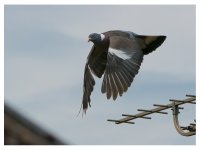
But, I did see Woody perched on the TV aerial opposite and managed to grab this one as he took off. So a bit of cheating - more take-off than in-flight -, but it sort of worked. Despite having had the G80 for a few years I'd never tried the tracking option until now. So this is the G80 with the 100-300, but quite a crop as I was wide out at just 114mm to give me space to work in. Other settings: ISO 400 f/5.6 1/6400 sec.

Woody Takes Off!.jpg
 
Last edited:
Some really useful info in this thread - just spent 15 minutes doing what @Phil-D suggested and discovered that I was previously raising the camera to my eye at an incorrect angle. A bit of practice and all of a sudden I was getting nice stationary chimney stacks in my EVF much quicker. Alas there wasn't a bird in flight to be seen.

But, I did see Woody perched on the TV aerial opposite and managed to grab this one as he took off. So a bit of cheating - more take-off than in-flight -, but it sort of worked. Despite having had the G80 for a few years I'd never tried the tracking option until now. So this is the G80 with the 100-300, but quite a crop as I was wide out at just 114mm to give me space to work in. Other settings: ISO 400 f/5.6 1/6400 sec.

View attachment 357288
Nothing wrong with that mate, did you shot burst or is that a single take?
 
I think that everyone jumping in with sample shots from there dslr equipment is less than helpful to Keith .. he is shooting with a panasonic MFT camera that is pretty basic and slow and is not coupled with the fastest lens either ..combine the two and go back to my original post where I stated his camera was not fast enough for b.i.f on a consistent basis .. yes he will have some success but as we all know the better the gear the higher the success rate ..
stick with it Keith learn some field craft ,visit a nature reserve locally . learn to anticipate bird behaviour eventually it falls into place and remember we all started in the same place your in now
Thanks Jeff, I'm beginning to get more perspective on this, and what I'm likely to achieve.
 
Just a single shot, Keith. I was posed with my finger holding the shutter button half pressed for about two minutes...
Single shot at 1/6400.
So if you use the shot burst, will that slow the shutter speed down to achieve the shots per second rate of the camera?
 
Single shot at 1/6400.
So if you use the shot burst, will that slow the shutter speed down to achieve the shots per second rate of the camera?

The shutter speed doesn't affect burst shooting unless you set such a low shutter speed that the burst rate can't happen.

Note that if you keep your finger on the shutter button you'll hear the burst rate slowing but this is nothing to do with the shutter speed and is just the camera struggling to clear the buffer and save the files, so as the buffer fills it shoots at a reduced rate but at the same shutter speed.

I've just Googled the burst rate and got to this...

"With the camera set to Single AF / AFS and High speed bursts, I shot 499 Large Fine JPEGs in 52.29 seconds for a rate of 9.54fps and the camera seemed happy to continue shooting while memory and battery remained. Switching to RAW allowed me to capture 61 frames in 8.31 seconds for a speed of 7.34fps; letting go of the shutter the moment the buffer filled then took a further 14 seconds to write the data to the UHS-II card. Note while shooting, the G80 / G85 indicates how many frames are remaining in the buffer, counting down as you continue to shoot;"

Here's the review that came from...


Ah, here's a clue...

"In practice the G80 / G85’s autofocus is supremely quick in Single AF mode, and works in lower light levels than most rivals too. Set to Continuous AF, it can’t help but lack the confidence of phase-detect systems, but when set to its Medium burst rate (3-4fps in my tests), it’ll still manage to successfully track and refocus on moving subjects like cyclists or birds in flight while providing some feedback – even when using long telephotos like the Leica 100-400mm. If you’re happy with that speed, or have a predictable subject that doesn’t demand live feedback (thereby allowing you to shoot in ‘High’ speed at 6fps), then the G80 / G85 should suffice. But if you need effective continuous AF at faster burst speeds or focus-pulling in video that stops dead on the subject, then models like Sony’s A6300 will serve you better. That said, the Sony lacks some of the G80 / G85’s features, so you have to think about what your priorities are."
 
Last edited:
The shutter speed doesn't affect burst shooting unless you set such a low shutter speed that the burst rate can't happen.

Note that if you keep your finger on the shutter button you'll hear the burst rate slowing but this is nothing to do with the shutter speed and is just the camera struggling to clear the buffer and save the files, so as the buffer fills it shoots at a reduced rate but at the same shutter speed.

I've just Googled the burst rate and got to this...

"With the camera set to Single AF / AFS and High speed bursts, I shot 499 Large Fine JPEGs in 52.29 seconds for a rate of 9.54fps and the camera seemed happy to continue shooting while memory and battery remained. Switching to RAW allowed me to capture 61 frames in 8.31 seconds for a speed of 7.34fps; letting go of the shutter the moment the buffer filled then took a further 14 seconds to write the data to the UHS-II card. Note while shooting, the G80 / G85 indicates how many frames are remaining in the buffer, counting down as you continue to shoot;"

Here's the review that came from...


Ah, here's a clue...

"In practice the G80 / G85’s autofocus is supremely quick in Single AF mode, and works in lower light levels than most rivals too. Set to Continuous AF, it can’t help but lack the confidence of phase-detect systems, but when set to its Medium burst rate (3-4fps in my tests), it’ll still manage to successfully track and refocus on moving subjects like cyclists or birds in flight while providing some feedback – even when using long telephotos like the Leica 100-400mm. If you’re happy with that speed, or have a predictable subject that doesn’t demand live feedback (thereby allowing you to shoot in ‘High’ speed at 6fps), then the G80 / G85 should suffice. But if you need effective continuous AF at faster burst speeds or focus-pulling in video that stops dead on the subject, then models like Sony’s A6300 will serve you better. That said, the Sony lacks some of the G80 / G85’s features, so you have to think about what your priorities are."
So if I've read that right, the medium burst rate could be worth a go?
 
So if I've read that right, the medium burst rate could be worth a go?

That's what that reviewer is saying.

His point about feedback is probably important too as if the bust rate is too high the evf updating may suffer, so a mid burst rate seems to make sense.

I haven't tried it myself as neither burst shooting or birds are my thing, but it seems like a good starting point.
 
That's what that reviewer is saying.

His point about feedback is probably important too as if the bust rate is too high the evf updating may suffer, so a mid burst rate seems to make sense.

I haven't tried it myself as neither burst shooting or birds are my thing, but it seems like a good starting point.
I'll try it tonight, but based on my garden success rate, I may not have much feedback :headbang:
 
I'll try it tonight, but based on my garden success rate, I may not have much feedback :headbang:

I think by feedback he means the evf giving a view of what's happening.

I've just tried it with my GX80 and you get a display on/off effect as it's firing off the shots like a machine gun but I guess it's useable.
 
I'll try it tonight, but based on my garden success rate, I may not have much feedback :headbang:

Just try it. Feedback is as woofwoof described, so you can see what you're trying to follow.

As for results, it doesn't matter if you don't get good results this time - just follow pigeons - it's the practice for when you get something worth shooting that counts.
 
I think that everyone jumping in with sample shots from there dslr equipment is less than helpful to Keith .. he is shooting with a panasonic MFT camera that is pretty basic and slow and is not coupled with the fastest lens either ..combine the two and go back to my original post where I stated his camera was not fast enough for b.i.f on a consistent basis .. yes he will have some success but as we all know the better the gear the higher the success rate ..
stick with it Keith learn some field craft ,visit a nature reserve locally . learn to anticipate bird behaviour eventually it falls into place and remember we all started in the same place your in now
Hence my first sentence in post #61 - it was a tongue in cheek response Keith's desire to have a nice shot of a Kite ... I just obliged :)
 
Wildlife and bird photography doesn't have to cost the earth. I'm not familiar with the equipment you use Keith but I've recently sold a D7200 and Sigma 150-600 for £800, a combo that proved its self worthy of competing with higher end, more expensive equipment. time and time again.

Assuming you're on your way to using correct settings, exposure, ss, ect, technique is the next thing to master.

The reference to using a shotgun earlier in the thread isn't that far off the mark, two of the most important techniques apply to using both, getting on the bird quickly and keeping the camera moving through whilst panning.

Where to start? Have you got any binoculars Keith? If you have, focus your eyes on an object, lets say the top of a fence post. Without taking your eyes off the post, bring your bins up, the post top should be in the bins. Practise this at different distances until you feel you're getting it right 90% of the time.

Next, do the same with moving objects, start with something easy. If its possible, stand at distance, 90 degrees to a road, pick up a car with your eyes, bring the bins up without taking your eyes off it. The car should be in the bins.........do you see where I'm going with this :)

Start trying it on birds, if you can quickly get on a bird in flight with binoculars, you're on your way to doing it with the camera. It takes practise, it'll come easier to some than others but it does work, I've been using the technique as long as I've been shooting BIF.

When you do think you're getting it right with the bins, start again with the camera on static objects. Fix the eyes on the subject, lift the camera to your eyes without looking away, what you were looking at should be in the VF. Same again start with large moving objects than onto birds.

Getting onto birds in flight quickly is a must in my book, getting it wrong is frustrating but practise, practise, practise until you feel happy (happier) :)

Razorbills and Guillemots off the cliffs at Flamborough have to be one of the trickiest, they come from no-where and fly like bullets, I like the challenge and have 100's of photos I'd be more than happy to show, plenty on me Flickr (link below) and a lot were taken with the D7200 and Sigma 150-600c.

So, just to briefly summaries, lock on with the eyes, bring the camera up without looking away from subject, subject should still be in VF

Keith, if any of the above is of help but doesn't make sense just ask me, I'm not the best at putting practical into words but happy to help.

atb, Phil

Good advice and great shots on your Flickr link. Where do you go on Flamborough? I have been to Bempton Cliffs a few times but have yet to find the right place at Flamborough.
 
Back
Top