Phil,
thank you for the suggestions, the first photo was taken at 200 ISO, I meant to set it at 400 but forgot to change it when coming indoors silly me, which would still have been to way to low then.
With regards to shutter speed, I was in Av mode set at 2.2 so the speed was set. Would not raising the ISO to 1600, slow the speed down, should I have gone manual?.
You say "less wrap around would lift them a little" could you explain what this means.
No raising the ISO would have raised the shutter speed.
so if they were 1/15 and 1/30 1600 ISO would have given you 1/125 which would be about right. You could possibly get away with 1/60 if your technique is good, it's something else you can practice just so that you know your limitations.
The light is coming at them from the front and their right, as you put it 'quite a bit from the left', which means that was your 'key light' with the light behind you acting as fill. There isn't loads of difference in the intensity but you can see the nearest cheek to the light is .
If you turn them slightly and move them closer to the side window, the intensity difference would increase, putting the l/h side of their face into slight shadow (only slight as the fill light is quite bright) it's the shadow that creates shape.
This is why we we hate on camera flash, the shadow is hard and slightly behind and low on the subject, so you don't really see it (apart from below the nose and chin).
Larger softer shadows create shape that is pleasing, look at an old master painting, the classic 45 degrees lighting the nearest cheek and creating a triangle of light on the far cheekbone. Look at the art nudes in the N&G section to see how gently playing light on a body illustrates definition. It's not the light that's important, it's the shadow the light creates.
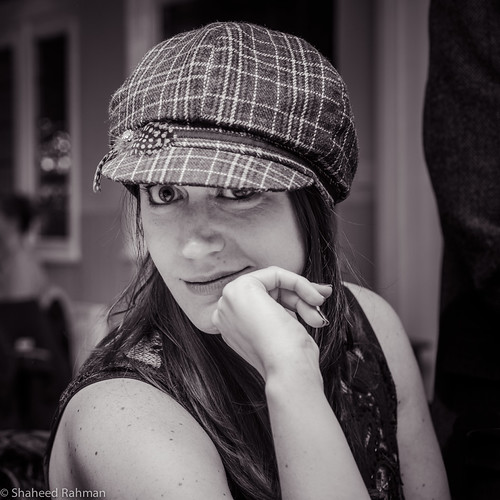
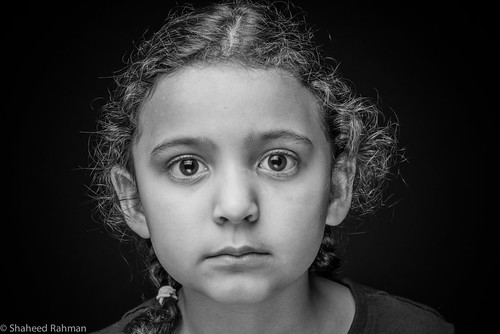
The second and 3rd of Shaheed's portraits above have fairly flat lighting.
These are guesses (I could be completely wrong):
The 2nd primarily bounced off a white table cloth and the 3rd is lit from a large window behind Shaheed slightly to his left (there's a hint of shadow on the subjects left cheek).
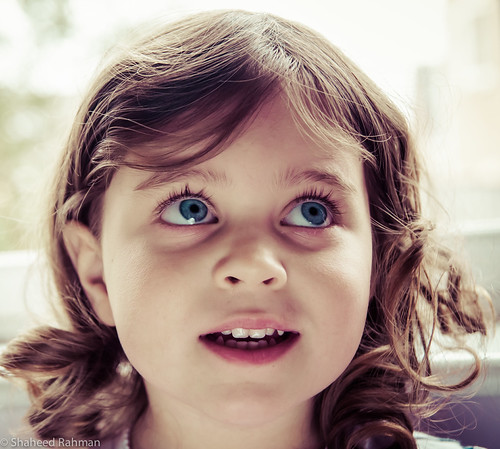
The 1st is more interesting because the subject is backlit, you can see the light wrap around from the window.The catchlight suggests an umbrella to fill from the front, but this is slightly less than the backlight on the cheeks.
Key light - main light on a subject - can even be the sun or sky)
Fill light - a light of lesser intensity used to fill the shadows, this can be a reflector a flash or even the sun (using a flash as keylight), this reduces the intensity of the shadows. Sometimes we aim for a flat shadowless light, but mostly it's the shadows that create interest.