Focal length what a pain in the butt !

Sorry to butt in again, but the point of having different focal lengths is so that you can choose a subject distance to get the perspective you want, and change the lens to get the amount of subject in that you want.
 
@woof woof Thank you for your time , you`ve taken quite a bit of time on this thread with explanations that make it somewhat easier to understand for us lesser experienced individuals ...


Coho - Blue
 
Sorry to butt in again, but the point of having different focal lengths is so that you can choose a subject distance to get the perspective you want, and change the lens to get the amount of subject in that you want.

That would be the ideal but I wonder how many people actually use zoom lenses with perspective in mind?

We often see the phrase "zoom with your feet" and it almost makes me cringe as with every step you take you change the perspective. I think a lot of people get confused by perspective but again I think it's a relatively simple thing once you put your mind to it and indeed you don't even need a camera to see perspective and if you think about what you are seeing you will understand and see what the camera will capture. That's another thing that's important, looking and really seeing and understanding what the camera will capture when you press the button. It really shouldn't be a big surprising reveal :D
 
Last edited:
@woof woof Thank you for your time , you`ve taken quite a bit of time on this thread with explanations that make it somewhat easier to understand for us lesser experienced individuals ...


Coho - Blue

I hope I have helped. There are other ways of looking at all this but I think some ways tend towards being a maybe a bit too complex.
 
As a beginner, the various complexities of modern cameras is quite daunting, even more so when more experienced people are posting there struggles with certain areas.

I'm already starting to throw the towel in and just "point what I've got and take what comes out" :runaway:

And why not?

When out walking one day with a camera and a film era manual lens an older guy came up to me and asked me what I was doing. He was an avid aviation guy and all he took pictures of was aeroplanes but talking to him and explaining about that old lens and how it could be used on a modern camera it soon became pretty obvious he knew nothing about apertures, format sizes or anything like that but it didn't seem to matter to him. And why should it if he was getting results he was happy with? :D

Looking at how you've moved on since you first started posting here Keith I think it's very noticeable that you have thought long and hard about what you're doing and I think it shows in your results :D
 
If you are buying fixed lens cameras then what is described as wide angle on one format will be totally different on another the difference in angle from a 110 camera with a 24mm lens to a large format camera with a 24mm lens would be amazing
But fixed lens cameras are always advertised with the ‘effective focal length’ (35mm equivalent).
 
But fixed lens cameras are always advertised with the ‘effective focal length’ (35mm equivalent).

Can't remember if 110 cameras were so marked. From memory, they tended to be wide angle.
 
Can't remember if 110 cameras were so marked. From memory, they tended to be wide angle.
Surprised to find you even buy 110 film any more.
What’s the point?
 
  • Like
Reactions: Nod
Depth of field depends ONLY on

focal length (longer = less depth of field at a fixed subject distance)

subject distance (the greater the distance, the greater the depth of field)

aperture (the smaller the aperture, the greater the depth of field)

degree of enlargement (out of focus areas show that they're out of focus as you enlarge them more)

viewing distance The closer you get to the print, the easier it is to see the fuzzyness. Think of approaching a "sharp" image on the billboard and see the sharpness vanish.

the size at which the circle in the image produced by a lens of a point no longer looks like a point (the circle of confusion)

That's it.

There can be an apparent contradiction to this in that depth of field tables can vary depending on the format, but this comes from adjusting the value of the circle of confusion to reflect the smaller degrees of enlargement from larger formats.

Format size controls how much of the image produced by a lens will be recorded. At infinity, the size of the image produced by a lens is directly proportional to the focal length. So as the format size decreases, so must the focal length of the lens used if you want to include the same amount. Hence why I find just working from the "standard" for each format really easy.

Forgive me if this creates even more confusion, but in my youth I got involved in grinding telescope optics and I think what you (and presumably other photographers) are calling the 'circle of confusion' is actually the diffraction pattern created by the lens. The size of this is proportional to the focal ratio D/f (aka f stop) and the angle is determined by the diameter of the lens (or mirror in the case of a reflecting telescope). Here's a link that goes into more detail (not for the faint-hearted) - https://www.telescope-optics.net/diffraction.htm#telescope .

Of course, the above is the theoretical best performance. Inaccuracies in the grinding of the lenses and construction of the whole lens assembly will make is worse in real life.
 
Last edited:
I'm probably lucky in having only one camera and a couple of lenses so I never think about the field of view a lens or a particular focal length will have. I can estimate if my 18-55mm kit lens or my 55-300 lens is likely to be what I want in any given situation.

Dave
 
You're talking about the Airey disc, which is what even a perfect lens will render a point as. At the plane of focus, this disk has a (calculatable) diameter; away from the plane of focus (in either direction) this image becomes both less sharp and larger. It's the size of this larger image that is the circle of confusion.
 
I'm probably lucky in having only one camera and a couple of lenses so I never think about the field of view a lens or a particular focal length will have. I can estimate if my 18-55mm kit lens or my 55-300 lens is likely to be what I want in any given situation.

That's probably the best method Dave ! You know from experience what each lens can achieve and thus you use the appropriate one. Sometimes I wish I could concentrate on one system/camera,lens or even one hobby instead of the amount of both cameras and hobbies that I have !
 
Last edited:
You could stop worrying about numbers and try looking through the view finder ;)

Yes but it can be a problem when you come to buy kit and don't really know what's going on... like me being confused why 28mm isn't wide on my APS-C DSLR or the poster above who was urged to buy a "nifty fifty" and then fond it too tight a field of view on his APS-C DSLR.

I think it is much better to be armed with a bit of knowledge. Some people seem to manage perfectly well with just one camera and lens because it suits them but problems could come if/when they want something new. My mind seems to be stuck in the 70's/80's so thinking about FF helps me.
 
After box cameras, I used solely 35mm cameras for probably about 30 years. I knew that the standard focal length for the format was 50mm, and also knew that the standard focal length for 6x6 was 80mm, even though I'd never owned one (out of my price range). I had no difficulty with the concept that when you scaled up the format size, you scaled up the focal length of the standard lens. All I needed to remember was one "magic number" for a format, and the effect of focal length on image size to know whether a lens would include more or less, and approximately how much. No mental arithmetic, no multiplying by "crop factors".

The modern method of memorizing crop factors rather than focal lengths, and then multiplying a given lens' focal length to see what it equates to in coverage on 35mm just seems overly complex. And I've seen so much confusion caused by it. Equivalent focal lengths are equivalent only in angle of view; in every other optical property they are NOT equivalent

 
After box cameras, I used solely 35mm cameras for probably about 30 years. I knew that the standard focal length for the format was 50mm, and also knew that the standard focal length for 6x6 was 80mm, even though I'd never owned one (out of my price range). I had no difficulty with the concept that when you scaled up the format size, you scaled up the focal length of the standard lens. All I needed to remember was one "magic number" for a format, and the effect of focal length on image size to know whether a lens would include more or less, and approximately how much. No mental arithmetic, no multiplying by "crop factors".

The modern method of memorizing crop factors rather than focal lengths, and then multiplying a given lens' focal length to see what it equates to in coverage on 35mm just seems overly complex. And I've seen so much confusion caused by it. Equivalent focal lengths are equivalent only in angle of view; in every other optical property they are NOT equivalent


The modern method of memorising crop factors is surely just another magic number?

I see no great complex confusion here, I see the crop factor as very simple and I see using it as a very simple way of understanding both the focal length and the DoF I'll get from the various systems.

But maybe this is just how my mind works and what my priorities are. I was never really into the science of photography, I just liked taking pictures, and I've never known the angle of view of any lens/system I've ever owned, I only vaguely know the size of the sensors in my cameras and although I understand at least vaguely the concepts of airy disks and circles of confusion I'm really not all that interested in making them a part of my life. So, as I move from system to system the crop factor is a convenient and simple reference for me. If I know the crop factor, the focal length and the aperture I'm up and I'm running with no surprises in store when I use the kit or see the final picture.

As I said above, going from 35mm film to APS-C was a jolt for me as I did no research and the shop assistant didn't explain, maybe he didn't know? So, the result was me being completely phased about why I'd lost the wide end of my lens on my APS-C Canon 300D. I then had to do my own research and when I moved from my APS-C 20D to a FF 5D I knew what I was doing and what lenses to take with me.

These days I have two main camera systems. A "FF" Sony A7 and a (x2 crop) Micro Four Thirds system. I have boxes full of film era lenses plus modern AF and manual lenses. I know that my most used focal length is 35mm and I need do only minimal mental gymnastics (x2 crop) to work out that I'd like a 17mm lens on MFT. When using one lens on the two system again the mental gymnastics are minimal and as I know how a 50mm f1.4 will perform on FF it's very easy to predict how it'll work on MFT or APS-C for that matter.

If other peoples minds work differently or they want to get more into the science of all this I'm happy for them but I have other priorities in life and the very simple (to me) crop factor is a great help without me needing to learn anything else :D
 
Last edited:
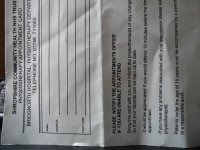
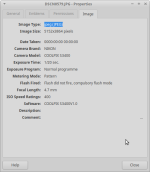
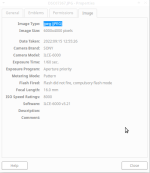
I'm not sure what this proves or disproves but here we go , I photographed from close distance this piece of paper so that the edges of the paper lined up with the edge of the frame ( nearly) then looked at the camera info the Sony is APS-C and the Nikon is 1/2.3. The cameras were as near as dam it the same distance away.

This photo is from the Nikon Coolpix but there is no point in me showing both photos of the same thing !

COOL2.JPG
These were the two focal lengths to get the same image from the same distance.

cool.png

sony.png

Just to add confusion Canons APS-C is smaller than the real APS-C film with Sony and a few others having proper APS-C size.
 
Last edited:
You could stop worrying about numbers and try looking through the view finder ;)
That can actually work quite well, if you then access how much tighter/wider you need & relate it to the lens on your camera.
My 50mm lens gets about 1/3 of the subject (width or height) in so I need around 16or17mm (50/3) alternatively my 50mm lens gets three times as much as I want > a 150mm lens should be about right.
 
I'm not sure what this proves or disproves but here we go , I photographed from close distance this piece of paper so that the edges of the paper lined up with the edge of the frame ( nearly) then looked at the camera info the Sony is APS-C and the Nikon is 1/2.3. The cameras were as near as dam it the same distance away.

This photo is from the Nikon Coolpix but there is no point in me showing both photos of the same thing !

View attachment 366996
These were the two focal lengths to get the same image from the same distance.

View attachment 366997

View attachment 366998

Just to add confusion Canons APS-C is smaller than the real APS-C film with Sony and a few others having proper APS-C size.
You can use the sensor sizes to compare equivalent angles of view.

e.g FF sensor 36mm x 24mm. Coolpix sensor 8.6mm x 6.6mm

So an 8.6mm lens on your coolpix will give the same angle of view as a 36mm lens on full frame .

A 6.6mm lens on your coolpix will give the same angle of view as a 24mm lens on full frame.

If the sensors have different aspect ratios, you need to compare horizontal and vertical angles of view separately, but it works across all sensor sizes and if you want to compare longer or shorter lenses you can multiply or divide the numbers.

So a 50mm lens on FF (approximately 2 x 24) would be roughly equivalent to 2x 6.6mm (13mm) on the Coolpix
 
Exactly why I think it's important to be clear in what we're saying.

Another thing which often raises an eyebrow for me is people recommending a 24-70mm to APS-C users. That could be a great choice but I think it's important to be clear that when using a 24-70mm lens on APS-C you lose the wide end you'd have with a 18-50mm.
Which points to listening to someone who knows what they are talking about, It must be very confusing for new shooters otherwise.

Of course that’s why forums like this are good as eventually if not immediately correct help can be found.
 
I must not be thinking about it. I just use what works. There are times when you need a longer, or wider lens to get the shot. It doesn't bother me what it is equivalent to on an APSC sensor. But if it did I'm fully aware that APSC is roughly equivalent to a 1.5 crop.
 
Back when I used primes (zooms were much poorer and more expensive back then!), I was pretty good at determining which FL I wanted/needed from the limited selection I had (28, 50, 105) but now I use zooms almost exclusively. Not that different in the number of choices but each choice covers a wider range - in fact, my main walkaround lens (18-135 on a 1.5x crop body, so an EFL [35mm] of 27-200) covers my old film primes and more!
 
Back
Top