F2.8, Is It Needed?

Dale.

Bo Derek
Suspended / Banned
Messages
13,716
Name
Dale.
Edit My Images
Yes
A question, rather than making a judgement.

I've been mulling over lenses, I would like (not necessarily need) a fast prime as I've been struggling at times in wildlife situations with light this year, this is Scotland after all. ;)

Lenses being considered are, to be used with and without my Canon 2xIII teleconverter and also, I'm not too fussed on what evolution, so could be Mk1, Mk2, Mk3, where applicable.

Cost is a factor, so will more than likely be used.

300 f2.8 L,

400 f2.8L,

400 DO ( this would have to be the mark 2)

500 f4L

600 f4L, although this lens isn't a realistic option as even used, it's too expensive.


About converters, I understand they are a compromise but they do seem best suited to the Canon big whites, rather than lenses like Sigma's zoom offerings, for example. I'm not knocking the Sigmas, I have one and love it.

My mentioned Sigma, the 150-600C, I love it, it's a super sharp copy, but f6.3 has seen me only being able to get perched birds in most cases, as I just can't get the shutter speeds in most wildlife situations, even when pushing the ISO, to get anything moving. The Sigma isn't extracting the most from the 5Div sensor either but still gives very good results.


What I'm not getting though is that even the 'faster' primes need to be stopped down to f8 to get the best sharpness. I understand that bigger apertures allow more light in and that's one of the main reasons so it seems for using one in a wildlife situation. The lovely mushy backgrounds too of course. 2 things there though, the bird or subject usually has to be side on, parallel to the sensor at such wide apertures. Also, even at f8, a background can be mushy enough if far enough away, even by 10-15 feet at f8.

My question is, if a lens has to be closed down to f8 to be at its sharpest, is there really a need for f2.8? I have a 300f4L IS USM, a lovely lens and I've been trialling it today, with and without the TC. It's been a bright day admittedly here today but even with the TC, I was getting great results image quality wise (albeit experimental) at my hide. With the TC, the 300 is f8.

I can stop the 300 I have down to f8, f10 or whatever, so would the extra expense of the 300f2.8 (or any other big white) be worth it, considering it would always be on the back of mind that even that lens needs to be at f8 (ish) to be at its sharpest? is the sharpness that noticeable?

Or am I missing something or completely misundertsanding the whole thing?

I don't want to make an expensive mistake here, so please help me out. I'm not at the buying stage yet and I may just forget the whole idea but I am interested in experiences.

ta muchly.
 
You should find that a Canon 300 2.8 or 400 2.8 are exceptionally sharp at f/2.8. They are prestigious lenses that are built to shoot wide open all day long. In my sports photography career I used a 3rd hand 400 2.8 mk1 for years and years, and it was simply excellent. The 300’s are no slouch either.

A teleconverter (especially the x2) will take away from the quality a bit. Newer versions are better. A x1.4 will get you a 560 f/4 on a 400 which is no slouch at all.

You could do well to get a 2nd hand 400 2.8 and see how you get on. You won’t lose much (if any) money if you sell it on again. They are big beasts so bear that in mind if you are going to be carrying it far.

You may find it useful to calibrate it with your Canon’s focus micro-adjustment facility (assuming your camera has it) as you’re looking at a very narrow depth of field at 2.8 and 400mm. I found I had to tweak my micro-adjustment a bit before I got it spot on. Easy enough to do - it took about 5 mins.
 
Last edited:
Pro lenses are sharp at f2.8. there is no difference in sharpness on my Nikon lenses. The depth of field is deeper(very slightly) which may lead a person to think the pic is sharper.

Buy a second hand 600mm f4 for birds.
 
IMO, you need a quality f/2.8 prime if you want to use a 2x TC w/ it, and a quality f/4 prime if you want to use a 1.4x TC w/ it. Or a quality f/5.6 prime/zoom; all get you about the same IQ. And it's really because they are all about the same magnification and qtty of light.

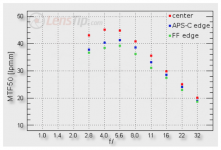
The better lenses are sharpest nearer their max aperture (typically w/in 1 stop)... i.e. a 300/2.8 will generate max IQ/resolution at ~ f/4; and the 300/4 at ~ f/5.6.
This is the 300/2.8 L IS II on 21MP FF:

Screen Shot 2021-11-03 at 4.26.52 PM.png

If you really want to maximize sharpness you need a very sharp lens @ it's best aperture and minimal distance; i.e. using that 300/2.8 at f/4 and from a short distance... It is the increased distance and the need for additional magnification (FL/TCs) that is really the equalizer... you wind up stuck in what I call "The Circle Of Equivalence."
 
Last edited:
Just to add and answer your questions, the difference in sharpness is not typically notable at the same distance; because they all have (nearly) the same size aperture opening means they all have the ability to resolve about the same minimum detail size (physical aperture, not f#)... barring some significant difference in optical aberrations/quality.

And the difference in IQ potential may not be notable either; because there are many other factors that typically limit maximum recorded resolution to something less than the max potential... (i.e. always in the real world).
E.g. I am not aware of a single Nikon/Canon/etc *photography lens that is actually diffraction limited (maximally sharp wide open), but you won't typically be able to tell the difference in IQ (w/o bench testing); and many will say there is no notable degradation from using a 1.4x TC with the better primes, but it is there....

IMO, the main reason for buying a shorter f/2.8 prime is for those times when you can use it shorter and/or need to use it wider (for low light). These days, with modern ISO performance and modern software, I find it much harder to justify.


*there are some lenses that claim being diffraction limited... extremely rare/expensive.
 
Last edited:
600mm f/4 is mostly still not long enough. Now you have plenty of pixels to crop in, etc. That is if you can lift and hold that thing for any meaningful amount of time, Do you need f/4 or 2.8 today... I don't know. It is not like you have a choice of 600mm f/5.6 prime. You can have a few slower and much softer zooms that don't quite even get to 600mm despite claiming it. Or you can have the new Canon plastic fantastic f/11 toy, that I suppose still goes well beyond any modern sensor capabilities under any cloud cover let alone dusk. My reference point is crystal clear pin sharp A3 print, or failing that A4.

I now only have non-stabilised 400mm f/5.6. It is mega sharp wide open... but it just has to go on tripod (on 5Ds) or else requires mega high ISO and shutter speed. Some of the new tech may mitigate some of it, but still the wildlife will also move, and the lens is nowhere near long enough for most things wild.
 
Last edited:
Thanks for the comments, all very interesting an eye opening.

I'm in no rush, I have time to think and to experiment with the gear I have. I must say, I was very impressed with the 300L f4 yesterday, even on a little M5, the detail was excellent. There was tons of light though, a bright sunny day but not that harsh way summer light can be. Even with the TC, it gave good results and unless I peeped the pixels, there was no significant difference.

Despite having a 5Div, I find myself using the M5 more at the moment, it's always on stand by with a lens on it, just incase the sparrwohawk visits the garden and with the 100-400L, it's not much bigger than some bridge cameras and great for hiking to wildlife locations.

I do feel the big prime whites would be even better though, especially when I get my kingfisher woirking as I want it to, I don't mind lugging the 5D and a big white to the location then.

I have time though, and I'm going to take it but I do see a 400 f2.8, or a 500 f4 in my future,(or possibly a 300f2.8 or the 400DO mk2) all being well. Both can be had around the £3k mark but I will of course shop around more seriously when the time comes.

I already have the 2xTC mk3, so up to date there. The 2x seems to be far better suited to the primes, even my little 300f4.
 
The 2x seems to be far better suited to the primes, even my little 300f4.
If comparing against your Sigma 150-600 wide open at 600mm, then it should be quite competitive; possibly a bit better even. I do not recommend a 2x with any zoom lenses; especially ones w/ variable aperture.

I have owned/used most of them (in Nikon line) and I have settled on the 400/2.8 +TCs (1.4x/2x) as the best for me. If you can also afford the 800/5.6 it will give a little better performance than the 400 + 2x... but the difference is not worth the cost/weight/versatility IMO.
 
Last edited:
Auto Focus normally works better with more light, so a benefit of a f2.8 lens will be that it ahould allow the auto focus to work better. How good your camera is at focusing I have no idea, but if it is older then the more light the better.
 
As far as sharpness is concerned the sweet spot of a lens is/was considered to be about three stops down from wide open so if you were using an f2.8 it would be between f5.6 to f8 or if an f4 then it would be f8 to f11 which makes a difference to DoF.
 
Auto Focus normally works better with more light, so a benefit of a f2.8 lens will be that it ahould allow the auto focus to work better. How good your camera is at focusing I have no idea, but if it is older then the more light the better.
With a DSLR it makes no difference unless the lens' max aperture is f/8 or smaller; because the PDAF system has its' own aperture limit... if you look at the low light AF specification there is nothing about lens aperture (it does still perform better with more light, i.e. in brighter conditions w/ more contrast).

But a mirrorless camera's low light AF specification IS lens aperture dependent; it is also dependent on using that max aperture (IDK if disabling exposure preview is enough). Generally the better the low light AF capability, the faster the lens required (f/1.2 for R3/R5).


5D IV spec:
Screen Shot 2021-11-04 at 3.06.13 PM.png

M5 spec:
Screen Shot 2021-11-04 at 3.07.04 PM.png

R3 spec:
Screen-Shot-2021-11-04-at-3.17.55-PM.jpg
 
Last edited:
With lower grade lenses, yes. But not with the better lenses (it's lens specific, but usually w/in 1 stop).
It will be but its so marginal it is essentially academic
 
Even with the best lenses they are usually at their best a couple of stops down. However they are usually entirely usable fully open. It is the edges that improve most.
However it is less important to day to have a 2.8 lens than in the past, as sensors are now so good used at higher ISO settings. And situations where a wide aperture might be needed to gather more light, are usually ones where a little softness or noise is less important anyway.
However if you want F2.8 to limit depth of field there is no other option.
 
Last edited:
Even with the best lenses they are usually at their best a couple of stops down. However they are usually entirely usable fully open. It is the edges that improve most.
However it is less important to day to have a 2.8 lens than in the past, as sensors are now so good used at higher ISO settings. And situations where a wide aperture might be needed to gather more light, are usually ones where a little softness or noise is less important anyway.
However if you want F2.8 to limit depth of field there is no other option.
There is not much dof at any aperture after 400mm. You can essentially get better bokeh. That's about it on that matter. Stopping down is nearly pointless on good long lens
 
There is not much dof at any aperture after 400mm. You can essentially get better bokeh. That's about it on that matter. Stopping down is nearly pointless on good long lens

No lens displays much depth of field when viewed at 100% as the plane of focus can be easily seen. and fall off starting from that plane is virtually immediate. Were this not the case manual focus would be very much more difficult.

However Depth of field in the conventional sense, is a useful concept to determine the depth of apparent good sharpness at a normal viewing distance.
This depend on aperture, distance, focal length and magnification ( which is usually replaced by sensor size in many newer depth of field calculators)

Your example of a 400mm lens has a considerable difference in depth of field at various apertures, vis-

A 400 mm lens focussed at 50 Meters provides a depth of field of-

apertureFull frameAps
2.82.63m1.75m
43.73m2.47m
87.48m4.97m
1617.22m10.02m

Depending on the lens construction the Bokeh ( the quality of the out of focus areas) changes very little with aperture on modern lenses, unless designed to give a swirly Bokeh.
 
Last edited:
Just to add and answer your questions, the difference in sharpness is not typically notable at the same distance; because they all have (nearly) the same size aperture opening means they all have the ability to resolve about the same minimum detail size (physical aperture, not f#)... barring some significant difference in optical aberrations/quality.

And the difference in IQ potential may not be notable either; because there are many other factors that typically limit maximum recorded resolution to something less than the max potential... (i.e. always in the real world).
E.g. I am not aware of a single Nikon/Canon/etc *photography lens that is actually diffraction limited (maximally sharp wide open), but you won't typically be able to tell the difference in IQ (w/o bench testing); and many will say there is no notable degradation from using a 1.4x TC with the better primes, but it is there....

IMO, the main reason for buying a shorter f/2.8 prime is for those times when you can use it shorter and/or need to use it wider (for low light). These days, with modern ISO performance and modern software, I find it much harder to justify.


*there are some lenses that claim being diffraction limited... extremely rare/expensive.
All lens become diffraction limited at some aperture.
However Diffraction takes place to some extent at all apertures. it is unavoidable. at wider apertures it become insignificant.

A diffraction limited lens would appear equally sharp/unsharp over the entire field. A fact taken advantage of in architectural photography where the uses of very small apertures combined with wide angle lenses is commonplace. In such situations the actual plane of focus becomes very hard to see, and the image becomes overall equally sharp. Though at no point is the image as critically sharp as the lens is capable of producing at optimum aperture.

This can easily be confused with depth of field which is also aperture related. Depth of field will continue to increase even in a diffraction limited situation, but sharpness will be unchanged.
 
A 400 mm lens focussed at 50 Meters provides a depth of field of-

apertureFull frameAps
2.82.63m1.75m
43.73m2.47m
87.48m4.97m
1617.22m10.02m

Depending on the lens construction the Bokeh ( the quality of the out of focus areas) changes very little with aperture on modern lenses, unless designed to give a swirly Bokeh.

Depending where you found this table it may be true-ish at 12MP or 18 if you are lucky. This is pixel size dependent. But let's carry on. 2.63m at f/2.8 will accommodate a bird or medium sized animal at that distance no problem. Now problem is at 50m away it will be a size of a grain unless it is an elephant or failing that a large horse. You are more likely looking at 3-8m range where DOF gets really tiny. That table is really for me shooting landscapes and it just means I need 4-6 image focus stack at f/8 unless it is all at near infinity.

Bokeh does change a great deal, namely because things get a little more infocus and break the soft continuos blur effect. Try it yourself.
 
Depending where you found this table it may be true-ish at 12MP or 18 if you are lucky. This is pixel size dependent. But let's carry on. 2.63m at f/2.8 will accommodate a bird or medium sized animal at that distance no problem. Now problem is at 50m away it will be a size of a grain unless it is an elephant or failing that a large horse. You are more likely looking at 3-8m range where DOF gets really tiny. That table is really for me shooting landscapes and it just means I need 4-6 image focus stack at f/8 unless it is all at near infinity.

Bokeh does change a great deal, namely because things get a little more infocus and break the soft continuos blur effect. Try it yourself.
I did not find that table, I created it with a depth of field calculator. I could have done so for any distance and the relative values would be in proportion..
it might be appropriate for shooting a football or rugby match from a stand.

Bokeh is the quality of the out of focus area not its amount.
You do not get more or less Bokeh, you get good or bad Bokeh
Of course the diffusion changes with a number of factors, including the degree of being out of focus. and the aperture used. Good Bokeh shows a smooth continuum from sharp focus to total diffusion. with no unnatural swirls, or hard rims to highlights.
 
All lens become diffraction limited at some aperture.
However Diffraction takes place to some extent at all apertures. it is unavoidable. at wider apertures it become insignificant.

A diffraction limited lens would appear equally sharp/unsharp over the entire field. A fact taken advantage of in architectural photography where the uses of very small apertures combined with wide angle lenses is commonplace.
I think you are confusing diffraction limited recorded resolution and diffraction limited lens resolution... Recorded resolution is limited by (decreases at) smaller apertures (diffraction exceeding the size of the pixels), and lens resolution increases at wider apertures unless optical aberrations prevent it.

A diffraction limited lens is a lens where the diffraction that exists at max aperture (any aperture) is the limitation, and not optical aberrations. i.e. the lens does not get any sharper stopped down from wide open... resolution only decreases.
There are some lenses that claim to be/are considered to be diffraction limited in relation to the CoC standard.
 
Bokeh is the quality of the out of focus area not its amount.
You do not get more or less Bokeh, you get good or bad Bokeh
Of course the diffusion changes with a number of factors, including the degree of being out of focus. and the aperture used. Good Bokeh shows a smooth continuum from sharp focus to total diffusion. with no unnatural swirls, or hard rims to highlights.
In practice, when the background is reasonably close and busy (i.e. dark branches with highlights showing through) the closing of the aperture naturally approaches the real life behind it or in other terms creates a more contrasty and busier rendering. The whole point of shooting with large aperture in this scenario is to completely obliterate such background into one diffuse mess. f/2.8 creates wonders, believe me.
 
Depending where you found this table it may be true-ish at 12MP or 18 if you are lucky. This is pixel size dependent.
The Depth of Field (standard) is not MP dependent (beyond ~2MP); it is only format size dependent (required enlargement/CoC)... that's why no DoF calculator has an input field for sensor resolution. However, Depth of Focus in terms of recorded resolution is MP interrelated.
There is not much dof at any aperture after 400mm. You can essentially get better bokeh. That's about it on that matter. Stopping down is nearly pointless on good long lens
That's exactly why stopping down benefits... it can be a tradeoff of larger details being more in focus (DoF) while simultaneously reducing total/max resolution due to loosing smaller details (diffraction).
F/16, 800mm, on 21MP (D5)... w/o stopping down almost nothing would have been in focus.


Immature RTHU by Steven Kersting, on Flickr
 
Last edited:
That's exactly why stopping down benefits... it can be a tradeoff of larger details in focus (DoF) while simultaneously reducing total/max resolution (diffraction).
F/16 @ 800mm on 21MP (D5)... w/o stopping down almost nothing would have been in focus.
Fair enough. That's the 800mm f/11 Canon sold. Long and light.
 
f/2.8 creates wonders, believe me.
FWIW, I almost never use aperture for BG separation (blur)... I use BG selection instead.
I choose the sharpest aperture first, and I don't change it unless there is a specific reason to do so.

Fair enough. That's the 800mm f/11 Canon sold. Long and light.
It's the Nikon 400/2.8 + 2x EIII... (sharpest around f/10 IMO/E)
 
Last edited:
I think you are confusing diffraction limited recorded resolution and diffraction limited lens resolution... Recorded resolution is limited by (decreases at) smaller apertures (diffraction exceeding the size of the pixels), and lens resolution increases at wider apertures unless optical aberrations prevent it.

A diffraction limited lens is a lens where the diffraction that exists at max aperture (any aperture) is the limitation, and not optical aberrations. i.e. the lens does not get any sharper stopped down from wide open... resolution only decreases.
There are some lenses that claim to be/are considered to be diffraction limited in relation to the CoC standard.
Diffraction is a function of light waves passing through an aperture. it has nothing to do with the lens elements good or bad. as the light wave passes the edges of the opening the wave front bends outward rather than passing directly through.
only with an infinite gap would there be no diffraction.

One way of looking at it is that the the rays of light passing the edges are bent and other unobstructed light passes directly through. At small apertures the proportion of edge to the area of the aperture is higher, so you get more diffusion. so at small apertures the images become softer
( in reality it is the effect it has on wave fronts , but that is hard to visualise with focussed light)

In practice It is almost impossible to construct a lens where the periphery of the lens focusses light to a point identically to light focussed through the centre of the lens.
The act of stopping the lens down excludes the uses of the outer parts of the lens, thus improving the overall sharpness. this has nothing to do with diffraction.

If to want to see diffraction in action. Set up a water bath with a dividing wall with a gap in it. set up a wave by dropping an object opposite the gap on one side. If you then observe the wave produced, as it passes through the opening, you will see that the wave front widens as it passes through.
Lots of interesting experiments, using multiple gates, can also be used demonstrate more complex interference effects and null points.
 
FWIW, I almost never use aperture for BG separation (blur)... I use BG selection instead.
I choose the sharpest aperture first, and I don't change it unless there is a specific reason to do so.
Presuming you have the luxury to do so every time then yes.

It's the Nikon 400/2.8 + 2x EIII... (sharpest around f/10 IMO/E)
I wasn't asking what it was. I was just stating the fact 800mm f/11 is the tool to go for for that particular type of shot at these settings. I would rather have 2kg in my hand vs 10. And likewise for cost. Unless your is permanently fixed on tripod and you are happy with that spot direction for a long while. But cost question remains. I don't question that you may have other uses for that lens without 2x. I'm sure you do. It is that particular type of shot because for some photographers that's what they mainly do.
 
Last edited:
I would rather have 2kg in my hand vs 10. And likewise for cost. Unless your is permanently fixed on tripod and you are happy with that spot direction for a long while. But cost question remains. I don't question that you may have other uses for that lens without 2x. I'm sure you do.
Yes; I tend to use my Sigma 60-600/4.5-6.3 *handheld more often these days...


Blackburnian Warbler by Steven Kersting, on Flickr
 
Last edited:
I’m sure there must be a difference given that pros the use big whites for wildlife and sports but given the quality of the latest Sigma and Tamron zooms and noise reduction software, is it a case of diminishing returns for most amateurs? The price difference is enormous but the difference in quality much less so.
 
Last edited:
Much as I would like a ‘big white’, I‘m very pleased with the EF 100-400mm ii that I bought a few years ago, coupled with my 7DII. The shot below was taken in Zambia in 2017.
267A6BDC-D44C-406F-9FF6-ECF9C9ECCB1B.jpeg
 
Last edited:
I had a 500 f4 i and then ii... in the end the weight was the kicker for me and I am very happy with my 400 D0ii. As usual, after buying a lens the weather went to pot and then we had lockdown! My point is, I suppose, that the weight oof such a pricey purchase in the future may be worth considering.
 
Before I got the 100-400II, I had a Sigma 300mm f/2.8 that was very good and worked well with 1.4x and 2.0x TC. Here’s a shot with the 2.0x TC on, (600mm f/5.6) taken with my 50D. Thing was, when travelling overseas, my camera kit was just getting too heavy, plus I wasn’t really using the 300mm often enough to warrant lugging it about. The 100-400II is more usable more of the time.
6CB88B2C-6970-4466-8599-D5B55FD98BB0.jpeg
 
My main setup is a 300 2.8 mk 2 with the mk 3 converters
The converters are optimised for the mk 2 lens , I can’t see any difference in quality when I use the 1.4 and the 2.0 image quality is still excellent
I went from a 7D 2 to an R5
I mainly photograph animals for birds ideally I would go for a longer lens
I like the 300 though as I can handhold my setup if I went longer (big prime ) I think I would have to use a tripod, someone more fit would probably be fine
I’m not convinced with the F11 primes for use in the UK on an overcast day you would be on a very high ISO but in good light they are probably excellent for birds
 
I currently use a 200-600mm zoom lens.
For me the dream is to own a 400mm prime with TCs which I can't afford at the moment.
Then replace my 200-600mm with a smaller telezoom.

Since the 800mm f11 has been mentioned a few times, my 2p on the lens....
It doesn't seem like a good lens for the UK. But pre-pandemic I used to travel to countries with a lot of sunshine and colourful small birds. I don't carry my massive 200-600mm but 800mm f11 would have been really useful and perfectly usable.
The AF with the lens also doesn't seem great going by reviews, so I'd mostly keep it for perched birds. Not to mention your shutter speeds won't be that high anyway shooting at f11.
 
Fast teles are usually sharp even when wide open. If you are a primary bird shooter, and that you must have the front of the bill to the tip of the tail feather pin-sharp, then a wide aperture lens may not be for you.

The primes also focus faster, in good or low light, which may or may not be important to you.

In terms of sharpness, no one else sees your full-res image other than yourself. Unless you post a 100% crop, you can't really appreciate how sharp an image is. Even then, what is sharp to someone else may not be sharp enough for you. So this point is really moot unless (a) you do this full-time and you actually need this for clients (b) you are a pixel-peeper and you must have the absolute sharpest shot in the universe, and that (c) you have deep pockets to attain (b).

Just my 2p...
 
Just my 2p...
...and extremely good value for 2p at that! ;)

I'll just add to your comments: sharpness is sometimes over-rated. Depending on your subject matter and use, too much sharpness coupled with shallow depth of field can be counterproductive. I've found that some subjects benefit from being less sharp at the point of interest if that is coupled with a smooth falling off over the rest of the subject.

Of course, it's nice to choose the level of sharpness and that's where the Leitz Thamber came in, allowing the photographer to choose just how sharp an image was overall. There's some discussion on that here: https://mrleica.com/leica-thambar-90mm-review/
 
Back
Top