Exposing to the right - please explain !

stevewestern

Suspended / Banned
Messages
5,472
Edit My Images
Yes
What does this mean - over exposing slightly ?
Why do people do it, and in what situations ?

Thanks for any help.
 
That didn't take long..!
3 minutes for a reply - thanks Tim.

I'll take a look right now
 
Some excellent links there; this is a technique that I've come to use and love a lot :thumbs:
 
Main thing to remember about ETTR is to avoid clipping the highlights (this is mentioned in at least one of the links above).

Clipped highlights cannot be recovered whereas noise can be reduced.
 
Funny this subject has come up as I was only thinking about this yesterday, albeit the other way round. I was wondering if it would be ok to slightly underexposed to get the shutter speed up a bit and then use pp software to brighten the image. By the looks of it this wouldn't be a good idea :D
 
Main thing to remember about ETTR is to avoid clipping the IMPORTANT highlights (this is mentioned in at least one of the links above).

Clipped highlights cannot be recovered whereas noise can be reduced.

Fixed the omission for you. :)

Not all highlights are important. You're not going to want to preserve highlight details in a street lamp in a night scene at the expense of all else in the photograph. A little clipping in small areas of the sky on a cloudy day are probably not an issue. I'm sure you'll not try to hold highlights in a reflection of the sun in glass or metalwork. You may have clipped highlights in areas which you intend to crop out later. Sometimes you may choose to overexpose something (to clipping and beyond) quite deliberately. That's why you should enable highlight clipping warnings on your camera as well as referring to the histogram. That way you can see what is being clipped and you can consider whether it matters or not. I like seeing clipping warnings. They let me know I'm right there, where I want to be. If I don't see them I have probably not ETTRd hard enough.

A raw file has reasonable latitude for pulling back areas which the camera indicates are clipped but in practice may not be. It's just the JPEG conversion that created the clipping. Here's a before/after example of a white shirt exposed at +4 in a raw file and pulled back in post. This is something you could never manage with a JPEG, but in raw it is pretty easy.

20120310_101432_000.jpg


Now that's pretty extreme ETTR, and not recommended in practice, but metering highlights at +3 (Canon camera) and having a few pixels sneak over the line is not a problem when shooting raw. The fact is that you need to know what you want to keep in your image, what you can afford to lose, and you need to know your equipment limitations.

Here's a more realistic example....

20110929_173728_.JPG


In this shot I wanted to retain as much detail as possible in the dog's fur, which meant pushing the histogram hard to the right with all the bright snow about. There are some areas of slight clipping, but only just over the edge, and easily recovered within the raw file. By shooting with manual exposure I locked in the shutter speed, aperture and ISO to ensure I had that histogram nailed right where I wanted it for shot after shot as the dog ran around.
 
Last edited:
Funny this subject has come up as I was only thinking about this yesterday, albeit the other way round. I was wondering if it would be ok to slightly underexposed to get the shutter speed up a bit and then use pp software to brighten the image. By the looks of it this wouldn't be a good idea :D

Noise you can tackle in post. Blurry shots you really can't. Use the shutter speed you need in order to control blur/shake and raise the ISO to get the brightness where it needs to be. There is no point leaving the image too dark in camera if you still have unused ISO to spare.

e.g. if you are shooting at 1/500, f/2.8 and 800 ISO and that is giving results about a stop too dark then absolutely raise the ISO to 1600 so the shots come out looking good in the first place. It's much better to do that in camera than salvage it in post.

EDIT : I just tried shooting a series of test shots at a fixed 1/25 and f/5.6, raising the ISO by 1 stop each time all the way from 100 to 6400. I then ran the files through Auto Tone in Lightroom to pretty much equalise the apparent brightness in software. Basically this meant the shot at 100 ISO was underexposed by around 4.5 stops. As it happens, so were all the other shots, since they all captured the same amount of light. However, by raising the ISO a stop at a time the underexposure became less and less apparent and the IQ improved step by step or stop by stop.

Here are the shots prior to adjustment, with the 100 ISO shot at top left and working down to the 6400 ISO shot at the bottom. Remember, all of these images have the same exposure - the same amount of light reaching the sensor. The brightness is changed because the ISO has been changed.

20120419_224645_000.jpg


Here are the shots after running them all through Auto Tone in Lightroom. They are not identical, but similar enough to show that Auto Tone did a good job of equalising the shots.

20120420_072621_000.jpg


Here is a comparison of the underexposed shot at 100 ISO (after Auto Tone adjustment) against the ETTR shot at 3200 ISO (after Auto Tone adjustment), which was equally underexposed to begin with, but compensated for by increasing the ISO. I have not changed NR or any other settings. As you can see, far from increasing noise, raising the ISO has substantially reduced it.

20120419_231147_000.jpg


It's worth making an important point here, which a lot of people may not appreciate. Most importantly, changing the ISO does not affect the exposure. A lot of people say that it does and they talk about the exposure triangle, as though there were three elements to be balanced. While that is true when it comes to determining how bright your image appears, only shutter speed and aperture affect how much light is collected by the sensor. If the shutter is open for a long time then lots of light can pass through. If it is open only briefly then not so much light is gathered. A large aperture lets light pass through the lens quickly. A small aperture reduces the rate at which light is gathered. Moving the ISO value up and down has no effect on how much light is gathered by the sensor. What it does do is to vary how bright your image looks.

When it comes to noise it's not high ISO that is to blame. The problem is that your chosen combination of shutter speed and aperture does not collect enough light to saturate the pixels covering the highlights. You've underexposed at the sensor. You could leave it like that by not raising the ISO and end up with a dim image, just like my shot at 100 ISO, which you can then try to fix in software later. Alternatively you could raise the ISO in the first place and allow the camera to brighten the image for you, before you get to make final adjustments, just like the image shot at 3200 ISO. You'll note in my example that the exposure for both shots was exactly the same - 1/25 at f/5.6 - and thus the same amount of light was recorded in both shots. The difference is that raising the ISO did a terrific job of improving the image before I imported it into Lightroom.

So, when you're shooting sports, or pretty much most things, select your shutter speed and aperture as a priority and then raise your ISO as far as you need to in order to make the image as bright as it should be. If you really want less noise then slow the shutter and/or widen the aperture, so that the sensor receives more light to begin with. Either that or add supplemental lighting such as flash.

 
Last edited:
Very interesting! Thanks for the links. Something else to try experimenting with.

(from a novice)
 
Thanks for that Tim that's really interesting. It completely blows my very novice underexpose theory out the water:) . I just thought underexposing would cause less noise than raising iso, how wrong one can be. I'm one of those people who used to think the iso changed the exposure :)
 
It's a point that is so important that I actually updated post #2 to put the explanation at the beginning of the thread.

To summarise, there are two big sins when it comes to noise...

1. underexposing at the sensor due to the chosen combination of shutter speed and aperture;

2. not raising the ISO value high enough to compensate fully for the underexposure

With #1 you often have no choice. That's just the way it has to be. With #2 you do have a choice, and you should take it. Whether you call it ETTR, ITTR or HTTR pushing the histogram towards the right should yield better photographs, with less noise and improved tonal range.
 
Last edited:
A great read Tim, although I pretty much knew this anyway it's always good to have it rebedded in the brain.

Cheers
 
It's a point that is so important that I actually updated post #2 to put the explanation at the beginning of the thread.

To summarise, there are two big sins when it comes to noise...

1. underexposing at the sensor due to the chosen combination of shutter speed and aperture;

2. not raising the ISO value high enough to compensate fully for the underexposure

With #1 you often have no choice. That's just the way it has to be. With #2 you do have a choice, and you should take it. Whether you call it ETTR, ITTR or HTTR pushing the histogram towards the right should yield better photographs, with less noise and improved tonal range.

Does beg the question though as to why applying gain in the camera seems to work far better than applying it in post production. In fact your example above shows this. The ISO 3200 shot looks much cleaner and retains more detail than the 'pushed' ISO 100 shot.
 
Does beg the question though as to why applying gain in the camera seems to work far better than applying it in post production. In fact your example above shows this. The ISO 3200 shot looks much cleaner and retains more detail than the 'pushed' ISO 100 shot.

It's because the gain applied in camera is done on the analogue signal from the sensor before it's converted into digital. The fake 'expanded' ISO settings on cameras are digital operations I believe.
 
tdodd - you certainly seem to know your stuff !
Fascinating reading - thanks for the effort you are putting into this.
 
It's because the gain applied in camera is done on the analogue signal from the sensor before it's converted into digital. The fake 'expanded' ISO settings on cameras are digital operations I believe.

Ahh, makes sense, cheers.
 
It's because the gain applied in camera is done on the analogue signal from the sensor before it's converted into digital. The fake 'expanded' ISO settings on cameras are digital operations I believe.

Yep, that's exactly it. :thumbs:
 
With this in mind, the only thing I have a slight gripe with is the suggestion that iso is not part of the 'exposure triangle.' I 100% understand why you say that and I can also see that in absolute terms it's correct as you need some light to amplify in the first place so shutter and aperture become number 1 priority.

The only reason I say 'gripe' is because by saying that iso is not part of 'exposure triangle' it implies that it is not important in terms of exposure. But seeing as the gain is done in an analogue manner and hence cannot be applied later, then that to me says that iso is an important part of the 'exposure triangle'. Or am I talking rubbish?

I hope this doesn't sound picky, more just trying to compose my thoughts. I actually found your post really quite enlightening.
 
With this in mind, the only thing I have a slight gripe with is the suggestion that iso is not part of the 'exposure triangle.' I 100% understand why you say that and I can also see that in absolute terms it's correct as you need some light to amplify in the first place so shutter and aperture become number 1 priority.

The only reason I say 'gripe' is because by saying that iso is not part of 'exposure triangle' it implies that it is not important in terms of exposure. But seeing as the gain is done in an analogue manner and hence cannot be applied later, then that to me says that iso is an important part of the 'exposure triangle'. Or am I talking rubbish?

I hope this doesn't sound picky, more just trying to compose my thoughts. I actually found your post really quite enlightening.

I totally understand where you're coming from and really you can choose to see it as you see fit. However, the origins of noise come from not capturing enough light - i.e underexposing the sensor.

What you do after you've finished absorbing photons has nothing more to do with exposing the sensor. It's only about how you choose to process the signal the sensor produces. Either you can apply analogue gain to the signal by raising the ISO or you can apply digital gain in software. Neither one of those activities change the exposure of the sensor to light. They do alter the brightness of the final image.

So, continuing to be pedantic/accurate people use the word "exposure" wrongly. They really mean "brightness". Before the age of digital people would refer to exposing the plate or the film to light. What they meant was selecting an aperture of "x" value and opening the shutter for a period of "y" time. The "exposure" was a measure of how much light was transmitted and had nothing to do with the sensitivity of the recording medium. You could say that a low sensitivity medium required a greater exposure and you adjusted that only by changing shutter speed or aperture and that was it. There really was no exposure triangle. You had a fixed sensitivity and you set your exposure to suit. If you should swap out one film speed for another then that on its own would not change the exposure at all. It would make the image either too bright or too dark, but unless you changed shutter speed or aperture your exposure would remain exactly the same.

Now, with digital cameras we aren't committed to first picking a sensitivity of medium and then setting an exposure to suit its needs. We can do it the other way round. We set an exposure which satisfies our goals for control of blur, shake, DOF, lens IQ and so on and then we alter the sensitivity of our medium, by changing ISO value, to suit those exposure settings. In other words we gather as much light as we can (the exposure) and then we amplify the light so that the image looks good (adjust the brightness). At least that's how I view the task of making the image look sufficiently bright.

At the end of the day it's no big deal, so long as we all know what we're really talking about. My bugbear in all this is that people so often say that shooting at high ISO increases noise. The fact is that it doesn't. It hopefully reduces it, as I have demonstrated with my example. If they actually understood how this all works and applied their thought processes to suit then they might produce superior images, technically at least. :)

In the future, as in the past, I'm sure I shall make reference to the exposure triangle. It is a convenient way to communicate, but it masks what's actually going on technically when you are setting up your camera to capture the best image you can.
 
It's explained here....

http://www.luminous-landscape.com/tutorials/expose-right.shtml

http://www.cambridgeincolour.com/tutorials/digital-exposure-techniques.htm

http://www.ophrysphotography.co.uk/pages/exposingtoright.htm


IMPORTANT EDIT : There is a common misconception about the term "exposure" and it follows that the expression "Expose To The Right" or "ETTR" is actually a misnomer. People talk of the "exposure triangle" and playing the settings of shutter speed, aperture and ISO off against each other in order to arrive at the correct "exposure". While it is very convenient to talk in this way it is not quite accurate and can lead to misconceptions about noise and the cause of it.

When we talk about exposure what we are really talking about is how much light is captured by the sensor and how far the highlights are away from being clipped. In other words the exposure is an expression of how much light we recorded. Within the camera settings only two adjustments can influence the exposure (ignoring flash) - shutter speed and aperture. Large apertures let plenty of light to travel through the lens. Small apertures restrict the flow. Long/slow shutter speeds gather the light for a while so gradually the exposure can increase. High/short shutter speeds only let light be captured for a brief moment. The ISO setting has absolutely no influence on how much light the camera records. It is not part of the fictitious "exposure triangle".

The ISO is more like a brightness control, not an exposure control. It affects how bright the image looks, but not how much light was recorded. Now, when it comes to the topic of noise, high ISO often gets the blame for noisy images. This is the tail wagging the dog. The reason for noise is that insufficient light is recorded by the sensor. It is not sufficiently saturated. The "signal" is not as strong as it might be. You have underexposed the sensor. Raising the ISO helps to compensate for your underexposure by brightening the image. In so doing it actually improves the noise performance of your camera overall.

So, I believe that rather than referring to ETTR (Expose to the Right) it would actually be more appropriate to ITTR (ISO to the Right) or even HTTR (Histogram to the Right). In other words you set the shutter speed and aperture you need for creative control of your image (blur and DOF control) and then you raise the ISO, if necessary, to make the image appear as bright as possible without clipping important highlights.

In post #9 I ran a little test/demo to demonstrate how two shots with identical exposures (same shutter speed and aperture) had completely different noise performance depending upon the ISO value chosen. The 100 ISO shot was a disaster. The equivalent shot at 3200 ISO was remarkably good.

Tim, you're going way out on a limb with this one. It appears to overturn more than 100 years of history and practise. And with respect, I fail to see how it is helpful.

'Exposure' is the business of adjusting the settings on the camera - the 'triangle' of shutter speed, aperture and ISO - in such a way that tones in the subject are rendered as a realistic likeness in the finished picture, as far as possible.

Your literal definition of exposure simply as the amount of light hitting the sensor, disregards the image processing necessary to achieve that, and the essential part that ISO plays. Call it photon capture if you like, but not exposure.
 
<snip>

...My bugbear in all this is that people so often say that shooting at high ISO increases noise. The fact is that it doesn't....

<snip>

Of course it does. You know it does. You've demonstrated that it does. Where are you going with this reinvention of the wheel?
 
Here is a comparison of the underexposed shot at 100 ISO (after Auto Tone adjustment) against the ETTR shot at 3200 ISO (after Auto Tone adjustment), which was equally underexposed to begin with, but compensated for by increasing the ISO. I have not changed NR or any other settings. As you can see, far from increasing noise, raising the ISO has substantially reduced it.

According to what you wrote the ISO 100 image was 4.5 stops under-exposed and the ISO 3200 image was 0.5 stops over-exposed (or 'over-brightened', whatever word you want to use). So correctly exposing clearly results in a better image than massively under-exposing and then increasing the brightness with software.

But it'd be interesting to see how correctly exposing compares with over-exposing (which is the topic of this thread) with a higher ISO setting, then decreasing the brightness with software.
 
According to what you wrote the ISO 100 image was 4.5 stops under-exposed and the ISO 3200 image was 0.5 stops over-exposed (or 'over-brightened', whatever word you want to use). So correctly exposing clearly results in a better image than massively under-exposing and then increasing the brightness with software.

But it'd be interesting to see how correctly exposing compares with over-exposing (which is the topic of this thread) with a higher ISO setting, then decreasing the brightness with software.

I read it, and i paraphrase heavily here as...shooting brighter with a high ISO produces less noise and a better overall exposure than shooting darker with a lower ISO as post processing introduces noise on the way up but not the way down :thinking:
 
So in TALK BASICS we are telling people ISO has no bearing on exposure and high ISO doesn't produce more noise..

I can't dispute or agree wiht the facts presented as I don't know enough.. What I do know its that we are not supposed to go this deep and techie in talk basics and telling people using high ISO has no effect on noise and ISO doesn't effect exposure is perhaps not the best post ...IMHO :)
 
KIPAX said:
So in TALK BASICS we are telling people ISO has no bearing on exposure and high ISO doesn't produce more noise..

I can't dispute or agree wiht the facts presented as I don't know enough.. What I do know its that we are not supposed to go this deep and techie in talk basics and telling people using high ISO has no effect on noise and ISO doesn't effect exposure is perhaps not the best post ...IMHO :)

+1
 
Hi Tim

Thanks for this.

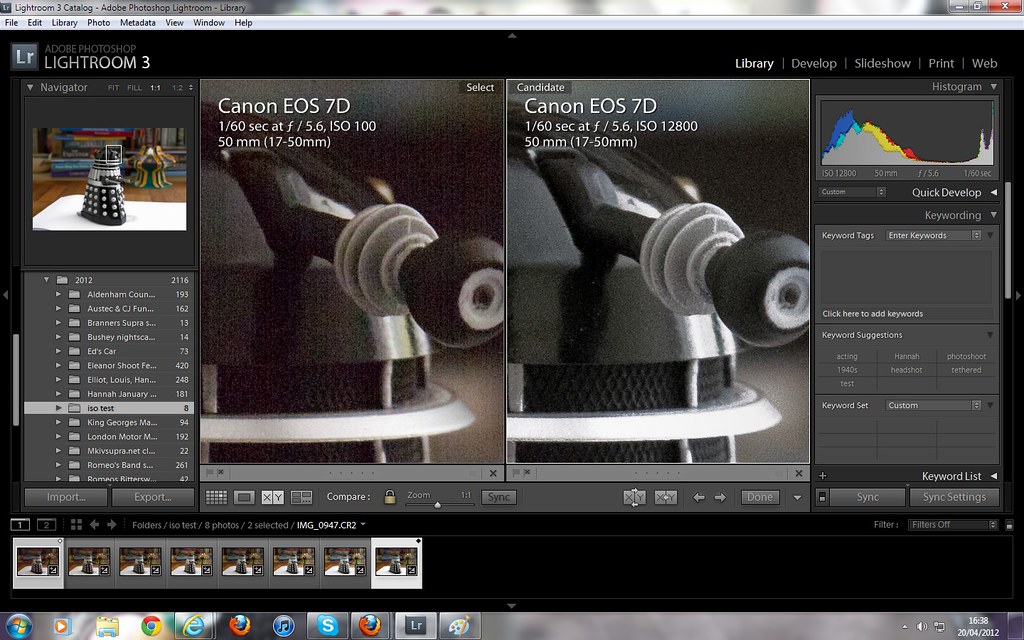
So I tried a similar thing with my son's Dalek.

I took 8 shots.

100 iso through to 12800,

f5.6 @1/60th for all shots.

Here is the screen shot of iso 100 on the left & iso 12,800 on the right.

No noise reduction was used except the default setting in LR3 of 25.

I'm really impressed with this, so thanks for taking the time :)

When I did add NR to the files, they were cleaned up beautifully, inc 12,800

Anyway, here's my screenshot.

 
Last edited:
I read it, and i paraphrase heavily here as...shooting brighter with a high ISO produces less noise and a better overall exposure than shooting darker with a lower ISO as post processing introduces noise on the way up but not the way down :thinking:

And I think that's what the photographs posted above show.

But what is the effect of correctly exposing at, say, ISO 1600, compared to over-exposing at ISO 6400 and reducing the brightness with software?
 
I think the change that has happened with digital is that the ISO is no longer a physical factor and is controlled via code and electronics.
Shutter speed and Aperture remain physical and 100% control the amount of light, ISO is more of a digital take on the physical difference of film speeds.

Still has a similar effect though...
 
Richard,

The nub of my argument is that I am saying that the exposure is the capture of photons. It is about the degree to which the sensor is saturated. This was just as true in the film days. An exposure was made by allowing light to pass through an aperture for a measured amount of time. The exposure started when the shutter was opened. It stopped when the shutter was closed. Anything that occurred after that point was film processing.

Of course, with film you actually did have different sensitivities, and fast film would react to light more quickly than slow film. This is not the case with conventional digital sensors, as far as I know. The sensor has a base sensitivity and it stays that way. The pixel wells fill up at the same rate regardless of the ISO setting you select. The saturation of the sensor (the photon capture) (the exposure) is determined by the following things....

- intensity of the light reaching the lens;
- shutter speed;
- aperture.

Everything that follows the photon capture is effectively some sort of post processing, even if performed within the camera. Changing the ISO does not change the sensitivity of the sensor and it does not alter the number of photons collected. It's just a post capture gain control. It does affect the image brightness. It does not affect how much light the sensor receives or collects.

So, back to ETTR - If your highlights are nudging saturation point on the sensor at base ISO then you already have an ETTR capture. There is no extra gain required, no need to raise ISO or make any other adjustments. If your capture at base ISO failed to deliver an ETTR file then you have some options....

- add more light;
- slow the shutter;
- open the aperture;
- raise the ISO;
- accept the file as is without striving for ETTR.

When you're shooting sports and can't add light, can't drop the shutter speed and have no more aperture to give then your only option remaining in order to achieve ETTR is to raise the ISO. This is the very thing that some people try to avoid for fear of increasing noise. They should not be afraid. Raising the ISO in this situation should lower noise. I thought this was made very plain in my demo example. How you can sit there and say that raising the ISO has increased noise has me completely baffled. I doubt there are many here who would agree that the 100 ISO shot looks cleaner than the 3200 ISO shot. :thinking:

I really can't think of anything more I can add.
 
Last edited:
So in TALK BASICS we are telling people ISO has no bearing on exposure and high ISO doesn't produce more noise..

I can't dispute or agree wiht the facts presented as I don't know enough.. What I do know its that we are not supposed to go this deep and techie in talk basics and telling people using high ISO has no effect on noise and ISO doesn't effect exposure is perhaps not the best post ...IMHO :)

Sorry, I forgot that this was raised in Talk Basics. I tried to provide a very simple response to begin with, and then as questions followed I'm afraid I got drawn into more depth with my answers. I'll try to tidy up some of the heavier bits.
 
Tim, it's the way you're confusing what we all know as 'exposure' with 'photon capture' which is obviously part of the exposure process (shutter speed and aperture) but misses out the ISO bit which is not only essential, but cannot be avoided either. They are all wrapped up together as the three corners of the Exposure Triangle. You cannot correctly set shutter speed and aperture without first knowing the ISO, and vice versa.

Film and digital do things differently, but with high ISO film we had 'big grain' (becuase larger silver halide crystals are more senitive to light) and I don't really see how that is really any different to 'big gain' which is how it's done with digital, by basically turning up the volume. And the end result looks much the same, whether it's grain or noise, with less of dynamic range and loss of shadow detail much the same too.

The good learning point that comes out of your excellent examples, is that it is far better to raise the ISO and obtain correct exposure in-camera, than it is to under-expose and try to rescue things in post processing. It's interesting to see that illustrated, and if that's your point then fine, but I thought everyone either knew that or at least accepted it.

You say that raising ISO doesn't increase noise, but actually reduces it. I know what you're getting at but it's an odd way of putting it and is the reverse of what most folks would take that statement to mean. For example, if I shoot a scene using 1/250sec at f/5.6 with iso400, and then again at 1/2000sec at f/5.6 with the iso raised to iso3200, my 'exposures' will be the same, but the one at iso2300 will have a lot more noise.
 
Last edited:
Been looking for a "dumbfounded" icon.. can't find one..

So you're telling me that the image at 100 ISO (the one on the left) is cleaner than the one at 3200 ISO? One of us surely needs to visit the optician.

20120419_231147_000.jpg
 
You say that raising ISO doesn't increase noise, but actually reduces it. I know what you're getting at but it's an odd way of putting it and is the reverse of what most folks would take that statement to mean. For example, if I shoot a scene using 1/250sec at f/5.6 with iso400, and then again at 1/2000sec at f/5.6 with the iso raised to iso3200, my 'exposures' will be the same, but the one at iso2300 will have a lot more noise.

Well it's that misunderstanding that I'm trying to steer people away from. In your example it's not the 3200 ISO that's done the harm. It's the adjustment of shutter speed from 1/250 to 1/2000 that is the problem. Being able to raise the ISO to 3200 has actually helped you out. Probably quite a lot.

Maybe my explanation of all this is a bit controversial, but that doesn't mean it is wrong. It's just a question of the perspective from which the problem is viewed. Does jumping off a high building kill you or is it the hard bit you hit when you reach the bottom? Does high ISO cause more noise or is it the high shutter speeds you so desire, which cause the sensor to undersaturate?

To a large degree my take on this stems from shooting mostly with manual exposure where I am always responsible for all three elements. I set my creative controls first and the ISO, which is wholly technical and not in the least creative, comes last. e.g. if shooting BIF I know I want at least 1/1000 in order to control shake and blur and I also want f/8 for a bit of focus leeway and to sharpen up the lens. Once I have those figures dialed in I'll then see what ISO value I will need in order to achieve ETTR on white/ bright areas of the subject and scene. Raising the ISO is not my enemy. The curse is the high shutter speed and middling aperture that crucify me.
 
....

You say that raising ISO doesn't increase noise, but actually reduces it. I know what you're getting at but it's an odd way of putting it and is the reverse of what most folks would take that statement to mean. For example, if I shoot a scene using 1/250sec at f/5.6 with iso400, and then again at 1/2000sec at f/5.6 with the iso raised to iso3200, my 'exposures' will be the same, but the one at iso2300 will have a lot more noise.

I think if you were to follow the original earlier explanation, your shutter speeds and apertures need to be the same...so raising from 1/250 to 1/2000 will increase noise...from what i read...just sayin'
 
Back
Top