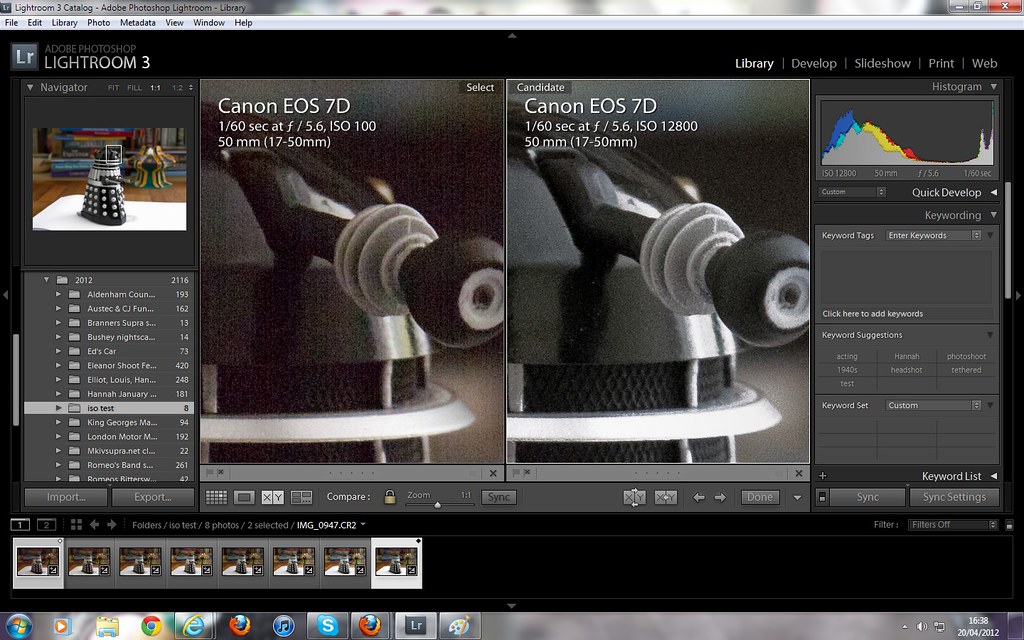
Funny this subject has come up as I was only thinking about this yesterday, albeit the other way round. I was wondering if it would be ok to slightly underexposed to get the shutter speed up a bit and then use pp software to brighten the image. By the looks of it this wouldn't be a good idea

Noise you can tackle in post. Blurry shots you really can't. Use the shutter speed you need in order to control blur/shake and raise the ISO to get the brightness where it needs to be. There is no point leaving the image too dark in camera if you still have unused ISO to spare.
e.g. if you are shooting at 1/500, f/2.8 and 800 ISO and that is giving results about a stop too dark then absolutely raise the ISO to 1600 so the shots come out looking good in the first place. It's much better to do that in camera than salvage it in post.
EDIT : I just tried shooting a series of test shots at a fixed 1/25 and f/5.6, raising the ISO by 1 stop each time all the way from 100 to 6400. I then ran the files through Auto Tone in Lightroom to pretty much equalise the apparent brightness in software. Basically this meant the shot at 100 ISO was underexposed by around 4.5 stops. As it happens, so were all the other shots, since they all captured the same amount of light. However, by raising the ISO a stop at a time the underexposure became less and less apparent and the IQ improved step by step or stop by stop.
Here are the shots prior to adjustment, with the 100 ISO shot at top left and working down to the 6400 ISO shot at the bottom. Remember, all of these images have the same exposure - the same amount of light reaching the sensor. The brightness is changed because the ISO has been changed.
Here are the shots after running them all through Auto Tone in Lightroom. They are not identical, but similar enough to show that Auto Tone did a good job of equalising the shots.
Here is a comparison of the underexposed shot at 100 ISO (after Auto Tone adjustment) against the ETTR shot at 3200 ISO (after Auto Tone adjustment), which was equally underexposed to begin with, but compensated for by increasing the ISO. I have not changed NR or any other settings. As you can see, far from increasing noise, raising the ISO has substantially reduced it.

It's worth making an important point here, which a lot of people may not appreciate. Most importantly, changing the ISO does not affect the exposure. A lot of people say that it does and they talk about the exposure triangle, as though there were three elements to be balanced. While that is true when it comes to determining how bright your image appears, only shutter speed and aperture affect how much light is collected by the sensor. If the shutter is open for a long time then lots of light can pass through. If it is open only briefly then not so much light is gathered. A large aperture lets light pass through the lens quickly. A small aperture reduces the rate at which light is gathered. Moving the ISO value up and down has no effect on how much light is gathered by the sensor. What it does do is to vary how bright your image looks.
When it comes to noise it's not high ISO that is to blame. The problem is that your chosen combination of shutter speed and aperture does not collect enough light to saturate the pixels covering the highlights. You've underexposed at the sensor. You could leave it like that by not raising the ISO and end up with a dim image, just like my shot at 100 ISO, which you can then try to fix in software later. Alternatively you could raise the ISO in the first place and allow the camera to brighten the image for you, before you get to make final adjustments, just like the image shot at 3200 ISO. You'll note in my example that the exposure for both shots was exactly the same - 1/25 at f/5.6 - and thus the same amount of light was recorded in both shots. The difference is that raising the ISO did a terrific job of improving the image before I imported it into Lightroom.
So, when you're shooting sports, or pretty much most things, select your shutter speed and aperture as a priority and then raise your ISO as far as you need to in order to make the image as bright as it should be. If you really want less noise then slow the shutter and/or widen the aperture, so that the sensor receives more light to begin with. Either that or add supplemental lighting such as flash.