Expose to the right - my quick experiment

bulb763

Suspended / Banned
Messages
711
Name
Jon
Edit My Images
Yes
Thought I'd do a few quick tests to see what this is all about. The article at Luminous Landscape makes for a very good read if you're interested at all.

Basically, from what I can understand, more of the luminance data for each pixel is recorded on the right (light) side of the histogram than the left (dark) side. So as long as the scene is well within the ~5 F-stops of dynamic range that our sensors are apparently capable of, there is room to play (assuming you don't want to blow highlights). The benefits of exposing to the right are a/ better tonal "mapping" compared with darker tones and b/ better S/N ratios. The article explains all this much better than I can.

OK, so I figured that to best show the differences, I would need a naturally dark scene so that the effects of ETTR would be more obvious. In an attempt to avoid reflections and glare, I closed the curtains and protected the setup with dark, non-reflecting objects. This contained the range of the scene to within ~1.5 stops, which gave me plenty of room to play.

BTW, when I say "stops" I am referring to the sections of the histogram on my D50, of which there are four.

It took a big of messing about finding out what the correct exposure was, and then even longer to work out how much I could ETTR without blowing any highlights. I also had to keep the ETTR exposure within the capabilities of RAW SHOOTER to adjust back to the correct exposure with the exposure compensation slider.

All images shown are 100% crops. Nikon D50, sigma 17-70 @ 70mm

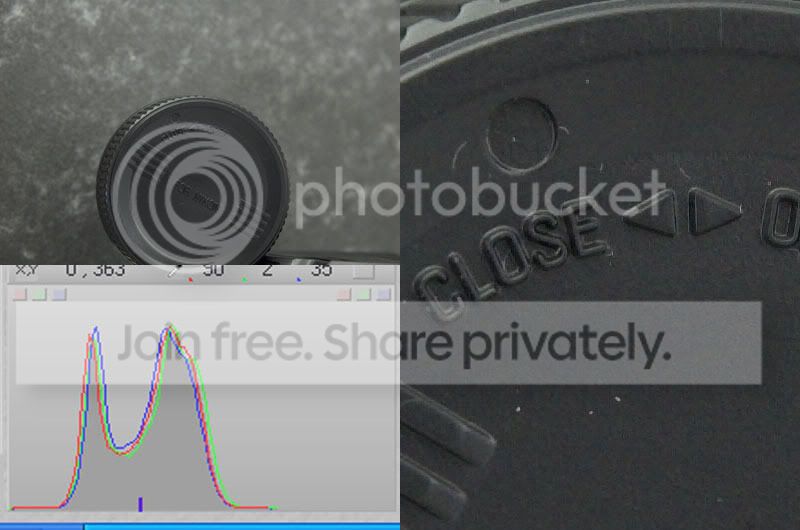
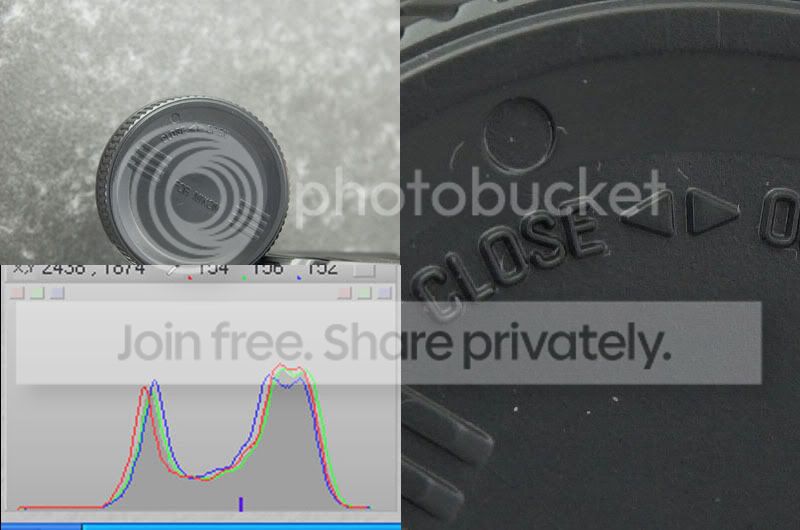
First test was at ISO1600. I worked out the correct exposure to be F8, 6 seconds:

_DSC00430003-crop.jpg


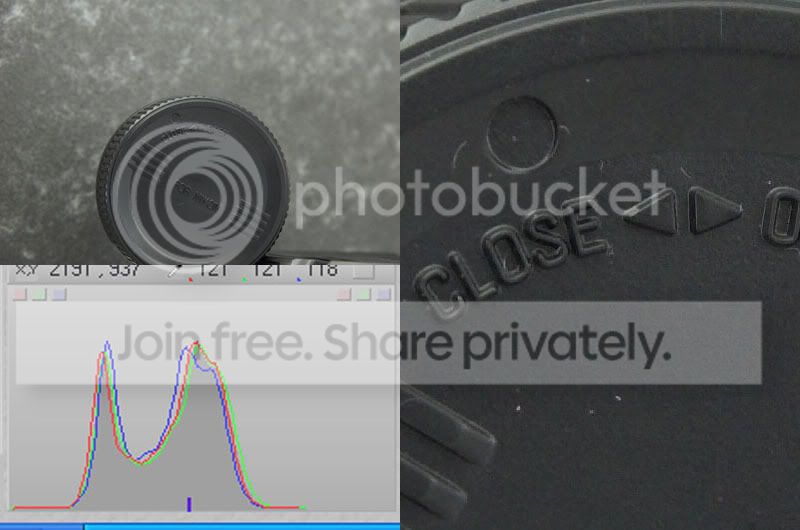
compare this to F4.5, 6 seconds (adjusted using RAW SHOOTER to the correct exposure):

_DSC00480008-crop.jpg


Straight away I think you'll notice that there is much less noise in the second image. I also think that the end of the top stripe is better defined in the second image, and generally the image seems slightly sharper.

Second experiment, adjusted the shutter speed rather than aperture. Still at ISO1600.
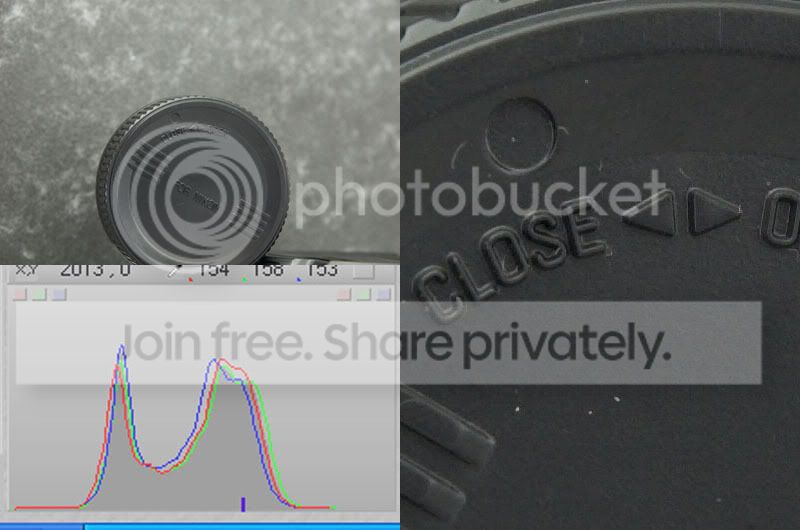
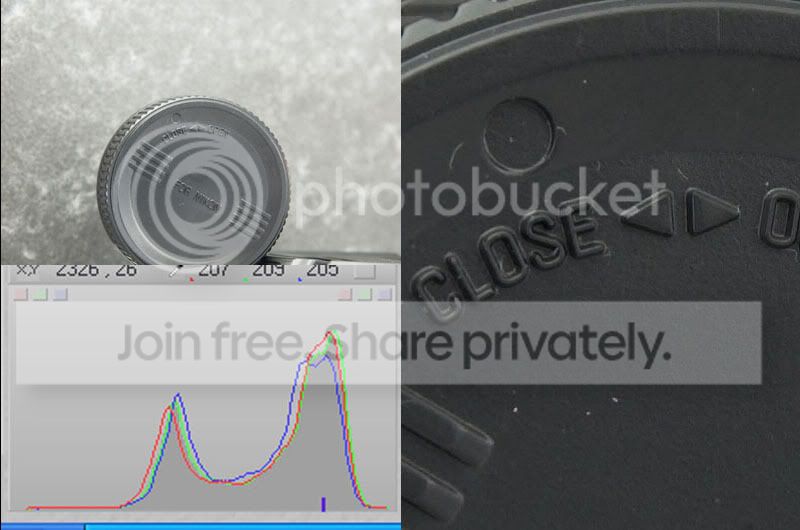
Correct exposure worked out to be F8, 10 seconds (so slighter brighter than the first):

_DSC00520003-crop.jpg


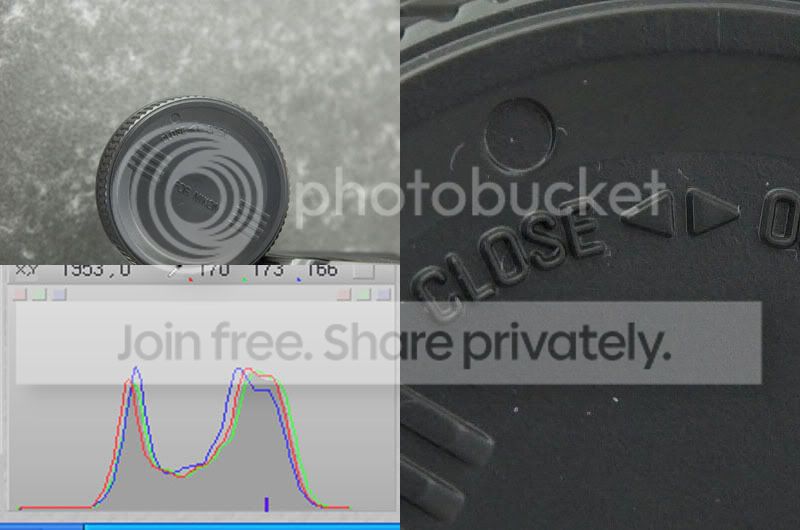
compare this to F8, 39 seconds :eek::
_DSC00580009-crop.jpg


Hmmm perhaps the first set weren't exposed quite correctly after all :thinking:

Again, the noise aspect of the image is noticeable straight away - much better in the ETTR image.

So I wanted to compare these results with ISO200, which I try to shoot with all the time - light permitting. Hmmm 1600 / 200 = 8, so that means exposures 8x as long, for the same exposure! Oh well, here goes...

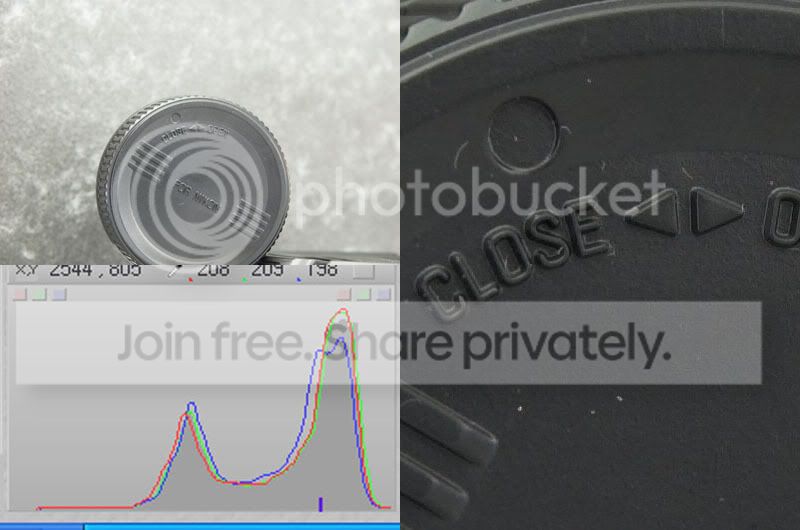
ISO200, F5.6, 30seconds:

_DSC00610003-crop.jpg


compared to F5.6, 3:10mins!
_DSC00620004-crop.jpg


These are a little dark, but the light was dropping by this point, and a ~5minute exposure didn't appeal! Besides which, I think these results show that at ISO200, ETTR has very little, if any, effect on the noise of the image. Certainly in the RAW file, I can't spot any difference, and of course JPEGs lose a bit of detail anyway.

So what are my conclusions and what have I learned?

Well, If you ever need to shoot a sub-5-F-stop image at high ISO, I think that by ETTR, you will be rewarded with less noisy results. I can't say for sure because I didn't try them, but I reckon its reasonable to assume the between ISO 200 and 1600, the difference in noise between the "correct" exposure and the ETTR exposure will increase linearly. A smaller-dynamic-range scene can benefit more from this technique than a higher-dynamic-range image.

It took quite a bit of effort to remove all the reflections and highlights from the scene, and it only took a tiny reflection to blow any highlights, and render the technique all but useless. This of course assumes you don't want to blow the highlights - I'm sure there are many cases where some highlights wouldn't matter, and just as many where they would be an integral aspect to an image.

For scenes where it is usable and useful, I certainly think the technique is worth employing. It only takes a quick look at the in-camera histogram to check the exposure, and then a quick tweak in the raw converter to get to the correct exposure.

This has been my first "proper" experiment (test-shots of pets don't count!), and I enjoyed seeing the results. Please remember that I am very much an enthusiastic amateur!

Besides the lessons I've learned about ETTR, I've also learned that ISO and shutter speed are directly related - i.e. double one: half the other. I'm sure the same applies to F-stops, but I've never understood what's an F-stop and whats a 1/2 F-stop :lol:). I've also learned that, in semi-auto, my D50 seems to expose for the shadows, or at least darker than what I would think is correct. And finally, writing up the results can take as long as the experiment itself if you're not careful ;)

Thanks for reading
 
It looks like a very useful test and I'll have a good butchers at it later when I have more time - but thanks for taking the trouble to do these tests. :thumbs:

Besides the lessons I've learned about ETTR, I've also learned that ISO and shutter speed are directly related - i.e. double one: half the other. I'm sure the same applies to F-stops, but I've never understood what's an F-stop and whats a 1/2 F-stop :lol:).

That's absolutely correct. If you've only learned that - the exercise was worthwhile. The situation is the same with digital as it was with film. If you had a film of 100 ISO which gave you a reading of 1/125 at f8, but you wanted a faster shutter speed, so changed to 200 ISO film - your exposure would be 1/250 at f8 in the same light. With 400 ISO, the film speed doubles again so you'd get 1/500 at f8.

As you quite rightly surmise, the situation is the same with apertures, so if you wanted to use a larger aperture rather then a faster shutter speed, then at 200 ISO your exposure would be 1/125 at f5.6. At 400 ISO your exposure would be 1/125 at f4.
 
Very informative and necessary - thanks for the effort but this stuff makes my head hurt!

I am longing for my K-1000 and a steady supply of Agfa's best!!

:D
 
Very interesting and useful stuff there!

You normally raise the ISO and risk noise as a last resort because there is not enough light. To get close to overexposing in low light you would have to push the ISO even further. Which raises the question - what is better for noise... 800 ISO normal exposure corrected if necessary or 1600 ISO nearly overexposed?

I'll leave that one with you :)
 
Bookmarked, will make good testing tonight,...

Now, must work.

King.
 
Very interesting and useful stuff there!

You normally raise the ISO and risk noise as a last resort because there is not enough light. To get close to overexposing in low light you would have to push the ISO even further. Which raises the question - what is better for noise... 800 ISO normal exposure corrected if necessary or 1600 ISO nearly overexposed?

I'll leave that one with you :)

How thick is your book of P/S tricks??:D

Still, shooting Ilford FP-4 in my K1000 I NEVER had a noise problem!!

:D
 
It is my understanding that blown highlights are only applicable to jpegs and not RAW and so it is actually advisable (not always but mostly) to have minimal "blown highlights" in order to have a well exposed RAW??:shrug:


Any comments?:thumbs:
 
Well theyre recoverable to an extent in RAW, more so than JPEG, but I prefer to work by what Robert says wherever I can, blown is blown. So if I get the chance to reshoot, I do.
 
I'm thinking what's needed here is the histogram info for each shot then we can see how far into the right hand noise the exposure is...

ie...
Within the first F/Stop, which contains the Brightest Tones 2048 levels available
Within the second F/Stop, which contains Bright Tones 1024 levels available
Within the third F/Stop, which contains the Mid-Tones 512 levels available
Within the fourth F/Stop, which contains Dark Tones 256 levels available
Within the fifth F/Stop, which contains the Darkest Tones128 levels available

hence the relative noise from exposure
 
You can drag the sliders around in RAW and stop the blown bits clipping but there isn't any detail in them as far as I can see. I'm no processing wizard so I'm quite easy to convince that I'm wrong :)
 
If those highlights are blown in RAW there's no recovering them. RAW does enable you to recover detail up to a point - but then they weren't really blown. :)
 
Oh well I'm no P/S genius either but I ASSUMED that, along with all the other settings - saturation, contrast, sharpness etc - that the blown warning was only applicable to jpegs.

I suppose we agree then that overexposure is better recovered in RAW but also only to a point?:shrug:
 
IIRC on my 30D the highlights flash as blown, but arent actually. There is a safe buffer...

If one were to assume a range of 0-254, then any data 250 and over would flash indicating over exposure/blown highlights. This is a very general generalisation, but you get the idea.
 
A properly blown highlight is no detail or 'white' information. It doesn't matter whether its TIF, RAW, JPG, NEF, etc, its fair buggered.

Anton, blow your highlights properly. I'm getting the right huff with your half-assed attempts at botching :D :lol: :lol:
 
A properly blown highlight is no detail or 'white' information. It doesn't matter whether its TIF, RAW, JPG, NEF, etc, its fair buggered.

Anton, blow your highlights properly. I'm getting the right huff with your half-assed attempts at botching :D :lol: :lol:

You DON'T want to be within 100 nautical miles when I make a proper c*#k-up!

Trust me!!:lol: :lol: :lol:
 
"I'm sure the same applies to F-stops, but I've never understood what's an F-stop and whats a 1/2 F-stop"

An f-stop or Focal Stop, as you say was originally the way of graduating the diaphragm opening so it let in either half as much or twice as much light as the previous one. This relationship held good whatever the focal length of the lens. The f-stop was originally the number of times the diaphragm diameter divided into the focal length of a conventional lens. Therefore the diameter of the hole in the diaphragm at f4 on a 100mm conventional lens would be 25mm and on a 400mm lens 100mm, which is why long focal length lenses do not have wide maximum apertures.

Obviously this explains why f2 is a larger diaphragm hole than f32 because f2 would be the equivalent of half the focal length of the lens, but f32 only one 32nd of it's focal length.

Why does the larger diaphragm opening at f4 on a 400mm lens not produce greater exposure at the film/sensor plane then? Simply extension, the 400mm conventional lens would have had a tube four times as long as a 100mm one so this extra extension means with the additional light loss only the same amount of light reaches the sensor.

Matters were complicated by the introduction of telephoto construction for long focus lenses because these allowed lens bodies to be made shorter for an equivalent focal length to the conventional lens, which previously was the same length as its focal length indicates. Therefore strictly speaking, though marked as f-stops on telephoto lenses they are T-stops (Transmission Stops) the makers merely recording what light they transmit at a given diaphragm opening and grading this equal to that a conventional long focal lens would give at the same set f-stop. See:-

http://en.wikipedia.org/wiki/Telephoto_lens

Half stops simply fall in between the conventional f-stops, plus many hand held meters are graduated in one third stops. Automatic camera lenses have infinitely variable diaphragms as you will note with the in between aperture values you get in the viewfinder or LCD top plate on Shutter Priority, Program etc.

DaveW
 
The f-stop was originally the number of times the diaphragm diameter divided into the focal length of a conventional lens. Therefore the diameter of the hole in the diaphragm at f4 on a 100mm conventional lens would be 25mm and on a 400mm lens 100mm, which is why long focal length lenses do not have wide maximum apertures.

DaveW

I think it relates to the size the aperture would be at the objective (front) glass not the actual diaphragm buried inside the lens somewhere. The front glass on a f4 400mm will be 100mm diameter but the diaphragm will be positioned where the light has converged to a smaller diameter so it does not have to open and close so far.
 
I think it relates to the size the aperture would be at the objective (front) glass not the actual diaphragm buried inside the lens somewhere. The front glass on a f4 400mm will be 100mm diameter but the diaphragm will be positioned where the light has converged to a smaller diameter so it does not have to open and close so far.

No Rob, I have to disagree with you on this one!

If it is as you say above it is a real coincidence but f-number is defintely a factor of aperture and focal length.
 
I'm thinking what's needed here is the histogram info for each shot then we can see how far into the right hand noise the exposure is...

ie...
Within the first F/Stop, which contains the Brightest Tones 2048 levels available
Within the second F/Stop, which contains Bright Tones 1024 levels available
Within the third F/Stop, which contains the Mid-Tones 512 levels available
Within the fourth F/Stop, which contains Dark Tones 256 levels available
Within the fifth F/Stop, which contains the Darkest Tones128 levels available

hence the relative noise from exposure

I'm not sure I understand what you mean exactly, but hopefully this will be useful...

Here are incremental exposures of the second test (ISO1600 fixed aperture @ F8):

1/ 10sec ("correct" exposure)
_DSC00520003-done.jpg


No EC done in RawShooter - that's straight from the camera.

The following images contain the original pic, the original histogram and an exposure compensated 100% crop of the centre.

2/ 13sec (-0.28 EC with RawShooter)
_DSC00530004-done.jpg


3/ 15sec (-0.57 EC)
_DSC00540005-done.jpg


4/ 20sec (-0.88 EC)
_DSC00550006-done.jpg


5/ 25sec (-1.25 EC)
_DSC00560007-done.jpg


6/ 30sec (-1.70 EC)
_DSC00570008-done.jpg


7/ 39sec (-1.98 EC)
_DSC00580009-done.jpg


The first and last images are the ones from the second test in my original "report".

In each of the ETTR'ed images, I have performed the compensation by dragging the EC slider until the histogram matched as close as possible to the "correct" histogram, then sampled 3 or 4 pixels' RGB values, and compared these to the "correct" exposure's values, just to confirm ;)

HTH :)
 
Robert and Anton it seems we are all partly right on this. I referred to a long focal length (telescope type) lens where the stops were true f-stops and also pointed out that telephoto construction, which came later, converted them to T-stops because their diameter then did not bear the same relationship to the lenses focal length except in that they transmitted the same amount of light at that setting to a proper f-stop on a conventional non-telephoto lens. When you use telephoto construction (or retrofocus construction for wide angle lenses) the relationship between focal length and diaphragm opening is lost, as is barrel length to focal length. See:-

http://www.uscoles.com/fstop.htm

DaveW
 
Can't beat a good argument :)

What that page does not have is a diagram. The wiki link in your first post does. There you can see the aperture ring (iris) is positioned away from the front element. f stop ratios are the ratio of the effective diameter of the object lens to the focal length - not the size of the hole in the iris. Project that hole in the path that the light travels back to the object lens and that diameter is the figure used for the ratio.
 
It is indeed the object lens width which is divided into the focal length to arrive at the effective max aperture of the lens. :popcorn:
 
one of the best smilies that one with the popcorn :)

edit: sorry if your thread is drifting a bit bulb. I'm still reading your stuff too ;)
 
I'll get back to this thread as soon as I fully understand this T-stop thing.

How do we calculate focal length and How did all of this apply to mirror lenses?


:thinking: :thinking: :bang: :thinking: :thinking: :bonk: :shrug: :thinking:
 
I read about this in Martin Evening's ps book. Also read another book which suggested creating a test strip to work out your camera's dynamic range and where on it the camera exposure reading falls (it isn't always in the middle).

It occured to me that to get the best exposure you could spotmeter the highlight in a scene and then set exposure so that is at the upper limit of the cameras dynamic range and then adjust in pp to get the scene looking right. Once the initial testing was done and you got used to it it would probably be quite quick.
 
This is all sensible when in a studio environment where you are in control of time and events...

When shooting on the move such as with a wedding the whole ball game changes somewhat and you don't have time to chimp and correct.
 
Thanks for posting the histogram stuff.
The point of shooting in RAW (not JPEG) is that the true data of the camera is recorded.

Even though all your shots are correctly exposed (no blown bits) the further to the right bumps the histogram are the more information is stored so the more chance you have of fiddling/PPing. Without adding posterisation/noise or otherwise.

ie:
1/ 10sec ("correct" exposure) you'll note is far more "left" than the 7/ 39sec (-1.98 EC) which is nicely over to the right.
Same image both times, but there will be a lot more lattitude with the latter if you were to tweak it. I believe my eyes also detect (as expected) more noise on the first.

Cheers again


Paul
 
Thanks for posting the histogram stuff.
Even though all your shots are correctly exposed (no blown bits) the further to the right bumps the histogram are the more information is stored so the more chance you have of fiddling/PPing. Without adding posterisation/noise or otherwise.
Paul

Precisely what I was testing :) and my results would seem to go along with this.

Totally agree with the fact that using this technique isn't always possible (not least because of the whites and blacks at weddings), but the results are still interesting, and I'm sure it would have its place (stock?).
 
:agree: If the dynamic range of what you want to capture (white bride/ black groom) doesnt allow then you do the best you can.
However when it's still life/landscape/roadkill etc.. then you can spend time and get it right.

:)
 
I think if you have the time to get it right, and can keep reshooting and adjusting exposure, then it would work.

I was out on saturday morning, shooting around our local market setting up, and I was *trying* to expose to the right, (without blowing the highlights), and for many shot, I just couldnt do it.
I set my camera to err on the side of overexposure slightly, which helped, so I dont think I got as much benefit from it as I could have done, but I was pleased with the results.
 
I've tried a few of the ideas about shifting my histogram to get more info, but I’ve continually found my Nikons meter to be a better guess (Noticeable when post processing, noise etc.) and my attempts to push things, I bad guess.

We all know the D70 has the label of slightly underexposing when utilising the auto expose modes ( I believe they all do it in this range type, not sure).... Now I've used the camera for a year or so.... Its lead me to believe that in fact its not underexposing at all… its in fact correctly exposing, as it only underexposes in bright conditions... in darker conditions it does the opposite and overexposes when using auto or semi auto.

It’s when processing that I realised the dynamic range (If I can call it that,) of the image had been sacrificed at little and this seemed to make more noise if over manipulated during processing

I think Paul’s info on what the sensor collects in terms of 'numbers' of light, if I’m reading that correctly, goes a long way to explaining this.

ie...
Within the first F/Stop, which contains the Brightest Tones 2048 levels available
Within the second F/Stop, which contains Bright Tones 1024 levels available
Within the third F/Stop, which contains the Mid-Tones 512 levels available
Within the fourth F/Stop, which contains Dark Tones 256 levels available
Within the fifth F/Stop, which contains the Darkest Tones128 levels available

So, hmm, in brighter conditions you’re going to fill those bright tones very quickly, the shutters going to be quick and you’re not going to get much info in those lower tones ...so best to underexpose and fill some of those lower tones as well.

The opposite for darker images ...fill the higher tones.

The idea being to collect as much useful info as possible to maintain maximum detail, from all I can tell this does seem to give me greater abilities when processing.

Just a personal observation ...not quite sure how that applies to the noise issue overall
 
I'm sure the same applies to F-stops, but I've never understood what's an F-stop and whats a 1/2 F-stop :lol:).

Learning the whole f-stops is something that will come over time. But all you need to know to work them out is that they start with 1 then 1.4 and then alternately double.

So next is 2 (double 1), then 2.8 (double 1.4), the process then repeats so that after those comes 4 (double 2) and 5.6 (double 2.8) and so on.

Though in the same way the shutter speeds get rounded off (half of 1/125th is 1/60th) the same happens with the aperture so twice f/5.6 is called f/11 and not f/11.2.

To get more technical, as has already been said the f-stop numbers are the ratio of the lens diameter to its focal length. But why is f/1.4 half the light of the f/1?

The reason is because the amount of light allowed is based on the area of the lens and not its diameter. If you halve the diameter you allow quarter the amount of light, this is why the alternate whole f-stops are 1, 2, 4, 8 etc.

It is easiest to think of this in terms of squares. If you had a large square and divided it in half both vertically and horizontally you will have squares a quarter of the size, not half.

If you feel so inclined, to work out the ratio of the focal length you take the square root of the reciprocal of the amount of light allowed for a lens with a diameter matching the focal length.

1/1th of the light = sq root of 1 = 1
1/2th of the light = sq root of 2 = 1.4
1/4th of the light = sq root of 4 = 2
1/8th of the light = sq root of 8 = 2.8
1/16th of the light = sq root of 16 = 4
1/32nd of the light = sq root of 32 = 5.6

As you can see every time you halve the amount of light you end up with the f-stop numbers that otherwise seem a bit random.

Also it is because the f-stop numbers are a ratio that they can be written in one of two ways:

f/n - meaning f (focal length) divided by n ()
= focal length ÷ n[i/] = diameter

1:n - meaning a ratio of 1 (lens diameter) to n (focal length multiplier)
= diameter x n = focal length

That was probably more confusing than helpful.

So, hmm, in brighter conditions you’re going to fill those bright tones very quickly, the shutters going to be quick and you’re not going to get much info in those lower tones ...so best to underexpose and fill some of those lower tones as well.

I can see what you are thinking but if you under exposed an image then each pixel on the sensor will have receive less light and not get up into the higher levels to be able to take advantage of them. The sensor would have less sensitivity to tonal changes by underexposing than from a properly exposed shot.

Best way I can think of it is to imagine the sensor being an upside down pyramid shape (point at the bottom) that you fill with light. Expose it to 1 second of light it only fills a small area, expose it to 5 seconds of light then each successive second has a much larger area within the pyramid to fill.

Like above I have probably made it more difficult to understand, lol. I really should stop trying to explain things.

The point of exposing to the right is that you record as much data as possibly in the highest end of the sensor's capability where it is most sensitive to tonal changes, then in processing push it back to the left so that when the data is normalized (where the pixels get distributed evenly throughout the range) it can make use of the greater shadow detail that was recorded in the higher tones.

Michael.
 
I actually understood that! :)

Makes sense that the starting (max) f stop for a lens is focal length/diameter then for shut down stops the ratios are based on changes in area.
 
Back
Top