


sk66
Suspended / Banned
- Messages
- 9,557
- Name
- Steven
- Edit My Images
- Yes
For a long time I have been troubled by many of the common explanations regarding exposure, and particularly "equivalence." For instance, how can f/ratio be a constant of the exposure formula and yet transmit more light for a larger sensor?
Lens measurements/calibration is done with a known/calibrated light source transmitted through the lens into an integrating sphere. There is no concept of a camera, sensor, or even an image/image circle included in this. The measurement is made without any consideration as to how the lens may be used. And all lenses with a given f(t)-ratio transmit the same amount of light relative to what they receive (% of light). That's what makes f(t)-ratio a constant.
Additionally, magnification (longer FL) is really just enlargement of the image circle which is a loss of light. It is that loss of light that requires a larger aperture for a longer FL in order to maintain the same f(t)-ratio. And any lens that cannot automatically adjust the aperture diameter (entrance pupil) experiences a loss of light (exposure) known as "bellows effect."
There were many other related things I found troubling and incongruent... so I've spent quite a bit of time researching, reading, and learning/relearning math. The answer that explains everything is etendue. Etendue is "an amount in phase-space." Much of the information available discusses "equivalence/conservation" which is what happens when the angles at both ends of (or all points within) a system are the same. But with variable FL's/angular FOV's you don't get equivalence/conservation. Etendue is area/size calculations because the actual amount of light will vary with the source luminance (which can be included if known). To find discussions on the topic relating to variable etendues requires quite a bit of digging into things like optic coupling (fiber optics) and system design efficiencies. But I believe I can correlate it fairly easily/clearly.
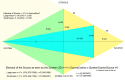
In this drawing (upper left) you will see that the etendue of the source (amount of light from) is constant for both FOV's/FL's (and the larger FOV's have equivalence/conservation in this drawing). However, when calculated as amounts received, the longer FL actually gets a little over 2x as much. (drawn to scale)
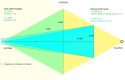
We can also look at it as area measurements using simpler math by just measuring the area of the triangles created by the different FOV's. In this case, the larger FOV contains more area/amount. However, when converted to amount/FOV the smaller FOV/longer FL again receives 2x as much. This also makes it easier to understand/correlate how/why larger diameter objective elements gather more light.
These calculations are effectively "per point" because I have not included the variables of source/system areas (i.e. diameters) in the calculations which makes them both "1." And it lead to this understanding/theory.
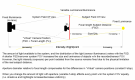
The "constant intensity per point" being controlled/limited by the physical subject distance is not exactly sensor illuminance/exposure. It is, but... If the source does not equal/exceed the lens' FOV then the sensor exposure will vary as the size of the source w/in the FOV varies (matrix metering). If the size of the source does equal/exceed the lens' FOV then the exposure will not vary as more/less is included (matrix metering). However, in both cases the exposure "of the subject" will not vary (i.e. spot metering).
Lens measurements/calibration is done with a known/calibrated light source transmitted through the lens into an integrating sphere. There is no concept of a camera, sensor, or even an image/image circle included in this. The measurement is made without any consideration as to how the lens may be used. And all lenses with a given f(t)-ratio transmit the same amount of light relative to what they receive (% of light). That's what makes f(t)-ratio a constant.
Additionally, magnification (longer FL) is really just enlargement of the image circle which is a loss of light. It is that loss of light that requires a larger aperture for a longer FL in order to maintain the same f(t)-ratio. And any lens that cannot automatically adjust the aperture diameter (entrance pupil) experiences a loss of light (exposure) known as "bellows effect."
There were many other related things I found troubling and incongruent... so I've spent quite a bit of time researching, reading, and learning/relearning math. The answer that explains everything is etendue. Etendue is "an amount in phase-space." Much of the information available discusses "equivalence/conservation" which is what happens when the angles at both ends of (or all points within) a system are the same. But with variable FL's/angular FOV's you don't get equivalence/conservation. Etendue is area/size calculations because the actual amount of light will vary with the source luminance (which can be included if known). To find discussions on the topic relating to variable etendues requires quite a bit of digging into things like optic coupling (fiber optics) and system design efficiencies. But I believe I can correlate it fairly easily/clearly.
In this drawing (upper left) you will see that the etendue of the source (amount of light from) is constant for both FOV's/FL's (and the larger FOV's have equivalence/conservation in this drawing). However, when calculated as amounts received, the longer FL actually gets a little over 2x as much. (drawn to scale)
We can also look at it as area measurements using simpler math by just measuring the area of the triangles created by the different FOV's. In this case, the larger FOV contains more area/amount. However, when converted to amount/FOV the smaller FOV/longer FL again receives 2x as much. This also makes it easier to understand/correlate how/why larger diameter objective elements gather more light.
These calculations are effectively "per point" because I have not included the variables of source/system areas (i.e. diameters) in the calculations which makes them both "1." And it lead to this understanding/theory.
The "constant intensity per point" being controlled/limited by the physical subject distance is not exactly sensor illuminance/exposure. It is, but... If the source does not equal/exceed the lens' FOV then the sensor exposure will vary as the size of the source w/in the FOV varies (matrix metering). If the size of the source does equal/exceed the lens' FOV then the exposure will not vary as more/less is included (matrix metering). However, in both cases the exposure "of the subject" will not vary (i.e. spot metering).





