

Etendue, Exposure, and Equivalence

sk66

Suspended / Banned
Messages
9,557
Name
Steven
Edit My Images
Yes
For a long time I have been troubled by many of the common explanations regarding exposure, and particularly "equivalence." For instance, how can f/ratio be a constant of the exposure formula and yet transmit more light for a larger sensor?
Lens measurements/calibration is done with a known/calibrated light source transmitted through the lens into an integrating sphere. There is no concept of a camera, sensor, or even an image/image circle included in this. The measurement is made without any consideration as to how the lens may be used. And all lenses with a given f(t)-ratio transmit the same amount of light relative to what they receive (% of light). That's what makes f(t)-ratio a constant.
Additionally, magnification (longer FL) is really just enlargement of the image circle which is a loss of light. It is that loss of light that requires a larger aperture for a longer FL in order to maintain the same f(t)-ratio. And any lens that cannot automatically adjust the aperture diameter (entrance pupil) experiences a loss of light (exposure) known as "bellows effect."

There were many other related things I found troubling and incongruent... so I've spent quite a bit of time researching, reading, and learning/relearning math. The answer that explains everything is etendue. Etendue is "an amount in phase-space." Much of the information available discusses "equivalence/conservation" which is what happens when the angles at both ends of (or all points within) a system are the same. But with variable FL's/angular FOV's you don't get equivalence/conservation. Etendue is area/size calculations because the actual amount of light will vary with the source luminance (which can be included if known). To find discussions on the topic relating to variable etendues requires quite a bit of digging into things like optic coupling (fiber optics) and system design efficiencies. But I believe I can correlate it fairly easily/clearly.

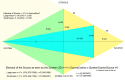
In this drawing (upper left) you will see that the etendue of the source (amount of light from) is constant for both FOV's/FL's (and the larger FOV's have equivalence/conservation in this drawing). However, when calculated as amounts received, the longer FL actually gets a little over 2x as much. (drawn to scale)
EtendueSource.png

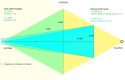
We can also look at it as area measurements using simpler math by just measuring the area of the triangles created by the different FOV's. In this case, the larger FOV contains more area/amount. However, when converted to amount/FOV the smaller FOV/longer FL again receives 2x as much. This also makes it easier to understand/correlate how/why larger diameter objective elements gather more light.
Etendue.png

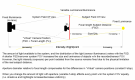
These calculations are effectively "per point" because I have not included the variables of source/system areas (i.e. diameters) in the calculations which makes them both "1." And it lead to this understanding/theory.
Total-Light.png

The "constant intensity per point" being controlled/limited by the physical subject distance is not exactly sensor illuminance/exposure. It is, but... If the source does not equal/exceed the lens' FOV then the sensor exposure will vary as the size of the source w/in the FOV varies (matrix metering). If the size of the source does equal/exceed the lens' FOV then the exposure will not vary as more/less is included (matrix metering). However, in both cases the exposure "of the subject" will not vary (i.e. spot metering).
 
Thanks for taking the time to post this explanation it's way over my head though :D
I have wondered how the exposure relates to focal length and aperture but have given up trying to understand the technical stuff i just do what works for me :)
 
Steven, I am sure that your post contains a useful explanation but can I politely suggest that you proof read and edit it to make it clearer?

The many subclauses, parentheses and digressions make it terribly hard to digest - and I'm used to reading mathematical papers.
 
Steven, I am sure that your post contains a useful explanation but can I politely suggest that you proof read and edit it to make it clearer?

The many subclauses, parentheses and digressions make it terribly hard to digest - and I'm used to reading mathematical papers.
The basics of it comes down to the area/FOV, the amount of light that enters that area in X time is the amount of light that will be recorded with X shutter speed. And the reason longer FL lenses transmit more light for a given f-stop is because there actually *is* more light entering the system in relation to the FOV receiving it.

It is effectively the same as moving closer to the source (the ISL) except for that the intensity of the light (per point) is controlled by the physical distance.

And the reason a longer FL has a larger aperture diameter/entrance pupil for the same f# is to ensure that it transmits the same amount (%) of light as any other lens at the same f#. It is not "increasing the amount of light," it is compensating for what would otherwise be a loss of light (reduced exposure).

I will re-read and see if I can re-write it so that it is easier to read/understand...
 
Last edited:
Thanks for taking the time to post this explanation it's way over my head though :D
I have wondered how the exposure relates to focal length and aperture but have given up trying to understand the technical stuff i just do what works for me :)
In the end, it doesn't really change anything... the "why" doesn't really matter much. ;)
 
Thanks for taking the time to post this explanation it's way over my head though :D
I have wondered how the exposure relates to focal length and aperture but have given up trying to understand the technical stuff i just do what works for me :)

A thousand times this. :-)
 
Too much to quote


To all pretence and purposes, equivalence does actually work and you are troubling yourself over nothing. I appreciate that you may be enjoying the research, but in all seriousness, reciprocity/f ratio can be treated as a constant in every day scenarios without worrying about any of that... no matter how interesting it may be :)
 
I don't need to know all the mechanics of an engine to travel in a bus; I don't need to know the coding of Windows to use my PC; I don't need to know the interactions of light in photosynthesis to enjoy an apple, and what does it matter if you don't understand how everything in the physics of light behaves if you can take a photograph?

The final aim of photography is surely to produce the best photos you can and have fun - just do that and the rest will slowly fall into place.
.
 
To all pretence and purposes, equivalence does actually work and you are troubling yourself over nothing. I appreciate that you may be enjoying the research, but in all seriousness, reciprocity/f ratio can be treated as a constant in every day scenarios without worrying about any of that... no matter how interesting it may be :)
I would have to agree...
I just found one primary thing about the common explanation of reciprocity(and exposure) troubling. And that is the fact that all lenses of a given f/t-ratio transmit the same percentage of the light received, that is what makes f-ratio a constant. So increasing the aperture diameter in conjunction with a longer FL does not in itself increase the amount of light transmitted (same f#).

Percent of light transmitted
Screen Shot 2016-07-20 at 9.21.00 AM.png
 
Last edited:
Intents and purposes.
 
I really struggle to comprehend people who see something they don't understand and feel the need to tell the world that because they don't understand it it doesn't matter. Why not just stay out of it? IMHO Steven has put a lot of effort into the OP and deserves some thanks for doing that. Some of us are interested in this stuff!
 
feel the need to tell the world that because they don't understand it it doesn't matter. Why not just stay out of it?


I think you're right in the civility aspect of it but these notions were important to know when…
  1. working at serious pro levels
  2. using film as the ASA was not so flexible
  3. reciprocity factor was a daily concern in say large studio setups for cars, furniture etc
    where one did not have 30,000 w/s to shoot in large format at ƒ45 and more
Nowadays, most amateur and even most pros don't even think about such considerations as
technologies have changed and workflows as well.

Not everyone needs to know about the Scheimpflug principle and effect but when one acquires
a PC lens or a optical bench, it's a whole different ball game.

I agree with you, Chris, some should be holding back commenting when they should… would it
only be as a sign of civility among members.
 
I really struggle to comprehend people who see something they don't understand and feel the need to tell the world that because they don't understand it it doesn't matter. Why not just stay out of it? IMHO Steven has put a lot of effort into the OP and deserves some thanks for doing that. Some of us are interested in this stuff!
Thank you, I appreciate that.
But it doesn't really bother me. The fact is that it doesn't really change much, and it's not like I'm thinking of these things when I'm taking pictures (or anyone else is). It does in fact affect people at times when doing certain types of photography (i.e. bellows effect with macro and LF). But built in metering has largely negated the impact for most.

I have re-written the information in an article on my website. I have eliminated some of the related periphery information, and I tried to be more careful/thorough with the explanations.
http://photographic-academy.com/exposure/78-exposure/171-etendue-exposure-and-equivalence
 
I really struggle to comprehend people who see something they don't understand and feel the need to tell the world that because they don't understand it it doesn't matter.

Because it actually does not matter :).. and I do understand it... which is why I know it doesn't actually matter.

Why not just stay out of it? IMHO

...because it was in a forum about photography, I felt the need to say it doesn't actually matter all that much to your photography, and knowing it will not make you a better photographer. So?


Steven has put a lot of effort into the OP and deserves some thanks for doing that. Some of us are interested in this stuff!

So? I put a great deal of effort into this morning's bowel movement, would you like me to share that too?

People can make whatever comments they like about someone's post so long as they're civil and making a valid point. I'm not discounting the effort he's put in... nor disagreeing with it's contents, and I was perfectly polite: I was just making a comment about it's value to his, or anyone else's photography. If you find it interesting, fine... to an extent, so did I, but I still stand by my comment.
 
Thank you, I appreciate that.
But it doesn't really bother me. The fact is that it doesn't really change much, and it's not like I'm thinking of these things when I'm taking pictures (or anyone else is). It does in fact affect people at times when doing certain types of photography (i.e. bellows effect with macro and LF). But built in metering has largely negated the impact for most.

I have re-written the information in an article on my website. I have eliminated some of the related periphery information, and I tried to be more careful/thorough with the explanations.
http://photographic-academy.com/exposure/78-exposure/171-etendue-exposure-and-equivalence

That's considerably clearer, thank you. To really understand I'm going to have to restate it as a purely mathematical problem and do away with many of the words, but that's just me.
 
I would have to agree...
I just found one primary thing about the common explanation of reciprocity(and exposure) troubling. And that is the fact that all lenses of a given f/t-ratio transmit the same percentage of the light received, that is what makes f-ratio a constant. So increasing the aperture diameter in conjunction with a longer FL does not in itself increase the amount of light transmitted (same f#).

It does at the lens because a larger diameter lens has a larger area upon which light is falling and being transmitted but the amount of light RECEIVED at the sensor does not.

And the reason for that, as I stated in another post, is the Inverse Square Law.
.
 
It does at the lens because a larger diameter lens has a larger area upon which light is falling and being transmitted but the amount of light RECEIVED at the sensor does not.

And the reason for that, as I stated in another post, is the Inverse Square Law.
.
Diameter of the lens isn't quite the same thing as the diameter of the entrance pupil (aperture). A larger diameter lens collects more light/a larger area of light (etendue). A larger aperture/entrance pupil includes more of the objective lens in the picture (up to the aperture stop/limit, typically the objective lens diameter itself). And a longer lens transmits more light to the sensor for a given f# because *there is more light* entering the optical system, but it is the *same percentage* of the light. (Or conversely, it is the same total light concentrated into a smaller area; more light/FOV).

If you were to photograph a light in the dark using matrix/average metering, as you make the light larger by zooming in the exposure (metering) does change... the sensor does receive more light.
 
Steven,
I always read your posts with interest, I like it when people think things through - but this time I have to agree the things you're concerned about just don't matter in any practical sense.
And you've annoyed me - you've done a lot of research and you've put a lot of thought into this, but you've spelled "maths" the American way, i.e. you call it "math" which, in my book, is unforgivable:)
 
Steven,
I always read your posts with interest, I like it when people think things through - but this time I have to agree the things you're concerned about just don't matter in any practical sense.
And you've annoyed me - you've done a lot of research and you've put a lot of thought into this, but you've spelled "maths" the American way, i.e. you call it "math" which, in my book, is unforgivable:)
:)
I have to agree. Like most things the theory and "why" don't matter much, you only need to know what to do about it (if anything).

I just find it personally very troubling when faced with the possibility that something I've "known" to be true for a very long time might be wrong. I'm ok with being wrong and learning something new, but I'm not necessarily going to just "take your word for it."

And you can't really win any debates without the science and (edit) maths behind it to support your position... that would just be me posting my opinions on a web forum.
 
Last edited:
Diameter of the lens isn't quite the same thing as the diameter of the entrance pupil (aperture). A larger diameter lens collects more light/a larger area of light (etendue). A larger aperture/entrance pupil includes more of the objective lens in the picture (up to the aperture stop/limit, typically the objective lens diameter itself). And a longer lens transmits more light to the sensor for a given f# .......

No it doesn't - regardless of the focal length of a lens the light falling on a sensor is always the same for a given f# - that is why we use them!

And, once again, the reason is the Inverse Square Law!

If you were to photograph a light in the dark using matrix/average metering, as you make the light larger by zooming in the exposure (metering) does change... the sensor does receive more light.

Only in the sense that a bright light has been magnified to cover more of he sensor - the sensor receives more light but the total amount of light does NOT change - if you did a SPOT measurement of the light BEFORE you zoomed in you would find it was much brighter than when zoomed - the laws of physics state that!
.
 
No it doesn't - regardless of the focal length of a lens the light falling on a sensor is always the same for a given f# - that is why we use them!

And, once again, the reason is the Inverse Square Law!


Only in the sense that a bright light has been magnified to cover more of he sensor - the sensor receives more light but the total amount of light does NOT change - if you did a SPOT measurement of the light BEFORE you zoomed in you would find it was much brighter than when zoomed - the laws of physics state that!
.
I can only suggest that you try that experiment for yourself... and then maybe read the re-written article.

I'm not sure you understand the ISL. The ISL states that when you make a source smaller by changing the distance it transmits less light to the receiver. 2x the distance is 1/4 of the light, and the source will be 1/2 the size in the image. And vice versa. It turns out that this change in distance may be either actual/physical, or "virtual" due to a change in the distance where the lens' FOV intercepts the light.
 
I can only suggest that you try that experiment for yourself... and then maybe read the re-written article.

I'm not sure you understand the ISL. The ISL states that when you make a source smaller by changing the distance it transmits less light to the receiver. 2x the distance is 1/4 of the light, and the source will be 1/2 the size in the image. And vice versa. It turns out that this change in distance may be either actual/physical, or "virtual" due to a change in the distance where the lens' FOV intercepts the light.

Which is EXACTLY what the Inverse Square Law states and exactly what I have said!
.
 
Which is EXACTLY what the Inverse Square Law states and exactly what I have said!
.
the sensor receives more light but the total amount of light does NOT change - if you did a SPOT measurement of the light BEFORE you zoomed in you would find it was much brighter than when zoomed - the laws of physics state that!
.
Uhm, "more light" but same total? Smaller and brighter? The first can't happen, and the second is contrary to the ISL.

Think about it. What you are explaining/stating is due to enlarging/reducing the image circle *without* a corresponding change in aperture diameter (variable f-stop). I.e. larger area dimmer, smaller area brighter. And if what you are stating were true, then larger sensors would not receive more light (due to requiring a longer FL), there would be no such thing as "equivalence," nor would there be a benefit to larger sensors in terms of light gathering.

Try your spot metering experiment for yourself, you don't have to take my word for it...
 
Uhm, "more light" but same total? Smaller and brighter? The first can't happen, and the second is contrary to the ISL.

Which is NOT what I said since I was talking about the reading you would get from a metering of the light spot which would obviously be much greater than a spot reading taken anywhere of the expanded spot when zoomed.

Think about it. What you are explaining/stating is due to enlarging/reducing the image circle *without* a corresponding change in aperture diameter (variable f-stop). I.e. larger area dimmer, smaller area brighter. And if what you are stating were true, then larger sensors would not receive more light (due to requiring a longer FL), there would be no such thing as "equivalence," nor would there be a benefit to larger sensors in terms of light gathering.

Larger sensors do NOT receive more light from a longer FL lens unless the diameter IS larger - don't take my word for it - just look at the diameter of Canon's f1.8 50mm lens and the diameter of the 200mm f2.8 lens which is massively larger even though it does not let through as much light on to the sensor due to the fact it is 4 times the distance from the sensor.

Try your spot metering experiment for yourself, you don't have to take my word for it...

I think you are confusing the reading your camera will get when taking a spot reading of a bright source and the reading you will get if you zoom in on the source USING YOUR CAMERA.

I was talking about a REFLECTED reading taken FROM the sensor (or even a white or grey surface) and NOT the reading the sensor will give you.

That will show you that as the spot expands to cover more area the brightness of any particular area will fall but the TOTAL amount of light will be the same.

And once again the Inverse Square Law states that it has to.
.
 
Which is NOT what I said since I was talking about the reading you would get from a metering of the light spot which would obviously be much greater than a spot reading taken anywhere of the expanded spot when zoomed.
Larger sensors do NOT receive more light from a longer FL lens unless the diameter IS larger - don't take my word for it - just look at the diameter of Canon's f1.8 50mm lens and the diameter of the 200mm f2.8 lens which is massively larger even though it does not let through as much light on to the sensor due to the fact it is 4 times the distance from the sensor.
I think you are confusing the reading your camera will get when taking a spot reading of a bright source and the reading you will get if you zoom in on the source USING YOUR CAMERA.
I was talking about a REFLECTED reading taken FROM the sensor (or even a white or grey surface) and NOT the reading the sensor will give you.
That will show you that as the spot expands to cover more area the brightness of any particular area will fall but the TOTAL amount of light will be the same.
And once again the Inverse Square Law states that it has to.
I think you are talking in circles...

All lenses of a given f/ratio transmit the same *percentage* of light. I.e. all f/1 lenses transmit 20% of the light received... that does not mean that they all transmit the same "total light."

A larger diameter objective element gives the lens a greater *potential* light transmission. The objective lens diameter is generally the aperture stop for a lens (limit to the maximum entrance pupil/f#). For the same f/# a larger diameter objective element does not transmit more light. I.e. the objective element has to be larger in order to allow the *same* f/ratio and the *same* percentage of light transmitted. For instance, the objective element on my 400/2.8 has a bit over 2x the area compared to the element on my 400/5.6 (and less vignetting). But when the 400/2.8 is set at f/5.6 it is using the same amount of objective lens diameter, the same entrance pupil size(f#), and it is transmitting the same percentage of light.

There is no difference in taking the reading from the source or from the sensor (if you could do that)... the source determines what falls on the sensor.

You're stuck on the ISL and the idea that the amount of light received is fixed/constant. But you must realize that if you make an object larger, and every point of that object maintains the same exposure/relative exposure (resolution dependent) then the sensor *is* receiving more light. That "more light" is due to a change in distance/virtual distance and follows the ISL... I.e. larger/closer equals more.
 
I'm sorry but I see no real point in continuing this discussion.

All I can do is suggest that whatever view you hold you should include the Inverse Square Law in it and also include it in your maths.

Then everything you seem to find so difficult is actually easy to grasp.

I wish you well.
.
 
Just an update.

When I first came to this idea/understanding I discussed it in a couple of threads on a particular "Photographic Science and Technology" forum and I got beat up pretty bad... to the point the threads filled with arguments/debates/generable disagreeableness and I stopped participating there for a while.
However, I have been revisiting the site recently and since then this understanding of etendue has become the prevailing explanation of how light/exposure works (on that forum and other technical websites as well, i.e. clarkvision.com). But I've also come to a (hopefully) simpler way of explaining it.

The total amount of light available to the system is controlled by FOV/magnification. A longer FL/greater magnification has more light available (more light from a smaller area).
The total light available is also controlled by what is w/in the FOV (the difference between a point source and an extended source).
And aperture manages/restricts the total light available (it is always a restriction as we cannot have an infinite aperture/entrance pupil).

**The first two factors combined *are* etendue.

For those that care, the full explanation is here. But in the end, it still doesn't really matter... aperture is still one of the constants of exposure.
 
Back
Top
