Equipment advice (macro flash)

MikraCoils

Suspended / Banned
Messages
118
Name
Darren
Edit My Images
Yes
I am looking at buying a macro flash for my nikon d850. It will be used while out and about.

I'm debating over the two kinda, the macro ring types or Twin macro light type.

Anyone have advise on which one is better and if so for what reason?

I currently use a really cheap old meike ringlight that seems very harsh in ttl, this could be because its so old and its also a cheap model
 
I am looking at buying a macro flash for my nikon d850. It will be used while out and about.

I'm debating over the two kinda, the macro ring types or Twin macro light type.

Anyone have advise on which one is better and if so for what reason?

I currently use a really cheap old meike ringlight that seems very harsh in ttl, this could be because its so old and its also a cheap model
not sure that being old and cheap makes the light very harsh.
- does it have flash exposure compensation? if so try dialing that back -1 or -2 stops maybe that helps. If not use in manual mode.
- also think about adding some diffusion.
trying these things will get the most out of what you have and if they don't work help you identify what you need for a replacement.
 
Get a diffuser for a normal flash.

Way softer light than either of the options you suggested.
One of those little speedlight mounted softboxes is perfect for Macro.

And absolutely flipping useless for all the things the marketing says they can do. ;)

Also I’d look at a way of mounting it on some sort of arm, off axis lighting always a better option than on axis. In fact on axis lighting is often described as ‘harsh’ for reasons not apparent in that description
 
Last edited:
I am a fan of the Godox MF12 twin flash paired with their x-pro controller. Really versatile kit which works great attached by the ring on the lens as well as off camera as they are wireless. I find them very useful for table top stuff as well as macro.

I have also had the YONGNUO YN24EX which worked great until it didn't when I had 2 units fail one just before the year warranty ended and the other just after.

You can also get great results with a standard speed light and either DIY diffusion or something similar to one of these.
 
I have both the Godox MF12 twin flash system and a dedicated diffuser for my TT350o from these guys https://www.macrodiffuser.com/

MF12 is great and you can also use the little flashes as bulbs and off camera. When I am out doing just macro I tend to take my diffuser.
 
Im leaning towards the twin flash systems as I can potentially use them for not just macro
 
This has just reminded me that I have a Nikon R1C1 kit that I never use. I'll put it in the for sale section in the next couple of days.
 
Get to know your lighting needs by experimenting with each kind of light on targets at the distance that you will be shooting. The target could even be a blank white wall or backdrop. Learn the size and shape of the resulting light from your flashes at different power settings, with and without modifiers, etc. You may need to take actual pictures of these light spots so you can compare the results easier, but with digital cameras you can erase them later. Then use this knowledge to help you choose the lighting type, position, and amount that you need for your desired shots. If you want totally even and shadow free shots, ring lights will usually do best, but best only if the subject is closer than about 1-5'. , Diffusion materials between the light and subject help, but the ring lights only work best for me when doing very close-in shots and I want zero shadowing. Some jewelry and insect shots are what I usually choose ring lights for.

Multiple speedlites will be better if you like some shadowing in the shots, like is usually preferred when doing portrait and sometimes jewelry type shooting, since some light shadows in the right places can infer depth and interest in the subject. Use the lights that suit your kind of photography best. Experiment with positions, diffusers, reflectors, etc. to get the result that you are looking for. Then tuck this information away in your head for the next similar shoot. If your memory isn't all that good keep a notebook handy and record your results, sometimes even drawing diagrams with distance and position measurements, to help you remember by referring back to it in the future.

You have to know what each of your lights can and can't do for you, and then chose which type works best for what you are shooting, be it tiny insects or beautiful women, or fancy cars, etc. What camera you use is of less importance than getting the lighting right, as long as it has the lens and adjustment capabilities needed for the kind of shots that you want to take. All of this is learned from experience. There is no "one size fit's all" and no video or book that will really teach you these fine details to get the best shots. It's a learning and experimenting process. I've spent nearly 70 years learning photography and lighting, and I'm still learning, since new lighting and camera technology keeps raising the bar. What was perfect 30 or 40 years ago is trash by today's standards, but great was indeed great for us back then too, since very little was available to let us do any better. The easiest part of photography is learning how to use your camera. Getting truly great shots requires a good knowledge of light and how it behaves, be it from the Sun, reflectors, or your photography lights. When using reflectors, it's best to hold them high so the reflected light will angle down on the subject. It's more natural for light to come from above, like from the Sun or ceiling lights. Only light from below if low levels are needed to reduce undesired shadows like neck and chin shadows, but keep this low and just enough to fill the need. Low light that's too bright and your subject will have a zombie appearance.

There have been times when I have waited most of the day for the Sun to get into the perfect spot for a special landscape shot that I have wanted, and then times when that perfect shot time arrived, only to have a cloud cover the Sun at that otherwise perfect time. I'm convinced that God does have a sense of humor. Fortunately he does let me win, sometimes.

Charley

 
Get to know your lighting needs by experimenting with each kind of light on targets at the distance that you will be shooting. The target could even be a blank white wall or backdrop. Learn the size and shape of the resulting light from your flashes at different power settings, with and without modifiers, etc. You may need to take actual pictures of these light spots so you can compare the results easier, but with digital cameras you can erase them later. Then use this knowledge to help you choose the lighting type, position, and amount that you need for your desired shots. If you want totally even and shadow free shots, ring lights will usually do best, but best only if the subject is closer than about 1-5'. , Diffusion materials between the light and subject help, but the ring lights only work best for me when doing very close-in shots and I want zero shadowing. Some jewelry and insect shots are what I usually choose ring lights for.

Multiple speedlites will be better if you like some shadowing in the shots, like is usually preferred when doing portrait and sometimes jewelry type shooting, since some light shadows in the right places can infer depth and interest in the subject. Use the lights that suit your kind of photography best. Experiment with positions, diffusers, reflectors, etc. to get the result that you are looking for. Then tuck this information away in your head for the next similar shoot. If your memory isn't all that good keep a notebook handy and record your results, sometimes even drawing diagrams with distance and position measurements, to help you remember by referring back to it in the future.

You have to know what each of your lights can and can't do for you, and then chose which type works best for what you are shooting, be it tiny insects or beautiful women, or fancy cars, etc. What camera you use is of less importance than getting the lighting right, as long as it has the lens and adjustment capabilities needed for the kind of shots that you want to take. All of this is learned from experience. There is no "one size fit's all" and no video or book that will really teach you these fine details to get the best shots. It's a learning and experimenting process. I've spent nearly 70 years learning photography and lighting, and I'm still learning, since new lighting and camera technology keeps raising the bar. What was perfect 30 or 40 years ago is trash by today's standards, but great was indeed great for us back then too, since very little was available to let us do any better. The easiest part of photography is learning how to use your camera. Getting truly great shots requires a good knowledge of light and how it behaves, be it from the Sun, reflectors, or your photography lights. When using reflectors, it's best to hold them high so the reflected light will angle down on the subject. It's more natural for light to come from above, like from the Sun or ceiling lights. Only light from below if low levels are needed to reduce undesired shadows like neck and chin shadows, but keep this low and just enough to fill the need. Low light that's too bright and your subject will have a zombie appearance.

There have been times when I have waited most of the day for the Sun to get into the perfect spot for a special landscape shot that I have wanted, and then times when that perfect shot time arrived, only to have a cloud cover the Sun at that otherwise perfect time. I'm convinced that God does have a sense of humor. Fortunately he does let me win, sometimes.

Charley

Very interesting read
 
This looks very cumbersome to be carrying around :)
It's what you need though - or some variation of it. (although sadly, the D850 has no pop-up so won't act as a commander without a suitable flash on the shot shoe - still has the PC-Sync socket though)

My tests ten years ago

and results


Check this guy out

and the solution he uses

Or you could go completely off camera and handhold the flash+diffuser or put it on a stand
These are not the world best macro shots but I quite liked them in 2011 :P https://owenlloydphotography.com/how-its-made-studio-insect-macro/
 
It's what you need though - or some variation of it. (although sadly, the D850 has no pop-up so won't act as a commander without a suitable flash on the shot shoe - still has the PC-Sync socket though)

My tests ten years ago

and results


Check this guy out

and the solution he uses

Or you could go completely off camera and handhold the flash+diffuser or put it on a stand
These are not the world best macro shots but I quite liked them in 2011 :p https://owenlloydphotography.com/how-its-made-studio-insect-macro/
Thanks i'll read them tomorrow when less tired :)
 
If you get into macro, insect and close up flower shots, etc., - you can make your own flash diffuser(s) for a normal SB Nikon flash

- but to get better and better shots you need to start to investigate "stacking" images and maybe a ring flash set up ....... or several flash units and a control unit.

- although the Nikon 105 f2.8VR is good there are more effective manual only focus lenses around if you want to achieve ......... ultra close up shots

- plus a tripod is also essential for the "best" shots
 
Last edited:
(although sadly, the D850 has no pop-up so won't act as a commander without a suitable flash on the shot shoe - still has the PC-Sync socket though)
Aw dang... I had to go look; had it confused with the earlier D8xx bodies.

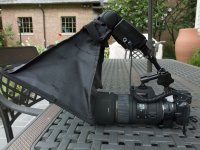
This looks very cumbersome to be carrying around :)
It is. It's adapted to a Nikon 1 V2 body for the increased magnification/resolution, although I'm not at all certain the lens can reach that level. The lens is the Sigma 150/2.8 Macro, and having the flash attached to the lens foot allows it to be rotated for optimum angle. Because the source is so large/close relative to a macro subject, it's very usable/versatile/soft.

20298474205_d2fb14c173_k.jpg


A ring flash gives pretty flat light because it lights from all angles... good for documentary (like dental/medical work, which it was designed for); not great for interest/drama/texture/detail.

Multi lights (of any sort) are really only good for static (or repeatable) subjects where you can set them individually; preferably with individual power adjustments. They also tend to be smaller/harder light sources; which isn't what you usually want.
 
Aw dang... I had to go look; had it confused with the earlier D8xx bodies.


It is. It's adapted to a Nikon 1 V2 body for the increased magnification/resolution, although I'm not at all certain the lens can reach that level. The lens is the Sigma 150/2.8 Macro, and having the flash attached to the lens foot allows it to be rotated for optimum angle. Because the source is so large/close relative to a macro subject, it's very usable/versatile/soft.

20298474205_d2fb14c173_k.jpg


A ring flash gives pretty flat light because it lights from all angles... good for documentary (like dental/medical work, which it was designed for); not great for interest/drama/texture/detail.

Multi lights (of any sort) are really only good for static (or repeatable) subjects where you can set them individually; preferably with individual power adjustments. They also tend to be smaller/harder light sources; which isn't what you usually want.
Just brilliant!
 
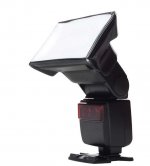
So I ordered the godox 860iii as all the reviews on it just seemed great, now skint and need a cheap diffuser untill I can get one of the akdiffusers or similiar, my question now is will the attached img reach a macro subject on the 860iii and a 100mm sigma lens?

2025-09-01 20_37_12-LumiQuest Mini Softbox with UltraStrap — Mozilla Firefox.jpg
 
So I ordered the godox 860iii as all the reviews on it just seemed great, now skint and need a cheap diffuser untill I can get one of the akdiffusers or similiar, my question now is will the attached img reach a macro subject on the 860iii and a 100mm sigma lens?
Just make a pringles can diffuser, super simple, cheap as chips with the added bonus of getting to eat said chips first.:D
Should get you started as a basic diffuser. I made one years ago and was really surprised how good it was for macro.
 
Just make a pringles can diffuser, super simple, cheap as chips with the added bonus of getting to eat said chips first.:D
Should get you started as a basic diffuser. I made one years ago and was really surprised how good it was for macro.
Yeah I was looking at that too, I go away to wales for 2 weeks on saturday, so need something quick :) Might do the pringles, might take me a couple of attempts so must buy in bulk ;p
 
A sheet of white typing paper formed into a sideways U and the ends held top and bottom to your speedlite makes a surprisingly good diffuser. Thinner is better, but not transparent. Try it sometime and you will be surprised at the result.

Charley
 
Back
Top