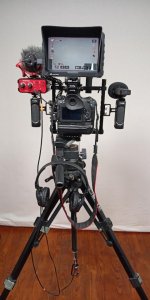
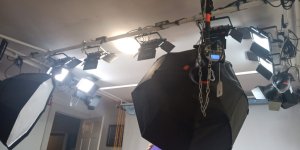
I'm across the pond from you, so some of the ways that I do things may be a bit different than what you will need to do, but here is a description of my photo studio, which is in a space about the size of your 2 car garage/ pending photo studio. If you want help understanding anything, ask questions and I will try to help. I'll be adding a few photos here to help too.
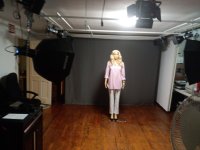
I built my present studio in a former 2nd master bedroom suite on the 2nd floor of my large home. It's small by most studio standards, but I have been able to do just about everything that I've wanted to do, except for difficulties shooting taller standing people. I give them stools instead. Macro is something that I also do that doesn't require much space. My shooting room is 19' wide, 26' long, and with an 8' ceiling height. All of the walls and the ceiling are painted "ceiling white". Yes, it is limiting for photographing tall people, but I can "make do" quite well for every other kind of shooting that I do here (mostly portrait work) I have a walk-in closet for gear storage, but hang my unused soft boxes on a side wall. Chairs, stools, and posing chair and table all get stored under the soft boxes. The South wall is windowed and below them is a line of computer tables with my editing computer, printers, scanner, charging area, and disk media storage on them. To block the Sunlight, as well as give me a blank white wall to bounce light off of or to just hide the computer tables, I have sliding closet door tracks attached to the ceiling, two track sections side by side, giving me 4 tracks total. Four 8' track sections, two side by side with needed spacing, and two more end to end for 16' length in a 26' room. I have coated foam insulation panels hanging on the rollers, one panel on each track, so one panel per track that I can pull to overlapping, which will cover all of the computer tables and Sunlight from the windows to block the view of the tables, etc as well as give me a white side wall for bounced lighting. I frequently bounce light intentionally off the ceiling too. These tracks and panels have worked so well for me that I am considering the installation of same to cover the opposite wall, with it's soft box and prop chair storage. I have 10' wide backdrops on a ceiling mounted roller system that holds 6 backdrops total. Black, gray, white, chroma green, chroma blue, and a pleated light blue backdrop that looks like a theater stage curtain. A 1 X 1 X 1/4 thick steel angle 10' long with 1/2" X 4" long steel pipe nipples are welded to each end and steel floor flanges allow attaching to the ceiling. This angle is parallel with the front backdrop roller and gets used to temporarily hang other backdrops or 5 X 7' backdrops, should I wish to use something different.
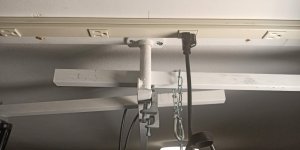
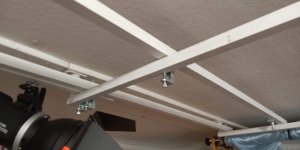
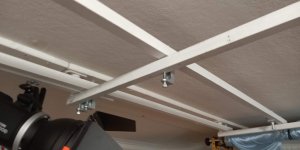
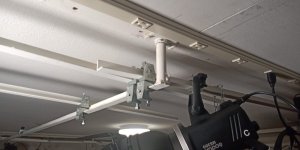
Because it doesn't take a significant setup of several light stands and power cords on the floor in this small studio to become a major trip hazard, I have built four more of the 10' long steel angles and spaced them parallel, but about 4' apart from the first steel angle to hang my lights from. The farthest is about 1' away from the wall behind the usual camera position. I use the 5' long pieces of this same steel angle to bridge between any two of the 10' long steel angles when I want to hang a light somewhere that there is no 10' angle. All of these angles get joined together for safety using electrician's beam clamps, two clamps attached back to back tor attaching the 5' angle to the 10' angle, and the short angles are always placed above the 10' angles. I use these same beam clamps with photography spigots attached to hang the lights, upside down from these angles. All of the angles are painted white, same paint as the ceiling. I have shot in studios with black ceilings and some with black walls as well as ceilings. It isn't a friendly place, though the black tends to prevent light reflections, I once used a theater stage with all of the curtains closed for my studio while working for the theater. It was just too black for personal comfort. I and the models did not like being in there. I prefer white walls and ceilings, at least in small studios , and I make use of their reflectability, instead of preventing it.
For electric power, I attached "Wiremold - a Brand name", outlet strips (multiple electric outlet strips) attached to the ceiling along both ends of the 10' angles, so there is an electric outlet every 6" on either side of the shooting area ceiling and within 5' of any light position within the ceiling grid from the backdrops all the way back and behind the usual camera location. These are all controlled by a switch in the wall behind the camera location. All power for the lights and strobes comes from outlets within 5' of the lights, wherever they are located under this grid. I do use light stands occasionally, when I'm determining the ideal position for the light. Then it is usually hung from the ceiling grid in that position. If on a stand, the light is usually powered from above anyway. All of my lights are radio fired and adjusted from the camera, so no sync cables to deal with. My tether cable is the only cable that might be on the floor, but it also is routed to the ceiling and along the grid to my computer desk and laptop. So there are usually no other cables or tripods on my studio floor to cause trip hazards. I mostly use ball bungies to secure the cabling to the steel angles, so easy on and off. I use chain loops with a snap hook looped around the handle of the light and the ceiling grid for safety should anything fall (A leftover from my stage lighting experience). I also always place the 5' lengths of angle to cross above the 10' angles and secure with beam clamps for safety. If one end of the 5' angle ever comes loose, it cannot fall from the 10' angle.
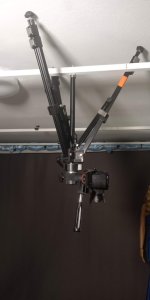
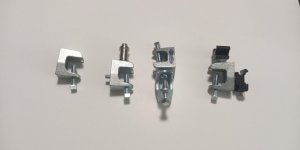
The electricians beam clamps are a standard commodity here. They work much like a C-clamp, with two already tapped 1/4-20 holes in them at 90 degrees from each other, making them ideal for attaching photography equipment to the steel angles and one 5/16" threaded hole with a 5/16-18 square head bolt included, for clamping the beam clamp to the structure (steel angle). I modified my smaller tripod stands, inserting a short round dowel drilled in the center to allowing installation of a 1/4-20 X 2" hanger bolt (wood threads one end and 1/4-20 threads on the other). This lets me hang the tripods upside down from a beam clamp on the ceiling grid with the lights attached, and easily adjustable for height. (Glue the dowel into the base end of the tripod. I used 5 minute epoxy).
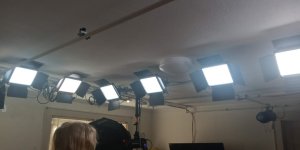
I have also attached one of my tripods upside down to this grid with the legs extended to the ceiling for stabilization, to digitize large antique theater coming attraction posters placed on the floor. Using blue tape for corner markings on the floor to make it easy to place each poster for the shoot it was easy and fast to do this way. I use several LED light panels, also hung from the grid, to provide the constant and even light needed for this shoot.
When I buy steel angle here, it comes in 20'-4" lengths, and I have them cut it into a 10' length and two 5' lengths. This makes hauling them home much easier as well as providing the lengths that I needed for my project. Here, each 20' 4" length costs me about $22 and when buying five of them they cut it free. After welding the pipe 4" (one 8" cut in half) nipples to the ends of the 10' lengths, I prime, and then paint them flat ceiling white ( See 2nd photo for positioning before welding). Screw on the floor flanges before painting too.
Here are 4 shots (using cell phone) of the ceiling grid, then one from my usual shooting position, where you can see the sliding panels on the right. Also a shot of one of my tripods when hung from the ceiling grid. My laptop and computer table is behind camera right in the corner of the room. All available light was from the one center ceiling LED light (my work light). On camera left I have a small metal wheeled tool box for holding the camera when not in use, plus lenses and accessories that I might need for the camera during the shoot. The next ot last photo shows the beam clamps and various common uses of the electricians beam clamps with photography spigots, cold shoes, etc. attached via 1/4-20 X 1/2" bolts. Since the holding bolt included with the beam clamps has a 5/16" square head, and because I tend to drop tools often, I use security badge lanyards, attached to my tools, and a slip knot around my wrist to keep the tools from falling when they get away from me. The 5/16" box/open wrench gets attached box end to the snap hook on the lanyard. The square head of the beam clamp bolt only fits the open end of the wrench anyway. I use a 2 step plus platform type folding ladder for all ceiling work. It folds easily for storage, and gives me a platform with a railing to work from safely. I have even hung props like signs, etc. on clear fishing line from this ceiling grid.
There is a full bathroom through a door behind the camera shooting position, and I have sometimes backed up into it for a few long shots. There is also a 6' wide by 10' deep gear storage closet behind the camera and next to the bathroom. Outside the shooting room in the large hallway is set up to be the hair/make-up and break area. Coffee, soft drinks, snacks, etc. are all available there, but our breaks usually occur in the center of the shooting room. Off the hallway is another very long closet that is used for about 1/2 prop storage and the other half for family personal storage. Stairs from this hallway go down into my home living space.
I hope some of this will give you some ideas to incorporate into your wife's studio. Hopefully she will like these ideas and have you incorporate them. Doing this has made my studio much safer of both me and anyone who comes here. Contact me or reply here if you want more information.
Charley