Do DSLR's still have a place

One of the reasons I prefer a non AF camera film or digital it will always do as I ask and not refocus when the sensor thinks it it needs to. Each to their own and what floats your boat, but don't you think that cameras have gone too far and people don't really understand how to work them properly.
My cameras focus where I want when I want. And much faster and more accurately than I ever could.
That’s because I set them up for the way I like to work! Maybe if you learned to operate the tech you’d feel the same.

I was very late to the AF party, so my first AF camera was around 2000. Of course it depends what you shoot, but for my uses, quick and accurate focus is the difference between capturing an expression or not, and taking too long to focus means a lost opportunity.
 
Do I get better images with my Z9 than my old D500.....NO!

Do I get more keepers with my Z9 than my old D500......YES!

Mirrorless has simply enabled us to do less work and still get great images!

This.... but I have Z8. I'd say the Z8 has given me more scope to get different views of subjects so that I don't have to squat or crouch as much as I used to..... but I still get joy of using the D500, D850 and K-1.
 
DSLR's still have a place today as I watched a lot of Pro Togs on YouTube, and a few still use DSLR's with the common one being Canon 5Div
For landscape one does not really need mirrorless with fancy aggressive AF, and some high MP sensor DSLR's can be had at good used prices. The Canon SR a 50mp sensor use to go for apx £550 - £850 now it is over a grand because channels like M2 were a Pro guy was using one. Which is a cheap alternative to R5 / R5ii at four and half grand.

Plus DSLR used glass is still widely available at pretty decent prices were as the mirrorless mounts are too expensive ( in my opinion ) for the amateur, or even Pro who has to justify cost over profit.

For portraits, sports, action the mirrorless generation AF tech is just getting better with each new model release, and older DSLR with fixed, and even limited AF points just can not compete with mirrorless.

However, I still have my canon 7Dii, and still use it now and then when I want a 2 lens set up when I out on shoot in conjunction with my R7, or Sony A6600
 
I think we're all somewhat vulnerable to the so-called "Shiny Object Syndrome"...


I like new toys as much as the next idiot. On the other hand, I find that the old toys can be just as much fun and just as useful as the new ones. In fact, whatever I'm holding, when the subject is in front of me, is the best camera ever made.

Perhaps, when someone tells you that the camera they currently favour, will provide you with better pictures, you should ask yourself if they're being objective or just have a confirmation bias problem...


So, my opinion is that if your dSLR once provided the pictures you wanted, it will almost certainly still get you the pictures you want.
 
So, my opinion is that if your dSLR once provided the pictures you wanted, it will almost certainly still get you the pictures you want.
That's true only if your expectations do not change - take ISO handling of sensors - when 1600 was high, everyone wished they could push it higher as the light dropped, but accepted that as being just the way things were.
If there wasn't enough light you moved on (or used flash to provide the light)
Now that limit might be 12800 or more - the older camera will still take just as good an image at lower ISO's as it always did - but the new camera will allow you to take images in situations previously not practical.
 
Mirrorless has made lots of photographers lazy and I'll include myself in that. Judging by some of the comments I've read here I can see that too plus it seems some seem to think you can only take well exposed images using mirrorless. I've come from fully manual film days, I learnt about exposure and composition and I apply all I learnt to my mirrorless and DSLR shooting and for me it works. So I think that DSLR's haver their place, they are still tools and the great ones are getting cheaper and there's still lot and lots of fantastic lenses for them too.
 
That's true only if your expectations do not change
My expectations never change. My desires may but that's quite different.
 
Mirrorless has made lots of photographers lazy and I'll include myself in that. Judging by some of the comments I've read here I can see that too plus it seems some seem to think you can only take well exposed images using mirrorless. I've come from fully manual film days, I learnt about exposure and composition and I apply all I learnt to my mirrorless and DSLR shooting and for me it works. So I think that DSLR's haver their place, they are still tools and the great ones are getting cheaper and there's still lot and lots of fantastic lenses for them too.
I do agree the Mirrorless can make you lazy, though were I believe the biggest gain with mirrorless is the AF alien technology !
Once that mirrorless AF locks on to a eye then all that you need to do is just to make sure you keep the subject in the EVF frame.
I remember I had to quick keep moving my AF points around on 7Dii when the subject moves from one side of the frame to another, or pull back focus, and crop in post later.
I also remember my 7D made lazy as its ISO, and DR was so much better than my canon EOS 400D my 1st DLSR.
When I got my 7Dii I notice the ISO was much better than my 7D, and now the ISO, and AF is way ahead on my R7.

Just imagine what my opinion would be if I buy a R5ii ! ! !
 
Last edited:
Apparently I am not unique. I do think manufacturers are ignoring the likes of me. I fail to see how all the new technology is going to improve my photographs. I take photos for me, I don't care if no one else sees them. I like optical viewfinders, have an absolute hate of composing with the screen, which is fir information of settings. I love to hear the sound of the shutter. In all the years of owning digital cameras, I have taken possibly three videos, which I don't think I have looked at. What would mirrorless do for me?
 
In terms of ISO performance, the RAW files haven't really improved in a decade. They were really good by this point and there was little scope to improve them. Any DSLR from after 2015 and some from as early as 2009 (eg a D3S) are still competitive in low light.

People's eyes haven't improved either. So when the camera and lens can out-resolve what the viewer can see, you are only really improving crop-ability. (But I've still got a 45 megapixel camera, in spite of it outperforming what I can see on using a 50% crop).
 
Apparently I am not unique. I do think manufacturers are ignoring the likes of me. I fail to see how all the new technology is going to improve my photographs. I take photos for me, I don't care if no one else sees them. I like optical viewfinders, have an absolute hate of composing with the screen, which is fir information of settings. I love to hear the sound of the shutter. In all the years of owning digital cameras, I have taken possibly three videos, which I don't think I have looked at. What would mirrorless do for me?
No camera can significantly ‘improve your photographs’ because cameras don’t take photographs, photographers do.
What modern technology does for many of us though is improve our keeper rate, the by-product of which is marginal improvements in our photos.
But it really depends what you shoot, for sports; technology has made a massive difference, but for landscape shooters, a 5x4 plate camera takes some improving on.
We all need to understand that our ‘use case’ isn’t universal.

If the tech won’t help you? That’s fine, but that doesn’t make it a waste of effort generally.
 
My cameras focus where I want when I want. And much faster and more accurately than I ever could.
That’s because I set them up for the way I like to work! Maybe if you learned to operate the tech you’d feel the same.

I was very late to the AF party, so my first AF camera was around 2000. Of course it depends what you shoot, but for my uses, quick and accurate focus is the difference between capturing an expression or not, and taking too long to focus means a lost opportunity.
Why, when I don't want to. I am mostly film based and I use whatever camera suits my purpose. I DON'T feel inclined to learn to operate the tech and no, I would not necessarily feel the same- that is your opinion, one I don't agree with. Even with my cranky old eyes I can still see to focus an internal split image rangefinder at whatever point in view I want to. I get more pleasure using my F2a than I do with either of the digitals I also have. They have their uses but for preference outdoors, manual every time.

I learned my craft using an MPP 5x4 Then a Rollie 2.8E and although the film frame is smaller, the technique I learned is much the same as in 1964. To be honest I cannot be bothered to be governed by multiple button pressing.
 
Last edited by a moderator:
No camera can significantly ‘improve your photographs’ because cameras don’t take photographs, photographers do.
What modern technology does for many of us though is improve our keeper rate, the by-product of which is marginal improvements in our photos.
But it really depends what you shoot, for sports; technology has made a massive difference, but for landscape shooters, a 5x4 plate camera takes some improving on.
We all need to understand that our ‘use case’ isn’t universal.

If the tech won’t help you? That’s fine, but that doesn’t make it a waste of effort generally.
I wasn't criticising technology, I am all for the latest computers etc., more, I suppose, crying that I don't want it in the photography I do, you are correct, landscapes, architecture, my wife's flowers etc. I was just wondering where do I go for a new camera, should I want one. hopefully the three relics I have will see me out.
 
Why, when I don't want to. I am mostly film based and I use whatever camera suits my purpose. I DON'T feel inclined to learn to operate the tech and no, I would not necessarily feel the same- that is your opinion, one I don't agree with. Even with my cranky old eyes I can still see to focus an internal split image rangefinder at whatever point in view I want to. I get more pleasure using my F2a than I do with either of the digitals I also have. They have their uses but for preference outdoors, manual every time.

I learned my craft using an MPP 5x4 Then a Rollie 2.8E and although the film frame is smaller, the technique I learned is much the same as in 1964. To be honest I cannot be bothered to be governed by multiple button pressing.
I can focus a camera, but I can’t focus on the eye of a table tennis player whilst shooting at 12 fps.
I’m pretty sure you can’t either.
If I’d got hours to set up a single image I’d happily still be shooting with my medium format film camera, but that failed to meet my needs nearly 30 years ago.

If I wanted to ‘enjoy’ the process of driving, I’d be running around in my Austin Healey Sprite. But I just want to get places, and adaptive cruise control, air conditioned modern vehicles make it easier to do that.

I understand that you’re deriving pleasure from ‘the process’ but I just want the process to get out of the way so I can make pictures.
 
I wasn't criticising technology, I am all for the latest computers etc., more, I suppose, crying that I don't want it in the photography I do, you are correct, landscapes, architecture, my wife's flowers etc. I was just wondering where do I go for a new camera, should I want one. hopefully the three relics I have will see me out.
If you genuinely can’t use an EVF, then the future choices will become limited, but for me it’s just something to adapt to. I can’t pretend it was an instant love, but the advantages of an EVF outweigh the disadvantages for me.
I’m rarely aware that I’m not looking through an OVF
 
In terms of ISO performance, the RAW files haven't really improved in a decade. They were really good by this point and there was little scope to improve them. Any DSLR from after 2015 and some from as early as 2009 (eg a D3S) are still competitive in low light.

People's eyes haven't improved either. So when the camera and lens can out-resolve what the viewer can see, you are only really improving crop-ability. (But I've still got a 45 megapixel camera, in spite of it outperforming what I can see on using a 50% crop).

For me ISO performance has improved but I might have to stretch the time frame a bit and I had Canon DSLR's and I don't think they were technology leaders. The original 5D I had was a long way behind later MFT cameras and by the time the original A7 came out it seemed to be in a different galaxy to the 5D.

I got a new Sony A7cII recently and just for fun I tried taking a few test shots at home late at night with the lights out and I was surprised how much better I could see with the camera than by eye and the pictures did show detail which just wasn't visible by eye. I don't know who'd ever want that ability, but it's there these days and is an improvement over the original A7.
 
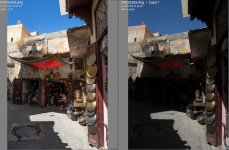
This illustrates why I'll choose mirrorless over DSLR:
Morocco dynamic range.jpg

My previous camera was a Nikon D610 - decent enthusiast full frame DSLR - and it simply couldn't cope with a shot like this. It was a good camera for the time, but no match for what was a design just a year or 2 younger.
 
Before getting my X-T2 (in 2018) I had my 5D for 10 years, so I thought I had good muscle memory with it. About 6 months switching to Fuji I borrowed a 5D, the same model I had, and found it alien. It just felt so slow and awkward to use. And my settings changes weren't reflected in the viewfinder. What was all that about?

Having said that - it is all down to personal preference. Some people prefer mirrorless, others SLRs or even range finders.
 
Not used one for over 11 years when I went mirrorless.
 
Having said that - it is all down to personal preference. Some people prefer mirrorless, others SLRs or even range finders.

I see quite a few DSLRs being used out and about. Several of the professional photographers I know are sticking with the likes of the 5D and D810.

Conversely I now find using a DSLR pretty frustrating at times for project work and if I'm forced to use one I can get pretty irritated.
 
Are the mirrorless cameras point and shoot?

The mirror has a certain amount of protection for the sensor. Is there a new technology to protect the sensor surface when changing lenses or are they getting bombarded with airborne particles the whole time resulting in very high maintenance costs.
 
Are the mirrorless cameras point and shoot?

The mirror has a certain amount of protection for the sensor. Is there a new technology to protect the sensor surface when changing lenses or are they getting bombarded with airborne particles the whole time resulting in very high maintenance costs.
Some of the higher end models from my experience on Nikon Z8 and Z9 have a sensor shield to protect it when changing lenses along with the higher end models from Sony Canon and Panasonic.
 
Are the mirrorless cameras point and shoot?

The mirror has a certain amount of protection for the sensor. Is there a new technology to protect the sensor surface when changing lenses or are they getting bombarded with airborne particles the whole time resulting in very high maintenance costs.

Point and shoot - they can be as automated or manual as you choose.

The sensors are exposed when you remove a lens, but in the case of my Sony, it needs far less cleaning than the Nikon I owned before. Have wet-cleaned maybe 3 times in 7 years, and usually just use a blower occasionally at home.
 
I can focus a camera, but I can’t focus on the eye of a table tennis player whilst shooting at 12 fps.
I’m pretty sure you can’t either.

If I’d got hours to set up a single image I’d happily still be shooting with my medium format film camera, but that failed to meet my needs nearly 30 years ago.

If I wanted to ‘enjoy’ the process of driving, I’d be running around in my Austin Healey Sprite. But I just want to get places, and adaptive cruise control, air conditioned modern vehicles make it easier to do that.

I understand that you’re deriving pleasure from ‘the process’ but I just want the process to get out of the way so I can make pictures.
Machine gunning with a camera at mega frames per second is not photography in the purist sense. It is using a camera to do a job which I have no need to use. When I was using a camera for a task in hand usually involved a tripod. There was no need to fire of dozens of frames to get one possible good one. Static objects. landscapes. and even portraits tend not to move very quickly so I have no real need to learn the technique.

It is the difference between constructing a flat pack piece of furniture using a screwdriver, compared to making it from scratch with skills, knowledge, hand tools and experience gathered over the years. I know what I prefer.
 
Machine gunning with a camera at mega frames per second is not photography in the purist sense. It is using a camera to do a job which I have no need to use. When I was using a camera for a task in hand usually involved a tripod. There was no need to fire of dozens of frames to get one possible good one. Static objects. landscapes. and even portraits tend not to move very quickly so I have no real need to learn the technique.

It is the difference between constructing a flat pack piece of furniture using a screwdriver, compared to making it from scratch with skills, knowledge, hand tools and experience gathered over the years. I know what I prefer.

With respect, it's more like choosing between a sedate family estate car and a rally car: you pick the tool that you need and will deliver the results you want in the way you want them. A landscape photographed well with a 1/2 plate camera can be a thing of beauty, but a very different set of methods and equipment are required for sports or action photography, and trying to apply the same approach used for landscape would be of very limited usefulness. Likewise using 12 frames per second to capture landscape would be more than a little strange, not to mention making image selection and editing very time consuming.

*Mod hat on*
In a more general sense for posters in the thread, lets recognise the value of what different people produce with different methods, but also lets not put down their chosen tools and processes.
 
Are the mirrorless cameras point and shoot?

The mirror has a certain amount of protection for the sensor. Is there a new technology to protect the sensor surface when changing lenses or are they getting bombarded with airborne particles the whole time resulting in very high maintenance costs.

I've had my A7Riii nearly 3 years - not wet cleaned the sensor once so far - and I shoot mainly primes too so plenty of lens changes.

The A7 has been wet cleaned a few times, but I've had that over 10 years.
 
Point and shoot - they can be as automated or manual as you choose.

The sensors are exposed when you remove a lens, but in the case of my Sony, it needs far less cleaning than the Nikon I owned before. Have wet-cleaned maybe 3 times in 7 years, and usually just use a blower occasionally at home.
The relatively cheaper model Canon R7 has a sensor shutter when you change lenses.
 
I know what I prefer.
I think we all need to remember that different folks : different strokes.

When it comes to photography, I think we should intend to please the viewer, be that ourselves or some stranger at the other end of the internet. I also think that the only valid criticism of a picture is "I like it" or "I don't like it".
 
I think most mirrorless have a mechanical shutter.

The problem with with anything over about 8 frames a second is that less mobile shots that only need a single got get 2 pictures. Sometimes I do it (11 fps, oh yeah) for performance based stuff when dancers are doing cool things all the time. Generally, it is not worth it. I might try it tonight and see if a second shot gets any difference on focus.
 
For me ISO performance has improved but I might have to stretch the time frame a bit and I had Canon DSLR's and I don't think they were technology leaders. The original 5D I had was a long way behind later MFT cameras and by the time the original A7 came out it seemed to be in a different galaxy to the 5D.

I got a new Sony A7cII recently and just for fun I tried taking a few test shots at home late at night with the lights out and I was surprised how much better I could see with the camera than by eye and the pictures did show detail which just wasn't visible by eye. I don't know who'd ever want that ability, but it's there these days and is an improvement over the original A7.
Yes. Canon DSLRs are fine machines but their home grown sensors were a bit noisier than Nikon or Sony. My current low light camera is 10 years old (D4S) and the dpreview picture comparison charts at ISO 12800 look really good against most mirrorless. It has big pixels and no need for phase detectors on the sensor.
 
Are the mirrorless cameras point and shoot?

The mirror has a certain amount of protection for the sensor. Is there a new technology to protect the sensor surface when changing lenses or are they getting bombarded with airborne particles the whole time resulting in very high maintenance costs.
If you remove the lens, dust can get inside the camera, mirror or not.

Some mirrorless allow you to have the shutter closed while changing lenses, which, like having a mirror down, will reduce the volume of 'free air' for dust to get into, so may reduce the overall amount of dust entering the camera, but neither a closed shutter or mirror will prevent the entry of dust, so once you attach a lens and the shutter opens, or take a shot and the mirror moves, that dust will circulate and can reach the sensor.

However, most (if not all?) sensors have dust removal technology to vibrate the sensor at high frequencies and remove any dust.

It's also a reasonably straight forward task to clean a sensor using a cleaning kit (and the sensor itself has a glass front, so you are unlikely to damage it if you take a bit of care).

Note: I'm not convinced having the shutter closed while changing lenses is a good idea - in principle it reduces the dust entering the camera as mentioned above, but it also introduces the risk of accidentally knocking and damaging the shutter - dust on a sensor is a quick and cheap / free fix at home. Replacing a damaged sensor is a significant cost and loss of the camera for several weeks while in repair.
I think one of the recent Nikon mirrorless is fully electronic shutter, but has a shutter like mechanism that closes while lenses are changed - I'd assume this can be more robust than a 'real' shutter, as it does not need to open/close anywhere near as fast as an actual shutter, in which case it won't carry the same risk.
 
Yes. Canon DSLRs are fine machines but their home grown sensors were a bit noisier than Nikon or Sony. My current low light camera is 10 years old (D4S) and the dpreview picture comparison charts at ISO 12800 look really good against most mirrorless. It has big pixels and no need for phase detectors on the sensor.
The D4s will look less noisy as you are comparing images of different resolutions - if you compare it to the Sony A7Siii (also a low MP camera) you will see the noise levels are very similar.

It has also been shown (but I don't have examples) that taking a higher resolution image from one of the modern mirrorless and downscale it to the same resolution as the A7Siii the noise levels will again look similar.
 
Machine gunning with a camera at mega frames per second is not photography in the purist sense. It is using a camera to do a job which I have no need to use. When I was using a camera for a task in hand usually involved a tripod. There was no need to fire of dozens of frames to get one possible good one. Static objects. landscapes. and even portraits tend not to move very quickly so I have no real need to learn the technique.

It is the difference between constructing a flat pack piece of furniture using a screwdriver, compared to making it from scratch with skills, knowledge, hand tools and experience gathered over the years. I know what I prefer.
You have said you have no experience of photography where you can benefit from high FPS or AF.

I have experience of 5x4 and medium format tripod mounted landscape photography with film (but now using digital) as well as wildlife (and a little sports photography) with film and digital; my views differ from yours

With sports photography and wildlife photography, you don't use high frame rates hoping to get "one possible good one".

You still use the same skills of timing and composition to "capture the moment" that you did before having high frame rates available. But, by anticipating the "moment," you can start a "short" burst of pictures to capture a few pictures before and a few pictures after the moment. You may well be running at 20fps but you might end up with only 5-10 (on rare occasion more than this) pictures to choose from.

With sports and wildlife, lots of what is happening is outside your control. For example with flying birds, you will be not only trying to watch every aspect of the birds behaviour, ie wing position, head position, beak open or closed etc, you also need to monitor the background as you pan across it following the flying birds, even if you have chosen you position to give a good background. On many days the light may be variable and changing rapidly so you also need to time pressing the shutter when the lighting is at its best Added to this is the extra complication of more than one bird flying, so you are also trying to capture several birds at the moment they make a pleasing composition.

I could probably add to this list, but with sports and wildlife, the moment you need to press the shutter is changing rapidly, as multiple, outside of your control, factors are changing, all of which will affect the success of your photograph.

You also need to keep the bird of primary interest in focus. Even with autofocus, there are myriad AF options, each with specific applications that you need to learn and apply. Even during the actual shooting, you need to be conscious of what is happening, and possibly override what the AF is doing (or not doing).

With so much going on when taking wildlife and sports photographs (not with every picture, but with a high proportion), being able to use AF, allows you to concentrate on the less mechanical aspects of sports and wildlife photography (ie composition. lighting, gestures and timing). Using short bursts rather than a single shot reduces the risk of a shot being ruined by all the things outside your control. Hopefully, if you have timed your burst of shots properly, at least one of them will come together the way you had seen it in your head when pressing the shutter, and you will have avoided something you didn't see ruining all your shots from the burst.

Overall, I would argue that even with high fps and AF, the knowledge and skills required for consistently "good" wildlife photography (and sports photography, but I cannot confidently comment on sports photography) is no less, and arguably higher than those required for consistently "good" landscape photography.

I have used "consistently" carefully because one consequence of digital, with AF, and high FPS is the increased chance of a "lucky" shot, but I am assuming a comparison between the working practises of enthusiast and professional sports and wildlife photographers and the working practises of enthusiast and professional landscape and portrait photographers.

Finally, regardless of how much you prepare and your level of skill, with nearly all photography there is an element of luck.

 
Machine gunning with a camera at mega frames per second is not photography in the purist sense
Well it is photography. Your opinion is worth whatever you believe it to be for you, and nowt to me. ;)

As I have previously posted (as well as others) we all have different aims and objectives.
And my sports photographs have to please the client and the subject, it’s less than disingenuous to decry that as lesser than making a picture just to please yourself :thinking: no matter how important you think pleasing you is.
 
....

Overall, I would argue that even with high fps and AF, the knowledge and skills required for consistently "good" wildlife photography (and sports photography, but I cannot confidently comment on sports photography) is no less, and arguably higher than those required for consistently "good" landscape photography.

I have used "consistently" carefully because one consequence of digital, with AF, and high FPS is the increased chance of a "lucky" shot, but I am assuming a comparison between the working practises of enthusiast and professional sports and wildlife photographers and the working practises of enthusiast and professional landscape and portrait photographers.

Finally, regardless of how much you prepare and your level of skill, with nearly all photography there is an element of luck.

The example I have read about is with the high end 120fps cameras - for the vast majority of shots that's totally overkill, but if you're shooting an Olympic figure skater spinning in the air mid jump, being able to grab a burst of 20-30 images in that split second will hugely increase the chance of capturing a front page image rather than one with them facing the other way!
 
The example I have read about is with the high end 120fps cameras - for the vast majority of shots that's totally overkill, but if you're shooting an Olympic figure skater spinning in the air mid jump, being able to grab a burst of 20-30 images in that split second will hugely increase the chance of capturing a front page image rather than one with them facing the other way!
That, of course, is the joy of digital: accessible choices that make it easier to find camera features that help solve a particular photographic problem.

In the days when I was a professional photographer, we used to use these (amongst other things) for high FPS.

 
As mentioned above cameras have different uses for different people.
For me I do like the smaller form factor of mirrorless for travel, the eye AF for wildlife, and portraits as it is just evolution of a cameras.

I can see the apply of DSLR, and as mentioned I still use my 7Dii now and then. Usually as a 2nd camera / lens set up on a shoot.
Those who own a top DSLR like D4s, iDX*** ect then I suspect they are still a joy to use !
 
Last edited:
The D4s will look less noisy as you are comparing images of different resolutions - if you compare it to the Sony A7Siii (also a low MP camera) you will see the noise levels are very similar.

It has also been shown (but I don't have examples) that taking a higher resolution image from one of the modern mirrorless and downscale it to the same resolution as the A7Siii the noise levels will again look similar.
If you click the right button on the top right of the page you will be able to compare the cameras at the same resolution. I was using this. The A7Siii pictures look a fair bit worse to me, even worse than the A7Sii ones.

Alternatively you could look at DXOmark for SNR on Print (which is for a 8Mpix image).

I've seen several videos of people claiming that high megapixel cameras are equally good but they were not at properly high isos. You won't see much difference at ISO 1600. The big pixel effect is less with more modern cameras than something from 2005 but it is still there.

I've got a D850 and the D4S low light pictures look less noisy.
 
Back
Top