


Garnett
Suspended / Banned
- Messages
- 191
- Name
- Sam
- Edit My Images
- No
There's been a spate of threads about shoulder straps, so I'm a bit wary about adding another but I thought somebody might be interested in my DIY take on the design.
After a lot of experimentation, my implemenation is currently this:-


Essentially it is a fusion of several different designs.
I wanted a wider strap than the Black Rapid and the Q Strap just for addded strength and comfort. I made the first version using webbing from an old bag, but it was grey, slightly grimy, untested, and not "ninja-black" so I bought some 38mm seatbelt material. Wherever possible I tried to use materials with tested breaking strains. This stuff is 15kN. It cost £8 for 10meters and I've used a third of the roll.
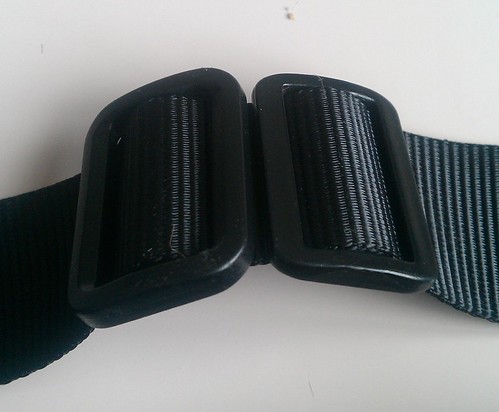
I wanted to use a loop, rather than stitching it to a shoulder strap and thus introducing more links into the critical chain. The Black Rapid copies I've have seen all have the strap stitched to the shoulder pad. This introduces more potential failure points (the stitching as well as the shoulder pad which itself then becomes a part of the critical chain). None of these seem like serious problems, but why run the risk at all if it can be removed? Also, this way, the loop can be disassembled if anything needs to be added, swapped out, or redesigned. I have made the loop by using 2 triglides. I had these lying around from old bags I'd previously thrown away. You can get these for about 40p each, and I've used 4 (2 here and 2 further down).
The other element of the strap is the shoulder pad. The strap itself is wider than the average strap and so doesn't really need a pad, but I wanted one. I was going to use a decent one that I took off a defunct laptop bag from work, but in the end sourced one from America from a company I like called Maxpedition which cost £12.

ALternatives are, as I said before, taking one off an old bag, or there are cheaper replacements such as this Tatonka shoulder pad for £6.50 mentioned by Dave here. I've been impressed with Tatonka stuff in the past so I am sure this would be excellent, and to be honest I'd have probably gone with this if I'd seen it first.
The main weakness/unknowable in the BR style straps to my mind is the swivel carabiner that slides up and down the strap. The internet has a lot of stories of Black Rapid straps breaking here, as well as the copies.
Additionally, another source of problems in that design is an inherent gap for user-error. There are lots of stories of people forgetting to attach or lock the carabiner when removing the strap.
I wanted a connection that was demonstrably stronger and which minimised the risk of user-error.
I researched options and found a usable adaption from Luma Labs, the M-connect. These guys seem to be the good guys to the Black Rapid villains of the piece.
I sourced some Hypalon offcuts for free from a friend at the RNLI. It is the stuff inflatable rib motor boats are made from and it's incredible material.
I have essentially pincered a loop of the Hypalon between my camera body and my tripod arca mount.
I tested this setup using a 16kg kettlebell. I pincered the looped material between two L-plates from BR style L-plates and hung the assembly from a railing. Then I attached the kettlebell via a maillon (more detail below) and then dropped the kettlebell from a range of heights. As a result the material took a very high stress test. I tried a range of materials such as 1000 Denier cordura, 1000D PU backed Nylon and similar PVC backed Nylon. The other materials all eventually tore catastrophically. The stress which caused them to fail was very large, and those materials would certainly suffice, but the Hypalon was in a different class and withstood far more extreme drop-tests, and came out looking utterly unaffected.
To connect the hypalon loop to the shoulder strap, I put a 5mm bar maillon in the loop of Hypalon. Maiilons (aka quicklinks,fast links or rapid links) are built for climbing and they are cheap. I had a few galvanised steel maillons in my bits box. A 5mm link can be got for less than £1, and they are rated for 250kgs. If I was buying new, I'd go for a stainless steel copy - slightly more expensive but stronger, more resistant to corrosion, and it will slide up and down the strap more readily.
I don't think it's necessary, but I've added a short section of old road bike innertube. This is just to stop the barrel tightener on the maillon from causing any abrasion on the Hypalon, as well as minimising the risk of the maillon undoing.

The thickness of the Hypalon material means the tripod screw does not screw into the camera's tripod mount as far as it would normally. It appears to me that the tripod screw normally screws in through 3 complete revolutions. With the Hypalon in place the standard screw only rotates twice. This seemed fine, and the rubber finish of the hypalon acts as a gasket and allows for a very tight lock-up. Nevertheless I sourced a slightly longer tripod screw for £4.
The additional benefit of this setup IMO is that less force is transferred into the camera tripod mount. I am not an engineer but I am happier with how loads are dealt with in my design than in the BR straps.
Despite this setup being far more secure than the BR straps(to my mind at least) I still wanted to have additional redundancy.
For this I am currently using spliced 2mm dyneema dinghy cord (as recommended by Whom). I am using this while I wait for thinner dyneema fishing line to arrive.

The advantage of the design I have used is that this line can be very short. Ultimately I want to have a very short line that hugs the camera body from the camera's mount for the standard neck strap down to the maillon. I'll heatshrink it too probably to minimise abrasion (and to maintain the stealth-black style).
The dinghy cord is tested to 240kgs and cost less than £3.
Lastly, the strap needs a "stopper" mechanism to stop the camera from sliding too far around one's back. I don't know about the Black Rapid strap, but the copies use a cam lock which works perfectly and is quickly moveable. I didn't want to pay for one though, and used 2 triglides instead. One only was too prone to slide along the strap, but two in tandem work admirably.
I've spent less than £30, and most of the expense was unnecessary - if you have a suitable old bag with usable strap, shoulder pad, and triglides, and you use your tripod's mount screw, you should be able to implement the same design for under £10.
As a postscript, I've added a small plastic cliplock behind the "stopper" triglides.
This is to attach a quickly removeable low profile case.
I hope that's of use to somebody. Please let me know if it does, and please post any improvements and pictures of similar ideas.
After a lot of experimentation, my implemenation is currently this:-
Essentially it is a fusion of several different designs.
I wanted a wider strap than the Black Rapid and the Q Strap just for addded strength and comfort. I made the first version using webbing from an old bag, but it was grey, slightly grimy, untested, and not "ninja-black" so I bought some 38mm seatbelt material. Wherever possible I tried to use materials with tested breaking strains. This stuff is 15kN. It cost £8 for 10meters and I've used a third of the roll.
I wanted to use a loop, rather than stitching it to a shoulder strap and thus introducing more links into the critical chain. The Black Rapid copies I've have seen all have the strap stitched to the shoulder pad. This introduces more potential failure points (the stitching as well as the shoulder pad which itself then becomes a part of the critical chain). None of these seem like serious problems, but why run the risk at all if it can be removed? Also, this way, the loop can be disassembled if anything needs to be added, swapped out, or redesigned. I have made the loop by using 2 triglides. I had these lying around from old bags I'd previously thrown away. You can get these for about 40p each, and I've used 4 (2 here and 2 further down).
The other element of the strap is the shoulder pad. The strap itself is wider than the average strap and so doesn't really need a pad, but I wanted one. I was going to use a decent one that I took off a defunct laptop bag from work, but in the end sourced one from America from a company I like called Maxpedition which cost £12.
ALternatives are, as I said before, taking one off an old bag, or there are cheaper replacements such as this Tatonka shoulder pad for £6.50 mentioned by Dave here. I've been impressed with Tatonka stuff in the past so I am sure this would be excellent, and to be honest I'd have probably gone with this if I'd seen it first.
The main weakness/unknowable in the BR style straps to my mind is the swivel carabiner that slides up and down the strap. The internet has a lot of stories of Black Rapid straps breaking here, as well as the copies.
Additionally, another source of problems in that design is an inherent gap for user-error. There are lots of stories of people forgetting to attach or lock the carabiner when removing the strap.
I wanted a connection that was demonstrably stronger and which minimised the risk of user-error.
I researched options and found a usable adaption from Luma Labs, the M-connect. These guys seem to be the good guys to the Black Rapid villains of the piece.
I sourced some Hypalon offcuts for free from a friend at the RNLI. It is the stuff inflatable rib motor boats are made from and it's incredible material.
I have essentially pincered a loop of the Hypalon between my camera body and my tripod arca mount.
I tested this setup using a 16kg kettlebell. I pincered the looped material between two L-plates from BR style L-plates and hung the assembly from a railing. Then I attached the kettlebell via a maillon (more detail below) and then dropped the kettlebell from a range of heights. As a result the material took a very high stress test. I tried a range of materials such as 1000 Denier cordura, 1000D PU backed Nylon and similar PVC backed Nylon. The other materials all eventually tore catastrophically. The stress which caused them to fail was very large, and those materials would certainly suffice, but the Hypalon was in a different class and withstood far more extreme drop-tests, and came out looking utterly unaffected.
To connect the hypalon loop to the shoulder strap, I put a 5mm bar maillon in the loop of Hypalon. Maiilons (aka quicklinks,fast links or rapid links) are built for climbing and they are cheap. I had a few galvanised steel maillons in my bits box. A 5mm link can be got for less than £1, and they are rated for 250kgs. If I was buying new, I'd go for a stainless steel copy - slightly more expensive but stronger, more resistant to corrosion, and it will slide up and down the strap more readily.
I don't think it's necessary, but I've added a short section of old road bike innertube. This is just to stop the barrel tightener on the maillon from causing any abrasion on the Hypalon, as well as minimising the risk of the maillon undoing.
The thickness of the Hypalon material means the tripod screw does not screw into the camera's tripod mount as far as it would normally. It appears to me that the tripod screw normally screws in through 3 complete revolutions. With the Hypalon in place the standard screw only rotates twice. This seemed fine, and the rubber finish of the hypalon acts as a gasket and allows for a very tight lock-up. Nevertheless I sourced a slightly longer tripod screw for £4.
The additional benefit of this setup IMO is that less force is transferred into the camera tripod mount. I am not an engineer but I am happier with how loads are dealt with in my design than in the BR straps.
Despite this setup being far more secure than the BR straps(to my mind at least) I still wanted to have additional redundancy.
For this I am currently using spliced 2mm dyneema dinghy cord (as recommended by Whom). I am using this while I wait for thinner dyneema fishing line to arrive.
The advantage of the design I have used is that this line can be very short. Ultimately I want to have a very short line that hugs the camera body from the camera's mount for the standard neck strap down to the maillon. I'll heatshrink it too probably to minimise abrasion (and to maintain the stealth-black style).
The dinghy cord is tested to 240kgs and cost less than £3.
Lastly, the strap needs a "stopper" mechanism to stop the camera from sliding too far around one's back. I don't know about the Black Rapid strap, but the copies use a cam lock which works perfectly and is quickly moveable. I didn't want to pay for one though, and used 2 triglides instead. One only was too prone to slide along the strap, but two in tandem work admirably.
I've spent less than £30, and most of the expense was unnecessary - if you have a suitable old bag with usable strap, shoulder pad, and triglides, and you use your tripod's mount screw, you should be able to implement the same design for under £10.
As a postscript, I've added a small plastic cliplock behind the "stopper" triglides.
This is to attach a quickly removeable low profile case.
I hope that's of use to somebody. Please let me know if it does, and please post any improvements and pictures of similar ideas.
Last edited:


