I think I spoke too soon, after thinking I had a grasp on it, this mornings reflections assure me I have not.
My delayed rhetoric skills, often a frustration, leads me to the saying " fools go where angels fear to tread".
Anyhow, if ss 100 at f10 exposure selection at 1600 iso results in 1000 photons through the shutter, for a correct exposure, how am I able to maintain that iso when everything in the exposure triangle theory states whatever ap/ss i select at that ISO will result in the same quantity of photons hitting the film plane.
Exactly how can I reduce noise by getting 10,000 photons through to the film/sensor whilst maintaining that same ISO.
Am I missing something? I seem to be going round in circles - lower the ISo, let more light in via SS/ap and there will be less noise
You are mainly missing that digital isn't film.
With film, the ISO was a measure of the film's sensitivity to light, which came from making the silver halides in the emulsion bigger, which in turn resulted in grainer negatives. So ISO was related to the films sensitivity to light
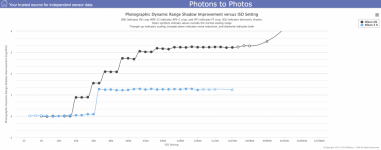
But with digital when you turn up the ISO you aren't affecting the sensitivity of the sensor, you are just brightening the image that the sensor has recorded at its "single" level of "base" sensitivity (ignoring dual gain sensors for now).
So the "correct exposure" to maximise quality and minimise noise, is the exposure needed for the base ISO, which usually around ISO 100.
If, for whatever reason, you cannot give that correct exposure (ie let enough light onto the sensor) then the image will be underexposed and look too dark. The more it's underexposed, the darker it becomes and the poorer the image quality.
When you turn up the ISO, all you are doing is making the underexposed image brighter and allowing the poorer image quality to become visible.
It's more complicated than this, but understanding the above is a good starting point.
Additionally, the idea of a "single" correct exposure is worth considering, and that was what I was illustrating in my example about the low dynamic range subject and looking at the histogram.
With that example, there would be several "correct" exposures, as several different exposures would still give a file where no highlights were blown, and no shadow detail was lost.
All that happens as you increase the exposure is that the histogram peak would move from left to right and the image would get brighter (easily corrected when processing), but as it gets brighter it's recording more data.
So, even though there are several 'correct" exposures the "optimal" exposure is the one where the histogram is as far to the right as you can push it, without blowing any highlights. This puts as much light as possible onto the sensor, and maximises the detail captured while minimising the noise.
With a high dynamic range image, the "correct" and "optimal" exposure will be the same, but on dull days with flat lighting and low contrast subjects you can optimise image quality by picking shutter speeds and apertures that keeps the histogram to the right, rather than in the middle, of the range. On dull days when light levels tend to be low anyway, keeping the histogram to the right, can make a noticable difference to image quality.
I haven't read this, but it looks like a good read.
We should begin by saying that the point of all of this is not just to criticize one of the most repeated photographic myths out there – that's just a tool, because an incorrect understanding of the way that exposure and ISO work, as well as their roles during the shooting process, leads to a...

www.fastrawviewer.com