Digital ISO

Westbury

Suspended / Banned
Messages
13
Edit My Images
Yes
Having come from film I undertand ISO, in essence the sensitiviety of the film to light. A chemical process. A once fixed for the entire roll of film setting (aside of a few bits of trickery).

ISO has morphed into an active setting now in the digital age but what does it actually do to the sensor ? I know change sensitivety but how ? What does the setting do to the sensor at an electronic / light level of function ?
 
VERY basically, it amplifies the signal from the sensor.
 
Correct, and if the light is low the captured data will be a lower value and thus nearer to the sensor basic noise level. The amplification will amplify the wanted data and the noise.

Dave
 
The topic is rather involved and the terminology is often confused.

I.e. "Digital ISO" does exist and it is ISO values beyond the analog amplification range; often called "extended ISOs." Those ISOs are simple mathematical manipulation of the raw numbers; it is done by the camera's processor after the ADC (analog to digital converter) and prior to recording the data.

Then there is "native" or "base" ISO; and for most cameras it is very much like film; it is a fixed value... it is usually the lowest numerical ISO selectable.

Above the base ISO there is the analog ISO range. These ISO's are analog amplification of the sensor generated signal prior to the ADC. For some cameras (most older cameras) this is beneficial because a stronger signal (not less noisy) allows for fewer ADC errors. Think of it as being similar to a brightness control... if you look at a very dark (weak) image it can be hard to discern anything. But if you make it much brighter you can start to discern details, even if it also makes the image appear more noisy. For most older cameras using a higher ISO results in a lower noise result compared to increasing the exposure in post. These ISOs are NOT a change of sensor sensitivity; although they are often wrongly described as such. And using a higher ISO does not result in more noise, even though it is often wrongly described as such... if anything using a higher ISO results in less noise (see below).

That's the basics of ISO with digital cameras... but...

As things have progressed, more modern cameras may have dual native ISOs. This is an actual change of the sensor's sensitivity to light; the sensor photodiodes have switchable conversion gain (but it is not typically user selectable). The low conversion gain state (low ISOs) can record more light (dynamic range) but are also less sensitive to light. The high conversion gain state (higher ISOs) cannot record as much light, but that's not a problem because you're (presumably) using a higher ISO due to a lack of light. The high conversion gain state is actually more sensitive to light and generates less noise in lower signal (darker) regions. My Z9 is an example of this. The low conversion gain state has a sensitivity (base ISO) of 64, and the high conversion gain state is ~ 1 stop higher at ~ 128; but the camera doesn't switch states until ISO 500 (ISO 560 in auto).

And then there are modern cameras which are some degree of "ISO invariant." These are cameras which do not benefit from increasing the ISO within the analog ISO range in terms of recorded SNR (signal to noise ratio). Many early DSLRs were ISO invariant, and also very poor performers in terms of SNR. What makes modern ISO invariant cameras so useful is that they have very good SNR performance and high accuracy (few errors/minimal noise). With these cameras, using a higher ISO does not result in a lower noise result compared to increasing the exposure in post. The analog ISOs are still "brightness control;" but the image does not benefit from fewer read/amplification/conversion errors (lower noise).
AFAIK there are no cameras that are truly 100% ISO invariant at this point, but there are many where it is near enough as to not matter (technically measurable, but below/barely at the level of distinguishability).
 
The topic is rather involved and the terminology is often confused.

I.e. "Digital ISO" does exist and it is ISO values beyond the analog amplification range; often called "extended ISOs." Those ISOs are simple mathematical manipulation of the raw numbers; it is done by the camera's processor after the ADC (analog to digital converter) and prior to recording the data.

Then there is "native" or "base" ISO; and for most cameras it is very much like film; it is a fixed value... it is usually the lowest numerical ISO selectable.

My camera has a base ISO of 125 but has lower extended ISOs (100 & 64). Would base ISO often lead to 'better' results or is lowest still best even when it is not 'analog' ISO?
 
My camera has a base ISO of 125 but has lower extended ISOs (100 & 64). Would base ISO often lead to 'better' results or is lowest still best even when it is not 'analog' ISO?
I very much doubt that extending below the base ISO would improve IQ...I like to think of it as a digital ND filter.
 
ISO has morphed into an active setting now in the digital age but what does it actually do to the sensor ? I know change sensitivety but how ? What does the setting do to the sensor at an electronic / light level of function ?
I read questions like this and wonder how the answer will improve people's photos.

I couldn't give a monkey's how the ISO works in my camera, all I (need to) know is that I can raise or lower it to keep the shutter speed and aperture I want to get the end result I'm after. Through trial and error I know how high I can raise the ISO without my photos turning to mush. How it all works is irrelevant to me!
 
I read questions like this and wonder how the answer will improve people's photos.

I couldn't give a monkey's how the ISO works in my camera, all I (need to) know is that I can raise or lower it to keep the shutter speed and aperture I want to get the end result I'm after. Through trial and error I know how high I can raise the ISO without my photos turning to mush. How it all works is irrelevant to me!

Do get what you’re saying and agree that this sort of information wont help with being in the right place at the right time which for me anyway is by far the most important thing in wildlife photography at least
It is interesting knowing how your camera works though and is also useful
For example with my 40D it was useful to know how increasing the ISO affected the noise, I used to set the ISO in steps from 320 to 640 etc (if I remember correctly)
With my R5 the signal to noise is the same at 3200 as 1600 so I may as well use 3200 to get a high enough shutter speed on moving animals :)
 
It is interesting knowing how your camera works though and is also useful
I agree.

Also, I think that the trick is not to fall through the Looking Glass, into that strange world where hundreds of settings, with strange names, wait to trip you up and provide you with fascinating new ways to mess up your pictures!

:tumbleweed:
 
I read questions like this and wonder how the answer will improve people's photos.

I couldn't give a monkey's how the ISO works in my camera, all I (need to) know is that I can raise or lower it to keep the shutter speed and aperture I want to get the end result I'm after. Through trial and error I know how high I can raise the ISO without my photos turning to mush. How it all works is irrelevant to me!
I think, that the more you know about the technology and craft of photography, the more able you become in deciding whether knowing how something works will or will not improve your photographs.

This includes informing and guiding a trial-and-error approach, which I still feel is essential, but far more valuable if you understand what background of what might be affecting your trial and error approach. Indeed, as a general comment (beyond photography), an uninformed empirical approach can easily draw incorrect conclusions.

For example, comparing "mushiness" between photographs is going to make much more sense if you know something about dual gain sensors, ISO invariance and how different levels of exposure at the same ISO, can have a bigger effect on mushiness than changing ISO values.

Understanding ISO invariance can allow you to focus on getting the picture right, and relax a little on the need to get the exposure "exactly" correct. (once you are into the ISO invariance part of the sensor's sensitivity).
 
My camera has a base ISO of 125 but has lower extended ISOs (100 & 64). Would base ISO often lead to 'better' results or is lowest still best even when it is not 'analog' ISO?
I can't say much since you didn't say what camera you have. But if it allows you to get an image you otherwise can't, then that is certainly better.

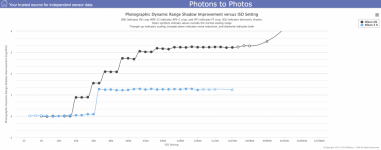
The website Photons to Photos has a chart showing Shadow Improvement of Dynamic Range which indicates if there is any real cost/benefit of using any particular ISO. For instance, this is my Z9 (blue) and the D6.

1756384721304.png
For the Z9 it shows that there is no real benefit to using any ISO (including the extended ISOs), which is a characteristic of being ISO invariant. Except that it shows a 1 stop improvement in DR (shadow noise reduction) at ISO 500, which is a characteristic of dual gain (dual native ISO).

For the D6 it shows that there is clearly a benefit to using higher ISOs as opposed to underexposing/recovering. But note that the chart is not a comparison between the two cameras, the stops of DR improvement are in comparison to itself. I.e. "Zero" isn't an absolute value; it is baseline for that camera.
 
I read questions like this and wonder how the answer will improve people's photos.

I couldn't give a monkey's how the ISO works in my camera, all I (need to) know is that I can raise or lower it to keep the shutter speed and aperture I want to get the end result I'm after. Through trial and error I know how high I can raise the ISO without my photos turning to mush. How it all works is irrelevant to me!

If you care about image quality, then why wouldn't you want to know what will give the best results?
I'm not saying (technical) image quality is all important; quite the opposite. But they are not mutually exclusive; there is (or can be) much more to photography than simply framing the shot.

The less I care about quality, the simpler and less expensive equipment I use (and there certainly won't be any advanced lighting involved). IMO, there is no real point to buying more advanced/expensive equipment if you are not going to learn how to best utilize it.
 
I can't say much since you didn't say what camera you have. But if it allows you to get an image you otherwise can't, then that is certainly better.

The website Photons to Photos has a chart showing Shadow Improvement of Dynamic Range which indicates if there is any real cost/benefit of using any particular ISO. For instance, this is my Z9 (blue) and the D6.

View attachment 461650
For the Z9 it shows that there is no real benefit to using any ISO (including the extended ISOs), which is a characteristic of being ISO invariant. Except that it shows a 1 stop improvement in DR (shadow noise reduction) at ISO 500, which is a characteristic of dual gain (dual native ISO).

For the D6 it shows that there is clearly a benefit to using higher ISOs as opposed to underexposing/recovering. But note that the chart is not a comparison between the two cameras, the stops of DR improvement are in comparison to itself. I.e. "Zero" isn't an absolute value; it is baseline for that camera.
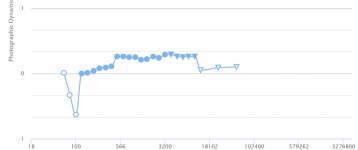
Thanks for the link, an interesting website. Very odd chart for my camera - apologies it's a Fuji XH2. It appears the L64 & base 125 are similar but L80 and L100 are reducing DR:

DR.png
 
For example, comparing "mushiness" between photographs is going to make much more sense if you know something about dual gain sensors, ISO invariance and how different levels of exposure at the same ISO, can have a bigger effect on mushiness than changing ISO values
That's gone right over my head. :LOL:

Sorry!
 
Thanks for the link, an interesting website. Very odd chart for my camera - apologies it's a Fuji XH2. It appears the L64 & base 125 are similar but L80 and L100 are reducing DR:

View attachment 461651

That is odd, usually the extended ranges do not have significant impact; but in your case it is clearly better to avoid using them if possible.
Note that an inverted triangle means that the camera is applying digital noise reduction. And when you digitally reduce noise, it inherently results in some loss of detail (DR).
Also note that a difference of ~ 0.5 stop is about the limit of a human's ability to discern. I.e. there's really no significant difference between the ISOs, even the 0.6 stop reduction at ISO 100 is minimal.
 
That's gone right over my head. :LOL:

Sorry!
I don't know what to say, but having some understanding of all this, and applying it, has a direct effect on how well you can manage "mushiness" on your images.

Not as a replacement for empirical testing but as an essential part of designing, interpreting and applying the results.

It certainly isn't essential for the production of a good photograph, but for 'consistency" and "predictability" of results, I feel understanding how the tools of your craft work and the affect they have on your pictures to be an important (essential) skill.
 
For example, comparing "mushiness" between photographs is going to make much more sense if you know something about dual gain sensors, ISO invariance and how different levels of exposure at the same ISO, can have a bigger effect on mushiness than changing ISO values.
Hello Graham,

Could you suggest any reading material to illustrate this point?

And if you could will you please
 
I don't know what to say, but having some understanding of all this, and applying it, has a direct effect on how well you can manage "mushiness" on your images.

Not as a replacement for empirical testing but as an essential part of designing, interpreting and applying the results.

It certainly isn't essential for the production of a good photograph, but for 'consistency" and "predictability" of results, I feel understanding how the tools of your craft work and the affect they have on your pictures to be an important (essential) skill.
I know a FF sensor produces less 'mush' and more detail in very low light than the small sensor in my compact - I don't worry about ISO 20,000 with the former but anything over 800 is pushing things with the latter. Why? I can't see how knowing the science/technology behind it will help me in any way.

I guess I'm simply more interested in pictures than photographs. So I don't understand the interest in the technology.
 
I know a FF sensor produces less 'mush' and more detail in very low light
Well, that is not necessarily fact. It may be true if you compare your FF camera to your compact camera specifically and for a specific use scenario. But if you were to compare different cameras, or for different use scenarios, the results will likely differ. And knowing/understanding the reasons helps in choosing the equipment, and in how to best utilize the equipment in use.
 
Last edited:
Hello Graham,

Could you suggest any reading material to illustrate this point?

And if you could will you please
Unfortunately, I can't think of a readily available reference. It tends to be an accumulation of articles or indeed youtube videos (over many years) , which have looked at various aspects of things like noise, dynamic range and effects of exposure, and explained why what you see in your results isn't always what you expect and provided the technical explanation.

Steven @sk66 is much more knowledgeable about these things than I am, so he might have a good resource.
 
I am particularly interested in the comment that different exposures will produce different noise levels at the same ISO, How can this be?
 
I know a FF sensor produces less 'mush' and more detail in very low light than the small sensor in my compact - I don't worry about ISO 20,000 with the former but anything over 800 is pushing things with the latter. Why? I can't see how knowing the science/technology behind it will help me in any way.

I guess I'm simply more interested in pictures than photographs. So I don't understand the interest in the technology.
I can't really think of a better way of explaining things than I already have, but....

Understanding the technology, allows you to appreciate that controlling the "mushiness" in a picture, isn't as simple as keeping your ISO below a certain threshold.

If "mushiness" concerns you, then understanding how the appropriate technology works will help you keep it under control, across the range of circumstances and subjects you might photograph.

It isn't a case of being interested in technology, it's a case of being interested in how the tools we use affect the appearance of the pictures we make, and how much control we can have over that appearance.

I am looking at this from a very different perspective, as I feel that what I am talking about, is an interest in learning the craft of photography, not an interest in learning the science and technology of photography. The latter being more abstract, and interesting enough in its own right, but with the former having a direct impact on how well we can make the kind of pictures we want to make.
 
I am looking at this from a very different perspective
This is the problem with this sort of discussion. The variety of perspectives of the participants.

I'll leave it at that because I think I know what you're on about, but it's too much trouble for me to bother about - certainly 'in the field'. I'll stick with Auto ISO as it works for me.
 
I am particularly interested in the comment that different exposures will produce different noise levels at the same ISO, How can this be?
I will see if can find something on this.

Steven has already partially explained this. And it's to do with the sensor gathering more data at higher levels of exposure than lower ones. Hence the concept of ETTR

As a simplistic example

If you have flat lighting with a low contrast subject, let's say a dynamic range of 3 stops. and you use an ISO of 800. Imagine this showing on the camera histogram as a three stop wide spike

As you change the exposure (but keep the same ISO) this spike will move from the left to the right of the histogram. As the spike moves right, you are increasing the amount of data in the shadow areas.

Increasing exposure, but avoiding clipping the highlights, will give a "brighter" image for processing, and shadow areas will have far less noise (because they had far more exposure/data), than you would have got from a duller image that needed "lifted" during processing.

A least that's the basic concept.
 
I am particularly interested in the comment that different exposures will produce different noise levels at the same ISO, How can this be?
It's because ISO is not the cause of noise. ISO simply makes an image brighter, which makes any noise that is there more visible... in some cases ISO actually reduces the recorded noise level (non-invariant cameras).

The primary cause of image noise in modern cameras is photon shot noise, which is simply the randomness of a photon falling where it should within a given timeframe (on a given photosite/pixel). This randomness causes unequal photosite exposures where it should not exist, which is/creates image noise. For any given exposure photon shot noise is equal to the sqrt of the signal (light) collected. And it is this noise which is amplified by ISO. But it is only the change in the amount of light collected that changes the amount of shot noise which exists (the SNR).

Example:
You take a 1 second exposure and collect 100 photons. The noise level in that exposure will be 10 (sqrt of 100) for an SNR of 100:10 (10:1).
Instead you take a 10 second exposure and collect 1000 photons. The noise level in that exposure will be 32 for ans SNR of 1000:32 (31:1). While the qtty of noise is higher in this exposure (32), the qtty of signal is exponentially greater. So the noise is buried by the signal and is much less visible.
It does not matter what caused the change in actual exposure (Ap/SS), and ISO will only make it more/less visible (brighter/darker).
 
Last edited:
Thank you both, for such clear explanations, I get it now and will be utilizing that!
 
This is the problem with this sort of discussion. The variety of perspectives of the participants.

I'll leave it at that because I think I know what you're on about, but it's too much trouble for me to bother about - certainly 'in the field'. I'll stick with Auto ISO as it works for me.
Fair enough. I've always been interested in the craft aspect of photography, so it's very much part of what interests me.
 
I will see if can find something on this.

Steven has already partially explained this. And it's to do with the sensor gathering more data at higher levels of exposure than lower ones. Hence the concept of ETTR

As a simplistic example

If you have flat lighting with a low contrast subject, let's say a dynamic range of 3 stops. and you use an ISO of 800. Imagine this showing on the camera histogram as a three stop wide spike

As you change the exposure (but keep the same ISO) this spike will move from the left to the right of the histogram. As the spike moves right, you are increasing the amount of data in the shadow areas.

Increasing exposure, but avoiding clipping the highlights, will give a "brighter" image for processing, and shadow areas will have far less noise (because they had far more exposure/data), than you would have got from a duller image that needed "lifted" during processing.

A least that's the basic concept.

Your explanation is correct.

Except that "ETTR" became a technique due to modern, more invariant cameras. It is typically used to reduce the exposure in order to save highlights which would otherwise clip. The shadows are then recovered in post, which would increase the noise level with older/non-invariant cameras; which is why it wasn't a common technique before.

In the days of film what you described would be called "pushing" the exposure and "pulling" the development, and what I described would be "pulling" the exposure and "pushing" the development. But with digital someone thought they invented something new and invented a new term for it (ETTR), which could actually be either depending on where the highlights fall within the exposure/DR.
 
Your explanation is correct.

Except that "ETTR" became a technique due to modern, more invariant cameras. It is typically used to reduce the exposure in order to save highlights which would otherwise clip. The shadows are then recovered in post, which would increase the noise level with older/non-invariant cameras; which is why it wasn't a common technique before.
Yes,
In the days of film what you described would be called "pushing" the exposure and "pulling" the development, and what I described would be "pulling" the exposure and "pushing" the development. But with digital someone thought they invented something new and invented a new term for it (ETTR), which could actually be either (depending on where the highlights fall within the exposure/DR.
Yes, as an industrial photographer from the film days, I'm very familiar with the concept of manipulating exposure and development.
 
For example, comparing "mushiness" between photographs is going to make much more sense if you know something about dual gain sensors, ISO invariance and how different levels of exposure at the same ISO, can have a bigger effect on mushiness than changing ISO values.

Understanding ISO invariance can allow you to focus on getting the picture right, and relax a little on the need to get the exposure "exactly" correct. (once you are into the ISO invariance part of the sensor's sensitivity).


I thought Ed Sutton's first post was a little bit harsh, but I agree with him that this would be incomprehensible to the average user. (It's not just you, Ed)

I suggest that the flexibility of digital photography, enabling the user to alter exposure after the fact, easily change white and black points and reduce or increase shadows and highlights make these very technical questions almost irrelevant.

(Not to mention the excellent noise reduction functions that most photographers have access to........)
 
Last edited:
I thought Ed Sutton's first post was a little bit harsh, but I agree with him that this would be incomprehensible to the average user. (It's not just you, Ed)

Yes, but I was only referring back to, and summarising, the points explained by sk66 @sk66 , I wasn't trying to explain anything technical in my reply, just putting it into context..

I didn't think Dave's @Ed Sutton response was harsh, because, I simply read it as reinforcing his lack of interest in the things explained by sk66.
I suggest that the flexibility of digital photography, enabling the user to alter exposure after the fact, easily change white and black points and reduce or increase shadows and highlights make these very technical questions almost irrelevant.
This is obviously the crux of the disagreement, because knowing about the things being discussed and putting that knowledge to use at the taking stage affects the amount of correction you can make at the processing stage.

As I said before, you certainly don't "need" this understanding to make good photographs, but it allows better informed decision making, when it comes to producing consistent and predictable image quality.
 
Yes, but I was only referring back to, and summarising, the points explained by sk66 @sk66 , I wasn't trying to explain anything technical in my reply, just putting it into context..

I didn't think Dave's @Ed Sutton response was harsh, because, I simply read it as reinforcing his lack of interest in the things explained by sk66.

This is obviously the crux of the disagreement, because knowing about the things being discussed and putting that knowledge to use at the taking stage affects the amount of correction you can make at the processing stage.

As I said before, you certainly don't "need" this understanding to make good photographs, but it allows better informed decision making, when it comes to producing consistent and predictable image quality.
I edited my post to add " (Not to mention the excellent noise reduction functions that most photographers have access to........)"

I think I must be from the school of intuitive photography! Although I managed OK in the days of film as well.....
 
Thank you both, for such clear explanations, I get it now and will be utilizing that!
I think I spoke too soon, after thinking I had a grasp on it, this mornings reflections assure me I have not.
My delayed rhetoric skills, often a frustration, leads me to the saying " fools go where angels fear to tread".

Anyhow, if ss 100 at f10 exposure selection at 1600 iso results in 1000 photons through the shutter, for a correct exposure, how am I able to maintain that iso when everything in the exposure triangle theory states whatever ap/ss i select at that ISO will result in the same quantity of photons hitting the film plane.

Exactly how can I reduce noise by getting 10,000 photons through to the film/sensor whilst maintaining that same ISO.

Am I missing something? I seem to be going round in circles - lower the ISo, let more light in via SS/ap and there will be less noise
 
Last edited:
I edited my post to add " (Not to mention the excellent noise reduction functions that most photographers have access to........)"

I think I must be from the school of intuitive photography! Although I managed OK in the days of film as well.....
Indeed, but I would still rather do my best to minimise noise at the taking stage.

As said before, I am much more oriented towards a school of "learning the craft" to create a strong foundation for working intuitively.

And, obviously, I see understanding how the workings of your tools can influence your pictures, is part of that learning for me.
 
I think I spoke too soon, after thinking I had a grasp on it, this mornings reflections assure me I have not.
My delayed rhetoric skills, often a frustration, leads me to the saying " fools go where angels fear to tread".

Anyhow, if ss 100 at f10 exposure selection at 1600 iso results in 1000 photons through the shutter, for a correct exposure, how am I able to maintain that iso when everything in the exposure triangle theory states whatever ap/ss i select at that ISO will result in the same quantity of photons hitting the film plane.

Exactly how can I reduce noise by getting 10,000 photons through to the film/sensor whilst maintaining that same ISO.

Am I missing something? I seem to be going round in circles - lower the ISo, let more light in via SS/ap and there will be less noise
You are mainly missing that digital isn't film.

With film, the ISO was a measure of the film's sensitivity to light, which came from making the silver halides in the emulsion bigger, which in turn resulted in grainer negatives. So ISO was related to the films sensitivity to light

But with digital when you turn up the ISO you aren't affecting the sensitivity of the sensor, you are just brightening the image that the sensor has recorded at its "single" level of "base" sensitivity (ignoring dual gain sensors for now).

So the "correct exposure" to maximise quality and minimise noise, is the exposure needed for the base ISO, which usually around ISO 100.

If, for whatever reason, you cannot give that correct exposure (ie let enough light onto the sensor) then the image will be underexposed and look too dark. The more it's underexposed, the darker it becomes and the poorer the image quality.

When you turn up the ISO, all you are doing is making the underexposed image brighter and allowing the poorer image quality to become visible.

It's more complicated than this, but understanding the above is a good starting point.

Additionally, the idea of a "single" correct exposure is worth considering, and that was what I was illustrating in my example about the low dynamic range subject and looking at the histogram.

With that example, there would be several "correct" exposures, as several different exposures would still give a file where no highlights were blown, and no shadow detail was lost.

All that happens as you increase the exposure is that the histogram peak would move from left to right and the image would get brighter (easily corrected when processing), but as it gets brighter it's recording more data.

So, even though there are several 'correct" exposures the "optimal" exposure is the one where the histogram is as far to the right as you can push it, without blowing any highlights. This puts as much light as possible onto the sensor, and maximises the detail captured while minimising the noise.

With a high dynamic range image, the "correct" and "optimal" exposure will be the same, but on dull days with flat lighting and low contrast subjects you can optimise image quality by picking shutter speeds and apertures that keeps the histogram to the right, rather than in the middle, of the range. On dull days when light levels tend to be low anyway, keeping the histogram to the right, can make a noticable difference to image quality.

I haven't read this, but it looks like a good read.

 
Am I missing something? I seem to be going round in circles
No, you are not missing something... I think you are just confusing yourself.

I am particularly interested in the comment that different exposures will produce different noise levels at the same ISO, How can this be?
how am I able to maintain that iso when everything in the exposure triangle theory states whatever ap/ss i select at that ISO will result in the same quantity of photons hitting the film plane?

Note that these are two different questions. The first is different metered exposures, the second is a constant metered exposure (trading ap/ss). I.e. the exposure triangle is about keeping the metered exposure the same and the histogram in the center. Whereas what we were discussing previously was not, as Graham described shifting the histogram to the right.

Here's the thing; the exposure triangle is/was based on film, where ISO is the reactivity of the film to light. With digital, ISO is not the reactivity of the sensor to light (other than the base ISO). And the exposure triangle leaves out the other main exposure factor that is in play... the quantity of light available. I.e. with film you selected the ISO speed of the roll you were going to use based upon the amount of light you expected to be available. You'd load a high ISO roll for sports (high SS's) and indoor events, and you'd load a lower ISO roll for outdoors daylight/landscape, etc. Once that choice is made the exposure triangle really becomes light/ap/ss, until you load the next roll.

With digital it seems like most everyone ignores the "amount of light available" variable because we have "variable ISO/sensitivity"; except that we don't.
The confusion arises from using the term ISO for analog amplification... The benefit is carryover understanding of primary factors that changing/increasing ISO causes; a change in the output image brightness and visible noise. The negative is that it hinders an understanding of what is really happening; a fixed exposure and just making that brighter/darker (like the brightness control on your monitor).

So, back to Graham's explanation of shifting the histogram to the right with a constant ISO... that is a different exposure (amount of light collected). Compare that to shifting the histogram right by changing the ISO; in fact, that is not a different exposure. And it is the exposure (light) that determines the actual noise level (not necessarily it's visibility).

What the histogram looks like, and where it falls, does not determine "a correct exposure." What determines a correct exposure is what the histogram should look like according to the result you want. I.e. pushing the histogram to the right side isn't a bad/wrong exposure. It is an intentional exposure (amount of light), for a specific result (less noise), with a known cost (post processing edits/time).
 
Last edited:
I should add that there are two forms of highlight clipping...

One occurs when the sensor has collected all of the light it can handle. That is when the histogram is beyond the right edge and the ISO is at base. And that is when you have recorded the maximum dynamic range that the camera is capable of. I.e. some pixels have reached max, and others are at whatever minimum exists in the scene (that can be recorded).

The other is when analog signal amplification (ISO) generates voltages beyond what the ADC can handle; i.e. the max voltage a photosite can generate without amplification. This can occur at any ISO; but the higher the ISO is, the less dynamic range you have recorded. I.e. no photosites have reached max because amplification is preventing it.

So while the histogram may be to the right edge in both, there are two very different causes, and two very different results; even though the max image brightness may be the same. In the first case you have maximum DR (light) and minimum noise; in the second you have reduced DR and increased noise.
 
Last edited:
Flipping brilliant explanation

Thank you!
 
Back
Top