
D810 noise

What's the comfortable max iso on a Nikon D810 that shows no noise?

Some would argue noise is present at base ISO on any camera. As for when noise becomes obtrusive is very subjective and will vary on a number of different factors.


I have the D800E since some years now and I know
that 800 ISO is the upper limit +/- 1/3 before image
degradation.

I got the D810 last month and it performs well at 800
but as Toby says…
As for when noise becomes obtrusive is very subjective and will vary on a number of different factors.
At this point, I did not yet explore its upper limit and
performance.
 
Noise to some degree will be present even at quite low ISO, reasonable noise can generally be removed without too many issues.
I would happily use mine with Auto-ISO set at 1600 max, Auto-ISO 3200 max was used many times and Auto-ISO 6400 from time to time.
If this is for your Kingfisher venture I would set the camera to Manual Shutter Speed and Aperture and start with Auto-ISO set to 1600 ... keep checking your shots to assess what the camera is doing.
You can always increase Auto-ISO if required, noise is better than a fuzzy blur! :)
 
Noise to some degree will be present even at quite low ISO, reasonable noise can generally be removed without too many issues.
I would happily use mine with Auto-ISO set at 1600 max, Auto-ISO 3200 max was used many times and Auto-ISO 6400 from time to time.
If this is for your Kingfisher venture I would set the camera to Manual Shutter Speed and Aperture and start with Auto-ISO set to 1600 ... keep checking your shots to assess what the camera is doing.
You can always increase Auto-ISO if required, noise is better than a fuzzy blur! :)
TBH I don't mind letting my camera go up to 12800 ISO (on a D750), but for birds I don't like it above 1600-2000. Even then you're losing too much feather detail really.

But as you say a noisy less detailed image is better than a totally blurred one (assuming of course you're not aiming for something artistic ;))
 
I set my limit at 1600 on the D810... above that and I'm switching cameras to something with less MP's (still FF) or I'll consider stopping. And that's only w/o notable cropping and for "smaller" reproduction/display.
You *can* use the D810 at just about any ISO w/o it being terribly worse than anything else (same size display), there's just no point to it.

Between minimum ISO and 400 I don't really see much/any difference in most images, but there are times...
 
Last edited:
I set my limit at 1600 on the D810... above that and I'm switching cameras to something with less MP's (still FF) or I'll consider stopping. And that's only w/o notable cropping and for "smaller" reproduction/display.
You *can* use the D810 at just about any ISO w/o it being terribly worse than anything else (same size display), there's just no point to it.
Crikey, and I thought I was intolerant of noise ;) :p I guess it depends on what you're shooting and for what purposes.
 
Noise to some degree will be present even at quite low ISO, reasonable noise can generally be removed without too many issues.
I would happily use mine with Auto-ISO set at 1600 max, Auto-ISO 3200 max was used many times and Auto-ISO 6400 from time to time.
If this is for your Kingfisher venture I would set the camera to Manual Shutter Speed and Aperture and start with Auto-ISO set to 1600 ... keep checking your shots to assess what the camera is doing.
You can always increase Auto-ISO if required, noise is better than a fuzzy blur! :)

Many thanks. Yes for my one of kingfisher opportunity this weekend.
There's two perches they use for diving and looking one is 16 feet and one is 9 feet so rather close.
I've done my own wee tests when I first got the camera and was happy with 800 and 1600 was ok but I don't want to loose the feather detail but I also don't want blurred blue streaks. Only thing I don't know about now is how the weathers going to be.
 
Many thanks. Yes for my one of kingfisher opportunity this weekend.
There's two perches they use for diving and looking one is 16 feet and one is 9 feet so rather close.
I've done my own wee tests when I first got the camera and was happy with 800 and 1600 was ok but I don't want to loose the feather detail but I also don't want blurred blue streaks. Only thing I don't know about now is how the weathers going to be.
ISO noise is at least 1 stop worse in low light...
I.e. the situation *requires* ISO 400; you could probably push to ISO 1600 for another 2 stops of SS, and it will look about the same as a shot taken that *required* ISO 800.
 
Yes but, it's .6MP (1024x614)... just how hard of a crop, and just how much downsampling is done will make a big difference in how "apparent" noise is.

Shouldn't that be at least 1.8MP since you have 3 channels (RGB)?
.
 
What's the comfortable max iso on a Nikon D810 that shows no noise?

There is always noise, and it's impossible to say what is acceptable and what isn't. It's highly subjective, dependent on output, and the critical standard being applied.

It also varies by subject: high-key subjects will show very little noise compared to low-key subjects with a lot of important shadow detail; under-exposure increases noise; ETTR technique reduces it; artificial light usually increases noise (because the blue channel needs more gain applied).

With very careful comparison testing, eg DPReview* it's easy to see which cameras are better, but even then impossible to say what is acceptable - only you can decide that.

Sorry, not very helpful ;)

*DPR has an excellent image widget comparison tool showing different cameras at different settings. D810 here https://www.dpreview.com/reviews/nikon-d810/12
 
What's the comfortable max iso on a Nikon D810 that shows no noise?
There is always noise, and it's impossible to say what is acceptable and what isn't. It's highly subjective, dependent on output, and the critical standard being applied.
Indeed. It way be worth amplifying that bit about it being dependent on output though.

The amount of noise you see in an image depends on the size at which you're viewing it. If you make an image smaller, you reduce the noise. (Because noise is random variation in brightness and/or colour, and when you shrink an image each new pixel is created by "averaging" the old pixels, and averaging reduces randomness.)

If you are making a large print (bigger than A2) and inspecting it critically, you are using all 36 megapixels and you will see a certain amount if noise. If you are making a print and viewing it from a comfortable distance, then you are probably only perceiving about 6 megapixels and the noise will appear to be reduced. If you are viewing your image on screen then you are probably seeing less than 2 megapixels and the noise will appear to be reduced still further.

So if you're testing what ISO levels you find personally acceptable (for a certain type of subject, photographed in a certain way) then you need to ensure that the resolution at which you are examining the images corresponds to the final use.
 
There is always noise, and it's impossible to say what is acceptable and what isn't. It's highly subjective, dependent on output, and the critical standard being applied.

It also varies by subject: high-key subjects will show very little noise compared to low-key subjects with a lot of important shadow detail; under-exposure increases noise; ETTR technique reduces it; artificial light usually increases noise (because the blue channel needs more gain applied).

With very careful comparison testing, eg DPReview* it's easy to see which cameras are better, but even then impossible to say what is acceptable - only you can decide that.

Sorry, not very helpful ;)

*DPR has an excellent image widget comparison tool showing different cameras at different settings. D810 here https://www.dpreview.com/reviews/nikon-d810/12
This is useful, to a point. I find that real world shooting doesn't necessarily reflect what these shots suggest. YMMV.
 
This is useful, to a point. I find that real world shooting doesn't necessarily reflect what these shots suggest. YMMV.

I think that's exactly the point, your mileage may vary, and your mileage may also be variable - basically Stewart's point above.

I did a product shot last weekend for a magazine review, and they usually get used across a double-page spread (A3) which is quite demanding. But then a few things changed at the magazine end, the space wasn't available and it finally got used about half page size (A5) that is way less critical.

So I always try to work to the highest common demoninator if the final output is uncertain and other camera settings allow. When they don't and low ISO isn't an option (common!) I find the local adjustments palette in Lightroom very helpful, as it's the shadows that show most noise, so I might apply local noise reduction if it's intrusive. As a comment though, the main problem I have with high ISO is usually not noise as such, but reduced dynamic range - noisy shadows always have poor tone gradation with rich blacks turning to grey porridge, and detail lost.
 
I have the D800E and have shot gigs at 5K and got good results, depends on the type of shoot, the ambient lighting etc ... but it's certainly clean up to 800, beyond that it's debatable.
 
.... As a comment though, the main problem I have with high ISO is usually not noise as such, but reduced dynamic range - noisy shadows always have poor tone gradation with rich blacks turning to grey porridge, and detail lost.
Greater signal noise due to amplification (ISO) results in losses everywhere else... just about stop for stop (1 stop >ISO = 1stop <DR). But, the loss of DR is at the bright end, not in the shadows/darks...you're essentially shifting what can be recorded left, and what would have recorded as white will now clip.

The issue is really just a lack of information (light) in dark areas. The one time I ascribe to ETTR is for very dark scenes (i.e. black on black). You can always make things darker w/o many penalties, and having more information recorded makes darks a lot more tolerant of editing.
 
Click on the blue highighted text in the first line of that link ;) There's a brief explanation, it's here https://www.dpreview.com/articles/2601653565/studio-test-scene
I hadn't noticed the new "low light mode"... it's not as good as I would have hoped, but it's a move in the right direction.
This is useful, to a point. I find that real world shooting doesn't necessarily reflect what these shots suggest. YMMV.
IME, if you leave it in "daylight mode" your results will generally be ~ 1 stop worse in practice (maybe closer to 2 stops worse).
 
Low light performance of the D800 is great in my experience. So long as you have exposed correctly!
 
Greater signal noise due to amplification (ISO) results in losses everywhere else... just about stop for stop (1 stop >ISO = 1stop <DR). But, the loss of DR is at the bright end, not in the shadows/darks...you're essentially shifting what can be recorded left, and what would have recorded as white will now clip.

The issue is really just a lack of information (light) in dark areas. The one time I ascribe to ETTR is for very dark scenes (i.e. black on black). You can always make things darker w/o many penalties, and having more information recorded makes darks a lot more tolerant of editing.

No, if you raise ISO (exposure adjusted for correct mid-grey, not ETTR) you lose dynamic range at the shadow end - as you actually say! In practise, you can push ISO a lot and see little or no impact on highlights and mid-tones.
I hadn't noticed the new "low light mode"... it's not as good as I would have hoped, but it's a move in the right direction. <snip>

Somehow, I didn't think it would be LOL ;) The most important thing with tests like that though, is consistency in the review procedure, when comparisons are being made between tests carried out months or even years apart. I think DPR's camera tests in general are very good, IMHO the best on the web.
 
If you are under expose too much for example, you will have worse noise etc in your shadows

My point is that a "correct exposure" as you put it will depend on the scene and the result you're going for. Personally when trying to get what I'd say were the best results and minimise noise I'd be likely to ETTR but what I'd meter and base my ETTR on may very well vary with the scene.
 
No, if you raise ISO (exposure adjusted for correct mid-grey, not ETTR) you lose dynamic range at the shadow end - as you actually say! In practise, you can push ISO a lot and see little or no impact on highlights and mid-tones.
ISO and DR are related, but not directly.... in other words, the DR the sensor is capable of recording is not variable.
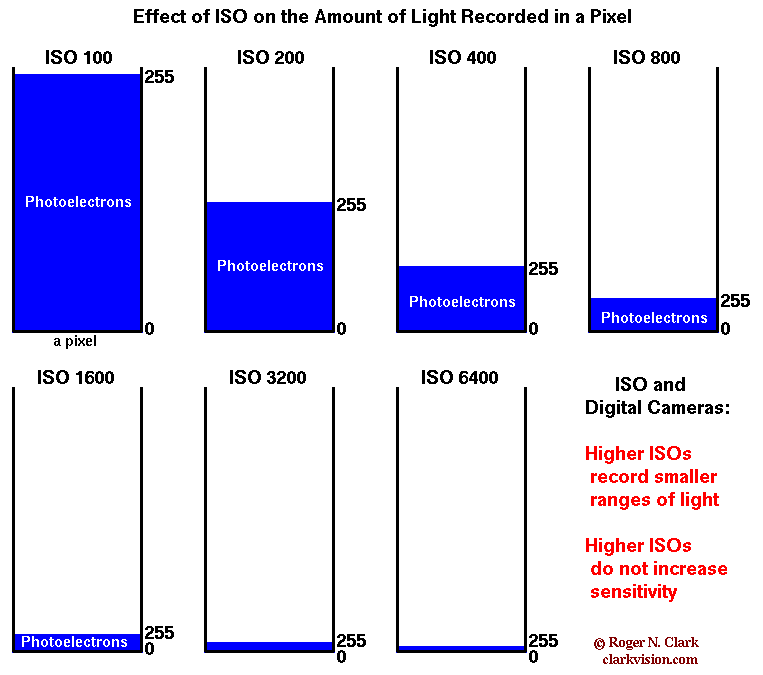
Consider a wide DR scene that encompasses the DR range capability. If you increase the ISO in order to bring up the darks or include more of them, what happens to the highlights? They clip and a new "lower level" becomes your highlights at the bright end... that's what happens when you use ISO to change the exposure. It does not also expand the sensor's sensitivity to low light (or light in any way, that's impossible), therefore the DR recorded is reduced.
Another way of looking at it is as increasing the ISO while keeping the exposure constant. Fewer photons/electrons are collected and the highlights are no longer highlights, they underexpose. Then when you push the exposure to recover (properly expose) the highlights, noise increases.
In both cases (fixed exposure/different exposure), fewer electrons are collected due to the higher ISO. And in both cases it is the highlights that are affected in terms of DR.

This diagram by Roger Clark shows the effect... the pixels are less full and it's the "highlights" that are lost from the DR. It's still 0-255 and 0 still collected the same number of photons, it's just lying as to what 255 (and everything in between) actually collected.
iso.and.a.pixel.v1.gif


The reason for the difference in ISO noise (and edit-ability) at various illumination levels is not (primarily/directly) the ISO amplification, nor the DR. It is due to a difference in photon shot noise/amount of light collected. Bright areas are like a dense stream of light/photons, and dark areas are like a sprinkle of light/photons... you can take a "thin slice" of the denser/brighter stream and still have more even coverage. That is why you can push ISO harder w/ less affect in bright light scenarios. But that's pretty atypical, and it's why I'm not fond of most "high ISO comparisons" on the web.

Somehow, I didn't think it would be LOL ;) The most important thing with tests like that though, is consistency in the review procedure, when comparisons are being made between tests carried out months or even years apart. I think DPR's camera tests in general are very good, IMHO the best on the web.
I agree.
My only "problem" with the low light scenario is that it's a wide DR scene where they kept the exposure the same, letting the darker areas underexpose. It's good as a representation of recording a wide DR scene, and gives you *an idea* of what the dark areas might look like if recovered in post based on experience/assumptions (you can download the files if you want to see "actual")... but it's not *quite the same as using ISO to properly expose a darker scene.

*these days, ISO in-camera/pushing in post can be very similar with some cameras.

EDIT: I should clarify, when I speak of ETTR I'm talking about using SS/Aperture to accomplish it, *not* ISO...
 
Last edited:
Steven, ETTR technique is shifting the dynamic range with potential highlights clipping, but that's not the point of this thread (and hence why I put a qualification in brackets earlier). Raising ISO for correct exposure increases noise and reduces dynamic range at the shadow end, highlights are not clipped. This is not up for argument ;)
 
Last edited:
I think we are talking in different terms.
You're talking of DR as the "characteristics" of what is recorded. I'm talking of DR as the number of stops recorded/recordable.
As I tried to explain, they really don't have much to do with each other...

http://photonstophotos.net/GeneralT...ographic_Dynamic_Range_Shadow_Improvement.htm

http://rawnalyze.rawtherapee.com/sourceofnoise.htm

I think we're talking at cross-purposes, and not for the first time ;) Your first link is not relevant and is about so-called ISO-less sensor characteristics. I couldn't be bothered with the second one.
The basic facts. When you raise ISO, and adjust shutter speed/aperture to restore correct* exposure then photon capture is reduced and signal gain applied to lift brightness. The effect on highlights and mid-tones is minimal, as there is still tons of data there (as your earlier link shows) but at the shadow end there comes a point where photon capture is so low that the big signal gain necessary introduces a lot of noise, and at the very dark end there is insufficient photon capture to register a usable signal. This is the point where dynamic range is lost.

Lost highlights only occurs when photon capture exceeds capacity of the pixel well resulting in blown/clipped highlights, but this cannot happen when photon capture is reduced.

*Technically correct exposure is when mid-tones in the subject are recorded as mid-tones on the sensor in standard JPEG mode, ie not ETTR!
 
I think we're talking at cross-purposes, and not for the first time ;) Your first link is not relevant and is about so-called ISO-less sensor characteristics. I couldn't be bothered with the second one.
I see what you are getting at... you are talking about the DR that exists in the scene. And I agree in that context (essentially)...

While I am talking about the DR capability of the sensor and how wide it will (could) be in the resulting image.
In terms of the resulting image and the sensor, it does not matter what portion/level of the scene registers as the lowest recordable (the first stop of DR). As you collect less light the recorded DR in the resulting image will remain constant at the limit of the sensor's capability *as long as there is something in the scene bright enough to still saturate some pixels.* It's when you get to the point where no pixels reach full well capacity that the recorded DR in the resulting image is reduced.

Analog amplification does add noise but it increases the signal more, which in turn increases the SNR. That is the benefit of increasing ISO, the signal (received) becomes relatively greater than the system noise (noise floor), and that's what allows darker areas to record as usable signal/DR. Otherwise, there would be no analog gain stage. The only problem is, the signal *also* contains noise. In other words, amplification (ISO) is not the issue, the issue is only w/ the reduction of light received irregardless of what causes it.
But there is a point where this is no longer true and the SNR is not improved with ISO increase. That is the point where the sensor becomes "ISO invariant" and there is no benefit to increasing ISO in-camera compared to adjusting exposure in post. All sensors exhibit this characteristic at some point, typically near the "highest usable ISO." But some modern sensors/systems are so good, with such low system noise, that they are essentially ISO invariant from the start (so called "ISO-less").


BTW, the first article wasn't "about" ISO-less sensors... but it did address/mention the ISO invariant characteristic.
Bill Claff is highly respected and his tests/expertise is used/referenced by DPR... his website is full of very good information. In relation to this discussion is the interactive chart on PDR shadow gains with ISO. A lower/flatter curve is indicative of ISO invariance...
("improvement" might not be the best word to have used, it's an increase of what is recordable w/in shadows/darks, not that they will necessarily look good).

Screen Shot 2016-08-25 at 1.57.53 PM.png
 
Last edited:
Back
Top