Martin England
Suspended / Banned
- Messages
- 1,404
- Name
- Martin
- Edit My Images
- No
What's the comfortable max iso on a Nikon D810 that shows no noise?


Some would argue noise is present at base ISO on any camera. As for when noise becomes obtrusive is very subjective and will vary on a number of different factors.What's the comfortable max iso on a Nikon D810 that shows no noise?
At this point, I did not yet explore its upper limit andAs for when noise becomes obtrusive is very subjective and will vary on a number of different factors.


TBH I don't mind letting my camera go up to 12800 ISO (on a D750), but for birds I don't like it above 1600-2000. Even then you're losing too much feather detail really.Noise to some degree will be present even at quite low ISO, reasonable noise can generally be removed without too many issues.
I would happily use mine with Auto-ISO set at 1600 max, Auto-ISO 3200 max was used many times and Auto-ISO 6400 from time to time.
If this is for your Kingfisher venture I would set the camera to Manual Shutter Speed and Aperture and start with Auto-ISO set to 1600 ... keep checking your shots to assess what the camera is doing.
You can always increase Auto-ISO if required, noise is better than a fuzzy blur!
 )
)
Crikey, and I thought I was intolerant of noiseI set my limit at 1600 on the D810... above that and I'm switching cameras to something with less MP's (still FF) or I'll consider stopping. And that's only w/o notable cropping and for "smaller" reproduction/display.
You *can* use the D810 at just about any ISO w/o it being terribly worse than anything else (same size display), there's just no point to it.
 I guess it depends on what you're shooting and for what purposes.
Noise to some degree will be present even at quite low ISO, reasonable noise can generally be removed without too many issues.
I would happily use mine with Auto-ISO set at 1600 max, Auto-ISO 3200 max was used many times and Auto-ISO 6400 from time to time.
If this is for your Kingfisher venture I would set the camera to Manual Shutter Speed and Aperture and start with Auto-ISO set to 1600 ... keep checking your shots to assess what the camera is doing.
You can always increase Auto-ISO if required, noise is better than a fuzzy blur!
ISO noise is at least 1 stop worse in low light...Many thanks. Yes for my one of kingfisher opportunity this weekend.
There's two perches they use for diving and looking one is 16 feet and one is 9 feet so rather close.
I've done my own wee tests when I first got the camera and was happy with 800 and 1600 was ok but I don't want to loose the feather detail but I also don't want blurred blue streaks. Only thing I don't know about now is how the weathers going to be.
Very nice and its in inclement weather. I have a whole day on Saturday so hope to get right by end of the day
Yes but, it's .6MP (1024x614)... just how hard of a crop, and just how much downsampling is done will make a big difference in how "apparent" noise is.Very nice and its in inclement weather. I have a whole day on Saturday so hope to get right by end of the day

Yes but, it's .6MP (1024x614)... just how hard of a crop, and just how much downsampling is done will make a big difference in how "apparent" noise is.

What's the comfortable max iso on a Nikon D810 that shows no noise?
Nope, .6MP total.Shouldn't that be at least 1.8MP since you have 3 channels (RGB)?
.
I wish I knew *how* they did their tests... changing aperture or SS does not result in the same ISO noise increase like reducing actual light levels does (increasing shot noise).*DPR has an excellent image widget comparison tool showing different cameras at different settings. D810 here https://www.dpreview.com/reviews/nikon-d810/12
I wish I knew *how* they did their tests... changing aperture or SS does not result in the same ISO noise increase like reducing actual light levels does (increasing shot noise).
There's a brief explanation, it's here https://www.dpreview.com/articles/2601653565/studio-test-scene
What's the comfortable max iso on a Nikon D810 that shows no noise?
Indeed. It way be worth amplifying that bit about it being dependent on output though.There is always noise, and it's impossible to say what is acceptable and what isn't. It's highly subjective, dependent on output, and the critical standard being applied.
This is useful, to a point. I find that real world shooting doesn't necessarily reflect what these shots suggest. YMMV.There is always noise, and it's impossible to say what is acceptable and what isn't. It's highly subjective, dependent on output, and the critical standard being applied.
It also varies by subject: high-key subjects will show very little noise compared to low-key subjects with a lot of important shadow detail; under-exposure increases noise; ETTR technique reduces it; artificial light usually increases noise (because the blue channel needs more gain applied).
With very careful comparison testing, eg DPReview* it's easy to see which cameras are better, but even then impossible to say what is acceptable - only you can decide that.
Sorry, not very helpful
*DPR has an excellent image widget comparison tool showing different cameras at different settings. D810 here https://www.dpreview.com/reviews/nikon-d810/12
This is useful, to a point. I find that real world shooting doesn't necessarily reflect what these shots suggest. YMMV.
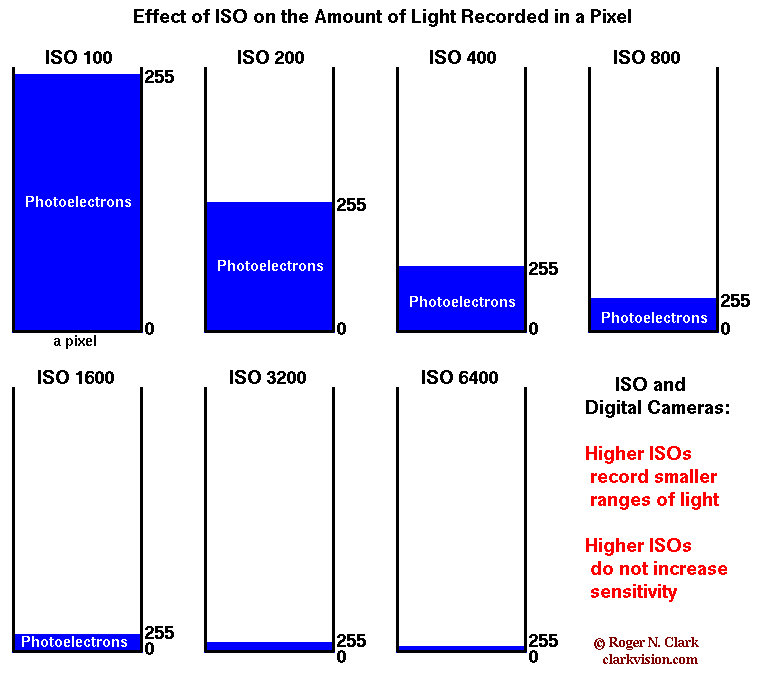
Greater signal noise due to amplification (ISO) results in losses everywhere else... just about stop for stop (1 stop >ISO = 1stop <DR). But, the loss of DR is at the bright end, not in the shadows/darks...you're essentially shifting what can be recorded left, and what would have recorded as white will now clip..... As a comment though, the main problem I have with high ISO is usually not noise as such, but reduced dynamic range - noisy shadows always have poor tone gradation with rich blacks turning to grey porridge, and detail lost.
I hadn't noticed the new "low light mode"... it's not as good as I would have hoped, but it's a move in the right direction.Click on the blue highighted text in the first line of that link
IME, if you leave it in "daylight mode" your results will generally be ~ 1 stop worse in practice (maybe closer to 2 stops worse).This is useful, to a point. I find that real world shooting doesn't necessarily reflect what these shots suggest. YMMV.

Low light performance of the D800 is great in my experience. So long as you have exposed correctly!
If you are under expose too much for example, you will have worse noise etc in your shadowsBut what does that mean?
Greater signal noise due to amplification (ISO) results in losses everywhere else... just about stop for stop (1 stop >ISO = 1stop <DR). But, the loss of DR is at the bright end, not in the shadows/darks...you're essentially shifting what can be recorded left, and what would have recorded as white will now clip.
The issue is really just a lack of information (light) in dark areas. The one time I ascribe to ETTR is for very dark scenes (i.e. black on black). You can always make things darker w/o many penalties, and having more information recorded makes darks a lot more tolerant of editing.
I hadn't noticed the new "low light mode"... it's not as good as I would have hoped, but it's a move in the right direction. <snip>
The most important thing with tests like that though, is consistency in the review procedure, when comparisons are being made between tests carried out months or even years apart. I think DPR's camera tests in general are very good, IMHO the best on the web.
If you are under expose too much for example, you will have worse noise etc in your shadows
ISO and DR are related, but not directly.... in other words, the DR the sensor is capable of recording is not variable.No, if you raise ISO (exposure adjusted for correct mid-grey, not ETTR) you lose dynamic range at the shadow end - as you actually say! In practise, you can push ISO a lot and see little or no impact on highlights and mid-tones.
I agree.Somehow, I didn't think it would be LOL
I think we are talking in different terms.This is not up for argument
I think we are talking in different terms.
You're talking of DR as the "characteristics" of what is recorded. I'm talking of DR as the number of stops recorded/recordable.
As I tried to explain, they really don't have much to do with each other...
http://photonstophotos.net/GeneralT...ographic_Dynamic_Range_Shadow_Improvement.htm
http://rawnalyze.rawtherapee.com/sourceofnoise.htm
Your first link is not relevant and is about so-called ISO-less sensor characteristics. I couldn't be bothered with the second one.
I see what you are getting at... you are talking about the DR that exists in the scene. And I agree in that context (essentially)...I think we're talking at cross-purposes, and not for the first time