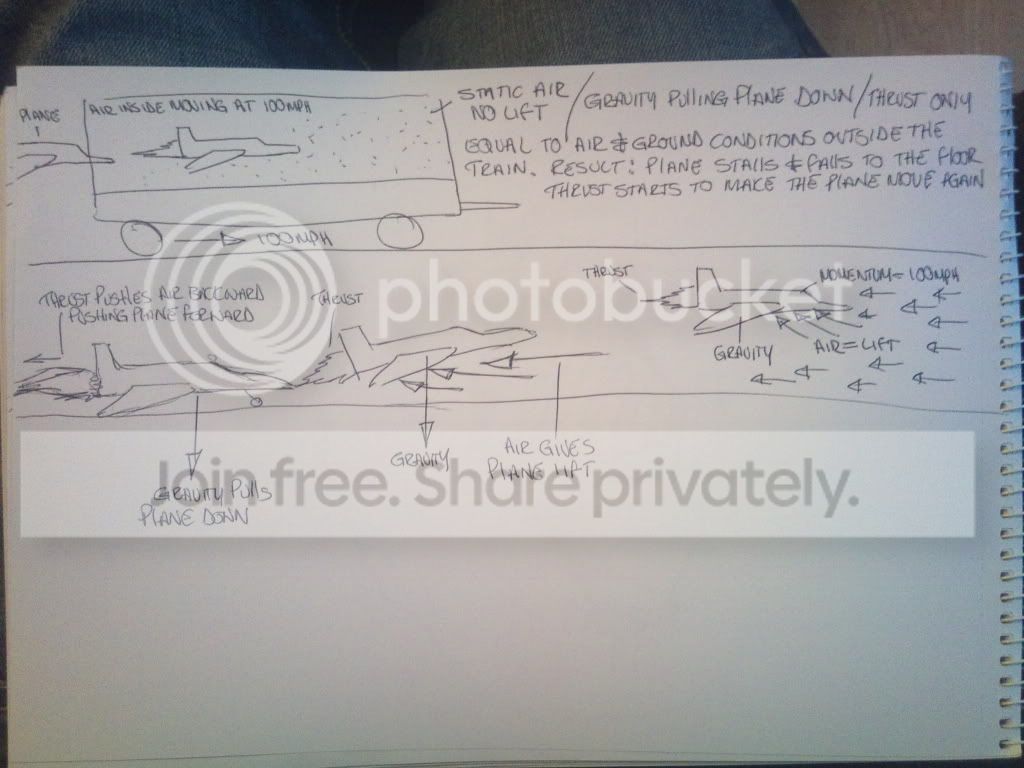
Can anyone figure this one out?

Why is the air inside the carriage moving? :thinking:

For the same reason that the guy with the controller in the carriage is moving. The train is carrying them forward.

But I get the feeling this is just a bit of a wind up, so I'll get some sleep.
 
The air inside the carriage is moving at the same speed as everything else within the carriage. If it didn't do this then when you ride on a train it would feel windy as you would be moving through still air - the air can only appear still within the train if it is moving along at the same speed of the train.
 
For the same reason that the guy with the controller in the carriage is moving. The train is carrying them forward.

But I get the feeling this is just a bit of a wind up, so I'll get some sleep.

But it's not moving, (neither is the guy you mention) within its / their reference frame ... i.e. to the carriage! .. When you drive down the motorway (with the windows closed) does the air within the car move ... :shrug:

The air inside the carriage is moving at the same speed as everything else within the carriage. If it didn't do this then when you ride on a train it would feel windy as you would be moving through still air - the air can only appear still within the train if it is moving along at the same speed of the train.

So if the plane is moving at 100kms ph (air speed) and the air in the train is not moving... why would the speed of the plane change?
 
But it's not moving, (neither is the guy you mention) within its / their reference frame ... i.e. to the carriage! .. When you drive down the motorway (with the windows closed) does the air within the car move ... :shrug:

LOL
If you drive down the motorway with the windows closed, the air inside the car is moving at the same speed as the car, but inside the car the air is static, the same as the driver is moving at the same speed as the car, got it? :thumbs:

So if the plane is moving at 100kms ph (air speed) and the air in the train is not moving... why would the speed of the plane change?

And LOL..

Because the plane is moving at 100kph. So as its flying through the air, the air around it is giving the plane its lift, imagine throwing a paper air plane.

Once inside the moving train, where the air is static and the momentum is relative to the train, the plane would lose its lift, which is what keeps it in the air.

The plane would not suddenly speed up once inside the train, which is what it would have to do, to hit the front wall.

If i ride along side you on a motorbike, holding a paper plane simulating flying, then pass it through your open window pasing me in a car, the plane would just fall to the floor, as the air that was giving it its lift, when i was holding it, has now gone from velocity through air to none. :thumbs:
 
Last edited:
The plane would not suddenly speed up once inside the train, which is what it would have to do, to hit the front wall.

If i ride along side you on a motorbike, holding a paper plane simulating flying, then pass it through your open window pasing me in a car, the plane would just fall to the floor, as the air that was giving it its lift, when i was holding it, has now gone from velocity through air to none. :thumbs:

Your analogy breaks down as you let go of the plane (removing thrust), this would be like the pilot shutting off the engines as soon as he enters the train.

Lets say instead of a car I have a nice big lorry with a ramp down to the road and instead of letting go of the plane you ride it right into the lorry and keep hold of it with the throttle up. What happens to you?
 
Last edited:
Your analogy breaks down as you let go of the plane (removing thrust), this would be like the pilot shutting off the engines as soon as he enters the train.

If you add thrust into the equation then the plane is only providing enough thrust to move through air at 100kph, for it to move through static air at the same momentum with no airflow it would need to double its thrust, in-effect causing it to only move at the same speed outside the train. Theory of relativity.
 
If you add thrust into the equation then the plane is only providing enough thrust to move through air at 100kph, for it to move through static air at the same momentum with no airflow it would need to double its thrust, in-effect causing it to only move at the same speed outside the train.
No, you are wrong. Once the transition between inertial frames has been made the thrust and drag forces are no longer balanced so the plane will accelerate. This is Newtons second law.

Theory of relativity.
General or Special? It doesn't really matter since we are dealing with non-relativistic mechanics. You might be trying to say Galilean invariance, but that just states that the fundamental laws of physics are true in all inertial frames and proves my side of the argument and not yours.
 
When Mythbusters did it, the microlight they used managed to accelerate so that it had sufficient airspeed in the opposite direction to the direction of movement of the pickup dragging the "conveyor" to achieve lift.
 
You are actually incorrect. Mythbusters did this.


See HERE

That's an answer to a different question!

When Mythbusters did it, the microlight they used managed to accelerate so that it had sufficient airspeed in the opposite direction to the direction of movement of the pickup dragging the "conveyor" to achieve lift.

:shrug: This thread is about a train carriage and an aircraft, nothing to do with conveyors .... :thinking:
 
I was replying to Brooksy's reference to the Mythbusters episode which (like many of their experiments) was flawed.
 
The only possible outcome is that as soon as the left wing enters box it will drop and cause the plane to turn at 90 degrees while loosing height and hit the guy with the controls painfully in his private region.

I am, of course, assuming that only a guy would be stupid enough to try this experiment
 
Last edited:
when I first read the question, it sounded simple, then as I read the replies, I get more and more confused.. :bang:

I think splog's and matt2martin's answers make the most sense to me..


Thrust pushes the plane forward... by moving forward, plane gains lift, and takes off..

it's flying at 100kph (same as the train)....

once it moves inside the train car (as others mentioned, assuming no transitional effects), while it seems like the plane should fall down because the relative air movement will fall down to 0 temporarily..

plane's thrust would continue, which would accelerate it again to reach 100kph again (if there is enough space)...

so, I guess if the plane doesn't actually crash in the instant when the relative airflow (hence the lift) is 0, it will accelerate again and hit the wall... :bonk:
 
This would be precisely the same scenario as a plane flying with an imaginary brick wall travelling at precisely the same speed ahead of it. The wall would prevent airflow over the wings, and thus the aircraft would drop out of the sky.

BTW, nohere in the OP does it say that which direction the train is travelling in (not that it makes the slightest difference).
 
This would be precisely the same scenario as a plane flying with an imaginary brick wall travelling at precisely the same speed ahead of it. The wall would prevent airflow over the wings, and thus the aircraft would drop out of the sky.

No it wouldn't! It would cause a lot of turbulence, but that's about it :shrug:
 
No it wouldn't! It would cause a lot of turbulence, but that's about it :shrug:

So where would the airflow come from? :shrug:

So, let's start from basics. Plane inside a giant ball moving at the same speed as the plane. Will it fly?
 
Last edited:
So where would the airflow come from? :shrug:

It's the air flow over the wings caused by the plane moving through the air .... hence the need for speed! :cool:

So, let's start from basics. Plane inside a giant ball moving at the same speed as the plane. Will it fly?

If the plane was inside a giant ball? The balls speed would be irrelevant as it would be stationary to the planes 'innertial frame of reference'! If the ball was big enough then the plane could easily fly inside it! :D

If you are on an aircraft travelling at 400 mph, you are still able to get up and walkabout ...
 
Then draw me a diagram showing the airflow over the wings of a plane flying inside a sealed giant ball with precisely the same velocity as the plane.
 
Last edited:
Then draw me a diagram showing the airflow over the wings of a plane flying inside a sealed giant ball with precisely the same velocity as the plane.

No diagram needed ... imagine a model aircraft in a real aircraft cabin! now tell me it won't fly! .... Sit on a moving bus and throw a paper plane at the driver :shrug: ... of course it will fly .... :) Drive down the motorway and get someone to throw a ball from the back seat to the front seat passenger, does the ball splat through the rear window? ... of course not! ... It's all relative :D
 
imagine a model aircraft in a real aircraft cabin! now tell me it won't fly!

It won't. If I hold it in my hand it has the same velocity as the real aircraft. If I let it go it drops to the floor. If I throw it it has a different velocity. Not sure of your point :shrug:.

Sit on a moving bus and throw a paper plane at the driver

Then the bus and plane would be at different velocities. I specifically said the same velocity.
 
Last edited:
(Note the use of the term "velocity", which has a very strict scientific definition, as opposed to "relative velocity" or "speed" :D).
 
Last edited:
It won't. If I hold it in my hand it has the same velocity as the real aircraft. If I let it go it drops to the floor. If I throw it it has a different velocity. Not sure of your point :shrug:.[/QUOTE]

No it doesn't .... Your supposed to start the motor and let it fly ... Just as if you were out in the park :shrug: If you hold it in your hand it's velocity is zero i.e. it's not moving


Then the bus and plane would be at different velocities. I specifically said the same velocity.

Velocity is totally irrelevant! The bus would have zero velocity from the planes inertial frame of reference :D
 
Never mind.
 
Last edited:
Ah. I see. You don't understand physics. Why didn't you say?

:lol: Okay, why don't you explain why an aircraft won't fly in your imaginary ball :razz:
 
No, you are wrong. Once the transition between inertial frames has been made the thrust and drag forces are no longer balanced so the plane will accelerate. This is Newtons second law.


General or Special? It doesn't really matter since we are dealing with non-relativistic mechanics. You might be trying to say Galilean invariance, but that just states that the fundamental laws of physics are true in all inertial frames and proves my side of the argument and not yours.

Woah! now we are getting into some technical talk. ;)
You have proved nothing.

When Mythbusters did it, the microlight they used managed to accelerate so that it had sufficient airspeed in the opposite direction to the direction of movement of the pickup dragging the "conveyor" to achieve lift.
Correct.
No diagram needed ... imagine a model aircraft in a real aircraft cabin! now tell me it won't fly! .... Sit on a moving bus and throw a paper plane at the driver :shrug: ... of course it will fly .... :) Drive down the motorway and get someone to throw a ball from the back seat to the front seat passenger, does the ball splat through the rear window? ... of course not! ... It's all relative :D
Flawed in so many ways, too many variables.
:lol: Okay, why don't you explain why an aircraft won't fly in your imaginary ball :razz:

Assuming the ball is moving at 100mph with a plane inside it then the plane wont fly as there is no AIR FLOW.

If the ball is big enough and the plane is on the floor of the ball then it would be able to generate enough speed and fly hitting the far end when it runs out of space, which leads me to the next part of the argument.


You start the clock and both plane and train being to move.

Both gradualy increase speed, from 0-100mph, after a certain speed the air moving around the plane gives it lift and its up in the air. (remember this part)

The plane now manouvers to the open carraige. (forgetting turbulence and assuming its a perfect world.)

Now the air inside the train is moving relative to the train at 100mph.

From inside the train the air is NOT moving, static air.

The plane is now occupying the same space and air as it did before it started to move in the first place.

The velocity of the plane cannot give it lift either as it is moving at the same speed as the train, occupying air that is travelling at the same speed as the plane and train. Since there is no AIR FLOW over the wings of the plane there will be no lift.

Propulsion either from propeller or engines, will give the plane lift, after it has reached the speed neccesary for it to take off from a static position.

If the plane was able to speed up once inside the train, then you have almost achieved perpetual motion, as you could, in affect, do this over and over again, moving in and out of open carraiges until the plane has reached a tremendous speed.

But as this is not possible, and all things being a perfect world, the AIR FLOW thats gives the plane lift, dissapears once inside the train, making the plane fall or stall, with engines going bonkers trying to push the air backwards and propel the plane forwards so that it gets lift again.

Co'r i said all of that without using technical words, :thumbs:
 
Assuming the ball is moving at 100mph with a plane inside it then the plane wont fly as there is no AIR FLOW.

If the ball is big enough and the plane is on the floor of the ball then it would be able to generate enough speed and fly hitting the far end when it runs out of space, which leads me to the next part of the argument.
OK, both of these are correct, you are not saying that it is impossible for the plane to increase speed within the ball just that at the starting conditions where there is no relative movement between the ball and the plane there will be no airflow and therefore no lift.

This is exactly analogous to the Earth & atmosphere which is essentially a big ball of air containing a planet and lots of planes all travelling at 67,000 mph around the sun - but from the Earth's inertial frame planes still take off from a runway fly around and land.

You start the clock and both plane and train being to move.

Both gradualy increase speed, from 0-100mph, after a certain speed the air moving around the plane gives it lift and its up in the air. (remember this part)

The plane now manouvers to the open carraige. (forgetting turbulence and assuming its a perfect world.)
OK with you up to here.
Now the air inside the train is moving relative to the train at 100mph.

From inside the train the air is NOT moving, static air.
These two sentences contradict each other. The second one is correct the air inside the train is not moving at 100mph relative to the train, it is moving at 100mph relative to the ground.

The plane is now occupying the same space and air as it did before it started to move in the first place.
No, the plane is now occupying an area of air that now travelling to 100mph relative to the ground - this are not the same as the initial conditions.

The velocity of the plane cannot give it lift either as it is moving at the same speed as the train, occupying air that is travelling at the same speed as the plane and train. Since there is no AIR FLOW over the wings of the plane there will be no lift.
Yes at the point that it enters the train it loses airflow and lift. Importantly it also loses drag.

Propulsion either from propeller or engines, will give the plane lift, after it has reached the speed neccesary for it to take off from a static position.

If the plane was able to speed up once inside the train,
The plane is able to speed up inside the train (just as it could within the ball earlier, like you said it could). Without the drag force opposing the thrust there is nothing to stop the plane accelerating. What do you think is stopping the plane from speeding up within the train?

then you have almost achieved perpetual motion, as you could, in affect, do this over and over again, moving in and out of open carraiges until the plane has reached a tremendous speed.

That isn't what perpetual motion is. Perpetual motion would be where a closed system generates enough energy to keep itself going for ever.

In this system you suggest all of the trains and the plane will be using fuel so isn't perpetual.

However if you were somehow able to build an infinitely long, infinitely big train containing an infinite number of other trains within one another and then generate the infinite amount of force that each train would need to move - then yes you could reach a tremendous speed.

But as this is not possible, and all things being a perfect world, the AIR FLOW thats gives the plane lift, dissapears once inside the train, making the plane fall or stall, with engines going bonkers trying to push the air backwards and propel the plane forwards so that it gets lift again.
Yes, at the exact point of transition. Then the engines either do work on the surrounding air (propeller) or the plane (jet) and the plane starts to gain speed relative to the train and the air in the train as it now has no drag forces acting upon it.
Co'r i said all of that without using technical words, :thumbs:

Actually you used many:
Perpetual motion, speed, velocity, lift, propulsion, relative.

In the context we are discussing these are all technical terms.

And whilst not wanting to sound like a 5 year old, you started it when you quoted the "theory of relativity" as if this would magically prove you right and everybody else wrong.
 
Last edited:
OK, both of these are correct, you are not saying that it is impossible for the plane to increase speed within the ball just that at the starting conditions where there is no relative movement between the ball and the plane there will be no airflow and therefore no lift.

This is exactly analogous to the Earth & atmosphere which is essentially a big ball of air containing a planet and lots of planes all travelling at 67,000 mph around the sun - but from the Earth's inertial frame planes still take off from a runway fly around and land.


OK with you up to here.

These two sentences contradict each other. The second one is correct the air inside the train is not moving at 100mph relative to the train, it is moving at 100mph relative to the ground.

Ok, so i shuld have said ground to make this clearer


No, the plane is now occupying an area of air that now travelling to 100mph relative to the ground - this are not the same as the initial conditions.

These are the same conditions except in relation to the planet the objects are now moving forward, train, air and plane.


Yes at the point that it enters the train it loses airflow and lift. Importantly it also loses drag.


The plane is able to speed up inside the train (just as it could within the ball earlier, like you said it could).

Assuming that the plane is on the floor of the ball and that it obeys every law needed to get it off the ground

Without the drag force opposing the thrust there is nothing to stop the plane accelerating. What do you think is stopping the plane from speeding up within the train?

See my earlier comment.


That isn't what perpetual motion is. Perpetual motion would be where a closed system generates enough energy to keep itself going for ever.

In this system you suggest all of the trains and the plane will be using fuel so isn't perpetual.

However if you were somehow able to build an infinitely long, infinitely big train containing an infinite number of other trains within one another and then generate the infinite amount of force that each train would need to move - then yes you could reach a tremendous speed.

Ok. So maybe i used the term perpetual a little too loosly

Yes, at the exact point of transition. Then the engines either do work on the surrounding air (propeller) or the plane (jet) and the plane starts to gain speed relative to the train and the air in the train as it now has no drag forces acting upon it.

As the plane loses its lift as soon as it enters the train, the force and distance needed to generate enough speed to give it lift again are too great. As the air is moving at the same speed as the train and the plane in relation to the ground, the plane would now need its original distance to get of the ground again.

Actually you used many:
Perpetual motion, speed, velocity, lift, propulsion, relative.

In the context we are discussing these are all technical terms.

And whilst not wanting to sound like a 5 year old, you started it when you quoted the "theory of relativity" as if this would magically prove you right and everybody else wrong.

As did you when you said, "General or Special? It doesn't really matter since we are dealing with non-relativistic mechanics. You might be trying to say Galilean invariance, but that just states that the fundamental laws of physics are true in all inertial frames and proves my side of the argument and not yours."

If your comparing any speed to the speed of light, then, yes they are small in comaprison


Ok, so now i know you are going to meticulously go through everything i have said and pick it apart, i better watch what i say. :p
 
Last edited:
Is it just me, or is this thread getting boring.yawn
 
Please exsuse the crudeness of the diagram.

3be46703.jpg


Now if we are really going to get into this little problem then once the plane moves near the train, turbulence would cause the plane to crash as the left wing crosses the pressure buffer, the plane would roll to the left and crash before the right wing gets into the plane.

As stated many times before, if it were indeed possible for the plane to get into the moving train, then the sudden lack of airflow would cause the plane to stall and crash.

However, if the plane was only flying at half speed and matching the speed of the train, then gave it full throttle at the point of entry, it may be possible for the plane to continue to fly, but there are too many variables; oxygen would be used up inside the train and cause the engines to stall, pressure buffer, power to weight ratio, amount of air space inside the train, length of train carraige, size of plane...

Train and ball would not work either, as the plane would need to be on a level platform for it to be able to take off, if its only on the floor of the ball then unless the ball is the size of Earth or the Moon, the model would not work.

AIR FLOW is the key factor to solving this problem, without AIR FLOW a plane cannot fly, no matter how much velocity, or thrust it has. Put thrusters or a prop on a box and what would happen? nothing, it would just get pushed along the ground.:bonk::thumbs:
 
Of course if it was a model of a AV-8B Harrier it may be possible to quickly rotate the exhaust nozzles and keep it hovering as it enters the train before it crashes.
 
As stated many times before, if it were indeed possible for the plane to get into the moving train, then the sudden lack of airflow would cause the plane to stall and crash.

I think every body has it backwards. If it were indeed possible for the plane to get into the moving train, then the sudden abundance of airflow would cause the plane to stall and crash. The aircraft and the train have no air flowing over them or around them to generate aerodynamic force. Aerodynamic force does not require air to flow around an object. The relative airflow that is influencing the plane and train is made up by static air; it only has relative motion because of the movement of the aircraft and train not the air.

The air inside the boxcar is moving at 100km/h. the reason people think that it is not is because if they were in the boxcar they would not feel the air move because they are moving at the same velocity. The same people will stick their hand out the window of a moving car and fell the air hit their hand. Of course this is impossible because the air is not hitting their hand their hand is hitting still air which feels exactly the same. So the aircraft goes from still air outside the boxcar to air moving at 100km/h inside the boxcar and totally loses its relative airflow and aerodynamic force because it is now moving at the same velocity as the air inside the boxcar.
 
Back
Top